Wherein Th’ Gaussling presumes to take exception

Some matters to which I wish to take exception.

Cray, the supercomputer company, is selling a desktop unit called the CX1. Their product literature uses the term “personal supercomputing” here and there. Also HPC, high performance computing.  A bit of scouting with Mr Google turns up a price of $25,000 (and up) for one of these units. If I had a CX1 I could finally get those hydrodynamic simulations finished for my cold fusion reactor.

I’ve never been able to refer to a computer as a machine. It’s a circuit. Somehow the flow of a few coulombs of charge across the bandgap and through the microscopic vias of lithographed and ion implanted junctions never qualified in my internal taxonomy as a machine.  Surely there are countless pencil necks and Poindexters out there who will line up to quibble. But, it’s a damned circuit. The cooling fan is a machine. The screws that hold the major components are elementary machines. The Klikkenhooters on the mouse are machine-like I suppose.

My eyes cross every time I hear some silly sod in the IT department solemnly state that they have fixed a problem in some persons “machine”.  Oh, is that true skippy? Chances are that young Edison selected a pull down menu and changed the state of some software variable or swapped out an errant disk drive. Machines make you greasy. You skin your knuckles tightening bolts on them. A Harley-Davidson motorcycle is a machine. A Dell laptop is not.

Fiat Lux

On an altogether different topic, an article entitled the Amoral Manifesto over at Philosophy Now raises some interesting issues regarding the basis of morality. The author is starting to get his arms around the qestion of morality without an absolute cosmic foundation. If you look at the physical universe, one of the first things that sorta jumps out at ya is the fact that everything is floating in space. Maybe we should take that as a kind of metaphor when considering absolutisms. We should learn to get along for its own sake, and not just to please angry, dispeptic spirits.  Not that those jabbering snake handling pentecostals would take any notice …

Speaking of dispeptic, Pastor Wingnut in Florida should consider another alternative to book burning. Simply down load copies of the Quran and repeatedly delete them until he feels that warm flush of righteous satisfaction.*  But I think we all know this wouldn’t have quite the spectacle of an actual public immolation. A book burning isn’t about individual books. It is a form of ceremony.  It is a ritual for all to particpate in and is part of the liturgy of indignation. Producing a show like this is in the skill set of any preacher, actually. They are expected to rouse  the emotions of their flock. It’s their job.  Some of it is quite interesting to watch in terms of the art of persuasion.

The pastor in Florida makes the case for why a great many of us do not want a government based on theological notions of law.  Whose law takes precedence- the Baptists?  Whose voice is speaking to you, really? And did you get all of the details? Exactly what kind of authority does an angry but righteous-in-the-Word mob get to have, anyway? How do bronze-age principles help us determine quotas for banana imports, plumbing codes, and the standards governing interstate trucking? Good gravy, we have to figure these things out ourselves people.

The eternal problem of civilization is to find the balance between high principle and pragmatic practice.  Civilization should be run by the living, not dictated by those who claim to know the intent of the long dead. The dead had their time in the sun. It is the privilege and responsibility of the those living the eternal now to sow the seeds of their fate. Easy retreat to the demon-haunted, authoritarian world of spiritualism is the realm of ignorance and fear. And fearful people are especially prone to being driven like sheep at the convenience of the vain and ruthless. History books are full of examples. So instead of burning the Quran, let’s read a few of the others. Maybe take some notes.

* Thanks to the Daily Kos.

Extractive metallurgy of the 19th century

The first gold lode discovered in Colorado was found where the town of Gold Hill, Colorado, now sits. Gold Hill is presently at the locus of the Four-Mile Canyon fire west of Boulder. As of  today, more than 170 structures have burned, including a few outhouses.

Today, a single gold mining operation remains active at Gold Hill. The kid and I recently visited the area and I wrote a post about Wall Street, south of Gold Hill.

In the last few years I have been fascinated by what started as a simple question-  How did they get the gold out of the ore in the 19th century?  What has become apparent to me as a chemist is the extent to which reasonably sophisticated multistep extraction schemes were employed by 19th century mills and smelters. Their methods of processing would not be unfamiliar to alchemists who practiced similar arts over 400 years earlier.

The alchemists had techniques of calcination, comminution, lixiviation, and distillation available to them. In using these processes, they were inadvertantly performing reduction and oxidation reactions so as to alter the composition of substances with the hope of improving the prospects for isolation of desirable metals.  The 19th century gold and silver mill operators inherited these techniques and mechanized them. One of the key improvements over their medieval predecessors was that they had reasonably sensitive analytical methods as well as some scientific knowledge of the chemical behavior of materials- we call it chemistry today. As the 19th century American gold rush went forward, there became available new methods of gold and silver extraction involving mercury, chlorine, cyanide, and sodium or potassium sulfide and thiosufate.

Any 21st century chemist will recognize most of the inorganic chemistry of 19th century milling and smelting of metals.  But in those days it was not referred to as chemistry- it was known then as it is today as Extractive Metallurgy.

Much of the technology for extractive metallurgy traces back through European mining engineers who had come to the American gold and silver districts.  Two mining engineers in particular stand out in 19th century Au/Ag metallurgy- Guido Kustel and Philip Argall. More about these fellows at a later date. Suffice it to say that they were prolific problem solvers in a time when mine and mill operators typically had more investor’s money than sense.

Some Milling and Smelting Business Models

Prospectors working alone or with investors backing them would prospect a promising area of ground for gold or silver, looking especially for vein outcroppings. If they has cause for optimism they would file one or more claims for the right to have access to the minerals therein. A patented claim was a claim issued by the federal government as a deed that could be bought or old like a a parcel of land. Most of the land of interest was state or territorial land. Many times a claim was filed based on speculation, and a nearby claim with a vein that might go in the right direction would potentially be valuable.

The miners would begin to develop the claim by digging an adit and drifting horizontally following a vein system, or they might dig a shaft in a promising spot in hopes of intercepting a vein rich in value.  Since they were focused on veins which were visible to the miners, the miners were able to dig along the direction of the vein. In doing so, they could hand sort unproductive rock into a waste pile and collect concentrated ore separately.  But then what?

Some mine operators were wealthy enough to have their own mill or smelter to extract the value. However, the majority of mines would sell their ore to a mill, which might be many miles away. A price based on an assay could be negotiated, and the ore sold outright to the mill. The mill would make its profits by selling the gold or silver it extracted. Sometimes a mine would pay the mill a tolling charge and keep ownership of the gold or silver.

Milling and smelting could be a lucrative business or it could result in a total loss. Mills and smelters were run by companies who had plowed a significant financial investment into+ the operation. They relied on the productivity of the gold or silver district. Not infrequently multiple mills or smelters would appear in a district affording lots of competition for ore.   Milling and smelting was labor and energy intensive. Old photographs often show the mills sitting in a mountainous area clear-cut of trees. Wood was needed for buildings and firewood. Refining operations required many cords of wood to run the furnaces or to generate steam for the stamp mills.  If a mill ran out of fuel, their operations were threatened.

Many mines produced ore that was sold to the mill. Mine operators might be paid for the assayed value per ton of ore delivered, or they might be paid a fraction of what was extracted by the mill. The mill could be just down the hill from the adit or shaft, or it might be many miles away.  As a rule, transportation costs were quite high.  Some districts like Caribou had teamsters who would haul ore by horse drawn wagons to mills some distance away. Other districts had rail transportation.

Naturally, ore samples could be tampered with by miners interested in increasing the apparent value of their ore. Sampling methods were developed to produce representative samples for assay. Mills had assay offices to test for the value in the ore and to measure the fineness of their bullion.  Cuppelation was a standard method of providing a gravimetric determination of the gold content of ore.  More on cuppelation in a later post.

Frito-Lay’s New PLA Rattle Bag

As a veteran of the polylactic acid market invasion (PLA or polylactide) in the late 1990’s, I was heartened to see a new commodity application of PLA packaging appear on the shelves of the hometown grocer.  Well, alright. MArket invasion is overstating it a bit. We were one company among several in the race to grab PLA market share.  The founders of our company were engineers familiar with corn wet milling and the starch business. In the end, the skill set that carried the day was the combination of Cargill’s agribusiness presence and Dow’s massive polymer production business expertise. We were doomed. Our place as a Coors subsidiary with a modest cornstarch and wet mill operation just didn’t give us the gravitas to make the thing happen.

PLA is the polyester of lactic acid monomer, or perhaps more accurately, lactide monomer.  I’m generally in favor of PLA as a replacement polymer for polyolefin materials. PLA ultimately sources from starch fermentation in corn steep liquor.  Our process produced lactic acid using steepliquors as a nutrient source.

One of the reasons I left academics was the unusual chance to be part of a seemingly well funded startup aiming to commercialize a PLA process.  I’ve written about this before and won’t repeat it here. Our operation ultimately shut down within a year of my arrival due to some technology problems and a nervous group of investors- not an uncommon scenario.

My job was to come up with a comonomer for PLA to lower the glass transition temperature (Tg) and to bring down the crystallinity a bit. But first, some background.

One of the issues with PLA as a substitute commodity polymer was its relatively high Tg. PLA’s high Tg caused it to be unsuitable for contact with hot liquids owing to the fact that the polymer lose its rigidity and deform.  Food contact applications are a major commodity market for polymer producers, especially if the value proposition to the consumer is the biodegradability of the product.  Commonly disposable items like coffee and soft drink cups & lids, plastic utensils, straws, and diaper components are cited as ideal applications for green polymers. In order for PLA to be substituted into the disposables market, the matter of price and performance had to be resolved.

Our projections by 1998 were that PLA would be price comparable with nylon, then roughly $1.50 / lb.  Nylon was more expensive than polyolefins/polystyrene by quite a range, so the thinking was that at least initially, PLA would be specialty polymer product selling along the applications margins. PLA would have to grow, gaining acceptance by some kind of consumer.

But what is “some kind of consumer”?  It is easy to fall into the thinking that the crucial polymer consumers are the people buying the finished goods containing the polymer. But that isn’t exactly true. There is another key group of buyers than must be satisfied. And they are tough customers.

A crucial group of people who make buying decisions are actually found upstream of retail level consumers. They are the raw material buyers and they reside at several links on the value chain.

Let’s assume that the producer of a polymer -sold in pellet form- has produced a satisfactory product. It meets rigid specs for quality and performance.  The buyer of pelletized raw polymer is some kind of converter. A converter is a company that buys pelletized polymer and converts it to some variety of higher value product by the process of compounding and extrusion.  The compounder may produce films, filaments, or molded widgets. At this stage, polymer products are referred to as resins.

A compounder may be a producer of resin films or resin widgets who, in turn, supplies another manufacturer who uses the resin products for their own applications. Or, compounding may be integrated into the total manufacturing chain by one operator. A producer of things-that-contain-resin-widgets-or-films may have their own extrusion operation to contain cost.

What is critical to anyone scheming to bring a new polymer into the market is this: you have to sell the new resin to the compounder. If the new resin is more expensive, then the value proposition just got really difficult. A new (replacement) resin must have some kind of added value to the compounder and for the manufacturer downstream to  justify the disruption that its substitution is likely to cause.

What kind of disruption can polymer substitution cause?  All manufactured goods have specifications by which the manufacturer is able to distinguish acceptable from unacceptable quality. Specifications for components usually cite raw material specifications comprising physical or chemical properties, appearance, odor, or even specific commercial brands.  Swapping materials of construction or different compositions is a serious undertaking for a manufacturer of established goods. If it ain’t broke, don’t fix it.

So, a resin substitution may require the persuasion of decision makers in a multicompany value chain to effect a substitution. This is the challenge before any producer of new resins. And PLA was in the same place as it was going to market in the late 1990’s. It takes a giant company with massive resources to effect the adoption of a new resin in the marketplace. Sales efforts have to be focused on the true decision makers. These are the manufacturers of packaging materials and the industrial buyers of resin components. They have to be convinced that any new resin won’t hurt existing sales and that there be some kind of premium for going to the trouble adopting change.

So, the new bag containing Frito-Lay Sunchips is on the market and it is made of PLA. Somewhere along the line a decision has been made to risk the change. I’ll say that the bags seem to have the same appearance as the previous variety.

The only problem is the rattle. The bags have rather a loud rattle due to the considerable crystallinity of PLA.  The way to make the rattle go away is to coploymerize it with a comonomer that increases the amorphous component of the polymer. PLA is made from enantiomerically enriched, biologically derived L-lactic acid. L-Lactic acid is used because it can be made cheaply by fermentation. The bugs only make one enantiomer.

The challenges of successfully incorporating a comonomer are many, and they are not all science related either. A comonomer must participate in ring-opening polymerization and combine with lactide. The relative reaction rates need to be in a range that allows for favorable incorporation without undue increases in reactor residence time. Comonomers can produce compositions varying from blocks of comonomer incorporation to random incorporation. It takes much time and abundant resources to work out the most desirable compositions and their respective economics.

We were using reactive extrusion where the residence time was related to screw speed and length of the extruder. Too much residence time at reaction temperature and the PLA would carmelize or darken. Residual acid is a killer. PLA is very sensitive to residual acid in the lactide. Very small amounts can be ruinous. It shut us down.

Incorporation of a comonomer that is not an agricultural or renewable product will taint the value proposition of “Green”.  Caprolactone is an example of a comonomer that had been explored by others, but [at the time of writing] I’m not aware that there is a Green route to that monomer. I recall that there were patent issues that prevented us from exploring caprolactone. However, there is a good chance that the patent issues have now expired. Nothing is forever, not even patents.

Follow this link for an earlier post on this topic.

The secret life of the industrial chemist

My blogging output volume has dropped to a trickle, and what little of what is posted is just blather.  Despite the relative quiescence of this blog, the blogger himself is busier than a one-legged cat trying to scoot across a frozen pond. Unfortunately, the one-legged cat has to keep mum about the missing legs or why he is on the lake in the first place.  If I don’t stroke out from the chronic cortisol exposure, I’ll write about it all one day.

After some years in the industrial setting I am able to see why there is such a disconnect between academia and industry. The imperatives of the industrial chemist are dramatically different than that for a brother or sister chemist in academia. It is the job of the academic chemist to uncover new phenomena and tell the world about it. Oh yes, and teach a few students along the way.

The industrial chemist’s job is to apply known processes or to uncover them himself for greater profit for the stock holders. The main difference is that the industrial chemist must keep the work secret, or more accurately, out of the public domain.

Why did I use the word ‘disconnect’?  Well, if an industrial chemist wants to collaborate with an academic partner, the matter of secrecy comes up.  If the academic cannot transmute the work into a scholarly publication for inspection by the promotion and tenure committee, then he has effectively been unproductive.  Academics turn funding into publications. Well, except for the 50 % of the money that goes into overhead support.  If an academic does collaborate with an industrial group, there is the very real problem for the academic of how to use the work for career advancement, i.e., publication. Just covering academic labor and materials isn’t really enough (or shouldn’t be) for the university workers.

Another issue arises in regard to intellectual property. That is the matter of secrecy within an academic research group.  Say professor Smith has taken advantage of the Dole-Bayh Act and is performing research with the goal of applying for a patent. This very fact sets the group down a path that requires non-disclosure of results prior to and during the application.   Several things have to be in place in an academic lab that are unusual for the academic setting, but normal for the industrial setting.

First, patent-seeking academics must be very quiet about their work during the critical concept development phases. One of the most disastrous things that can happen to a patent application is confusion relating to the matter of inventorship.  And one way to muddy the inventorship is to be careless about who is involved in technical discussions while the invention is in the formulative phase. In the university setting, group meetings with outsiders or uninvolved group members can lead to unexpected and poorly documented inventive contributions.

Word to the wise: You don’t have to wait for someone to complain about inventorship after the patent is allowed. If your own patent attorney, who is an officer of the court I might add, gets wind that someone was left off the inventors list during prosecution, he/she is duty bound to amend the application, possibly casting doubt in the mind of the examiner on the veracity of earlier signed documents.

Playing games with the list of inventors is the fast track to rejection of the application. All inventors and assignees should clearly understand that your own patent attorney, the one whose boat payment you’re funding, answers to a higher calling, so to speak.  They have obligations and liabilities that you can’t  imagine. Help them get you a patent with the cleanest possible file wrapper.

An academic research group with more members than inventors probably needs to split the invention away from the rest of the group. This is a good opportunity for the patent attorney to school the group members on the patenting process and outline best practices. The research prof should outline a plan to partition the group in a way that disclosure is minimized. Notebooks and meetings should be carefully monitored in any event, but some kind of isolation is always best.

Then the question arises of what to do with thesis work that arose from an incomplete patent project. What does the student get out of it? This is magnified even more if the professor is part of a startup company who intends to use the technology the grad student developed. Again, what does the grad student get of it?  A degree? For development services in getting a startup off the ground?  Good question. Certainly there examples out there where these matters have been worked out.

My views on academic patenting have been expressed previously and I still believe it is terrible public policy.

It is plain that patenting in the academic environment poses special challenges and cultural changes for those hoping to get a patent.  In the industrial setting, such matters are normal and institutionalized.

Alan Simpson to Receive Honorary Degree

Guapo, Arizona.  University Chancellor Dr. Tina Grimstone issued a press release containing the annual list of Honorary Degrees to be conferred by Pultroon University at the spring 2011 commencement.   Notable are three awardees from the State of Wyoming, former US Senator Alan Simpson, former Sectretary of the Interior James Watt, and former Vice President Richard “Dick” Cheney. 

In her brief comments Dr. Grimstone stated that “seldom has a state produced three characters of the magnitude of Simpson, Watt, and Cheney in a single generation. We felt it was important to highlight this fact as an example to others who may choose public service.”

The University public affairs office disclosed that Sen. Simpson will deliver the commencement address on the topic of “Folksy Farm Witicisms in Public Life.”  Secretary Watt will follow the ceremony with a pentecostal benediction spoken in tongues and Vice President Cheney will pesent the Honorary St. Elmo’s Firing Pin to the Chancellor in the precessional.

The American gold rush and relativistic electrons

Exactly why do people value gold? Is all of the allure of gold due to its color? What if gold metal did not have the golden color? Instead, what if it had a silver luster like its neighbors on the periodic table of elements? Would we find it quite so appealing?

There are many reasons why people might desire gold.  The motivation to possess gold would surely vary based upon where in the value chain the metal was encountered.  Gold prospectors might value gold because it was an item of trade. Artisans would value gold for more pragmatic reasons relating workability.  Rulers would value gold because it was an asset that could be put in the treasury and later used to buy influence or fund military adventures. Thieves and plunderers valued gold owing its high value per unit volume  and the ability to offer it in trade virtually anywhere.  

Here is what we can say for sure about gold.  It’s high degree of inertness means that it can retain its golden luster indefinitely and bestow an everlasting aspect. Its malleability and ductility means that metalsmithing with fairly primitive tools was feasible. Gold could be hammered into thin sheets that could be cut, punctured, and otherwise worked by artisans to produce impressive art objects. Gold could be worked to produce all manner of ornamentation for the sake of religiosity, as an ostentatious display of wealth and power, or for coinage. Whatever the context, gold leaves an impression on people, aesthetic or otherwise.

Here is where it all gets interesting. You see, one of the consequences of Einstein’s theory of relativity is that as an object approaches the speed of light, c, its mass increases by an amount defined by a fairly simple mathematical relationship. An object’s rest mass is less than its mass appreciably near lightspeed.  The term “relativistic” refers to effects relating to objects traveling near lightspeed.

It turns out that some of the outer electrons around heavy atoms like gold and mercury are moving at an appreciable fraction of the speed of light- they are relativistic electrons.  If these relativistic electrons are at the outer, valence level, then aspects or behaviors affected by relativity may become apparent by how the atom interacts with light or other atoms. 

Chemistry is about the behavior of electrons confined to the space in the immediate vicinity of nuclei, or bound electrons. In particular, the electrons outer, valence, electrons. This is the realm of chemistry.  Chemists go about their business manipulating these electrons for fun and profit. Virtually our entire material experience of life is dictated by the manner in which these electrons interact.

In the case of gold, the 6s electrons are moving at a significant fraction of the speed of light. The magnitude is 58 % of c, according to one internet reference. At this velocity, the electron mass has increased by a factor of 1.22 times its rest mass. This being the case, the Bohr radius of the orbital is contracted by 22 %. 

The implication of this perturbation in orbital size is that an electronic transition between the 5d and 6s orbitals shifts out of the UV range and into the visible band. The molar extinction from the UV cutoff to about 500 nm is high enough that metallic gold takes on its characteristic golden hue from the reflected light.

Gold is not the only element to be affected at the valence level by relativistic effects. Mercury is also affected. The contraction of the 6s orbital results in relative inertness of the 6s^2 lone pair and poor interatomic (metallic) bonding, resulting in the unusually low melting point of mercury.  Indeed it is likely that most of the interatomic attraction is due to van der Waals forces, which is notably weak.

The inertness of the 6s lone pair reveals itself in the oxidation states of bismuth, which has stable oxidation states at +3 and +5. Like other pnictogens, bismuth (III) compounds have a lone pair. But unlike nitrogen and phosphorus lone pairs which are reactive and an important part of their ordinary chemistry, bismuth’s 6s lone pair is rather inert and not significantly hybridized. Triarylbismuth (III) compounds are trigonal planar with the lone pair taking spherical s-orbital symmetry.  UV-Vis experiments will show that for some simple BiAr3 compounds, the n->pi* transition has a very low extinction coefficient, unlike the analogous Ph3P.  Exposure to Pd(II), for instance, will show scant indication of coordination in the UV spectrum, again unlike Ph3P.

This is quantum chemistry stuff that the reader can run down later. What is of interest to me in this post is the fact that, without knowing it, gold prospectors, miners, and mill operators of the 19th century took full advantage of certain relativistic effects in their search for gold.

The first relativistic effect the early miners took advantage of was the simple fact that gold is a colored and relatively inert metal. It could be spotted by simple inspection in streams and quartz veins. The color of gold made it impossible to confuse with other metals. Ofcourse, iron pyrite was always a problem, but there were simple ways to test for pyrite.

The other relativistic tool used by miners was amalgamation of gold (and silver). Mercury, being a metallic liquid by virtue of relativistic valence electrons, could be intimately contacted with gold dust or larger particles to form a solution that would remain liquid up to some modest fraction of gold. Mercury, being quite dense, would naturally seek the low points where the gold would also be found. This dissolution could be affected by simple sloshing or by grinding the mercury with the ore in an arrastra or an amalgamation pan.  After agitation, the mercury would pool and could be easily collected.

Later amalgamation techniques would combine aqueous cyanidation of the ore in the presence of mercury in hopes of better gold and silver  recovery. Reduction of gold or silver chloride occured in-situ to provide amalgam.  Amalgamation of ore that had been chlorinated by roasting in the presence of NaCl was a common solution to the serious problem of sulphuretted auriferous or argentiferous ore.

The miners of the 19th century American gold rush certainly didn’t know that their task of extracting gold would be aided by the effects of high velocity electrons. Most people walking around today don’t know or even care about this more than 55 years after the passing of Albert Einstein.  But it goes to show how subtle effects of nature can affect our lives in unexpected ways. And this is just one of many such nuances of physics.

Professor claims Lincoln was wrong; southern states should have been let go.

Guapo, Arizona.  A political science conference held to reexamine the American Civil War has produced some surprising and controversial conclusions. At a news conference sponsored by Pultroon University, a spokesperson for the Office of University Affairs tried to assure reporters that the event was in fact a scholarly meetiong and not part of a political movement.  Meeting organizer and political science professor Udo Rotmensen spoke at the press conference and reiterated that this was not an anti-tea bag event, but rather a venue for professional discourse.

The subject of the controversy is a paper delivered by associate professor Edward Zaldibar, from Penninsular College in Wisconsin, entitled “Was Lincoln Wrong? Alternatives to Reunification.” In his paper, which is soon to be published in the Proceedings of the Sherman Society, Zaldibar explores alternate resolutions to the Civil War.  Zaldibar’s hypothesis is that the Confederacy was a genuine and organic political evolution fundamentally incompatible with the Union and democratic ideals. 

Where Prof. Zaldibar generated the controversy was the conclusion that the US should consider the merits of forcibly separating the former Confederate States from the Union, sans nuclear weapons, and begin negotiations on the merging of the Northern states with Canada.  

Amidst the outcry and shouting from the aisles, Prof. Zaldibar maintained that it was “obvious on its face” that these states should be let go in the interest of a peaceful and prosperous future. “After all”, the professor continued, “the Tea Party movement pretty much clinches my argument, doesn’t it? Its southern anti-federalism undercurrent combined with a penchant for ‘2nd amendment solutions’ for conflict resolution is a reincarnation of antebellum ideals.” 

After the meeting, Prof. Zaldibar was escorted past a gauntlet of outraged attendees and students. He remains in seclusion and declines to be interviewed.

Some Questions

What do farmers think of crop circles? Isn’t it just … vandalism? Is there such a thing as crop circle insurance?

Many of the fellows who boarded the three ships at Griffins Wharf and pulled off the Boston Tea Party were disguised as Mohawk Indians. How patriotic or heroic is it to destroy property and attempt to blame others for the deed?

When Rand Paul implodes alone in the forest, will he make a sound?

Daytripping in the Gold Hill and Wall Street Mining Areas

The Gold Hill mining district northwest of Boulder, Colorado, is dotted with many signs of mining activity from an earlier time. This district is adjacent to the towns of Ward and Nederland and situated in the northeastern extreme of the Colorado Mineral Belt (CMB).  The first significant gold lode discovery of the 1859 Colorado Gold Rush occurred in this area. Gold Hill is at the northern end of a particularly rich band of gold lode occurrences within the CMB stretching southward in parallel with the Front Range through Central City, Idaho Springs, and further south to Cripple Creek.

The town of Gold Hill (actually a CDP) is connected to Left Hand Canyon road via Lick Skillet road, reportedly the steepest maintained county road in the USA. I can verify the steepness of this gravel road and would heartily suggest shifting into first gear while driving down this mile-long toboggan run.

While mining has long since halted at the great majority of mines in this district, the Cash Mine east of town is still in operation.

To the south of Gold Hill is a CDP settlement called Wall Street. This was the location of a mine and a mill. Or they called it a mill. It should probably be called a smelter since roasting was used in the process.

No, it’s not a Babylonian fortress. It is part of the Wall Street Mill in Wall Street, Colorado. Copyright 2010 Th’ Gaussling.

The Wall Street Mill today sits on private property and access is not available to the motoring public. The site sits along the road on Four Mile Canyon Drive, a mile from the intersection with Gold Run Road and south of Gold Hill.

The imposing structure along the road is actually a cooling bin for the storage of freshly roasted ore.  A sign posted along the road says that the mill process used roasting, chlorination, and cyanidation to recover the gold values. The sign also indicates that the mine closed after only a few years of operation due to poor management. Poor operating practices were not uncommon.

Roasting was a common step in the metallurgy of sulfur-rich gold and silver ore. The purpose of roasting is to change the chemical composition of the ore by oxidation of metal sulfides to produce metal oxides. The gold and / or silver in the ore was difficult to isolate without this process. The matrix of metal sulfides in the ore interfered with the extraction of distributed and native gold by amalgamation. And without chemical processing, silver was all but impossible to extract from the ore with 19th century technology.

But roasting was only a prelude to further processing. Roasted ore could be crushed in a stamp mill to produce a greater surface area for extractive metallurgy or could release particles of native gold. Reduced, native, gold could then be isolated with shaker tables to partition the dense gold particles into a slurry stream for isolation and further refinement. Alternatively, the pulverized ore could be passed over copper amalgamation tables for dissolution into mercury. A trip to the retort would distill away the mercury (mostly) and afford a button of isolated gold. Gold and silver can be extracted with mercury.

Gold that was highly distributed in microscopic particles could be extracted chemically using several options in the late 19th century.  Selectivity was always a problem and processing trains became relatively complicated in an effort to provide the purest gold and silver possible.

Roasted gold and silver ores could be subjected to chlorination (or chloridation) processes that produced chemically extractable gold or silver. Roasting ore with sodium chloride in a reverberatory furnace, for instance was commonly done to produce gold and silver chlorides that were accessable via aqueous extraction methods. The origin of metallurgical chlorination  traces back to von Patera in the Bohemian silver mining town of Joachimsthal.

Chlorination by generation of Cl2(g) was not uncommon. Wetted ore was exposed to freshly generated chlorine, producing metal chlorides in the roasted ore pulp. A process similar to the method of Scheele in 1774 (MnO2 + 4 HCl-> MnCl2 + 2 H2O + Cl2) was used to generate the chlorine on the spot for chlorination. Manganese dioxide, sometimes referred to as the peroxide of manganese, was treated with sodium chloride and sulfuric acid. Gold chloride could be extracted by water and then reduced to gold powder with zinc, iron scrap, or green vitriol (iron (II) sulfate, a 1-electron reducing agent).

Cyanidation was also used according to the information at the site. I’ll leave this method for another post.

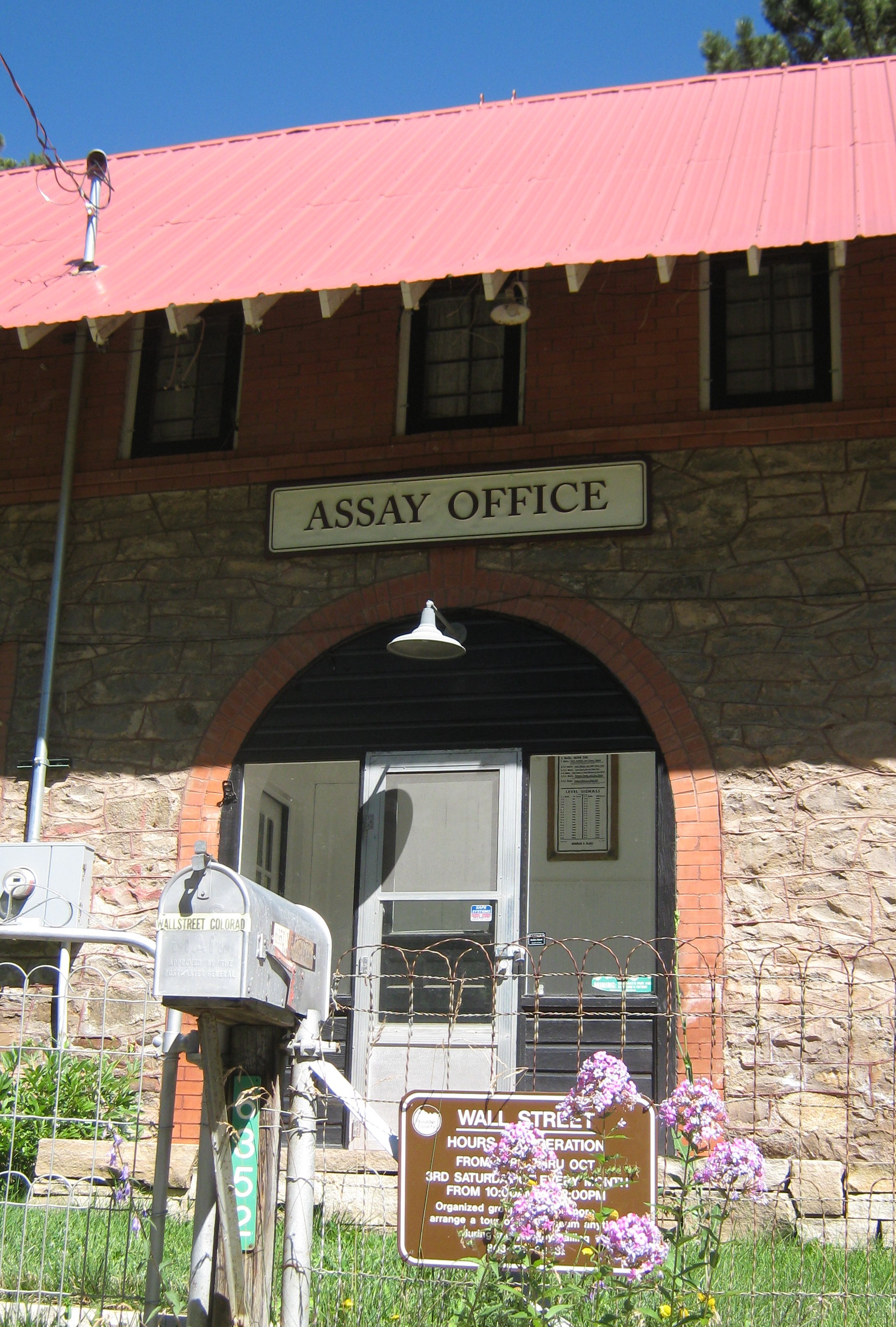
Wall Street Assay Office Copyright 2010 Th’ Gaussling

An assay office sits adjacent the mill. The upper level of the assay office served as a residence and pool hall. At its peak, this site was home to 300 people. The Assay Office is now maintained by Boulder County.