Cogitations on the sunflower

My morning commute through the countryside takes me past more than a few fields of sunflowers. By late July the flowers are out and without exception, all nodding toward the east where a star appears every day. Many of the local farmers have taken to raising sunflowers rather than the usual corn and sugar beets.  I haven’t a clue as to what kind of machinery is used to harvest these things.

One of the local heliotropes

It is uncanny that the entire crop will lock the flowering body orientation in the direction of the sun.  Somehow the direction of the sun at other times of day does not randomize the orientations. If you stand and look at a field of sunflowers, you’ll see outliers in height, but not direction of flower orientation. Or so my experience has been. There has to be some frequency of orientation outliers.

I wonder if there isn’t some growth step in the stem than occurs over a short time span X days into its growth, removing what stem mobility that might exist and locking the flower in place?

Such things make me wonder if our concepts of consciousness, with human consciousness as the benchmark, aren’t a bit too self serving.

Summer Kitsch

Every once in a while fate brings you to a location that you’ve lived by, but have never visited.  We had the occasion to visit a local ranch that markets itself as a working ranch and event center. The ranch, which will go unnamed, sits in the Little Thompson River valley along the Colorado Front Range. It is one of the very few river valleys that does not have a public road in it.

The ranch defies easy description. The rancher has dedicated the property to open space, so McMansion construction will not fill the valley with subdivisions of tedious, look-alike housing with black Escalades parked out front. He wants to keep the property, well, not wild exactly, but early 20th century ranch style.

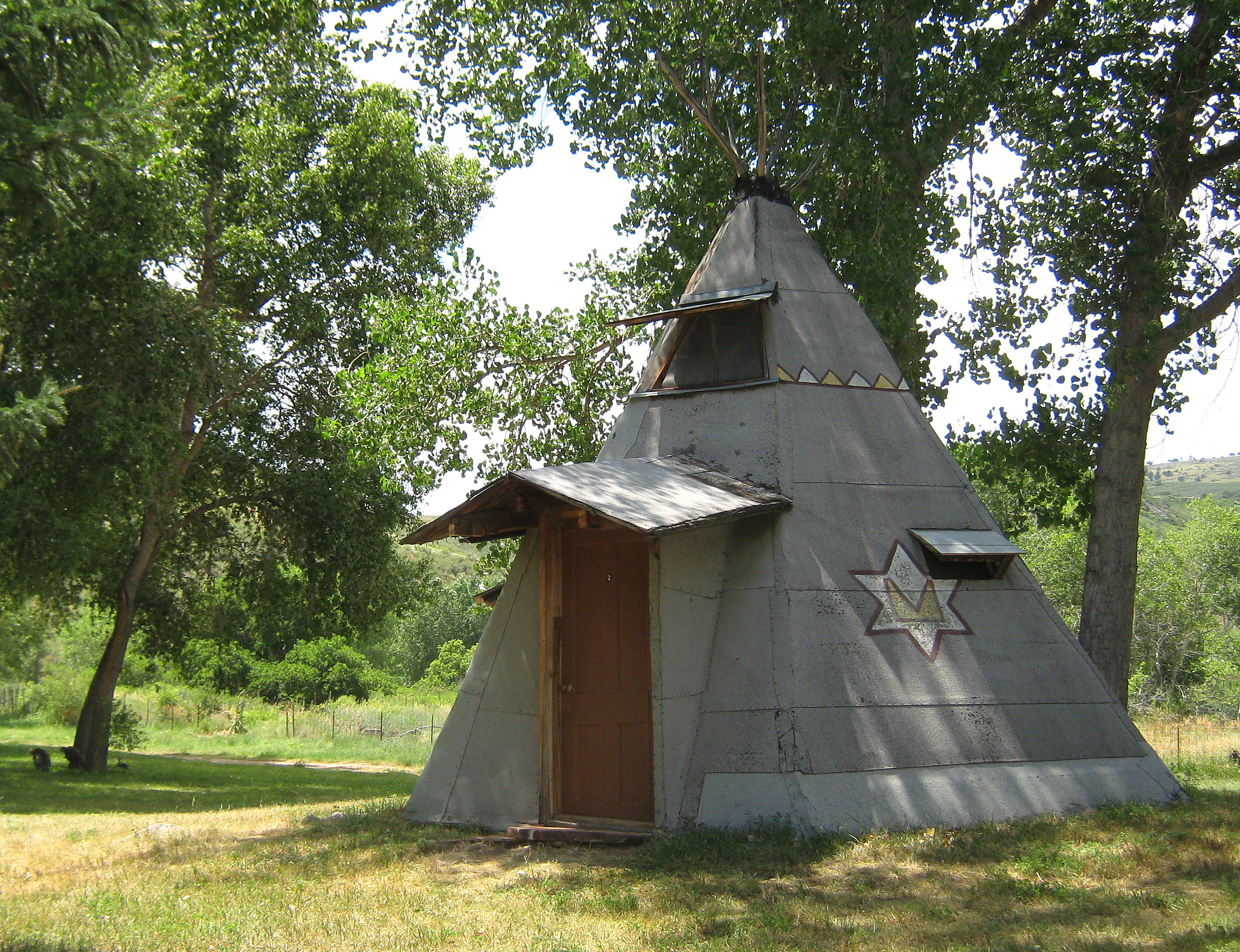
Tar Paper Tee-Pee

The ranch has a campground with unimproved space for campers and tents as well as a half dozen pentagonal pyramidal structures referred to as Tee-Pees. These Tee-Pees are covered with rolled tar paper roofing and festooned with images of native American artwork. I’d say it’s pretty kitschy.

Campers Powder Room

The restroom facilities are nearby, festive, and unmistakable.

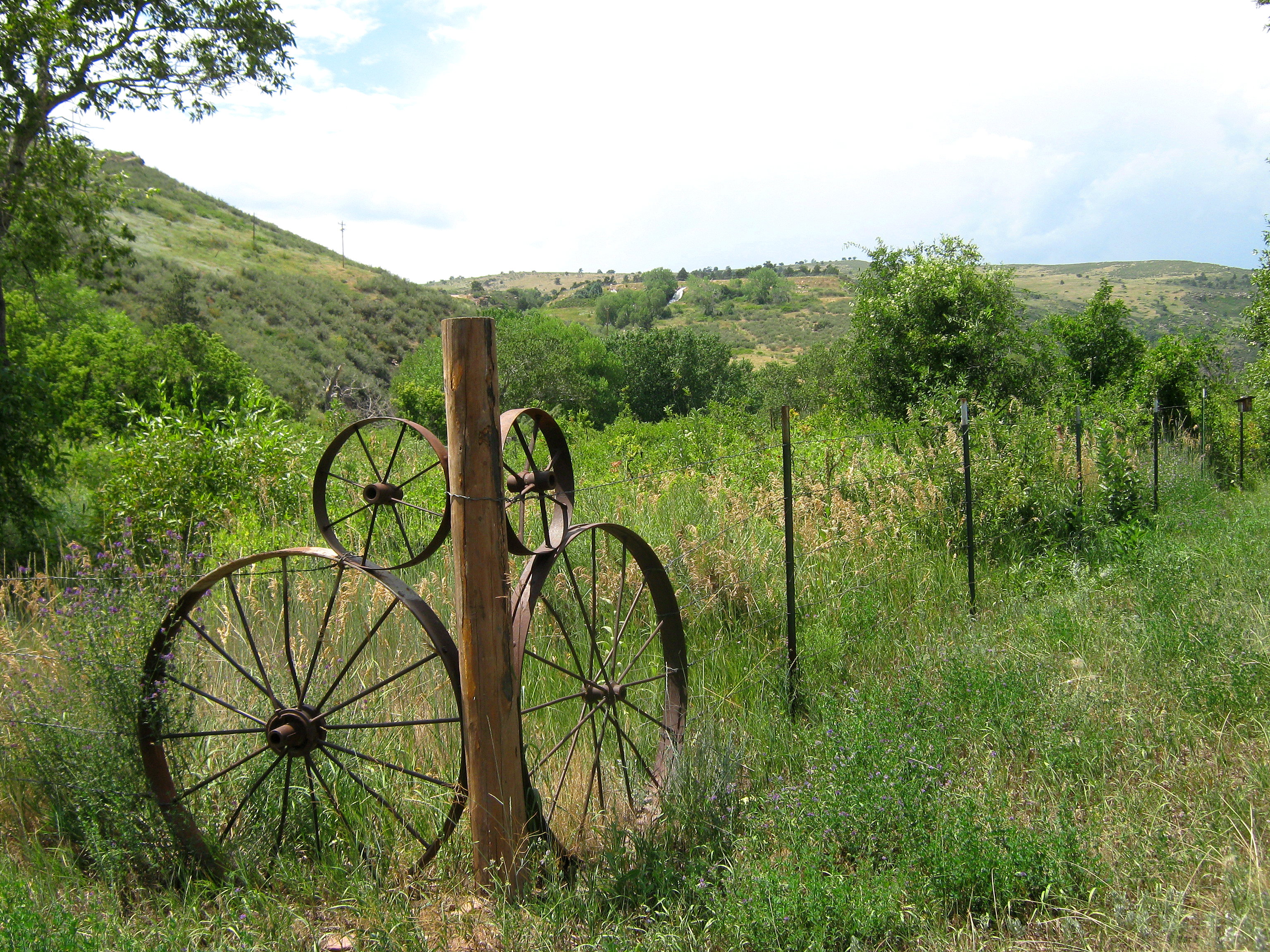
Don't Fence Me in

The ranch is quite large and sits on the north side of Rabbit Mountain, sometimes known as rattlesnake mountain. This is rattlesnake country and you need to be wary when charging through the grass to get that great photo.

Folk Art of the Little Thompson Valley

There are plenty of places to sit over yonder at the dance hall. This bit of folk art is there for you to rest your weary feet.

Of course, if you give an arc welder to a rancher, there is no telling what he’ll come up with.

Lucky Horseshoe Chair

There is much to be learned from a day on the ranch. For the keen observer, metaphors abound. While a rolling stone gathers no moss, a standing wheel gathers a tree.

What happens to all of us when you quit moving

Process development and struggle

One of the hazards of having a degree in chemistry is the appealing idea that you can explain everything and predict everything on the basis of textbook notions on solubility, electronegativity, pKa’s, or molecular orbitals. These are important things to be sure. But in the field, the recall of knowledge isn’t always enough. More often than not you have to collect data and generate new knowledge.

Rationale of a result on the basis of hand waving and a few reference points can seem compelling in a meeting or brainstorming with a colleague to understand a problem. But in the end, nothing can top having solid data from well conceived experiments.

My chemical “intuition” have proven wrong enough times now that I am deeply skeptical of it. After prolonged periods of absence from the lab I find myself resorting to a few cherished rules of thumb in trying to predict the outcome or explain the off-normal result of a process.

In chemical process development there is no substitute for running experiments under well controlled conditions and capturing solid results from trustworthy analytical methods. It is hard work. You may have to prepare calibration standards for chromatographic methods rather than the preferred single-transient nmr spectrum  in deuterochloroform.

We’re all tempted to do the convincing quick and dirty single experiment to finesse the endpoint. Certainly time constraints in the manufacturing environnment produce an inexorable tilt towards shortcuts. But in the end, depth of knowledge is only had by hard work and lots of struggle in the lab. The most important part of science seems to be to frame the most insightful questions.The best questions lead to the best experimental results.

An involuntary grunting reflex

Make magazine is one of my very favorite publications. It’s made for hillbilly engineers and aspirants like myself.  Their Maker Shed Store offers kits as well as plans for making all sorts of cool gadgets. Check out this Berliner Gramophone kit and this vacuum tube radio kit.  

Kit building and garage engineering are important activites for aspiring young scientists. We senior scientist types should be on the ready to mentor local high school students in their bid to learn about technology from the ground upwards.

Electronic experience is invaluable to all experimentalists- physicists, chemists, geologists, biologists, etc- and is a subject of lifelong utility. Many students do not have peer groups or family members who can help them get into this subject.

As a junior high school kid, I worked on TV sets (tube electronics) and acquired some electrical and mechanical ability in doing so. I actually fixed a few problems, surprisingly. A family friend had a TV repair shop (remember those?) and as a result I had a steady supply of TV chassis to take apart for my collection of parts like potentiometers and variable capacitors.

Like most kids rippin’ stuff apart and eyeing the construction methods I gained valuable electrical insights and personal experience with electrical current.  Like the time I discharged a picture tube through my hand while trying to remove a flyback transformer from my grandparents color TV. It was great lesson in capacitance and isolated static charge. As my grandparents sat on the Davenport and watched, they heard a sudden and involuntary grunting noise burst from my mouth as I hurled myself from a squatting position by the opened console TV set and backwards across the room. I probably absorbed more joules of energy from landing on my backside than the joules absorbed by my hand. Luckily I was not burned. The next day I learned how to properly discharge the aquadag in the picture tube.

It is nothing at all like tangling with an vicious animal who might stand there after the altercation spent and panting, wondering in its little badger brain how to tear an even bigger chunk out of your leg. A discharged electrical appliance bears the same silent affect before as afterwards. It’s wicked electrons are inanimate and unparticular in their singular drive to find ground. An unexpected jolt from a device is much like a magical experience. It comes from nowhere and everywhere and is over in the blink of an eye. Afterwards you stand there in shock and awe of the effect of even modest amounts of energy.

The impulse to do science is also the impulse to find boundary conditions of phenomena. Where are the edges? How does it switch on or off? You have to be willing to leave some skin in the game to find out about things.

Obstreperous Theocracy

So it appears that the US is quietly building up military forces within striking distance of Iran. The island of Diego Garcia (UK) has served as a staging area for standoff weapons. The military-political establishment has been busy with threat analysis and is evidently staging forces to some extent based on their conclusions and evolving policy.

I think there are many credible arguments that rightly assert that Iran is an active threat to what passes for stability in that region. Or at least at the first-order level of political analysis. Iran is plainly an obstreperous theocracy with a particular zeal for the export of its orthodoxy.

As always, the drums begin to beat for war and the business of manufacturing public consent begins in earnest. I’ll go out on a limb and make a gross generalization. All human populations seem to have a fraction, say 1/4 , who are particularly fearful by nature. These are the folks who susbscribe to concrete notions of nationalism, righteousness, and the associated keenness for adherence to orthodox doctrine. These were key proclivities of the US/Soviet cold war era. It is part of a collective consciousness that is especially adept at finding patterns that validate its fundamental fear.

It would seem that we may be in yet another run up to the projection of force on the far side of the world. A good question would be this: Are we addressing the fundamental cause of World-vs-Iran conflict? At minimum we trying to shore up the result of a century of bad western foreign policy.  This region is at the overlap of profound social forces associated with abrupt infusions of petrodollars, reflexive militarism, ethnic antipathy, and religious orthodoxy.

I think that Chomsky has some valid points about the origin of these conflicts. Iran and other groups have used the Israeli-Palestinian conflict as a bully pulpit for their own regional ambitions. Obviously there is sincere religious and ethnic outrage over the the Palestinian issue. But a state like Iran is sure to use this conflict to their own political advantage to exercise the projection of power.

The US and other western states have chronically miscalculated the magnitude and direction of regional conflicts.  For instance, would a military strike against Iran be viewed as just an attack on the government of Iran, or as an attack by infidels on Shi ‘ism? Are we prepared for what would follow? I think I can guess the answer.

Trombone Shorty

I have a guitar and sometimes I pick at the strings before I retire for the evening. Regrettably, I can’t produce much that is recognizable. It’s just an elementary condition related to a lifelong neglect of this kind of activity. My brain plasticity has produced a tough layer of rythmic dissonance between my grey hair and grey matter like a skin of old playdough or expired custard.  

What I have come to understand is this- guitar players whom I have taken for granted as providers of background music were in fact some extremely clever fellows.

In trying to convert the sheet music of a few players into sound, I have come face to face with the truth of their talent. And I am humbled. Most people learn this well before their fifties. But not me. My insights are hard won and accumulate when most of the other runners have already passed the finish line.

I was just surfing Youtube for guitar players like Chet Atkins, Leo Kottke, Eric Clapton, Stevie Ray Vaughn, Jeff Beck,  and a few others.  Another way of looking at the spectacle of their art is this:  Behold what neurons are capable of!! The player’s central nervous system seeks maximum satisfaction in the refinement of the exercise of producing sounds from an external object. It is a feedback loop that explores for a target state and, through brain plasticity via evolving neuron interconnectivity, refines its own capacity to produce a desired effect.  What an amazing universe it is that can produce such things.

And what an amazing demonstration of the marvel of brain biology. Even if they find the Higgs boson next week, we’re still a long way from a fundamental mechanistic understanding of how someone learns to excel at Spanish guitar.

Lately I’ve been listening to Trombone Shorty. He has brought new life to that venerable background instrument, the trombone. This is from his album Backatown.

I’ll be blunt. It’s all about putting butts in seats.

Ok. So I’m one of the founders of a theatre group more or less based in my home town.  Truthfully, I’m the least experienced of this group.  We’re a bunch of community theatre enthusiasts who have decided to start our own theatre group. Together we’ve had a few critical successes, but we wanted some autonomy.  Most of our shows ended up with a modest surplus of cash with only one production that was well executed but poorly attended. The next show is largely funded by the receipts of the previous show.

Together or in groups we’ve done Proof, Brighton Beach Memoirs, Murder Room, Beets, and Love letters. Last fall I was in Room Service. We’re starting to accumulate a bit of experience. Luckily there have been no disasters.

What does it really mean to be a board member of a theatre group? It means that you are a producer. It means that your main purpose is to find and allocate resources so that others- sniff, sniff– can perform. As a board member you find out what it really means to be a producer of a show. It’s a lot of work.

So here is the deal. We have two productions scheduled, one at a very nice municipal theatre next January.  The question before us is this- how do you marshall resources and staff willing to work for free to put on a good show? Yes, we have 6 board members who are also actors, writers, and directors. But we can’t do everything. We need people for props, costumes, sets, and makeup. We also need someone to do lighting and sound. Possibly two or three of us may be in the show with bit parts.

In show business, there are several criteria for success. Obviously there is critical success. Everyone wants to be part of a great show.  We’re obligated to provide a nights entertainment in exchange for tickets. So, we need to snag some good actors and a director up to the task of directing upcoming Neil Simon production. Fortunately, we have an experienced director who has contacts in the local network of actors. So,  with some luck the audition will be well attended with prospective actors.

But beyond all of the handwringing about production value, what matters most to the producers is that we put butts in seats. We could put on the best performance in history, but without an audience, it’s all a silly exercise.

The question arises, then, as to how does one get the message out? We recently learned the expensive lesson that newspaper advertising is highly unreliable. A good writeup in the local entertainment insert can be very helpful, though. But the staff writers have to see a compelling newspaper story in order to do a good writeup. So, if you’re doing a Neil Simon play, one that has been done many, many times, how do you stir up the excitement?

Well, you have understand who your audience is and what they respond to. Who attends plays, anyway? In the case of community theatre, there is a substantial reservoir of blue hairs and the Q-tips who love to see a show. You know, retired people. So then, how do we get the message out to the retired folks? This is the nut we have to crack in the dog days of summer. Who is willing to go out on a January night to see a show?


Andy Grove on Scaleup

Andrew Grove is the former CEO of Intel who was responsible for its transition from memory chip producer to microprocessor producer. According to Wikipedia, Grove is responsible for an increase of 4500 % in Intel’s market capitalization. In his youth he and his family escaped from Budapest, Hungary during the Soviet invasion of 1956. Groves holds a PhD in chemical engineering from UC Berkeley. Grove is now retired and is a senior advisor to Intel.

Grove recently wrote an article for Bloomberg that is quite insightful in its analysis of certain aspects of American corporate culture. In particular, Grove notes the disconnect between US technology startups and the subsequent expansion of business activity leading to job growth. He also notes that startups are failing to scaleup their business activity in the USA. The Silicon Valley job creation machine is powering down.

Grove makes an interesting point here,

A new industry needs an effective ecosystem in which technology knowhow accumulates, experience builds on experience, and close relationships develop between supplier and customer. The U.S. lost its lead in batteries 30 years ago when it stopped making consumer-electronics devices. Whoever made batteries then gained the exposure and relationships needed to learn to supply batteries for the more demanding laptop PC market, and after that, for the even more demanding automobile market. U.S. companies didn’t participate in the first phase and consequently weren’t in the running for all that followed. I doubt they will ever catch up.  Andrew Groves, 2010, Bloomberg.

To build on what Grove is saying, I’ll embellish a bit and add that an industry is actually a network of manufacturers, suppliers, job shops, labor pools, insurers, bankers, and distributors. When deindustrialization occurs, the network of resources collapses. The middle class takes a big hit when a commodity network moves offshore. In the end, the intended market for commodity goods and services- ie., the middle class- is weakened by the very move that was supposed to keep prices down and profits up.

Grove is most concerned with the matter of scaleup. This is the business growth phase that occurs after the entrepreneurship proves its worth in the marketplace. Investors pour money ino large scale operations and staff to get product onto the market. Grove suggests that investment in domestic startups who do not follow on with domestic scaleup are not participating in keeping the magic alive.

Offshore scaleup negatively counteracts the benefit of domestic innovation. In a sense, it is an abdication of the trust given to the entrepreneurs by the citizens who provided the infrastructure to make the innovation possible.

Grove makes a good point in his editorial and I think that the rest of us need to take an active stance to question the facile analysis so often uttered by business leaders when it comes to relocation of business units offshore.  Citizens paid for the infrastructure and a large part of the education that makes our innovative technology possible. There needs to be more public pushback on business leaders and government officials about this topic.

Russia being Russia

It was reported that the Russian Parliament has approved a draft of a law to increase the powers of its FSB, or the remnant of its Soviet era KGB.

The final version is somewhat weakened from its earlier form, which prescribed punishment for individuals who ignored such warnings from the F.S.B. In remarks posted on his party’s Web site this week, Vladimir Vasiliyev, the chairman of the State Duma’s Committee on Security, described the new power as “a preventive conversation” with “someone who is beginning to move toward committing a crime.” (New York Times, July 16, 2010)

Imagine that. A Future Crimes Division.

When asked about the bill by a German reporter during a meeting with German Chancellor Angela Merkel on Thursday, President Dmitri A. Medvedev said, “what is going on now is the result of my direct instructions,” and that foreign commentators should not concern themselves with it. (New York Times, July 16, 2010)

The police state is back. The Russian gov’t is moving (back) towards policing perceived intent. What a sad day for Russian civilization and the world.  Queen to E5, check.