Viewpoints on American Business

Over at the Robert Reich blog there is a recent commentary on Chinese currency policy. Reich makes some interesting comments on the Chinese approach to industrialization.

But most fundamentally, China is oriented to production, not consumption. It wants to become the world’s preeminent producer nation. While keeping the yuan artificially low is costly to China — it pushes up the prices of everything China imports — China is willing to bear these costs because its currency policy is really an industrial policy.

We think the basic purpose of an economy is to consume, not to produce. So we only grudgingly support industrial policy. We think of government efforts to rebuild our infrastructure as a “stimulus.” We approve of government investments in basic research and development mainly to make America more secure through advanced military technologies. And we give American companies tax credits for R&D wherever they do it around the world.

Don’t be fooled into thinking that US companies will continue to make big profits from sales in China. China allows big U.S. and foreign companies to sell in China on condition that production takes place in China – often in joint ventures with Chinese companies. It wasn’t American know-how, so it can eventually replace the US firms with China firms.  [Italics by Gaussling]

It seems to me that American policy leaders have no clue whatsoever on how to coexist or compete with China economically. Because of the authoritarianism in contemoporary Chinese culture, they are able to focus their resources on long term goals while we in the USA rely on a kind of economic Darwinism. It seems that we are waiting for the rational forces of the marketplace to take us forward in the economic struggle with China.  In reality, American businesses have no nationality. Their obligation is only to achieve maximum shareholder value, irrespective of parochial concepts of national interest.

Americans like to put on a show of maintaining an orthodox capitalistic stance against a nation state like China. One with a centrally controlled economy.  Unfair currency policy is a foreign policy that China is using to leverage the flow of export dollars their way.  Somehow we are content to play cards with an opponent who has stacked the deck.

It is worth remembering that much of the technology that economically emergent states use to energize their manfacuring sectors was paid for by US citizens over the last 100 years. Electronics , metallurgy, chemistry, aerospace, transportation, automation. The US has made substantial contributions to technologies that are now ubiquitous.

These emergent states have not funded generations of successive invention and improvement to achieve their semiconductor FAB or petrochemical complex. Corporate investors dropped it out of the sky.  This technology that we have been busy exporting has been dearly paid for by generations of hard working citizens here. Yet, through the exercise of advanced business philosophies, this magic of ours has been transplanted off shore to the benefit of a few.

I think there is an assumption that our American democracy is somehow a uniquely robust form of democracy. It is hard to make that argument anymore. A culture that equates money with speech and validates it in the Supreme Court is a culture that accepts the notion that the congress is part of the marketplace of goods and services.

In the face of a shift in the global economic center of gravity, Americans are busy in an orgy of fratricidal disassembly of its institutions. Journalism and independent media come to mind.  The former watchdogs of democracy are now quasi-analytical entertainment divisions of a few major comglomerates.

The market is like a stomach. It has no brain. It only knows that it wants more. I think nations like China know this about us and take full advantage of the fact that we like to wear the badge of orthodox capitalist on our sleeves. In a way we are just country bumpkins who have never traveled out of the county. We’ll be true to our doctrine as we run aground.

I think that, in the end, publically owned corporations will be the death of our economic vitality. Blind reverence for CEO’s who maneuver a dividend no matter what the economic climate force this species of organization to abdicate any sense of national affiliation. It’s been happening for many years. Legions of B-school students study the strategy of Jack Welch and similar ethically agnostic characters who serve the greater good of the corporation.

Instead, legions of B-school students should be trying to figure out how to sustain American manufacturing rather than how to outsource it. These people should not confuse M&A with progress. Making things and offering services that people want is how progress happens. If taxes are too high to sustain business within these borders, then an open effort to bring corporate taxes into line based on mathematically defensable arguments should be made. To work for progress is to be progressive. We need more progressive business people, not more financial wizards. The grownups of America need to step up.

Process Intensification and the Chemical Marketplace

Somewhere along the timeline of a given chemical plant process a manager will (or at least should) ask the question: “can we run this process in a more efficient and safer manner”?  Chemists and engineers may be set to work finding ways to extract more profit from a process.

There are numerous ways any given process may be improved. How that is done specifically depends on the process, obviously. But certain generalities can be made that serve as a guideline in thinking through the process.

In this essay I will limit my comments to batch or semi-batch processing and to specialty and fine chemicals. Continuous processes and commoditized products are out of the scope of this essay.

Batch and Semi-Batch

A batch process is one in which a vessel is charged with raw materials which are allowed to react to form a desired product. A semi-batch process is one in which raw materials are metered into the vessel over the course of the reaction. From a process safety perspective, the big difference between the two is that the batch reaction is the one with all of the reaction energy contained in the vessel from the start. A semi-batch process is one in which the energy is metered in based on the limitations of heat transfer capacity.

Commodity Chemicals

Some chemicals are commodity products and others are specialty or fine products. A commodity chemical is a product which is produced at a large (relative) scale, commonly in a continuous process, and is subject to price pressures generated by national or global scale competition. There are exceptions, naturally. Generic drugs or semiconductor chemicals may be commoditized but manufactured by relatively small scale batch processing though still subject to commodity market dynamics.

A commodity chemical product is one which has numerous producers offering similar specifications and varying mostly by price, often resulting in strong competition. As a result of the large scale and the great competition, commodity chemicals are often priced at low dollar-per-unit levels. Owing to the basic nature of commodity chemicals in manufacturing, it is not uncommon for commodity chemical sales volume to be an economic indicator.

Here is an important economic point in thinking about commodity vs non-commodity chemicals. Commodity chemicals typically have a cost structure featuring large raw material or energy costs. Commodity processing is all about the dilution of overhead into high volume. Commodity cost structures may be quite immobilized by fixed raw material and/or energy costs.

Commodity chemicals are commonly used for mass production of other goods. Examples of commodity chemicals include NaOH, soda ash, potash, sulfur, sulfuric acid, HCl, chlorine, BTX, ethylene, propylene, butanol, ethanol, methanol, naphtha, methane, hydrogen, ammonia, etc. These are materials bought and sold by the railcar and whose sales volumes indicate the health and vigor of entire nations. Other, lower volume, chemicals are commoditized as well. Additives and treatment chemicals for commodity consumer goods like pigments, solvents, plasticizers, dyes, food processing additives, lubricants, polymer additives, metal treatment chemicals, agrichemicals, etc. These goods are sold on the large scale for their performance modification or other properties.

Specialty and Fine Chemicals

Specialty and fine chemical products are commonly sold in lower volumes for a broad range of manufacturing and formulation activity. There is no sharp line of demarcation between commodity and high volume  fine chemicals. Commoditization is less a manufacturing phenomenon and more of a market phenomenon. The same is true for specialty and fine chemicals.

Specialty and fine chemicals are an important part of the total chemicals market sector. There are tens of thousands of chemical entities on the market. Most are deeply obscure, in demand only by a few researchers. A common growth strategy of  catalog companies is to increase the number of catalog offerings, thus snagging new customers by providing specialized precursors to those who do not want to make a science project out of starting materials. This business strategy has helped to grow the well known chemical catalogs to their immense size.

A specialty chemical is a material that feeds into a particular use, or is valuable or usable only to a particular end user. Commonly, a specialty chemical may be used for a single application by a single customer or a few narrow applications for a few customers. A specialty chemical is often part of an intellectual property package whose use and identity is highly controlled. The specialty chemical, like a fine chemical, may be covered under process patents that limit manufacturing practices.

A specialty chemical may be of technical grade (i.e., 60 to 95 % purity) or it may be highly purified. It might be of a complex composition and specifiable only under bulk properties like viscosity, flash point, or color. Or a specialty chemical might be highly purified and have sharply defined specs requiring spectroscopy, chromatography, XRD, % ee, or elemental analysis. A specialty chemical might also be a fine chemical in the sense that its composition is in the public domain, but its application is just obscure or covered by a patent.

Generally, a fine chemical is a substance whose composition is in the public domain and is refined to some commercially viable level. A fine chemical may be a reagent or a substrate and may be  used by anyone technically qualified to handle it. Very often, the composition of a fine chemical is understood to a high level. Fine chemicals may be starting materials for the manufacture of other substances, or may be used directly in an application where it remains chemically intact at the retail level.  An example would be an emulsion stabilizer or some polymer additive.

Specialty and fine chemicals are not mathematically distinct definitions. The differeces are based on market behavior and intellectual property. Examples exist which may find a home under both definitions. For the most part, a specialty chemicals manufacturer is a producer of customized materials with a limited base of potential customers.

The Prime Directive

Here is the central business imperative of any chemical plant- we want to run the reaction as fast as possible without taking undue risks. Labor costs and other overhead accumulate with process time, Δt. Any given batch fine or specialty plant has x gallons of capacity available for use 24 x 7 every year. The key to profitable operation is to get maximum product output per unit time. That means maximum space yield and/or maximum rate. Decreasing production time is equivalent to increasing plant capacity.

Production risk divides into two principal domains: 1) safety and 2) economic. While it is possible to have an economic risk without a significant safety risk, the practical fact is that all safety risks are also economic risks. So in the execution of a process improvement, very practical thinking has to guide the work.

Cost Drivers

Commoditized chemicals are often disproportionately raw material or energy cost intensive relative to specialty and fine chemicals. High volume, low margin products that have been in a competitive market a while have most likely been optimized such that the labor contribution to overhead has long been minimized. For a given plant, significant improvements to the cost structure may not be easily found in the labor column if the major costs are raw mats. Except as follows. Relocating a plant to a country with lower labor and/or tax costs. Commodity production follows the labor cost gradient from a high-cost labor pool to a lower-cost labor pool.

Process intensification on chemical products that have been commoditized for a long time is difficult. Besides relocation of the manufacturing site, a step change in processing technology may be needed to improve process economics. Fundamentally new chemistry (or catalyst!) or reactor type or in materials handling may be needed to justify a change.

Whereas commoditized chemical costs may be driven by raw material or energy costs, specialty and fine chemicals are most likely to have a cost structure driven by labor and overhead. A dominance by labor cost contribution will be especially true early in the life of the chemical product. The early developmental period in the market life of a fine or specialty product is the time when competition is likely to be minimal and price pressures lowest.

Early in the life of a fine or specialty chemical product is the time when the end user is struggling to understand the market picture. This is the commercial development period. While the end user (customer) is certainly trying to contain costs, low volume may cause the buyer to rely on a single supplier for a time. This gives the vendor a chance to log enough process iterations to bring the production costs more in line with expectations.

When pricing smaller volume products, every effort should be made to pad the costs in anticipation of process upsets and low yields. And for high margin. R&D and scaleup costs are typically highest early in the life of a product. Margins should be high enough early on so that the early production pays for the development. Customers will not be enthused about this. They’ll want you to “partner” with them and get some skin in the game early. Try to avoid this, politely.

A small volume fine or specialty product should be heavy in labor costs. Over time, and as price pressure from customers mount, the vendor should be able to accept price concessions through improvements in labor contribution. This is wiggle room. A smart vendor will never price a new product too close to raw mat cost since the inevitable movement of price is downward.

Low volume specialty or fine chemicals are often not subject to the same sort of pricing dynamiocs as the commodity chemicals. This category of chemical manufacture is more obscure and the products may not be manufactured constantly or in large lots.

Importantly, lower volume fine and specialty chemicals are commonly purchased on a spot buy basis rather than a supply contract. Owing to the lack of long term certainty of cash flow, spot buy prices are always higher than contract prices.

Process Intensification. The benefits.

The business of making a reaction execute in a shorter time or in a higher batch space yield or batch chemical yield is called process intensification. The idea of intensification is to produce more product per unit batch volume of processing equipment and/or per unit batch time. Every chemical plant has a fixed number of operable reactor gallon hours per year.  Given that conventional chemical batch reactors are fixtures that are very expensive to modify or change out, it is desirable to focus effort on getting the maximum product out of those limited reactor gallon hours.

In a competitive market, one way to grow is to find advantageous economies of scale and pass some of that improvement along in the form of more attractive pricing.  The ability to maximize the throughput of product in fixed equipment is the ability to dilute overhead expenses into a greater number of kgs of product and direct more cash into the profit column.

Process intensification almost always involves doing something faster, hotter, at higher pressure, or in increased concentration. That is the intensification part. An exception might be an alternate process that affords a higher chemical or space yield, or faster rxn rate without undue risks.  One should always be on the lookout for these plums.

Process Intensification. The down side.

The attactive part of process intensification is quite plain. But there is a down side that may or may not be apparent in any given intensification project. It is a change that could bring plant operations closer to the release of hazardous energy.

The question that any process intensification project should squarely address is the matter of the accumulation of hazardous energy. This can be manifested in many ways.

For example, you increase the concentration of your reaction mixture in your process. This is a space yield intensifying improvement that has the benefit of advantageous bimolecular kinetics. You get more product per batch and you increase the reaction rate by increasing the reagent concentrations.  Reagent feed times are nominally increased, but probably not to a deleterious extent.

Naturally, there are consequences to consider. Is there an induction period to look out for? The thermal consequences of this may be magnified at higher space yields.

Does the intensified process produce excessive and unwanted side products?

Does the process generate a precipitate or increase the viscosity of the reaction mass? Increased viscosity has a deleterious effect on heat transfer and mixing efficiency. Slurry formation may be enhanced and consequently produce problems with discharge and pumping of the reactor contents. Filtration may be problematic as well.

Furthermore, as a result of reagent addition the reaction mixture may have a greater density that the initial solution in the vessel, diminishing power transfer efficiency in agitation. Effectively you may end up vortexing an inner band of reaction mass with poor flow along heat transfer surfaces.

Cavitation at the impeller tips may occur and attenuate the efficiency of heat transfer. Heating a viscous two phase reaction mass may lead to localized overheating along the reactor  jacket if it is rigged for heat. I have seen this lead to flash boiling of volatile solvents along the jacket surface with an increase in pot pressure.

Another form of process intensifiaction is through the application of higher reaction temperature and/or pressure. Increasing the reaction temperature could be as easy as using a higher boiling s0lvent. Or it could entail higher pressure as well. Whereas most operations can easily accommodate a higher boiling solvent, higher pressure will require specialized pressure vessels. These are less common, in fact, they are part of a manufacturing subspecialty in their own right.

To summarize, intensify a commodity chemical process is more likely to involve  addressing raw materials, energy inputs, and material handling.  Conversely, while specialty and fine chemical processing could benefit from the above areas of concern, unit labor cost is likely to be a target for process improvement. Labor cost is something that can be minimized most easily by process intensification and quite likely without fundamental equipment changes.

From time to time, all processes should be re-examined for efficiency and safety improvements. But the operator should expect consequences in any process change.


NatGeo King Tut Exhibit- Ho Humtep of the Ballyhoo Dynasty

Th’ Gaussling went on a minor field trip recently to the local art museum in Denvertown to see the marvels of King Tut. And what a marvel it was … of marketing. It is hard to say that the exhibit met expectations. To be sure, there are some fine artifacts on display.  And it is a splendid example of museum-craft. Notable is the exquisite goldsmithing and scuplture on display. There are decorative articles that resemble a form of gold filigree that are quite impressive for the era. My northern European ancestors were sleeping in hollow logs and howeling at the moon when the Egyptians were doing the work on display.

But at the end of the day, the exhibit is yet another recasting of history in a theatrical form suitable for the attention deficit masses. Case in point:  a video short subject portrays DNA work on a mummy where the scientist assures us that such research is a part of the larger effort to cure disease.  Golly, sounds urgent.

Well, maybe there will be useful findings that contribute to the betterment of human health. But if it doesn’t , is the knowledge useless? I think not. This is the same sort of lame apologia used for jusifying space exploration or studying the frogs of Amazonia. If you are not looking around, you are not going to find new things.

Scientists should stand firm with the conviction that exploration is a net benefit for mankind. We should be more careful that claims of a breakthrough are tempered bya realistic warning about the speed of progress.  We should stop leading people along with false expectations about the fabulous things just around the corner. All progress is the result of prolonged hard work by many people.

A chemist’s encounter with boneheads and the disreputable

One of the things that happens to a chemist in the sales department is the business of taking odd phone calls. Someone out there will scan the internets for information on some particular substance or product and find the number of your company switchboard. The person at the front desk  will spend a moment with the caller and then connect them with someone like myself.

During my business development time I have been amused, surprised, pestered, annoyed, and yes, a little frightened.  I have fielded calls from a prisoner wanting expert witnessing (his planned appeal was based on a false premise), illicit drug makers wanting bulk intermediates sent to their motorcycle or chrome shops, and crooked characters wanting items on the MCA list sent to their garage operations.

I am not a member of the law enforcement fraternity. God knows these characters have never asked for my help.  There is precious little I can personally do in the fight against drug crime. But foiling those who would profit from poisoning the nervous systems of our citizens is something that can be done by chemists.

I have spoken with misguided people on the dark side of chemistry who are on the fast track to prison. And, I have taken calls from parents of K-12 students wanting energetic or otherwise hazardous materials for their science fair project. In this case, we’ll have a polite discussion about safety and I’ll offer some alternatives.

I have been yelled at by frustrated foreign nationals for my refusal to quote on items on the munitions list or the State Department’s official shit list of bad actors. Some were persistant buggers, but I extracted satisfaction in interfering with their sourcing plans. The front lines in illegal technology transfer or illegal synthetic drugs is not in the offices of the authorities. It is on the phones and emails messages of companies who sell materials or devices that facilitate the activity.

It turns out that knowingly selling substances to suspicious characters is not only morally wrong or makes you an accessory, but it is just plain bad business. Long term stability for you and your company requires compliance with the code. Selling materials that may be used for illicit purposes by unqualified buyers is only an open invitation for trouble.

Trolling for organizational weaknesses happens all of the time and all over the business world. Industrial espionage, attempts at illegal export/import of controlled materials, and raw material sourcing attempts for illicit or controlled substances. You have to keep your head on a swivel and qualify your customers.  

Trade shows are particularly bad for spying and competitive intelligence gathering. Companies who can afford large trade show booths will have an enclosed room to meet privately with potential customers. That way watchful eyes will have a harder time figuring out what they’re up to.

Few experienced business development people are shy about asking questions, especially yukking it up over a business dinner and drinks. When in doubt about giving information, just shut your yap, shrug your shoulders, and grin.

Always be up front and honest when it comes to withholding confidential information. Even, or perhaps especially, when you have an NDA in place.  You do not want to get in the habit of discussing sensitive topics in social settings. Leave that for meetings in the conference room where your cohorts can participate and everyone can hear what was disclosed. Savvy business people on either side will halt conversation on the spot if they believe that proprietary information is being divulged inappropriately.

As to the matter of gaming the system, I’ll offer that it’s always better in the long run to avoid planting misinformation. It is better to be regarded as uninformed or unhelpful rather than as a liar in the sales world. You can eventually slough off the reputation of being a bit uninformed or rude. But once branded as a liar, even in a field of liars, it is a stink that will follow you for the rest of your career in sales.

Travel Tips From the Department of Devil’s Advocacy

If you’re wandering the country on I-90, say to or from Sturgis, SD, a stop at the Devil’s Tower north of Sundance, WY, is very worthwhile.

Devils Tower

The identity of this geological oddity is the subject of some disagreement. Three theories of its origin are in play: 1) an igneous stock, 2) a volcanic neck, and 3) the remnants of a laccolith. Whatever the case, it is plain that the sedimentary rock surrounding it has long since eroded away to reveal the more weather resistant igneous rock. 

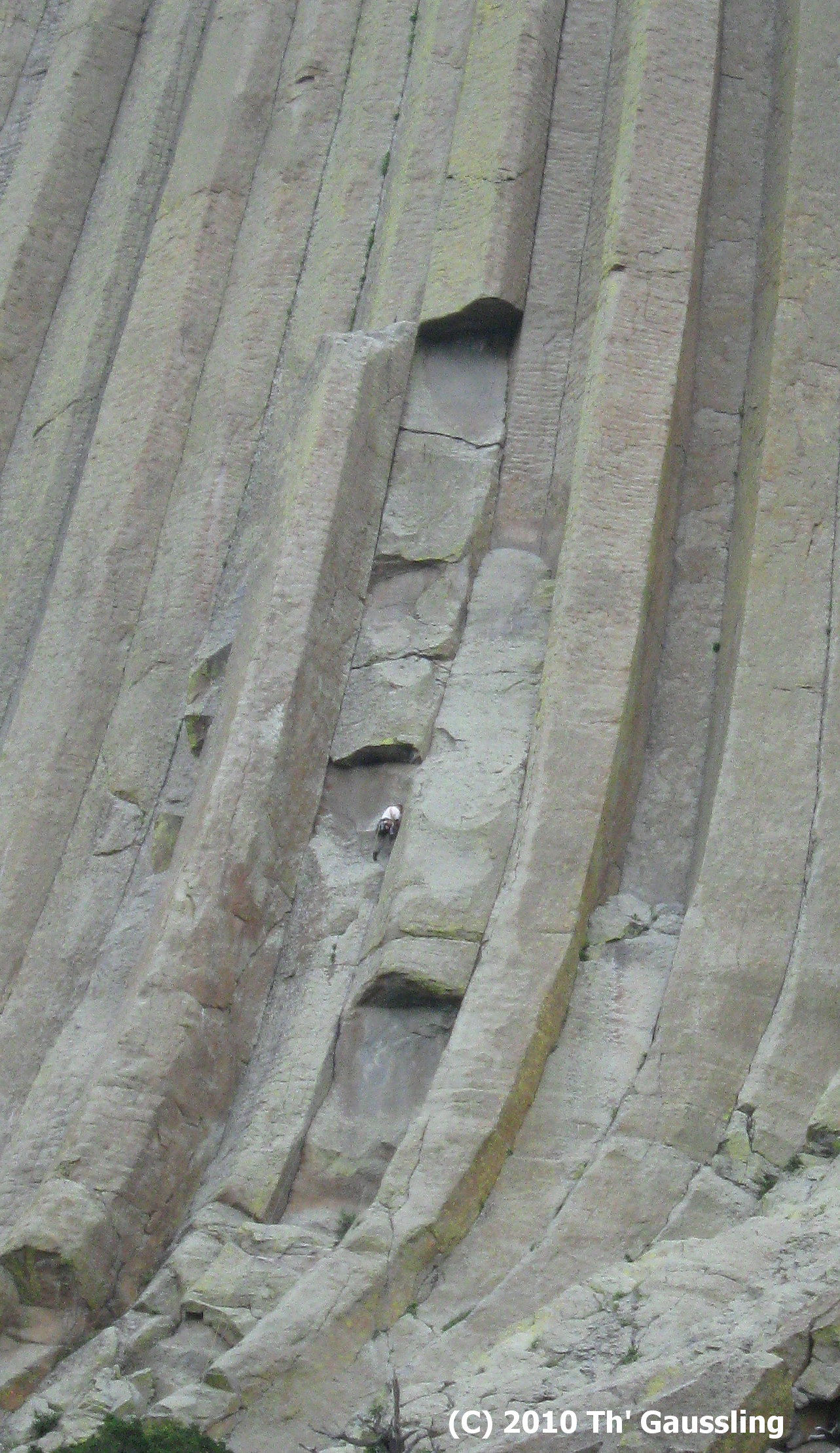
Climber on Devils Tower

Close up, the columnar structure of the formation is evident. This feature speaks to a slow cooling process, one made possible for a magmatic body deep underground insulated by the surrounding formation.

Devils Tower, Wyoming, June 2010.

Homestake Mine Visit

The town of Lead, SD, pronounced “leed”, is home to the Homestake gold mine. The mine was purchased and subsequently developed by George Hearst, father of William Randolph Hearst, and partners ca 1876.

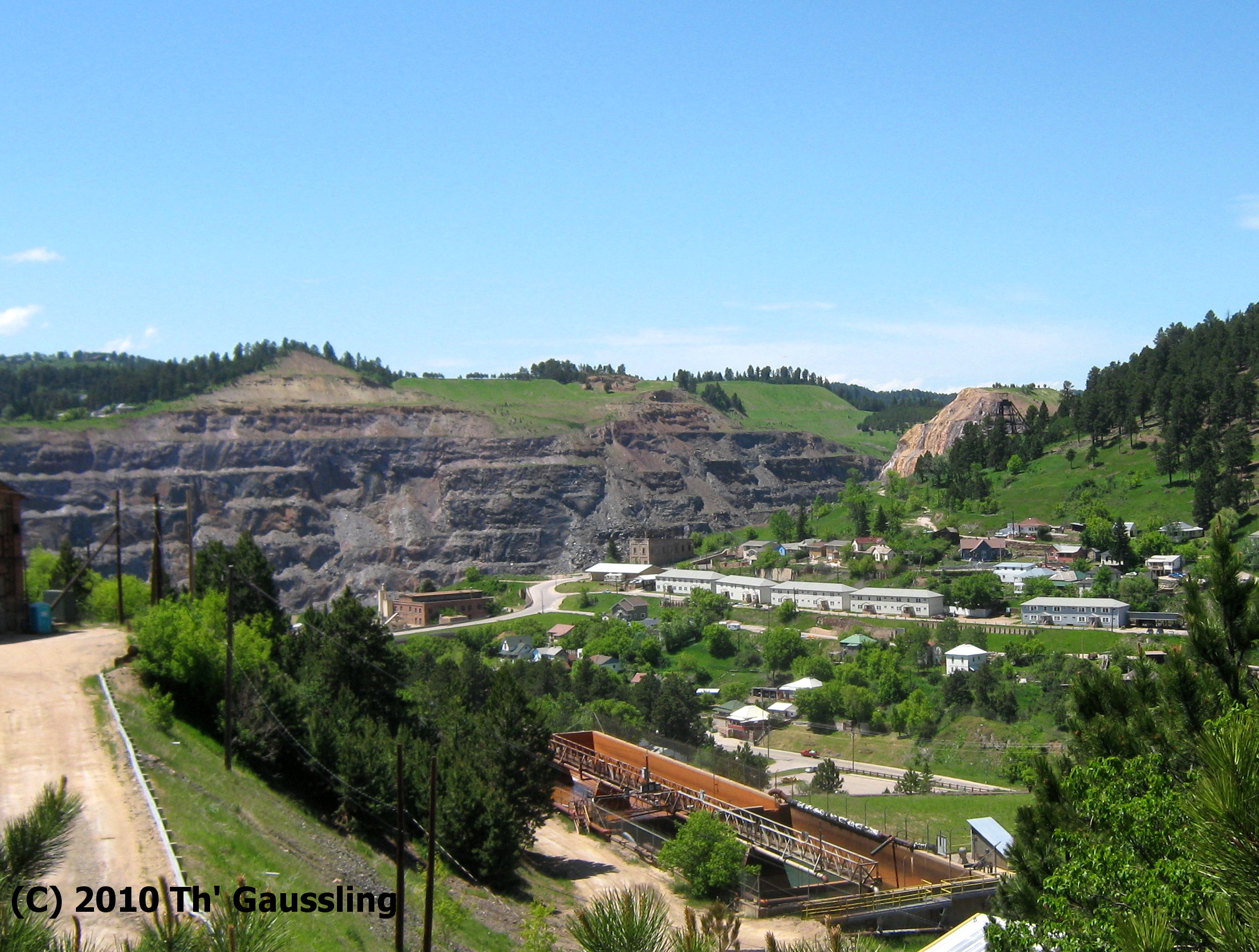
Homestake Open Cut from Yates Hoist House

 The photo above shows one ground view of the large open cut found on the north end of town. The pit is approximately 1/2 mile across and 1200 ft in depth from the highest elevation.

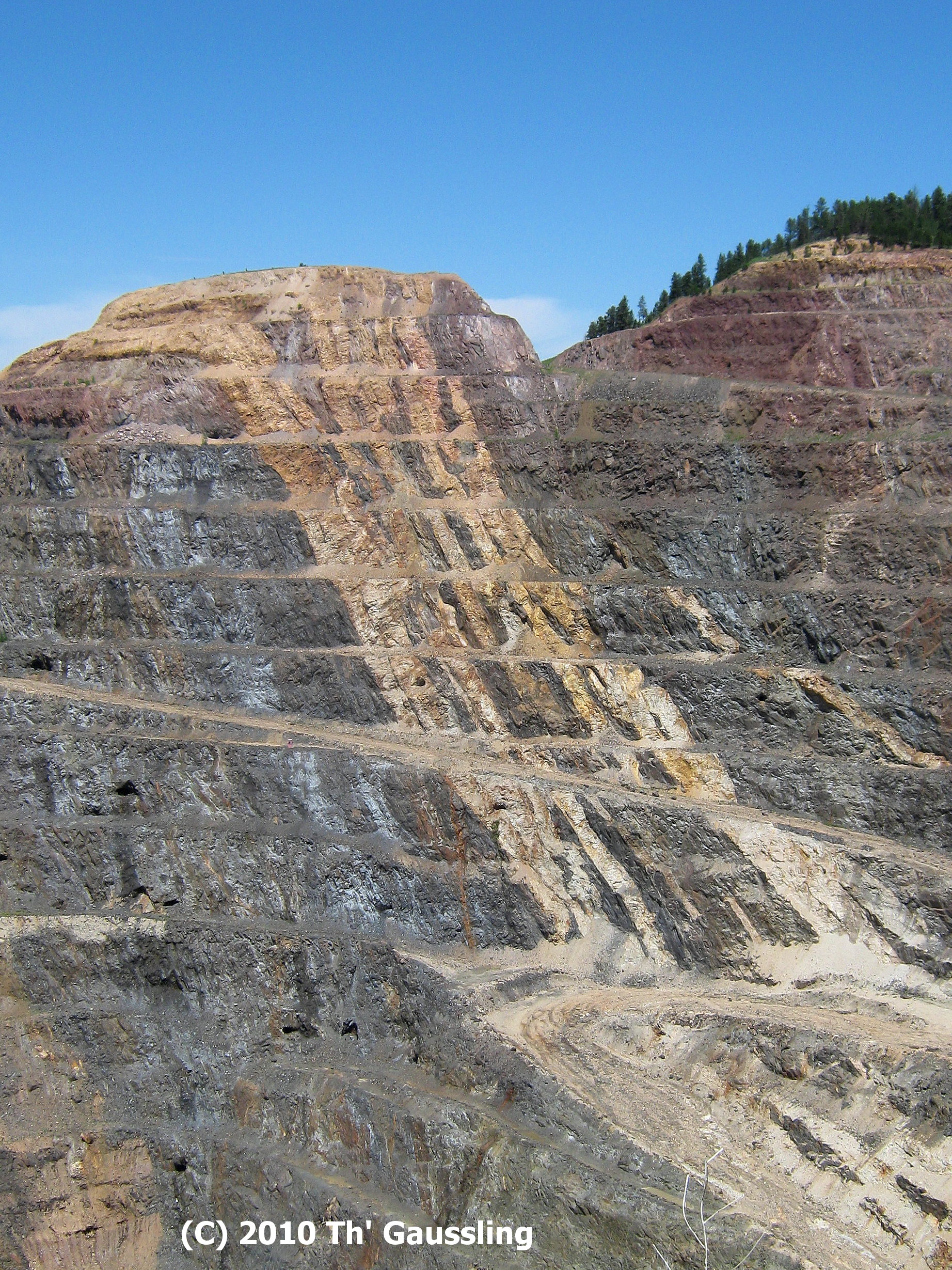
The pit exposes the ore body which is comprised of inhomogeneous igneous rock with gold bearing veins. In the photo below the vein structure can be seen. The buff colored rhyolite bands seen below are not associated with value.

Homestake Open Cut, Lead, SD.

Gold was discovered at a surface exposure, called a “lead”, which became the namesake for the town of Lead. Mining activity was halted in 2002, in part due to the low price of gold at the time. By that time the underground workings had reached a depth of 8000 ft, which puts it at ca 3000 ft below sea level. The rock temperature at the 8000 ft level was reported to be 130 degrees F, requiring substantial air conditioning for the workers and equipment.

Hoist Cable

The (poor quality) photo above shows the hoist equipment in the Yates head works. Of interest is the conical cable spool used to provide lift for hoisting operations at the Homestake mine. The purpose of the variable diameter feature of the hoist was to provide maximum mechanical advantage when the cable was at the end of its reach, presumably when it was ready to lift a heavy load of ore from the bottom of the shaft.

Homestake Honey Wagon

The “ore cart” in the photo above was the toilet facility for the miners. It featured a seat on top which could be sealed, a thoughtfully placed foot platform, and railings so the user could hang on for those rough rides.

The surface tour of the mine consists of a trolly ride around town with a stop at the Yates hoist. Warning: It is quite superficial in content, but is the only type of tour available. Our tour guide was student on summer break with near-zero knowledge of the geology or the engineering. He was accustomed to entertaining the barely interested.  If you are keen on the particulars of Homestake history, I recommend Nuggets to Neutrinos, by Steven T. Mitchell.

Homestake was one of the very richest loads of gold in the western hemisphere. Reportedly, some 40 million oz of gold were extracted from the mine.

Today, the Homestake mine is being converted to an underground nuclear physics lab facility under a program called DUSEL. On a side note, it is interesting to listen to the townsfolk talk about the new labs. I could tell they are trying to be enthusiastic, but the reality of neutrinos is very hard to get your arms around.

The Black Hills- Of Chiselers and the Chiseled.

The Black Hills are a mountain range that stand in the southwest corner of South Dakota and extend a bit into northeastern Wyoming. The area is known for the natural beauty of its forested mountains and green meadows. The relatively low population density along with the dramatic monuments and natural wonders make this a satisfying destination. In rather stark contrast to the panoramic beauty of the area, however, is a geopolitical history that is quite a bit less than pristine.  

After decades of expansive settlement from the US in the east and the corresponding conflicts, a treaty was forged in 1868 between a confederation of northern plains Native tribes and the US government. This treaty deeded the Black Hills region to the Native confederation.

Within a few years the Native American confederation lost possession of the land granted to them by the Treaty of Ft Laramie. It seems to have happened not so much by the US government backing out of its obligations, but by lack of decisive government enforcement of the terms of the treaty.

The discovery of gold in 1874 by the Custer expedition and the prompt announcement of this discovery lead to an irreversible economic migration to the area by gold seekers and those who would follow them. Many of the gold seekers were miners and entrepreneurs from other gold fields seeking new opportunity. Custer met his end in battle, hopelessly outnumbered by Indian forces.

Today the Black Hills of South Dakota are a locus of tourism, gambling, and recently, neutrino physics. Native Americans reside on a handful of reservations scattered throughout the eastern plains.

It is a curious contrast to behold. Today automobiles and tour buses disgorge well fed tourists by the hundreds of thousands each year to marvel at the spectacle of Mt Rushmore, buy souvenirs, and to rejoice in nationalistic self satisfaction.

Bikers make the annual sojourn-in-leather to nearby Sturgis in part to celebrate the freedom of motorcycling. All of this celebration of freedom in an area where the lust for gold has trumped the freedom of a hunter-gatherer society by those who had mastery of explosives, metallurgy, and steam energy. I suppose it was inevitable.

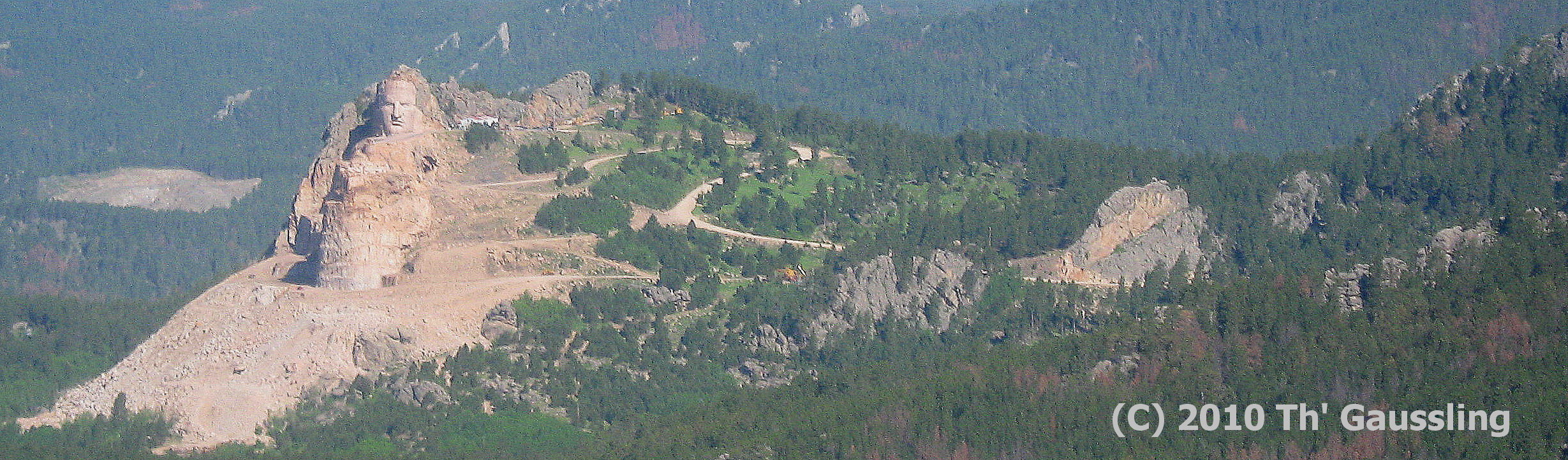
View of Crazy Horse Monument from Helicopter

Th’ Gaussling and family splurged (Yoww!!) on a helicopter tour of the Mt Rushmore and Crazy Horse area. It was just spectacular. The heliport was a mile from the Crazy Horse Monument so we were treated to two visits to the site.

Crazy Horse in Context

Gutzon Borglum launched his ambitious monument project on a mountain the locals called Mt Rushmore. The final form differed somewhat from early models.

A great deal of resources and effort went into the Mt Rushmore monument. It features a parking garage, gift shops, museum, two indoor theaters, an amphitheatre, cafe, and Borglums studio. The visior is free to simply sit and ponder the monument or dive into the historical details of its construction.

Mt Rushmore Profile View

Borglum fabricated scale models of the subject faces in his workshop below the site and used a geometric device to transfer the dimensions to the mountain. A plumb bob hung below a protractor-style device mounted on the model. A rudimentary coordinate system would provide a basis for scale-up.

Scale Model Faces of Mt Rushmore

Borglum died of complications from surgery in March of 1941. Gutzon’s son Lincoln Borglum carried on with the project after his death. However, Lincoln left the project substantially in the form left by his father. The project was officially halted later in 1941 owing to a lack of funding.

Mt Rushmore

Mt Rushmore is a spectacular thing and everyone should see it. All of the fellows captured in stone had attributes worthy of meditation. The timeline between them and we of the present day is jam packed with fantastic events that they had a hand in initiating. I’m certain that they would say that our technology is different but human nature is the same.

On the road

Th’ Gaussling is off-site for a few days of happy motoring in the mysterious Black Hills of South Dakota, or Paha Sapa in Lakota. 

The discovery of Black Hills gold in 1874 by an expedition led by General Custer and the 7th Cavalry ultimately triggered another bout of  hostilities with the Lakota as the land deeded to them by the Fort Laramie Treaty of 1868 was pushed aside by miners and settler. Government agents were not able to prevent mining and settlment of the Black hills area. 

The blowback to Custer’s discovery of mineral wealth in the Black Hills was in the form of his defeat by Sitting Bull at the Little Bighorn River in Montana in late June of 1876.

The locals now mine tourists rather than gold.  The homestake mine has workings at 8000 ft below the surface! Over 1 billion dollars worth of gold was extracted between 1877 and 2004. Presently in the process of being set up for underground labs, the Homestake Mine in Lead, SD, will reopen in the coming years as a center of particle physics and dark matter research as the Sanford Underground Laboratory. Part of a program known as DUSEL, the new labs will exploit the great depth of the Homestake mine for the inherent radiation shielding at the lower levels of the site.  

Analysis of the Crash of AF 447

Air France Flight 447 crashed in the Atlantic 400-odd miles outbound from Brazil to Paris after its evening departure from Rio de Janeiro on May 31st, 2009. While the flight data recorder has not been recovered, 24 fault messages were relayed to the AF headquarters via satellite. From these messages, and from forensic evidence found floating in the area of the crash site, a picture of the event is beginning to emerge. Spiegel Online has published an analysis of the disaster based on what is presently known.

The evidence collected so far suggests that the aircraft impacted the water on its belly with a 5 degree nose up pitch attitude. The calculated impact force based on certain kinds of material strength data is 36 g.  The aircraft departed just under max gross takeoff weight with 70 tons of kerosene fuel on board.  Abnormalities did not begin to appear until the aircraft was ostensibly at cruising altitude of ca 35,000 ft. There was a suspicious uptick in the OAT reading (outside air temperature) of a few degrees. Investigators believe that this is an indication of icing on the OAT sensor and pitot tube.

The aircraft may have been attempting to penetrate an area of thunderstorms in the inter-tropical convergence zone. This is a band of atmosphere on either side of the equator where northward and southward flows from the respective hemispheres meet and produce vertical air movement. The convergence of these flows can result in moisture laden air being lifted. Together with the natural buoyancy of warm humid air, vigorous convection cells can be kick-started into severe thunderstorms. The cloud tops in this zone can be substantially higher than those at the mid latitudes. At altitude, storm cells commonly produce icing conditions.

Out in the midocean spaces at night, airline pilots have only on-board radar and the moonlight, and perhaps a few pilot reports by others who have just been in the area, to estimate the areas of high storm intensity ahead. Flight through the intertropical convergence zone can produce bumpy rides to the point of violent turbulence. What most passengers don’t understand is that passenger jets are build to absorb considerable abuse before a structural failure occurs due to turbulence.

The upshot of the report is that the pitot tube that senses the airspeed of the aircraft failed due to icing.  This failure basically causes the computerized flight control system to shut down owing to lack of input of this key airspeed data. In flight control, airspeed is one of the very critical pieces of information necessary to sustain controlled flight.

Without airspeed information, and without computer assistance in the control of the various flight control surfaces, the modern passenger jet becomes very difficult to handle manually. The is especially true if the aircraft is under instrument conditions with low/no visibility and in high turbulence.

A complex and aerodynamically clean aircraft being jostled along all three axes at a high mach number presents a large workload for the pilots. At a mach number (o.85 or so) as typically attained in high altitude cruise, a sharp pitch down in the nose can lead to transonic flow over the control surfaces and in the engine inlet. This can lead to engine instability and loss of flight control. Sonic flows over ordinary flight surfaces can lead to flow separation and loss of control. This lesson was learned the hard way in the early days of high speed aviation. Pilots typically throttle back after penetrating turbulent air.

The investigators of AF 447 have all but concluded that the aircraft crashed owing to loss of critical airspeed information and subsequent departure from stable flight.  While the Spiegel article states that investigators are confident in this analysis, recovery of the flight data recorder will undoubtedly provide important details for refinement of the investitgation.

Link-n

Here is a link to a great review of Anthony Bourdains latest book, Medium Raw. If you have the chance, read Kitchen Confidential.

The University of California system is pushing back on price increases by publishers of periodicals. Let’s hope they have some success. Why do researchers just hand over copyright of their work, anyway? The public finances the work and then the public has to pay to read the results.

Think the internet is giving you a short attention span? Steven Pinker doesn’t think so.

Why are the British so rude? Are they naughty by nature? I have my own views on that, thank you.

Looking to upgrade your collection of Soviet Posters?