Snow

June 15th, 2010. Colorado Front Range.  After a week of rain the clouds have parted to reveal severely clear azure skies and a fresh layer of snow above ~ 11,000′.  The grass is growing so fast you can hear it if you listen carefully. The lagomorphs are frolicking in the dewy turf and the adjacent prairie dog colony is overflowing with barking rodentia. The landscaper’s lawnmower releases a refreshing bouquet of terpenes into the air from freshly severed plant tissues. 

As I wave my card in front of the security card reader, the electromagnetic door release mechanism clicks and I leave behind the flora and fauna of the great outdoors and enter the world of mass selective detectors, nmr, and exotic molecules.  It is a transition from the macro to the micro, from the kilo to the nano. The world on the other side of the wall is immediately concerned with turf management and burrows. In this tiny space we’re concerned with nuclephiles and kinetics, exotherms and yields.  Interesting, yes. But in the end, where is it taking us?

Lithium Dreams

A well written article on the supply situation of lithium can be found at the Daily Kos. There is no point in my adding to it except to say that I second the motion. The USA needs to get serious about forging relationships fostering stable lithium supplies.

Update:  Journalists have only now “uncovered” a 2007 USGS report on the mineral resources of Afganistan.  Prospecting for minerals in Afganistan- there is a plum job for a westerner. Imagine doing anything there? Not least of which, poking around in the countryside attracting IED’s and snipers. Even better, imagine trying to work a deal with the authorities (whatever that means) to obtain mineral rights?  I’ll bet the South Africans are working a deal this very moment. 

When is comes to minerals, China has been building relationships in Africa for a while now. I get the sense that China is centrally focused on manufacturing oriented activity rather than just running finance games of chance. China hasn’t forgotten that infrastructure is built upon access to natural resources and is quietly stitching itself into the supply side of the market. America, with its great hordes of MBA’s and strutting bankers, seems to have an unhealthy fetish for financial gymnastics and celebrity.

American CEO’s of public corporations will tell you that they have a fiduciary responsibilty to maximize shareholder value. Based on the way the rules are written, they are right. The corporate masters of the western world will be replaced if they lose sight of this fact. After all, Rome could have been built in a quarter if they had the right consultants and financing, couldn’t it?

This structural shortsightedness predisposes them to focus on financial instrumentalities that operate on the same short time interval as they do.  You can’t build a factory, grow the business, and earn profit over one or a few quarters. But you can put monies into accounts which promise a return on a quarterly basis beginning the day of the transfer. What if that fiduciary argument could be put to rest? What if a CEO didn’t have to emulate Jack Welch?

The USA needs new thinking on how to operate manufacturing businesses profitably within its borders in a manner that they are not so easily subject to obsolescence by competing foreign operations with a lower tax base and lower labor overhead. Existing theories of city planning, zoning, and suburbia must be reconsidered. 

In a previous posting I recalled the experience of walking through the back streets of Bangkok, Thailand. There I saw endless streets lined with shops that served both a mercantile and residential function. The shopkeepers lived in their shops. They could consolidate their assets and labor to serve the need for shelter and for making their living.

American workers have little opportunity to consolidate their assets in this manner. Their wages must cover rent or a mortgage to provide shelter which cannot be put to work. This severely limits entrepreneurial options, rendering the worker subject to the vagaries of  employment by others. If a US worker loses his/her job, they have little in the way of self-help options for survival because of municipal zoning. If one wanted to sell custom furniture or repair cars, they would have to find a properly zoned space. But this takes resources up front along with licenses, tax ID #’s, insurance, etc., and most US workers are poorly prepared for this eventuality.

Lower pay might be tolerable in the USA if employees could have a lower cost of living. One way to do that is to offer company owned housing for employees. Interest payments on a mortgage or residential rents are a large part of an employees lifetime expenses. If an employee had the option of living in housing provided by his/her employer at a reduced interest rate, part of the savings in living costs would be captured by the company in a correspondingly reduced payroll or a rent arrangement. I get the feeling that large groups of hourly workers out there would give this a try if it were available.

This is not part of the current standard model of US business or of US lifestyle. “Company store” models have been used in the past with less than happy results. But it strikes me that if you want to build a viable textile mill or zinc smelter in the US, for example, a factory with a company dormatory will be needed to make the thing fly.

The reindustrialization of the USA will need this kind of change in lifestyle to bring back low and medium skill industrial jobs. High labor overhead is not stable in a world of low labor and tax rates abroad. The metrics of the American Dream have to be recalibrated to account for competition and the loss of the frontier with its endless resources and space.  

What is most worrisome about the current political and economic epoch is the fragmentation of the middle class. Societies become unstable when large swaths of the the middle class become unemployed and begin to adopt ultra-nationalist sentiments. The Tea Party movement is the result of elements of fascist thinking entering into the dialog. Chomsky has pointed out some parallels found earlier in the 20th century. The current extent and intensity of the certitude of patriotic ideals has been seen before in recent history and with terrible effect. Fascist thinking requires pushback from the center of the bell curve or the xenophobic dread that it spreads may become uncontrollable.

Entrenched maladaptive behaviors displayed by US businesses and government are a real barrier to stability over the long term. We in the USA assert superiority in many areas of activity, but show very little ability to actually adapt to the dynamics of global politics. Mindless adherence to threadbare nationalistic doctrine and tired notions of “greatness'” will not get us out of economic trouble. But an imaginative and adaptive marketplace can help.

Dog the Bounty Hunter Sighting

We arrived at a Perkins restaurant to rustle up some grub this evening and had an encounter with reality television.  The characters from the cable television show “Dog the Bounty Hunter” were filming inside the restaurant. Dog is actually named Duane Lee Chapman and has quite a colorful history. He was born in Denver, CO, in 1953. According to Wikipedia he did 18 months of prison in Huntsville, TX.  He belonged to the Devils Diciples at one point and worked as a bail bondsman. Between all of the wives, he has ca 12 kids.

Dog the Bounty Hunter filming at a local Perkins dining establishment. Photo by Th' Gaussling, (C) 2010.

The film crew included two hand-held camera operators, a director chick in tight blue jeans and a western blouse, Dog’s 5th wife, Beth, two subjects to be interviewed by Dog, and a half-dozen other on and off camera crew.

Dog & the Mrs Leaving Perkins. Photo by Th' Gaussling, (C) 2010.

The universe provides surreal experiences on occasion and this was one of those times. This was my second “dog” experience in this restaurant. The first involved a psychotic roughneck called Mad Dog a long time ago. But that is another story.

A bit of sympathy for BP

I can’t help but have some sympathy for the folks at BP just now. They are not the evil empire and despite their poor safety history, say, the recent Texas City refinery explosion, they do in fact rack up a good many safe operating hours doing very hazardous work. They handle and process flammable materials on the gigantic scale.  And, they respond to market pull for petroleum products.

I have been to meetings in their facilities in the UK and discussed new technology platforms that they wanted to bring on stream. I have listen to a few of their scientists describe their technology and marveled at the new things they have found for molecules to do. They are smart, competent, and well meaning people and we should not lose sight of this.

BP helps to provide the petroleum that we use to conduct out busy modern lives.  We gladly consume every bit of their output. In fact, their contribution to the supply picture helps to keep hydrocarbon prices low. The same is true of all the producers.

The now famous spill in the gulf is clearly a bad thing and it happened to them for several reasons.  But consumers have not responded to this in what you might call a philosophical manner. Nobody seems to be jolted into wakefulness by the depth that producers have to drill to find oil or the fact that these guys are resorting to drilling way out on the continental shelf.  We just plug along expecting demanding that they keep producing at the same price.

If the critics of BP can drill better or operate distillation towers or cat crackers better than BP, then they should get off their duffs and do it. Put up or shut up. The chronic condition we are all subject to is the truism that we can do better.  If you think you can be a better driller, then try it. It’s harder than it looks and it doesn’t look easy.

Gaussling’s Nuclear Policy

I’m glad to hear that the US and Russia have decided, in principle anyway, to dial in another notch of reduction in nuclear arms. I think it is hard for people to fathom the magnitude of the effects of nuclear weapons or to estimate how many are really necessary to bring an adversary to submission. You don’t have to knock down every city, crater every underground installation, or bounce every bit of rubble to rattle an enemy state to the point where they sue for peace.

But enough of this heady atomic theatre. I have my own nuclear policy. You see, I’m generally in favor of the extreme reduction of nuclear warheads to maybe less than 100. But I must insist that a few be kept aside for the purposes of bringing the hammer down on those who would devise computer viruses.

Yes, individuals or groups who devise malicious code to infect computers should live in fear that tactical nuclear hellfire could rain down upon their greasy, pointed heads at any moment. People who initiate malicious code should be regarded as international combatants-against-humanity with bounties on their heads.

Microsoft should be required to post a kind of bond for the purposes of reimbursing society for the countless hours of time lost waiting for anti-virus software to come out of scan-mode so your computer can function in the manner it is designed to work.

The dark collusion between Microsoft and the plurality of organizations thriving on the weakness of MS products should be brought to the surface for all to see. Apparently, nobody really wants to see a virus-proof OS dominate the market. It would bring too many vendors to ruin. And, too many 20-somethings holed-up in the dark, fetid recesses of the internet would have to find honest work with their skills.

Needlessly invoking clathrates. BP’s underwater ice machine.

In the news reporting on the BP oil spill, there is talk of methane/water forming a special ice composition that defeated the previous attempt to channel oil to the surface.  I think folks are referring to clathrate formation. This ice blocked the flow of petroleum from the concrete structure that was lowered over the well head.

But, here is the deal. Wouldn’t you expect cooling of a compressed gas as it exits the well pipe and into the sea water? Isn’t this just an example of the Joule-Thompson effect?  As the natural gas component of the petroleum discharge exits the pipe, it is going to expand somewhat, even at a one mile depth, and cool the surrounding water. If this occurs in unconfined, open water, the jet of petroleum will entrain water in the flow and be warmed by the continuous flow of heat from the water.

But, if the gas/oil mixture of petroleum is ejected in a confined space that interferes with heat transfer, then one would expect the expansion cooling of the gas phase to predominate and cool the water in the confining space, possibly to the freezing point. Clathrates may be formed, but the simplest explanation is from good old thermodynamics.

Minnesota’s fabulous Cu-Ni-Pt-Pd-Au Nokomis deposit

A world class non-ferrous mineral deposit in Minnesota is on the cusp of opening.  Duluth Metals, a Canadian mining company, has been engaged since at least 2006 in developing its Nokomis property in northern Minnesota along the north shore of Lake Superior. The magnitude of the find is stunning and Minnesota will eventually be synonymous with non-ferrous metals like copper, nickel, platinum group metals, and Norwegian bachelor farmers.  The Duluth complex is part of the second largest mafic intrusion in the world, second only to the Bushveld complex in South Africa.

Mining people are accustomed to looking at these reports and the accompanying prospectus. But it is interesting for we sheltered, begloved, and begoggled chemists to view the birth of a new mining district from the protected confines of our air conditioned laboratories. Perhaps in a few years Minnesota palladium will catalyze your Suzuki coupling.

BP oil spill. What are the merits of using dispersants?

BP Oil Spill Image, May 4, 2010 (NASA Earth Observatory)

Oil Spill near Mississippi delta. Vegetation, red; Oil, silver. MA 24, 2010. (NASA Earth Observatory photo)

Eventually, BP will find a way to block the discharge of petroleum into the Gulf of Mexico.  And, eventually, the effectiveness of how the relevant parties responded to the incident will be analyzed and findings posted.

I hope that some effort will be put into an analysis of the merits of using dispersants in general and Corexit in particular. What sparks my comment is the finding that considerable subsurface petroleum has been found. This material is evidently close to neutral buoyancy and is drifting with the currents.

Question 1: Is there a connection between the dispersant use and the presence of this subsurface body of petroleum?  

Question 2: What is the desired outcome of dispersant use?  Where did the planners think the petroleum would go?

Question 3: Is there any advantage in encouraging petroleum to remain below the surface, if that is even possible?

At some point, a decision was made to use dispersants on this massive discharge. Is there a scientifically supported rationale for this, or was it palliative treatment intended to mask the surface effects of the release?

Field Trip Report. Finding Faults.

Th’ Gaussling, traveling with a 3-van convoy of local geologists, participated in a field trip on May 22, 2010. The purpose of the trip was to get an appreciation of the kinds of faults to be found in and around the IRSZ and get some insight into the phenomena of faulting. The trip was organized by the Colorado Scientific Society, an earth science oriented organization. This was my second field trip with CSS.

GPS coordinates and elevations were acquired with a Garmin eTrex handheld receiver. Waypoints (WP’s) are just the latitude and longitude of physical locations of interest.  Elevations generally aren’t required to find the formations, but are provided as a matter of general interest.  The photographs are my own and if copied, I would appreciate a citation and/or link.

The trip leader was Jonathan S. Caine, a USGS research geologist who has done more than a bit of work relating fault and fracture networks and fluid flow in the earths crust. A feature called the Idaho Springs-Ralston Shear Zone (IRSZ) was part of the topic of this trip. As Caine says in the abstract on the previous link, the IRSZ is thought to be a persistant weakness in the continental crust. There is interest in the relationship between the IRSZ and the Colorado Mineral Belt. 

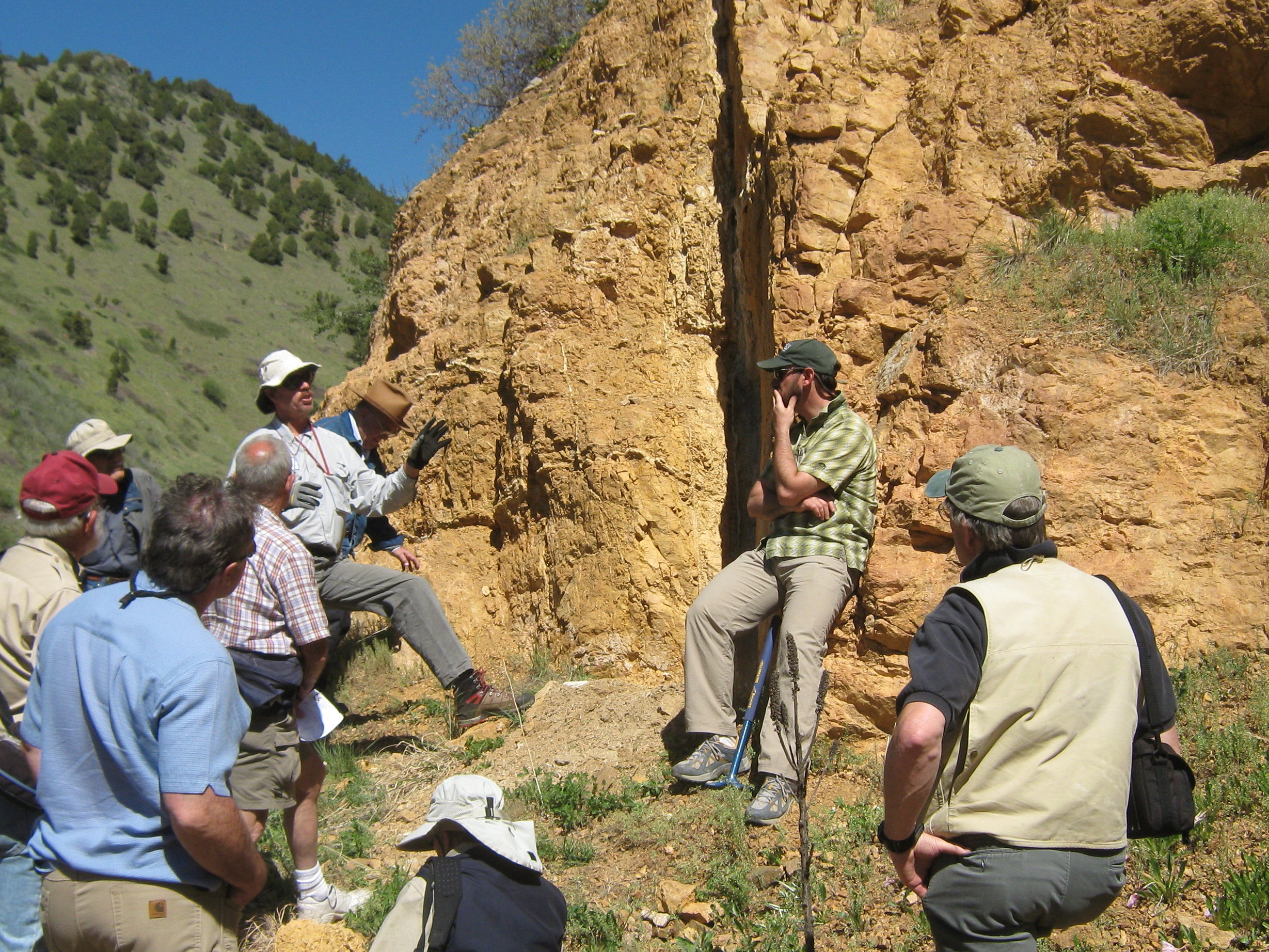
Geologists discuss Junction Ranch fault (WP003)

  WP003-  N 39° 44.700′, W 105° 17.485′ elevation 6266′. 

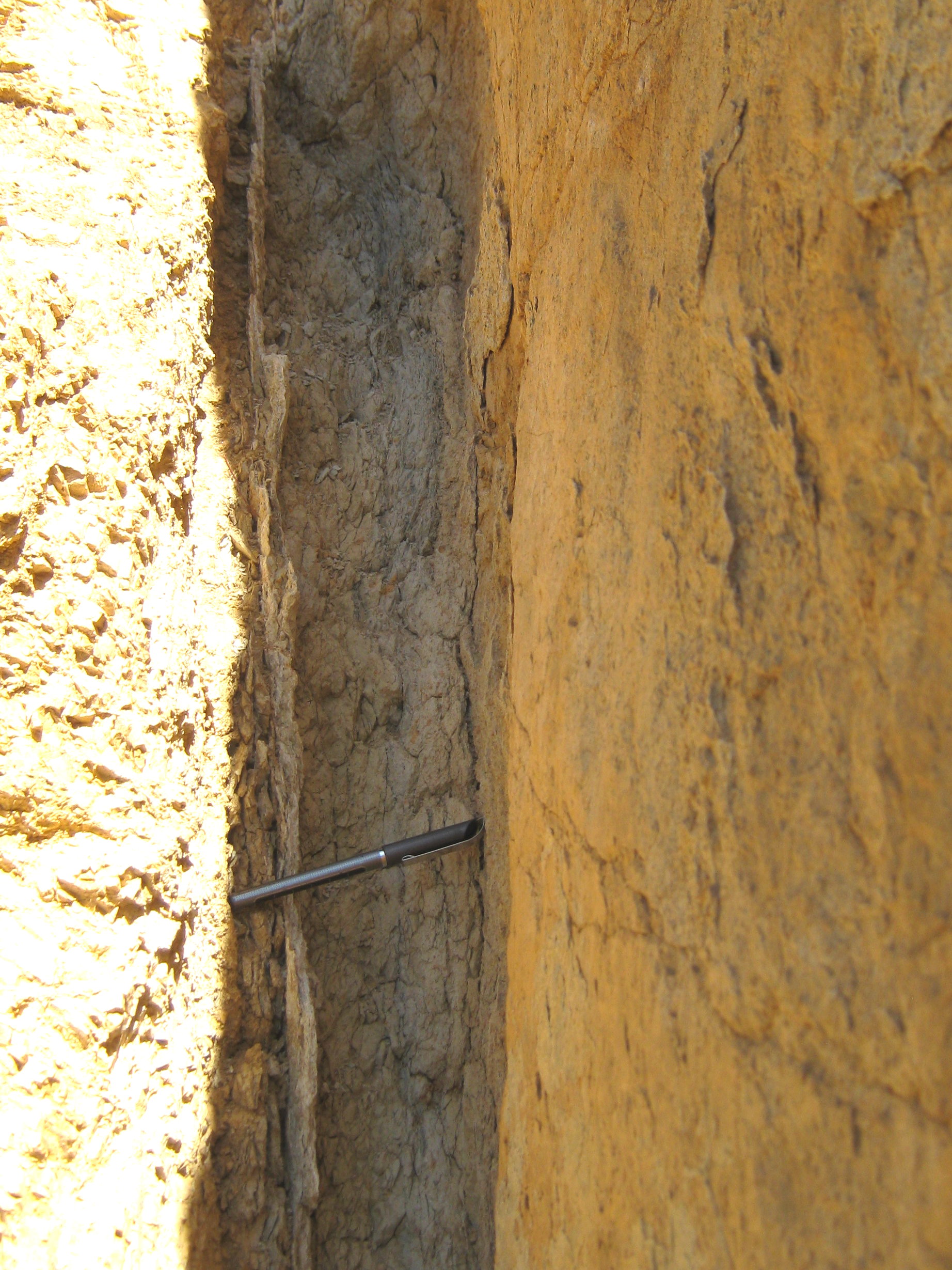
Closeup of Junction Ranch fault. Note white calcite vein (WP003).

 The Junction Ranch fault which had an exposure at waypoint 003 was an example of a fault in a formation that has seen considerable hydrothermal alteration. The orange iron stains on the rock are a clue that fluid transport of minerals has taken place. Calcite veins within the foliated clay filling the fault are an indication that the clay was deposited first. There is no evidence, however, that the fault predates the hydrothermal alteration. 

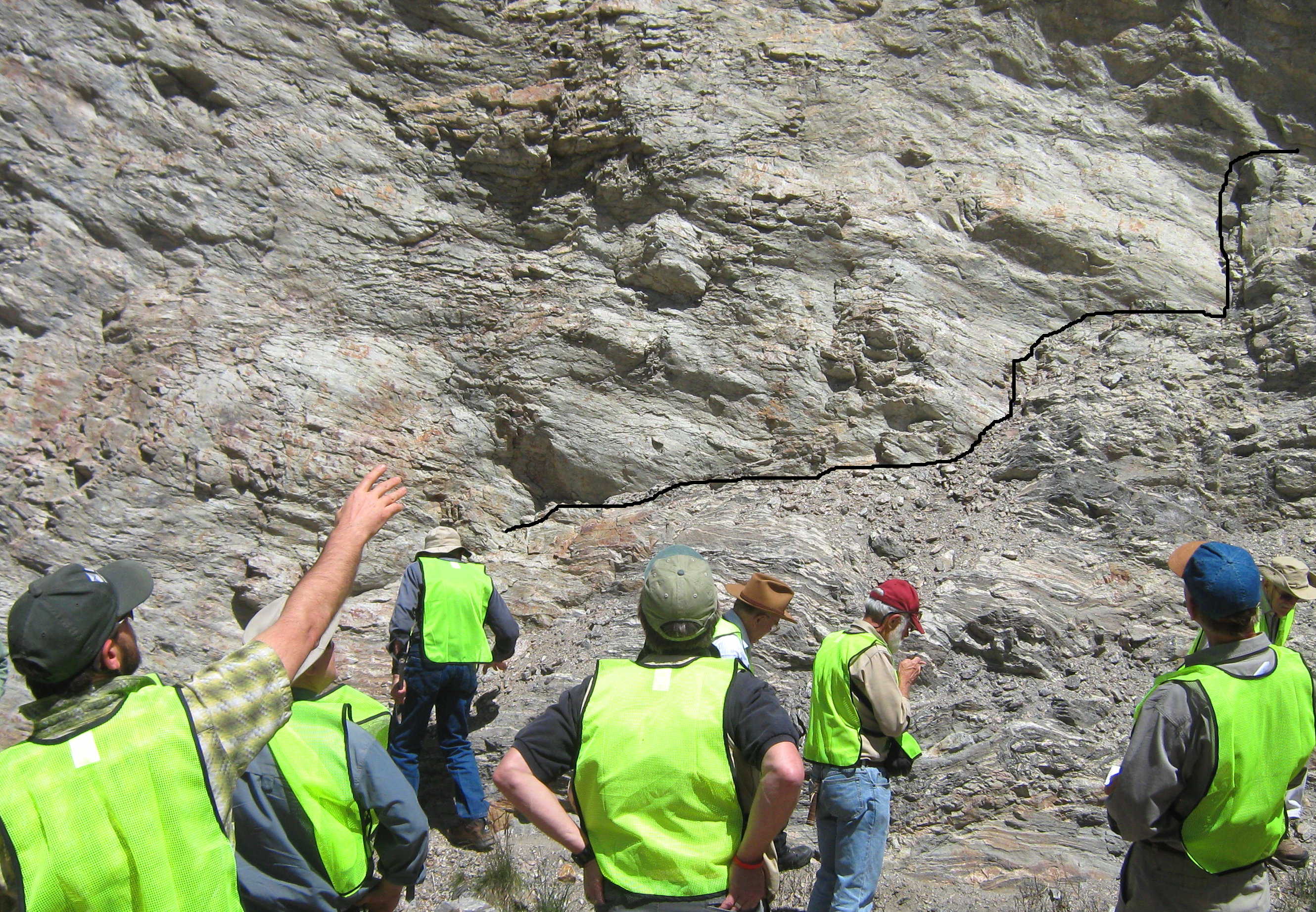
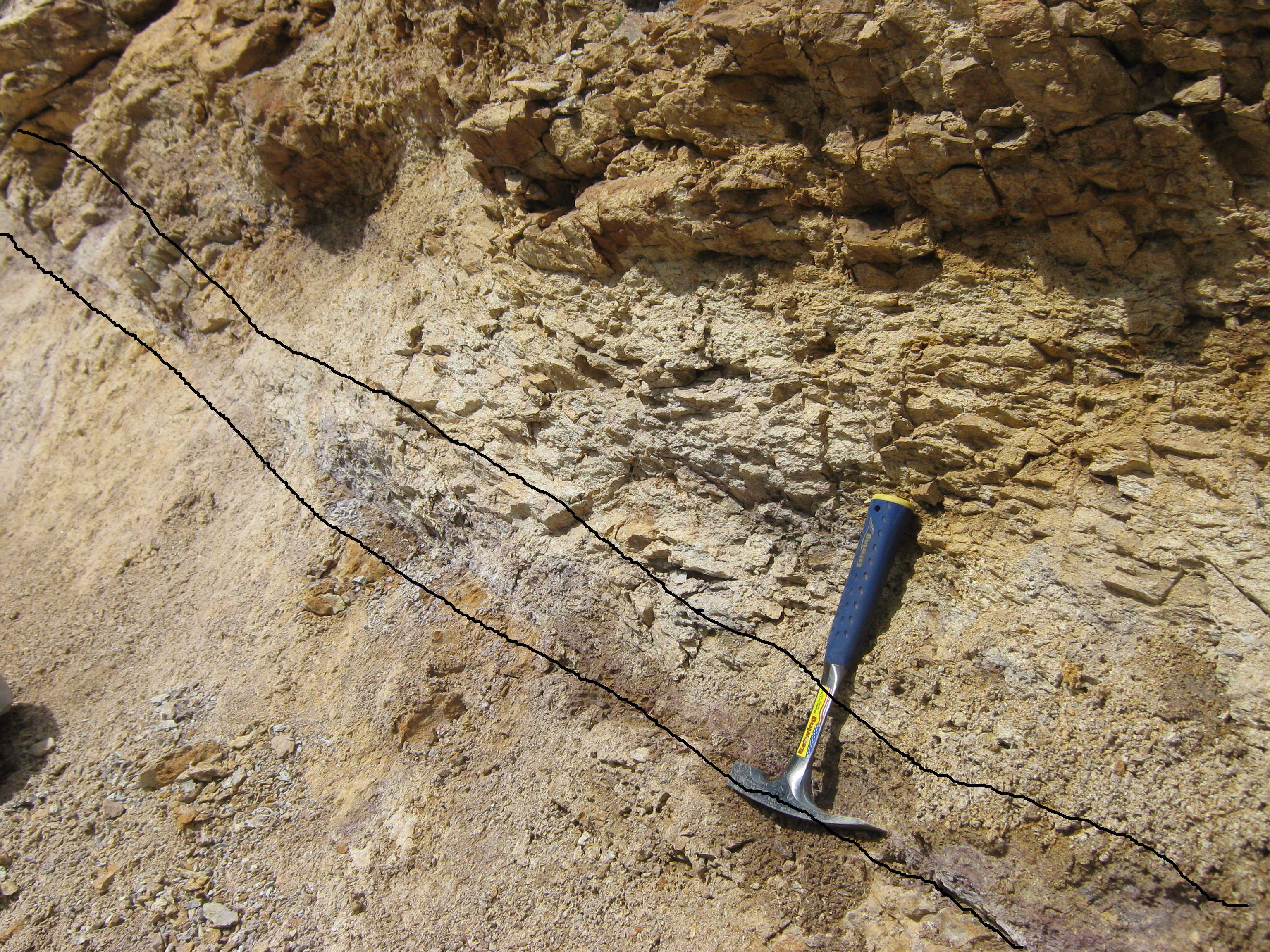
In a roadcut along the Central City Parkway is an exposure of a brittle fault at location WP005-  N 39° 44.990′, W 105° 28.233′, elevation 7571′. 

Roadcut exposing a brittle fault along Central City Parkway (WP005).

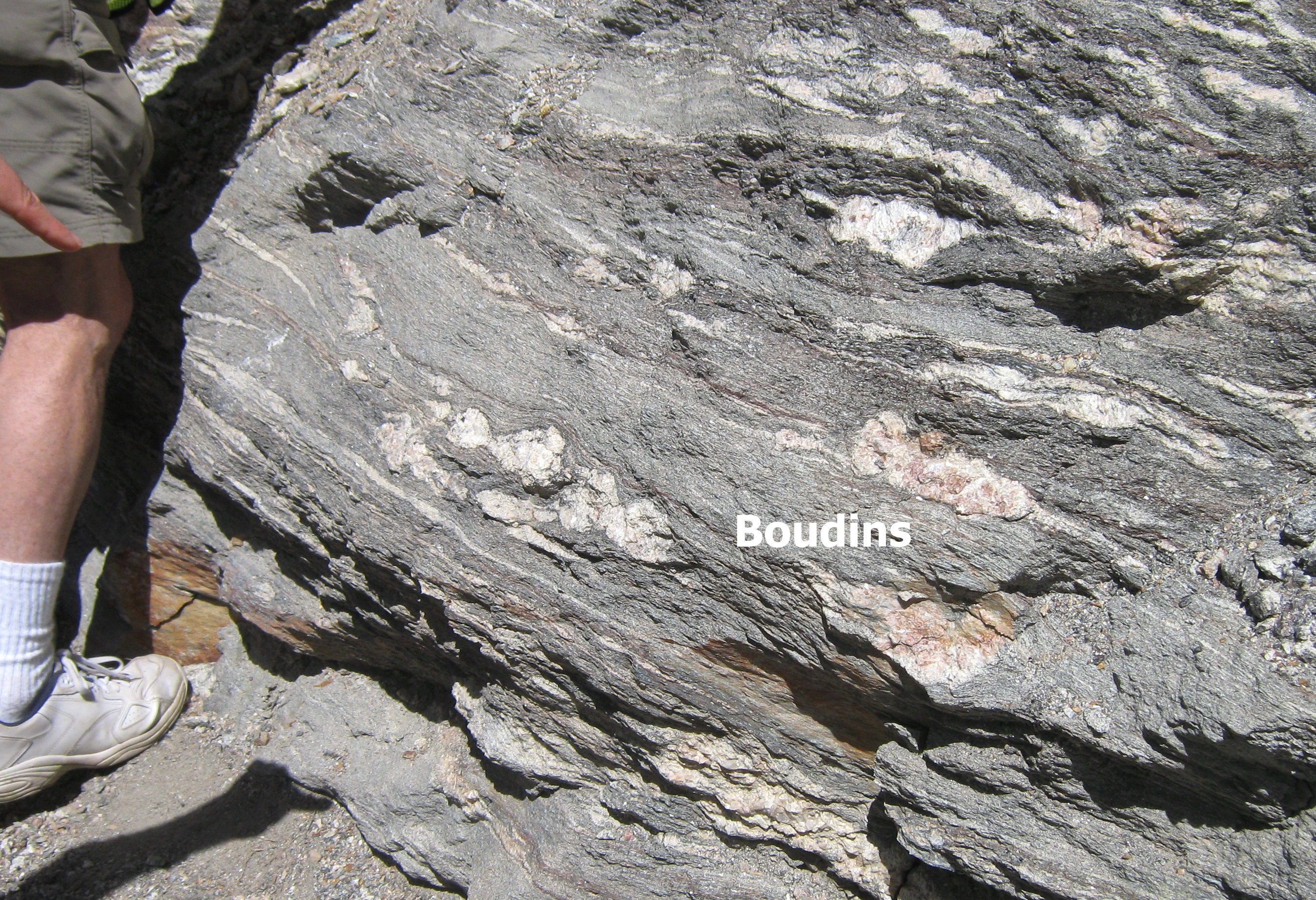
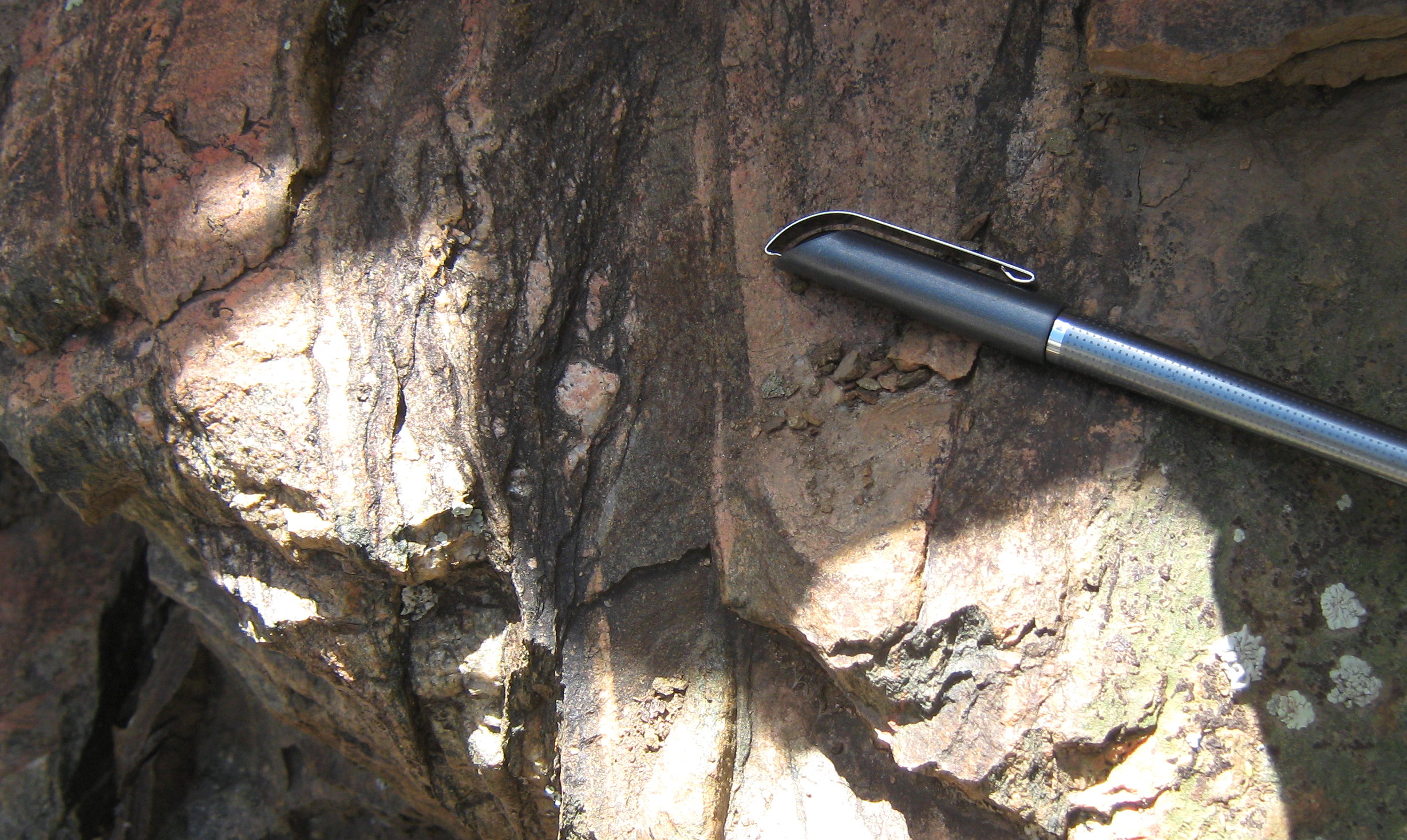
 The formation exposed at WP005 was part of a very old structure with multiple faults and igneous intrusions. In the photo above, the edge of the fault is enhanced with a black line drawn in during editing. The surface above the black line is an example of a slickenside, or one surface of the fault. Some members of the trip said they could see slickenlines, but they are so subtle that it is hard to be certain. A large igneous intrusion 100 m away showed signs of dislocation, presumably due to a fault. Boudins were observed at this location and are shown in the photo below. 

Central City Parkway road cut, boudins visible in foliated rock (WP005).

We visited the location of a fault in Coal Creek Canyon. This is a NNW trending distributed deformation zone which is part of the Boulder Batholith. This location is designated WP008- N 39° 54.268′, N 105° 20.795′, elevation 7771′.  

This fault was discovered filled with clay and dips 35 to 45 degrees. It was further exposed by excavation by Caine and another geologist. Again, the approximate boundary of the fault was enhanced with black lines in editing. There was considerable alteration of the rock on the hanging face side of the fault with iron staining associated with hydrothermal alteration.

Coal Creek fault at WP008 May 22, 2010.

We visited a ductile shear zone with suspected mylonite features. It was located at WP007- N 39° 51.026′, N 105° 21.155′, elevation 7634.  Mylonite zones are evidence of ductile shear in response to a stress field.  Near the mylonite zone was a fault with exposed slickensides. While faulting and ductile deformation may seem incompatible, it should be remembered that over time many kinds of phenomena can be overprinted on the rock formations. Rock may deform in a ductile manner and sometime later undergo brittle fracture.

Suspected myolinite feature (WP007).

 The field trip leader was very enthusiastic and because of his background, was able to provide many important insights into the local geology. It was a very worthwhile day in the mountains.

Whither Diethyl Ether?

Diethyl ether seems to be in short supply in North America these days. Suppliers have customers under allocation constraints.  Yes Virginia, people still use Et2O in certain kinds of chemical processing. Sometimes Et2O is prized for its solvent effects and sometimes for its volatility. Sometimes the only way to solubilize some  inorganic compounds is as the metal etherate.  Solvent residues in fine chemicals are often a problem and volatile process solvents can be a big help in ameliorating that issue.  You can purchase 5,000 gallon tanker loads of Et2O if the supplier has qualified you. Another reason not to swerve in front of trucks on the highway. 

Part of the problem with Et2O availability is the considerable reduced demand for it these days.  Many companies have banned the use of Et2O on their site for any purpose. It is easy to understand why. The insane vapor pressure and low autodecomposition temperature are problematic for plant safety. The low boiling point of Et2O means that plant utilities can heat a vessel of ethereal soln rapidly and blow a rupture disk at reasonably low pot temps.  Naturally, the safetly department gets surly about this kind of thing.

Tetrahydrofuran is not always a suitable process stand-in for Et2O. Reactivity behaviors may be quite different from Et2O solns.  THF’s sensitivity to butyllithium, for instance, forces one to keep the processing conditions at low temp with a chiller. Lower pot temperatures increase the thermal margin of safety, but may have a deleterious effect on activation of a transformation once BuLi has done its job. 

I have studied the decomposition of methyl tetrahydrofuran with BuLi and have determined that it decomposes in the low 30’s °C range, somewhat higher than THF. MeTHF is not an exact stand-in for THF or Et2O either.  But it is definitely worth having in the stockroom for development work. It will surprise you in regard to how different it can be from THF.

While MeTHF is touted for its ability to phase separate with water, it will hold appreciable amounts of water.