Who would have guessed that the voters of America would elect someone like Trump- twice? Now this guy is saying that he wants to rename the Gulf of Mexico to the Gulf of America or something similar. He is also making a lot of noise about annexing Canada as the 51st state, taking back the Panama Canal, and “buying” Greenland. His rationale is that it is for ‘national security’. He and his top supporters seem very positive about Vlad Putin and Victor Orban, but down on the EU and NATO. The nut wants to halt aid to Ukraine in its defense from Putin’s Special Military Operation. Does he see the importance of stopping Putin? I don’t think he cares.
Writer Tony Schwartz who “co-wrote” the 1987 memoir Trump: The Art of the Deal published in a 2016 article by Jane Mayer said that that-
“I put lipstick on a pig,” he said. “I feel a deep sense of remorse that I contributed to presenting Trump in a way that brought him wider attention and made him more appealing than he is.” He went on, “I genuinely believe that if Trump wins and gets the nuclear codes there is an excellent possibility it will lead to the end of civilization.”The Atlantic, Donald Trump’s Ghostwriter Tells All, Jane Mayer, July 18, 2016.
Some are speculating that a change in the world order is in the offing, so perhaps Trump wants in on it. Both Russia and China have expressed their desire to relieve the US of its hegemony role in the world. Whatever it is that Trump is planning, his words are suggestive of his past job as a real estate developer looking for property to acquire. He is renowned for a tough bargaining stance and his business history has shown that standing tough and using lawyers as battering rams is key to his success.
The explanation I’m left with when writing to an international audience is that half the adult population of the US is considerably less educated than many of us understood. While many of us were trying to achieve and grow in the 21st century, a great many citizens were decades behind and woefully undereducated for the times. Millions of people didn’t realize that a 12th grade education wouldn’t be nearly enough to weather the times and grow with civilization. They placed their bets on physical labor as a lifestyle and not even training for one of the better trades. Whereas low paying jobs may have been sufficient at one time for getting by, the cost of living in all of its dimensions inflated beyond them.
Many citizens in the MAGA population find themselves near or at retirement age with little savings after a hard life of low paying work. Add the high cost of American health care later in life and they realize they are cornered. In their minds the promise of American success has excluded them. But it’s not just in their minds. Opportunity sailed by them in the middle of the night with many job descriptions that required knowledge and skills they didn’t know they needed. They were toiling to stay afloat and unaware of the opportunities that further education or training could bring. Many are now deeply resentful of those more educated or just luckier people who found a greater piece of prosperity in changing times. Trump’s populist message rings true to them.
Theoretical chemist Martin Karplus passed away 28 Dec., 2024, at age 94. Karplus shared the 2013 Nobel chemistry prize with Arieh Warshel and Michael Levitt for their work in “the development of multiscale models for complex chemical systems,” for computer programs they developed in the 1970s.
Those who have studied proton nuclear magnetic resonance will recall the Karplus equation or curve relating hydrogen-carbon-carbon-hydrogen dihedral bond angles to proton-proton coupling constants, 3JH,H, across 3 sigma bonds. If your molecule of interest is conformationally constrained such as an aliphatic ring, and there are coupled protons with the right splitting patterns, integrations and coupling constants, you may have some good data to prove/disprove a proposed structure in Acta Retracta.
The Karplus curve relating dihedral angle to proton-proton (1H-1H) coupling constants. The curve shown is the theoretical curve- measured coupling constants varied from the curve just a bit. Source: Wikipedia.
Newman Anecdote
Seeing the Newman projections above reminds me of the time I met him. It was 1993 and I and a faculty colleague found ourselves trudging through the hallowed chemistry department halls of her alma mater, The Ohio State University. We’re shuffling along when who should we spot working in his lab but the eminent Professor Mel Newman. Newman, who passed away later in 1993, was very near the end of his life then and looked every year of his age. My grad school research was in the area of stereochemistry and organic asymmetric synthesis, so I was naturally enthralled. We stepped in the lab like we owned the place and introduced ourselves. Newman was busy shaking a 2-Liter glass separatory funnel full of some jet-black liquid. We made sure not to startle him and let him set the funnel down into a ring stand before speaking. We exchanged pleasantries and I sputtered out words expressing my admiration and unexpected delight in meeting him- you know, fanboy stuff. He took the time to draw out the reaction chemistry he was performing and the target molecule. As I recall, it was a polyaromatic compound made with carbocation chemistry. Soon, we said our goodbyes and left.
On the way out of Columbus, OH, we stopped at a White Castle’s and enjoyed some sliders. It was a banner day- I met Mel Newman and had my first White Castle slider. It can get better than that, but probably not in Ohio.
For a chemist, the highest award is being recognized as an adjective for something, like Karplus Equation. Karplus made adjective status and that is an accomplishment most of us will never reach.
As I finish my last day at my present company, I found some photos that might be worth sharing.
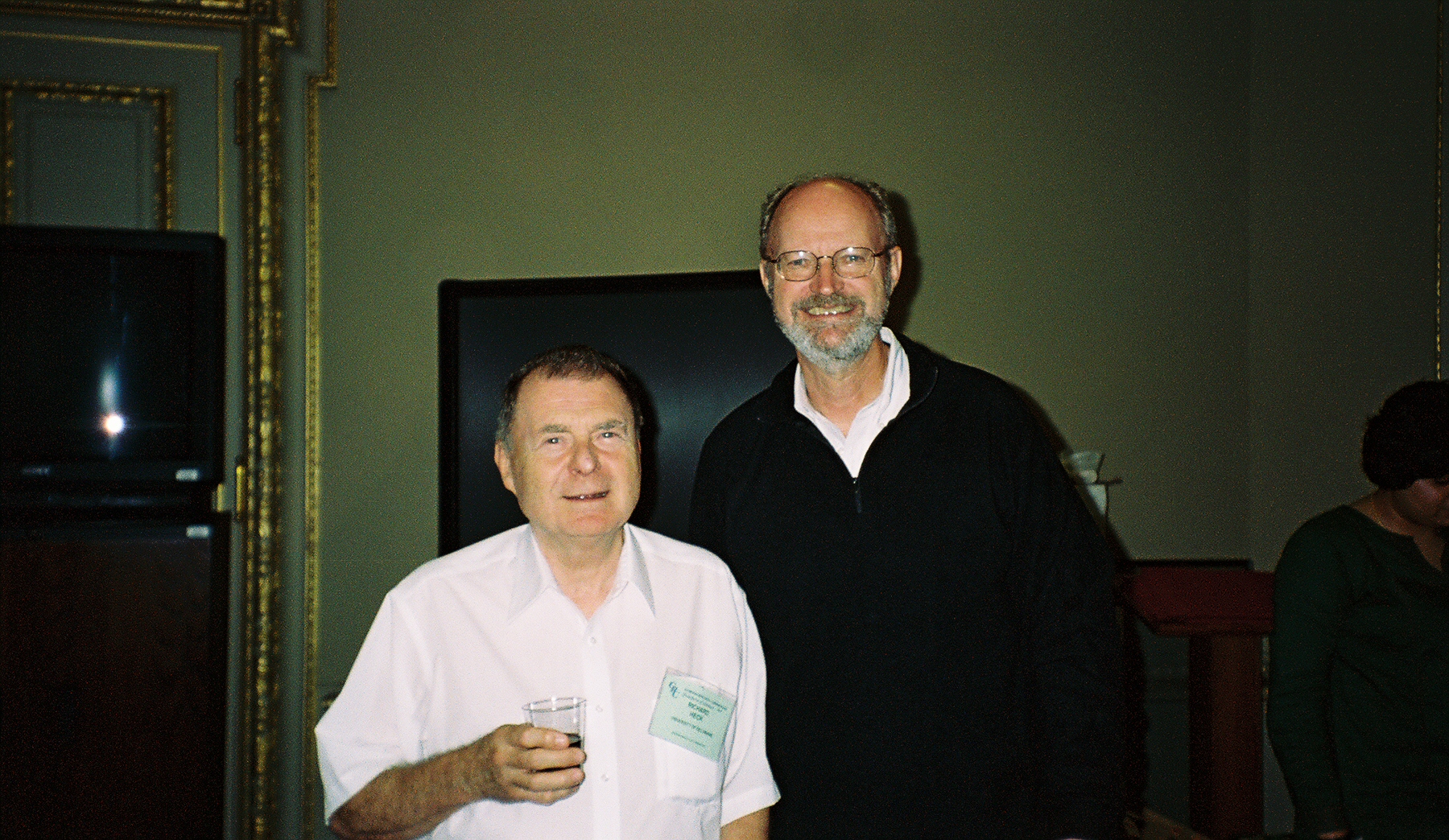
Richard Heck and Bobby Grubbs. Sippin’ wine with the boys. Organometallics Gordon Conference, 2005, Salve Regina University, Newport, RI. Photo credit: Arnold Ziffel.
In addition to the smattering of super-luminaries there were numerous regular luminaries of the organometallic world as below. All great guys, in my experience.
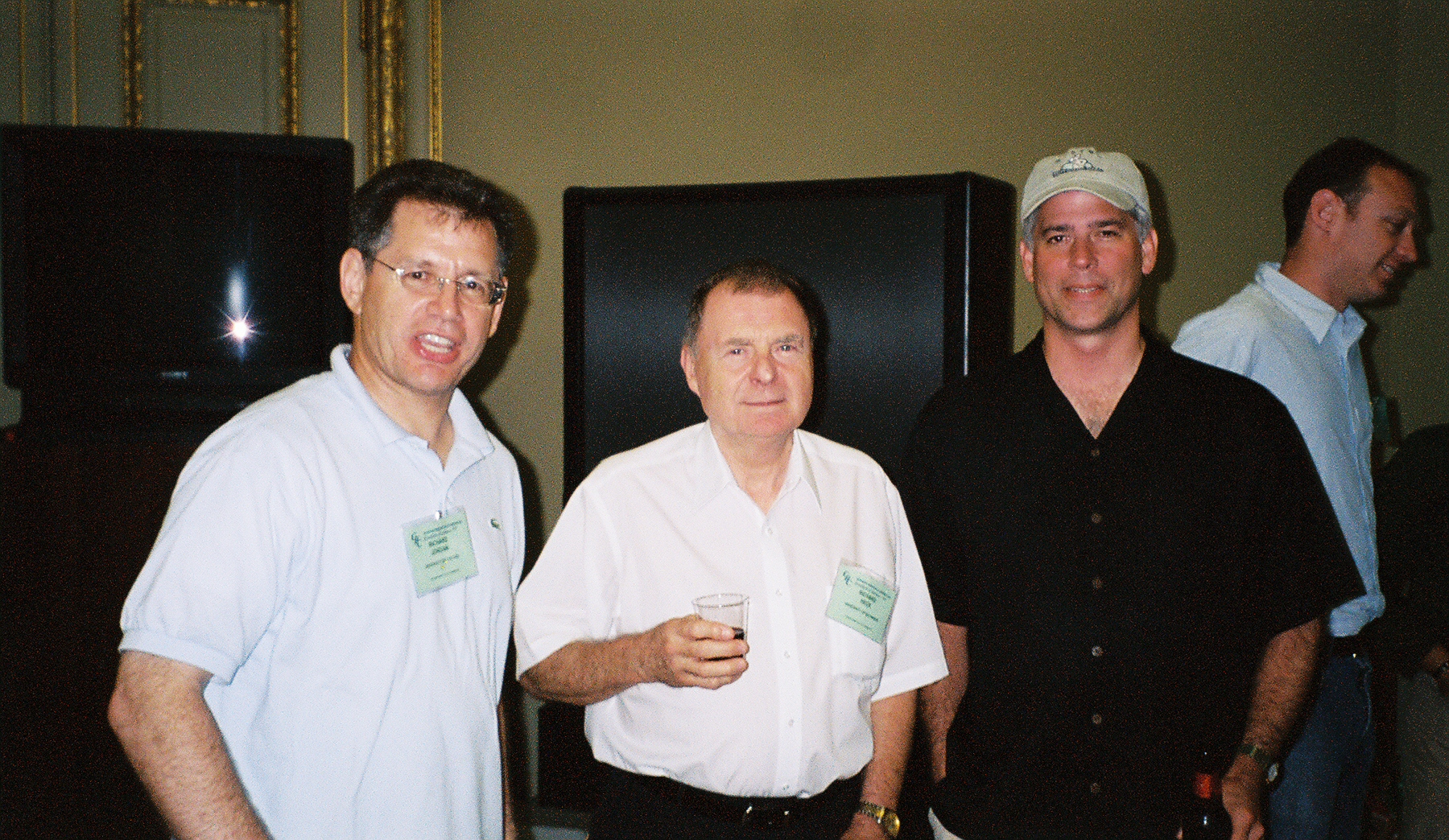
Richard Jordan, Richard Heck, and Larry Sita. Organometallics Gordon Conference, 2005, Salve Regina University, Newport, RI. Photo credit: Arnold Ziffel.
Salve Regina is beautifully situated along the Newport Cliff Walk. The school is a coeducational university founded in 1934 by the Sisters of Mercy.
[Note: This is a much-updated revision of a previous post from March 24, 2023. I’ve brought in just a tiny bit of protein structure and how it relates to opioid receptors- but only slightly. I’m thinking of you, dear reader. I’ve succumbed to my compulsion to include chemistry tutorials in my posts.]
First, a lot of chemists could say a lot of things on this topic. This is what I have to say. This essay is not written for medicinal chemists or molecular biologists. They already know this stuff. This is for everyone else. Learning usually requires an expansion of your vocabulary and this is no different.
When it comes to illicit drug synthesis I’ve always been a bit of a Puritan. As an organic chemist I’ve always felt that it is morally indefensible and a waste of talent for a chemist to make or help make dangerous and illegal drugs. Putting potent, illegal drugs on the market is like leaving a hand grenade in a playground.
For myself and for many others, what is fascinating about drug molecules is how structural features on a drug molecule confer pharmacological effects on biological systems. The molecular-level effects are referred to as a structure/activity relationship, or SAR. The chemical structure of a drug molecule makes all of the difference in how a drug functions. Among the key features are water solubility, acidity/basicity, hydrogen bonding, resistance to metabolic degradation, and the manner in which charge is distributed on the drug molecule. As a reminder, in order for two molecules to react they must bump into one another in a particular way. And not just that, but bump into a particular spot oriented properly and with sufficient energy.
Drug molecules do not swim directly to the site they are intended to go. They must take a random walk through flowing, jostling biofluid molecules and a certain minimum dose must survive the ordeal before they are metabolized, excreted or both. Some pharmaceuticals, called “pro-drugs“, are constructed in a way that relies on the action of metabolic processes to change them into the active drug. This is because they have some kind of chemical vulnerability and must be whisked into the body in disguise. Many drugs are bind to blood proteins and may remain unavailable for their action.
What the protein can do depends in large part on the sequence of amino acids that it is comprised of and how it relaxes into a largish, kinked and contorted chain with helices and pleated sheets. A protein polymer is made of a chain of amino acids that can interact with other molecules or with itself. Some lengths of a protein may lie flat and be somewhat rigid while other lengths may coil into a helical form. A protein molecule made of these features can then bunch up into a wad of protein that holds a particular shape. Along the surface of this shape are bumps, folds and crevices. In these places, there may be exposed amino acids that can attract acidic or positively charged parts of a molecule. Other spots may attract basic features like nitrogen with its lone pair of electrons. Still other places will attract molecular features with poor water solubility or just low polarity.
Drugs are used to activate or inactivate the function of a protein. Living things use proteins in several ways. In the case of drug action, proteins are large chemical structures that can make or break chemical bonds. proteins that do this can do it catalytically, that is, one enzyme molecule can perform its function repeatedly. That’s not all. There are features along the length of a folded enzyme chain that can attract, bind and even deform a molecule that is bound to it. In doing so, a chemical transformation can occur at physiological temperatures that might otherwise occur only under more chemically forcing conditions. This ability of enzymes is crucial to life itself.
Another function of proteins is the ability to change their shape to open or block the passage of smaller ions and molecules through it. The cell walls in our body consist of a double layer of fatty, detergent-like molecules that are water repelling on one side and water attracting, or ‘hydrophilic’, on the other. The water repelling, ‘hydrophobic’ side consists of a long chain of 2 or 3 hydrocarbon chains that comingle with one another.
In order for a drug to function it must bump into the target biomolecule like an enzyme (protein) and at a particular location on the enzyme. Some drugs may remain unchanged and just spend a lot of time bound to the active site of an enzyme, preventing the intended biomolecule from doing so. Others may permanently bind to a protein or other molecule, thereby blocking it from doing its job for the life of the enzyme. And others, like aspirin, may leave behind a fragment of itself permanently blocking the active site of an enzyme. Some drugs prevent a protein or enzyme from working and are called antagonists. Others may activate it and are called agonists. What you aim for depends on the system you are trying to manipulate.
A dip into proteins
An atom, ion or molecule that binds with a metal or a protein is called a “ligand“. A ligand, pronounced ‘LIGG und’ by organikkers and inorganikkers, or ‘LYE gand‘ by waterchemists biochemists, can connect with a protein through one or more attachment points. The greater the number and strength of the attachment point(s), the more time the ligand will spend being attached. A ligand may even become permanently attached. Ligands purposely or externally provided for a desired outcome are considered as “drugs”. Ligands that cause an undesired outcome may be referred to as toxic. Not all ligands are aimed at human proteins, however, such as the beta-lactam antibiotics which bind with certain bacterial enzymes. This is a fascinating topic all by itself, but it is left as an exercise for the dear reader.
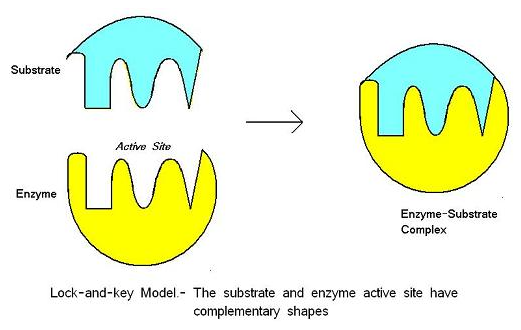
Ligands or drugs can have specific structural features that are associated with its activity or potency. This assembly of molecular features on the ligand is called a “pharmacophore“. An enzyme will have small region on its surface that can accommodate the “docking” of a ligand with the right shape and polarity
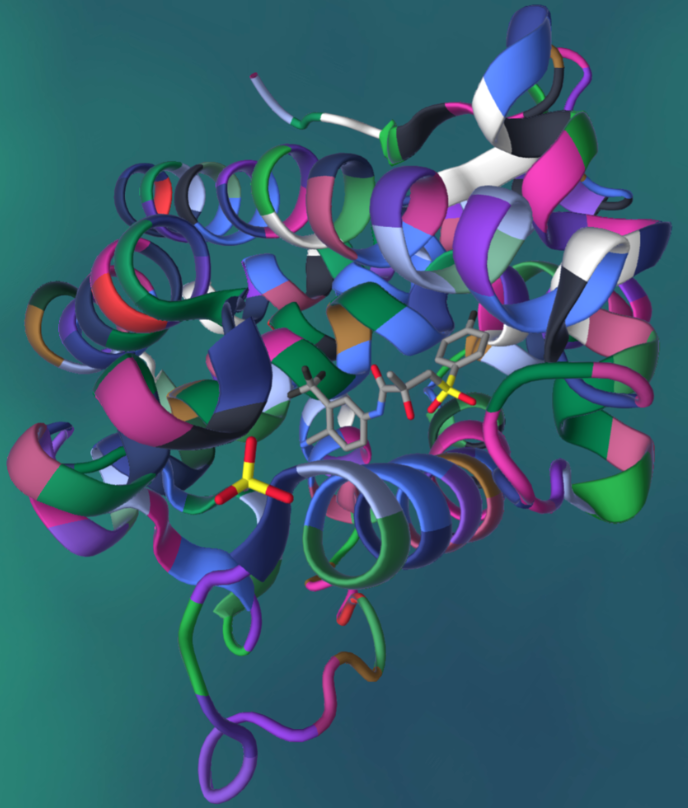
Source: Wikipedia. This image is from x-ray data showing a ligand snugly fitting into a pocket on a protein. Crystal structure of W741L mutant androgen receptor ligand-binding domain and (R)-bicalutamide complex. An example of a protein–ligand complex.
In the image above, a close look will show a drug molecule sitting in a space that is complementary to its shape and polarity. If it turns out that this space is where the normal biological ligand docks in order for the enzyme to do something to or with it, then the enzyme behavior has been altered. The drug molecule being bound by the enzyme blocks the site that is normally occupied by the biological ligand. The biological ligand may enter the site to be chemically altered, or it may be the natural signaling agent that activates or deactivates the enzyme. The activation/deactivation may be permanent or not.
Another possibility for ligand-type activity is that of a cofactor. When the cofactor docks to an enzyme, the shape of the enzyme changes -a common effect- and another docking site is activated, enabling the enzyme to function. Some cofactors are vitamins or are made from vitamins.
The amino acid chain making up the enzyme is folded up in a particular way depending on the amino acid sequence. The overall shape of the enzyme consists of ridges, bulges, clefts and can also include a hole straight through the structure. Each of the 20 amino acids available is unique by way of its particular kind of chemical functional groups that are attached. If we imagine the exterior ‘surface’ of the protein, the amino acid chain twists and turns giving a lumpy surface topography. The different amino acids with their unique attached side-groups can jut out from the chain and be accessible to external molecules.
Different substances that share these features may comprise a family of substances having similar activity. In the case of opioids like fentanyl, this active site is referred to as an “opioid receptor“. There are a several variants of opioid receptors distributed throughout the human brain.
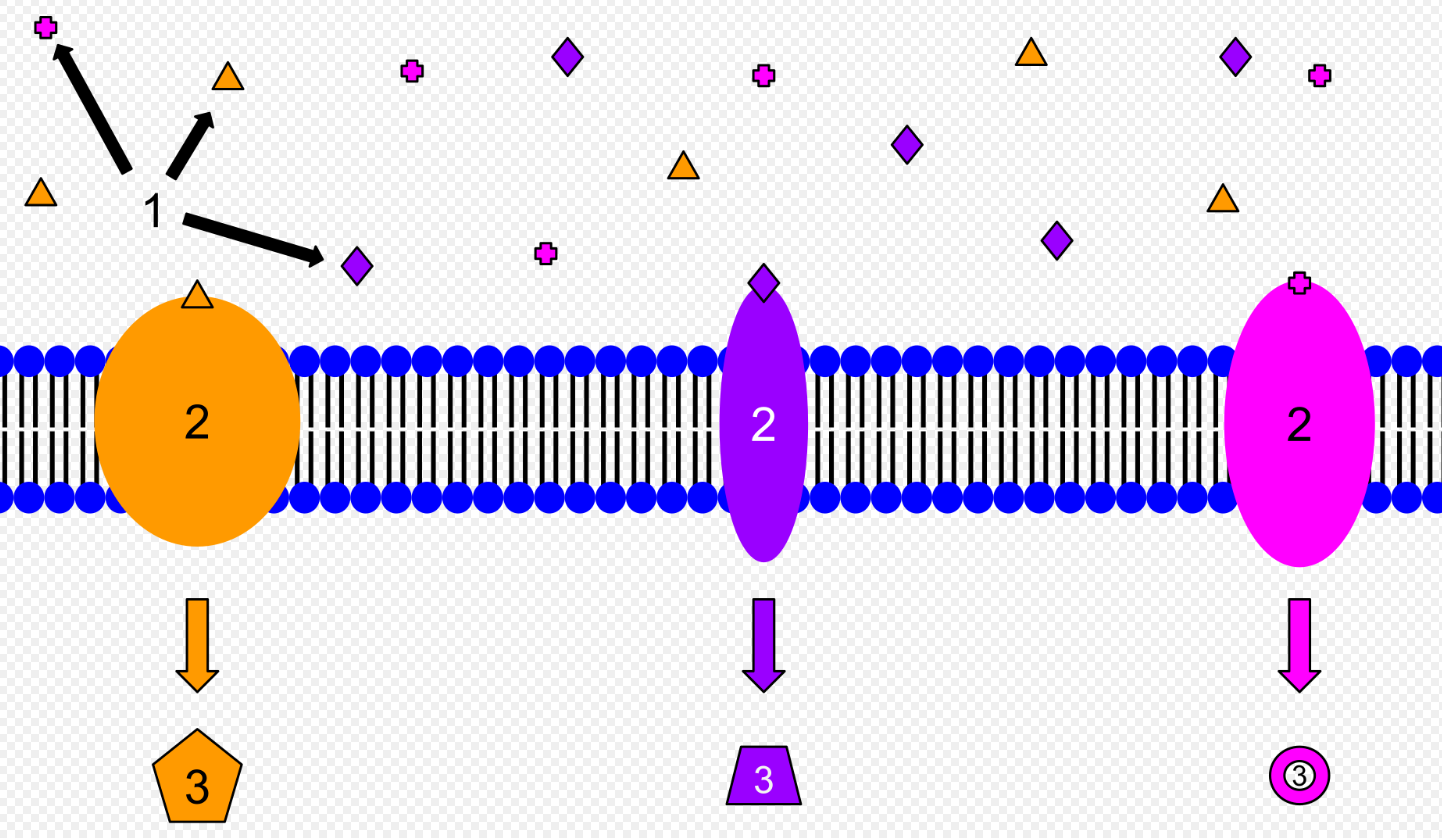
Opioid receptors are transmembrane proteins. They sit immobilized within the cell membrane with their external receptor protuberances gently swaying in the warm biofluid currents. They lie in wait for a shapely substate to happen by and nestle into its special cleft and be rewarded with a small release of Gibbs Energy.
The lipid bilayer of a cell membrane, comprising comingling long-chain hydrocarbon tails, is very hydrophobic (water repelling). Transmembrane proteins are compatible (likes dissolve likes) with that environment and can exist imbedded within the cell membrane. In this position, with access to both interior and exterior sides of the membrane, the protein is set up to be a receptor. A receptor is a protein that by virtue of its shape and polarity can recognize complementary shapes and polarities of a specific range of signaling molecules such as a hormone and transmit or release a chemical signal to the other side of the membrane.
Source: Wikipedia. The enzymes above are called transmembrane proteins. The opioid receptors are of this variety.
Source: Wikipedia. Complementary shapes. This illustrates ‘recognition’ of opioids by opioid receptors. Different but similar shapes can also be complementary but with varying degrees of affinity. Close resemblance in shape allows drugs to function.
End biochem section
According to the DEA, fentanyl is the most serious drug threat the US has ever faced. In the 12 months ending January, 2022, there were 107,375 deaths from drug overdoses and poisonings. Of those, 67 % involved synthetic opioids like fentanyl.
Fentanyl is not found in nature. It is made in a reaction vessel or a bucket by a person. It is totally synthetic in origin and is prepared from other manufactured substances. The molecule is relatively simple and there are many places on it where new functional groups can be attached to produce designer analogs. Due to its startlingly high potency, a large number of doses can be made in fairly small batch equipment.
The explosion of fentanyl use is mind boggling. Drug cartels have taken to producing it themselves for greater profit and a more secure supply chain. The common syntheses are fairly simple, high yielding and, in the case of fentanyl, there are no stereochemical issues other than the atropisomerism of the amide bond. As far as purification goes, this isomerism is difficult to control and it is hard to believe that it is considered a problem by the “cooks” who make it.
A quick search of Google failed to bubble up information on what chemical form of illegal fentanyl commonly shows up on the street, whether as a free-base form or a salt. Like most amines, the free-base could be salted out of a reaction mixture by addition of an acid to a solution of free-base fentanyl in an organic solvent to produce the insoluble salt crystals. This solid material is then recovered by filtration. This is a common method of recovering amines from a reaction mixture.
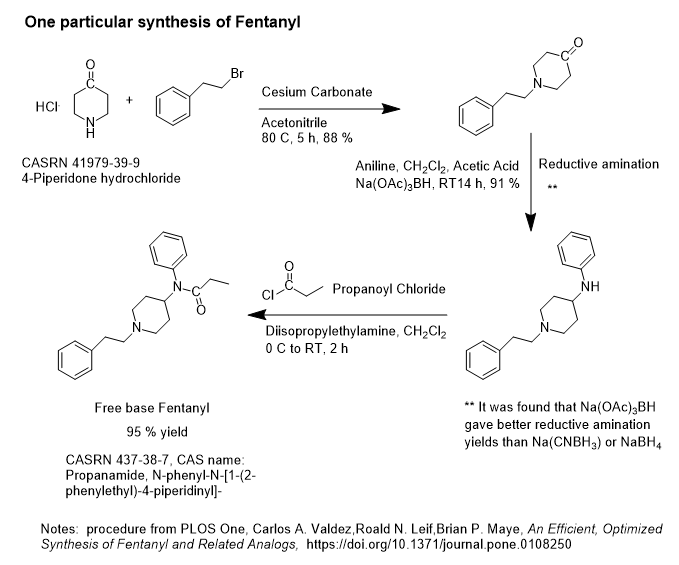
It is worth looking at a synthesis of fentanyl to see what kind of chemistry is performed (see below). There is nothing remarkable about this synthesis- it’s just an example. A key raw material is the 4-piperidone hydrochloride on the upper left of the scheme. It is a piperidine derivative which is a feature of many drug substances. This one has 2 functionalities– the nitrogen and the C=O at the opposite end of the ring. Connections will be made at each end as the synthesis proceeds. The hydrochloride feature results from how the manufacturer chose to sell the product. Ammonium salts are frequently more shelf stable than the free amine.
The first step in the process below combines 4-piperidone hydrochloride with phenethyl bromide in the presence of cesium carbonate in solvent acetonitrile. In this transformation the nitrogen displaces the bromide to form a C-N bond connecting the fragments. Cesium carbonate is a base that scavenges acid protons. According to Wikipedia, cesium carbonate has a higher solubility in organic solvents than do the sodium or potassium analogs. Cesium carbonate is commonly used when a base stronger than sodium carbonate is needed. In order for the reaction to go forward, the HCl must be neutralized to liberate the free base. It is hard to imagine that the folks doing an illegal preparation are using a cesium base due to higher cost. The displacement of the bromide by nitrogen releases hydrobromic acid as well which must be removed from the mixture. Bromide is chosen because it is a good leaving-group. para-Toluenesulfonate, or tosylate, has been used as well.
Next, aniline must be added to the piperidone ring where the C=O is located. We have to end up with a single C-N bond connection from the aniline nitrogen to the C=O double bond then remove the oxygen and replace it with a hydrogen atom. Aniline is quite toxic and volatile with an LD50 of 195 mg/kg (dog, oral). It stinks too. This sequence is referred to as a “reductive amination“, meaning that the oxygen is replaced by single bonds to nitrogen and hydrogen. Adding hydrogen to a molecule is referred to as a reduction. The authors of the work commented that of three hydrogen donors tried, sodium triacetoxyborohydride gave the best yields. These borohydrides donate hydrogen as the negatively charged hydride, H:–.
Acetonitrile is a polar aprotic solvent that allows enough solubility to the reagents and intermediates so as to help the reaction along. Reductive amination classically proceeds through a C=N (imine) intermediate which then undergoes a hydrogen reduction of the bond to give the amine product.
The two-nitrogen intermediate is then fitted with a 3-carbon fragment bearing a C=O to the aniline nitrogen connected to the benzene ring. With this transformation, the amine nitrogen becomes an amide nitrogen. The fragment added is called propanoyl chloride (pro-PAN-oh-ill KLOR-ide) and involves the displacement of the chloride with the nitrogen producing hydrochloric acid. The purpose of the diisopropylethylamine base is to serve as an acid scavenger. The solvent was dichloromethane which is not uncommon for this kind of reaction. It has a low boiling point for easy removal by distillation and a slight polarity for dissolving substances that are somewhat polar. It is also inert to the reaction conditions.
It takes a high level of education, training and resources to design and perfect a process like the one above. However, it can be executed by most people after a bit of training. You don’t have to be a chemist to follow the procedure. The trick will be to avoid poisoning yourself from aniline or fentanyl exposure in the process.
However illegal fentanyl is made, the raw materials going into it must combine to give one unique final product. There are not an infinite number of pathways to fentanyl. However, structural variations of the raw materials could be chosen using the same basic reaction conditions to produce a spectrum of designer analogs. If specific molecules are outlawed, analogs can readily pop up to skirt regulations.
The people who make illicit fentanyl are sourcing the raw materials from somewhere. Unlike heroin, there are no natural substances in the manufacture of fentanyl. Heroin is just plant-based morphine that has been acetylated. Acetic anhydride is the choice commercial reagent for this. The acetic anhydride supply chain can be traced. Fentanyl, however, requires a supply chain for numerous fine chemicals. In the US, many substances are flagged by suppliers in a way that could cause the authorities to investigate the buyer. Furthermore, US commercial suppliers often could do a Dun & Bradstreet credit check on you to gauge your suitability as a customer. Commercial chemical suppliers will not ship to a residential address or PO box. So it takes a bit of business structure to get chemicals sent from established chemical suppliers to your address.
The way to avoid this hassle is to import from somewhere like Asia. Given the high potency of fentanyl, the mass of raw materials in a shipment could be very low. Most organic chemicals are whitish or colorless and can be mislabeled. The lower the molecular weight of a substance, the lower the mass that will be needed for the process. There are no high MW reagents in the scheme above.
Herein lies the problem with fentanyl. It requires raw materials that have legitimate uses in the chemical/pharmaceutical industry and these substances can received by unscrupulous operators who can repackage and divert shipments to the bad guys in countries along the Pacific coast of the Americas. It is just simple smuggling.
The estimated lethal dose of fentanyl for humans is 2 milligrams. According to one source, “The recommended serum concentration for analgesia is 1–2 ng/ml and for anesthesia it is 10–20 ng/ml. Blood concentrations of approximately 7 ng/ml or greater have been associated with fatalities where poly-substance use was involved.” Overdosing with fentanyl is reportedly treatable with naloxone. But this is only effective if your unconscious body is found by a sympathetic bystander and help is called in promptly. This is a very slender reed from which to hang your life.
It is left to the reader to look further into the pharmacology and therapeutic window details fentanyl. Suffice it to say that dosing yourself with illicit opioids is a stupidly risky business. The illegal opioid risk is multiplied by other additives or the possible presence of designer analogs which may be 10 to 100 times more potent. End-use safety is not a priority of those who make and distribute these opioids.
Given the estimated 2 mg lethal dosage, fentanyl should be regarded as a highly toxic substance. As long as there is demand for potent opioid substances, someone will provide it. When the oxycodone supply tightened recently, heroin demand rose. It’s a deadly whack-a-mole situation. The only answer is reduced demand.
Writing is simply using language to convey intended information, meaning and to persuade. Many activities in life contribute to this skill. Learning to effectively speak in public is a big contributor. While overcoming shyness, a serious problem for some of us, a person learns to put together language to persuade others of something.
One of the extracurricular activities in high school that paid off later in life was forensics. No, not crime scene investigation. In case the reader doesn’t know, high school forensics is competitive public speaking. A ‘speech team’, led by a communications or other teacher trains students in one of several categories like debate, drama, humor and extemp. I competed in extemp- extemporaneous speaking.
In a speech meet, the extemp competitors from several schools draw from the hat a current-event topic to argue for or against, then given 30 minutes to prepare. When the time is up, the competitors gather in a classroom and are called up one after another by a judge to make their case. The judge will rate the effectiveness of their ‘performances’ and rank them. The judge may or may not offer advice, or a post-mortem, to each student. To prepare we would scour the better magazines like US News & World Report for background on current events and create a card file for preparation.
In the speech meet my school hosted, the extemp competitors came up with a few ridiculous topics like- what will be the effect on American society of replacing the diamond with cubic zirconia in wedding rings? The kid who drew it nearly cried.
The effect of competitive speaking later in life for me was profound yet incomplete. In my college public speaking class I would more fully come out of my shell. In Air Force ROTC we were taught to give military-style briefings. Grad school required us to give two public seminars on topics of our own choosing. Then we had both a preliminary oral exam and a final oral exam in front of our graduate committee. The preliminary oral exam was defending an original research plan. My paper exercise was developing a novel asymmetric synthetic method and as proof of concept, dream up something interesting to do with it. I proposed the synthesis of enantiomerically enriched quercus lactone. Whiskey lovers would rejoice.
Still later, I was a founder of a local theater group and we began to produce theater performances. By the time I ‘retired’ from acting I had performed in 17 productions. In the end, my stage fright had evaporated.
An unanticipated consequence of losing my stage fright turned out to be that I can quickly switch on my actor’s countenance in public. In doing so, I’ve been known to take people to task in public when I’m faced with ridiculous situations. On one occasion, after waiting 40 minutes and giving 3 reminders to the server for the au jus for my now cold French dip sandwich, I marched into the kitchen and addressed the cooks shouting authoritatively ‘Order up! Au jus please’. Their surprised faces and the puzzled stare of the assistant manager were priceless. Before leaving the kitchen I explained the situation with the assistant manager who listened politely and then gently ushered me out of the kitchen and back to our booth. There I met my horrified spouse and frightened teenaged kid staring at me in shock. I quickly received my au jus. I put on an extemporaneous show. It was hilarious, but my sanity was now in question.
I’ve been writing Lamentations on Chemistry since 2006. Part of the reason is that occasionally I get a seed crystal of an idea floating around in my ADHD consciousness. [Note: Here is where a dear reader put his foot down and demanded that I explain to the other dear readers what a ‘seed crystal’ is. This thing I shall do.].
Usually, the seed crystals are intrusive thoughts that have blundered into the maelstrom swirling vortex of my mind. Outside of work I can squelch myriad intrusive thoughts simply by watching YouTube or BritBox. But at work I am trapped at my desk, unsupervised and alone in a closed and silent room. I could die in here and nobody would notice for days. Maybe they would resort to waking up the company cadaver dog and going for a look.
A digression. What is a seed crystal?
Let me say at the outset that the ability to produce purified crystals from a less-than-pure solid substance is a mark of the laboratory skill of a synthesis chemist. It is quite satisfying to struggle with purifying a new compound and finally contrive a way to grow crystals. It is a thing of beauty.
Imagine a glass of warm water into which sugar has been dissolved. Sugar is added and added and soon the warm solution can hold no more sugar. You quickly pass the warm solution through a filter into another glass and remove all of the sediment. You again warm the sugar solution with stirring so there are no more solids remaining. You put a lid on the glass and as the solution cools, it invisibly goes from a condition of saturation to supersaturation. With the glass sitting still and allowing no evaporation of water, the clear solution continues to cool to room temperature and remains clear. Now you gently lift the lid and drop in one or two tiny sugar crystals. As they drop to the bottom of the solution you see a cloudy/granular-looking event spread quickly through the solution. Solid sugar is precipitating, forming sugar crystals.
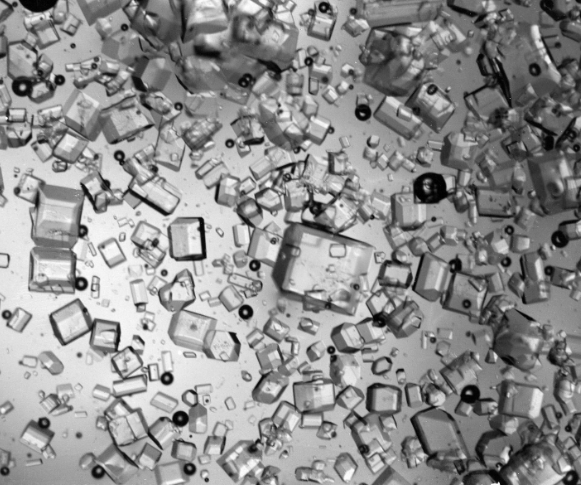
Sugar crystals. Source: Vancouver Archives. Any one of these crystals can act as a seed crystal, providing a surface on which sugar molecules can slip into place and grow the crystal. Crystallization is also an exothermic process that can be easily demonstrated in a calorimeter.
The crystal you dropped into the solution is called the ‘Seed Crystal’. It begins to grow, and rapidly other crystals will begin to grow, often causing an avalanche of individual crystal formation throughout the solution. If one allows the water to evaporate, more of the dissolved sugar will precipitate, increasing the yield of crystals. If the mixture is allowed to dry, the remaining dissolved sugar will cement the precipitated crystals together into a solid mass. Crystallization is a form of isolation and purification where contaminants may remain in solution. Allowing the solution to dry means that the purified crystals become cemented together with any remaining sugar and contaminating substances. This defeats the purpose of crystallization as purification.
Okay, back to writing
In my experience, the process of writing helps me find coherence out of the dust devil of my mind and, through some kind of synthesis, into something bigger than I had first considered. I usually have 20-30 drafts going simultaneously. If after months of latency I can find a way to complete an essay I may post it. But many will be deleted to avoid public embarrassment.
The very act of laying out an essay requires one to deconvolute thoughts and emotions. Usually it becomes obvious that some background reading online is necessary and then sprinkle around relevant links. Typically, some sentences begin to appear and are quickly edited. With the help of Ms. Google, words are double-checked for spelling and meaning or more suitable synonyms may be found. Often I find that I have been misusing a word. Soon, a paragraph is temporarily tacked in place and another is begun. Sometimes the order of paragraphs is changed thanks to the inventor of ctrl c and ctrl v. Then there is always ctrl z to save the day.
All of this organizing of language while writing causes me to reevaluate preconceived notions and find previously unseen connections and pathways. Often, the compelling thought originating an essay vanishes because half-assed notions are cast away or entirely new arguments materialize. In 7th grade I realized that certain alternative words could alter one’s thinking. Even synonyms may hold nuanced meanings that may or may not sharpen your language, and they are worth considering.
Writing is better thinking. It can lead to sharper analysis and helps to straighten out kinks and connect discontinuities in your communications.
In the end, I like to write but ‘I like to have written‘ even better.
Here is the definition of ethnic cleansing provided by Wikipedia.
Ethnic cleansing is the systematic forced removal of ethnic, racial, or religious groups from a given area, with the intent of making the society ethnically homogeneous. Along with direct removal such as deportation or population transfer, it also includes indirect methods aimed at forced migration by coercing the victim group to flee and preventing its return, such as murder, rape, and property destruction.[1][2][3][4][5] Both the definition and charge of ethnic cleansing is often disputed, with some researchers including and others excluding coercive assimilation or mass killings as a means of depopulating an area of a particular group.[6][7][8]
Maybe the US is truly concerned about the legality of the millions of illegal aliens within its borders and nothing else. Shipping them out of the country would be an act of law enforcement then. While the GOP members who are spearheading the upcoming mass deportation may be following the letter of the law, the broken laws pertaining to their supreme leader, a felon actually, are easily overlooked. He is more good than bad I suppose.
Given the well-known animus towards those not of European decent, is it just a coincidence that Americans are deporting a very, very large number of them? Certainly, the majority of those to be deported could be identified as coming from a different culture than ours- you know, obese, ignorant and cynical Americans. And, those from Central and South America are likely to be a bit tanner colored than common specimens of the pasty white American couch potato. This alone makes them easier to apprehend.
My guess is that once the Trump manhunt is underway, a place to concentrate them will be necessary. It will have to be a lock-up sort of place because we can’t have them just walking away. A remote location because the NIMBY reflex will not allow them near population centers. I’m thinking the concentrating camps will be along the US-Mexico border.
If we decide to bus them, will Mexico cooperate by allowing the buses into their country? If we fly them, will the Mexican authorities allow the planes to land? And if they do, will they be allowed to deplane and enter passport control? Or will they be denied entry at this point, passport or not? Final question: can they keep the air miles?
If they don’t ship them out right away, how long before the camps become an apartheid situation?
Look at all of the awful words I’ve used- ethnic cleansing, concentrating camp and apartheid. And, all in the context of America, land of the free and home of the brave, and … all men are created equal …
This is not the America I remember going to school in. Half of the electorate has put in place a despicable wannabe dictator and felon plus a republican guard of rabid elected followers. This is a moral disfigurement of the United States of America. Somebody put a drop cloth over the Statue of Liberty until this is over. It’s embarrassing.
This solution of deportation of millions of illegal immigrants certainly has the stink of ethnic cleansing to me. Maybe I’m wrong. I hope so.
“Technological triumphalism” is a term that occasionally surfaces, encapsulating the belief in human capacity to resolve almost any issue through the innovative use of technology. While technological progress has led to pivotal breakthroughs, such as rational pharmaceuticals, aerospace and the transistor, it has also given rise to the means to magnify age-old human tendencies towards destructive behaviors. As our tools and methods evolve with technological advancements, so too do our desires and avarice, often intensified by the fresh opportunities these new technologies bring to the table.
As an example of technology bursting on the scene producing both good and bad consequences, consider the Haber-Bosch process for the industrial manufacture of ammonia, NH3. The Haber-Bosch process has been called the most important chemical process in the world. An industrial product like ammonia can split into several streams. On the plus side, cheap and available liquid or gaseous ammonia for fertilizing crops was a boon for mankind in terms of increased food production. As a chemical feedstock, the combination of ammonia and its oxidation product, nitric acid, led to the economic production of the solid fertilizer ammonium nitrate.
Another and wholly different product stream involving the oxidation of ammonia (Ostwald Process) is nitric acid production. Nitric acid is required for the manufacture of materials including high explosive nitrate esters like nitroglycerine and nitroaromatics like TNT, picric acid and a great many other explosives. Explosives are neither inherently good nor bad- their merits rest on the shoulders of the users. When used for construction or mining, explosives are a positive force in civilization. However, they cast a long, dark shadow when used to destroy and kill.
Fritz Haber: Ammonia and Zyklon
A good example of unanticipated consequences of a technology uptick is in the story of the German chemist Fritz Haber. Haber won the 1918 Nobel Prize for Chemistry for his part in the invention of the Haber-Bosch synthesis of ammonia. It is estimated that 1/3 of global food production relies on the use of ammonia from the Haber-Bosch process or some improved version. Haber has been widely praised for his part in the invention of catalytic ammonia production using atmospheric nitrogen. These are important developments, but … [Wikipedia]
As a German nationalist, Haber was also known for his considerable contributions to German chemical warfare through WWI. Early on, Haber suggested chlorine as an improved chemical weapon over tear gas during WWI and was later involved in the development of Zyklon B as a fumigant, pesticide and later a weapon of mass murder.
There is contradictory information as to who actually developed Zyklon B. One source claims the inventor was Bruno Tesch, Gerhard Peters and Walter Heerdt while another claims Haber developed it. The composition and story of Zyklon B is subject to confusion in a Google search. The actual contributions of Tesch and Heerdt to the production of Zyklon B was to produce sealed cannisters of HCN adsorbed onto a sorbent like diatomaceous earth along with a cautionary eye irritant to signal the presence of the HCN in the air. The early use of Zyklon B was to delouse clothing, ships, warehouses and trains. The Nazis began using Zyklon B to murder human beings in the concentration camps beginning in 1942 as well as delouse their clothing to stop the spread of typhus.
The identification of Zyklon, Zyklon A and Zyklon B is a bit confusing. Zyklon was originally developed as a pesticide. When exposed to moisture it hydrolyzed to form hydrogen cyanide which was the active toxicant. Lachrymatory warning additives were blended in to alert those exposed. Eventually, the Nazis requested that the warning additive be removed since it spooked the prisoners.
Graphic by Sam Hill. The three Zyklons sorted out.
Tesch and Stabenow founded Tesch & Stabenow in Hamburg in 1924. The next year they became the sole distributors of Zyklon, manufactured by its patent holder, Deutsche Gesellschaft für Schädlings-bekämpfung mbH (German Corporation for Pest Control), shortened to Degesch. Tesch & Stabenow was the exclusive reseller of the “Zyklon” which was produced by Degesch (founded 1919) whose director was Fritz Haber.
Tesch & Stabenow was founded in 1919 as a subsidiary of Degussa with its first director, Fritz Haber. Later, in 1936, Degesch was owned by its parent company Degussa along with IG Farben and Th. Goldschmidt AG (now Evonik). The company was said to be extremely profitable from 1938 to 1943 with sales of Zyklon B to the German government and Schutzstaffel (also known as the SS). After the war, Bruno Tesch, co-founder and owner of Tesch & Stabenow, and “director Karl Weinbacher were convicted and sentenced to death by a British tribunal and executed in Hamelin Prison on 16 May 1946.”
The only practical difference between the three Zyklon products was that Zyklon B contained and delivered HCN directly while Zyklon/Zyklon A requires water to decompose it, releasing HCN.
Graphics by Sam Hill. Mander’s Reagent can transfer a methyl carboxylate group selectively to the carbon atom of a lithium enolate. The absence of O-alkylation is very useful. The methyl carboxylate group is in blue.
Cyanide
The history and chemical manufacture of all the various cyanides is rich in diversity. The word ‘cyanide’ is usually reserved for ionic compounds or hydrogen cyanide, HCN, or those that release cyanide anion readily.
The cyanide group, :Carbon-triple bond-Nitrogen:, is a functional group found in many natural sources.
The cyanide group, -CN, on an organic molecule is usually bound more strongly by covalent bonding though not often connected directly to a carbonyl group (C=O) where it is susceptible to loss as with Zyklon/Zyklon A. It is the connection of the cyanide group to an ester carbonyl group that is behind the ability of Zyklon/Zyklon A to release free cyanide. In Zyklon/Zyklon A, the carbonyl group (C=O) is subject to aqueous hydrolysis producing CO2, CH3OH and HCN.
The word ‘cyanide’ is probably best limited to situations where the anion, :CN–, is present as a discrete chemical species. Common cyanides in use today are potassium cyanide, KCN and sodium cyanide, NaCN. KCN in water is commonly used in gold mining to selectively extract gold as a soluble cyanide complex, replacing the hazardous mercury amalgamation method. When covalently bonded to an organic molecule or to a polymer like polyacrylonitrile, the cyanide functional group is strongly bound. When CN is a feature of an organic substance where it is covalently bound to a carbon atom, it is referred to as a ‘cyano’ group, ‘nitrilo’ or ‘nitrile’ group. These words signify that the CN group is not present as a discrete anion but rather is tightly bound to an organic framework. This is less likely to spook the general public.
A swerve into the weeds with acrylates
Graphics by Mr. Peabody.
It is said that neither Fritz Haber nor Carl Bosch were fans of National Socialism in Germany in the 1930’s. Haber claims to have done his WWI gas warfare work for Kaiser Wilhelm as a German patriot. Intimidated by German laws aimed at Jews and Jewish colleagues, Haber (a Jew converted to Catholicism) left Germany in late 1933 for a position as director of what is now the Weizman Institute in what was at that time Mandatory Palestine. He died in the city of Basel, Switzerland, while enroute to Palestine at age 65.
Haber’s work in chemical weaponry included the use of chlorine gas which was chosen for its density and would sink and collect in enemy trenches. Chemical warfare in WWI began with an idea from volunteer driver and physical chemist Walther Nernst (yes, that Nernst) who suggested in 1914 the release of tear gas at the front. This release was observed by Fritz Haber who recommended chlorine instead and later supervised Germany’s first release of chlorine gas at the Second Battle of Ypres in WWI. Well known German scientists involved in the development of chemical weapons included chemist Fritz Haber, chemist Otto Hahn, physicist James Franck and physicist Gustav Herz. Of the 5 scientists, Nernst included, all would receive a Nobel Prize in their lifetimes.
‘Haber defended gas warfare against accusations that it was inhumane, saying that death was death, by whatever means it was inflicted and referred to history: “The disapproval that the knight had for the man with the firearm is repeated in the soldier who shoots with steel bullets towards the man who confronts him with chemical weapons. […] The gas weapons are not at all more cruel than the flying iron pieces; on the contrary, the fraction of fatal gas diseases is comparatively smaller, the mutilations are missing”.’ Source: Wikipedia.
I don’t mean to demonize German scientists specifically since the 20th century was peppered with engineers & scientists from many countries who engaged in weapons of mass destruction research & development, both in the private and government sectors. Naively and from afar to nonscientists it might seem like scientists are a benevolent brotherhood or sisterhood of “do-gooders” bent on the application of science for the benefit of mankind. To be sure, all whom I have known understand the importance of basic science to society at large and are of high moral character, mostly. Note, though, that the phrase “do-gooder” is actually an insult. According to Dictionary.com it means “a well-intentioned but naive and often ineffectual social or political reformer.”
Even Yugoslavia’s Tito had chemical weapons and a nuclear weapons project out of fear of an attack by the Soviets. In the end the project amounted to little more than some research institutes to support the nuclear project. Eventually Tito cancelled the project. Yugoslavia did have its own deposits of uranium ore and developed a method of extracting uranium concentrates from it. In October, 1958, they had a nuclear criticality event within a teaching reactor of their own design.
It is hard for me to grasp that chemical weapons are a notch of evil above other conventional arms. Bullets fired from military-style small arms can kill instantly, slowly or cause survivable mutilation. High explosive charges from artillery, missiles, hand grenades or land mines can kill instantly, slowly or cause survivable mutilation. Is this somehow preferable to a chemical attack? Chemicals too can kill quickly, slowly or cause survivable mutilation. These chemical weapons can be either a gas or an aerosol which can deposit on surfaces and retain toxicity for some period of time. Both gases and aerosols can drift with the wind making them trickier to ‘aim’ and are subject to dilution by cloud or gaseous dispersion. Many have suggested that chemical warfare is more useful for its ability to terrorize a population than to kill.
High explosives are point sources of shock waves followed quickly by sharp flying metal fragments. Like all point sources of dispersing energy, the intensity of the shock falls off as some kind of inverse square law and fragments soon fall to the ground. The bullet or the artillery shell are projectiles that can be aimed, often with great precision, and deliver their kinetic energy or explosive charge to a distant location. This applies equally to cruise missiles, drones, jet fighter ordnance and other flying mayhem.
All of the weaponry mentioned above are the result of the application of chemical energy.
Rest stop along the highway of knowledge
At some point for all of us whose areas of specialty may overlap with weapons technology, we have to decide how we will confront it. We can pitch in to defense R&D and make a contribution or we can contribute to civilization in other ways. For myself, I chose to work on improving life through chemistry. Others can find better ways to destroy things.
For me, military aircraft are a guilty pleasure. I am absolutely in awe of the technology and the people who build and get them into the air. The stratospheric art of aerospace engineering is endlessly fascinating. Still, they are weapons platforms that exist solely for the purpose of killing and serving devastation. I understand the necessity of countries acquiring such deadly flying machinery. The monster Putin has provided the latest reminder of the importance of military readiness.
The DuPont slogan. At some point the words “through chemistry” were omitted.
High explosives as a paradigm shift
The research and development of nitrate esters like nitroglycerine in the 1830’s and later nitroaromatics like nitrobenzene, picric acid and trinitrotoluene (TNT) rapidly led to the sometimes-inadvertent discovery of their detonability. The discovery led to the creation of a new class of explosives, marking a significant shift from the relatively slow burning of gunpowder to the high velocity detonation of “high explosives” such as picric acid or RDX. Unlike gunpowder, which needed to be confined to produce an explosion, the introduction of detonable nitroaromatic and nitrate ester explosives resulted in a large increase in the sudden release of energy. The availability of a relatively safe and easily produced explosive like TNT facilitates the leap of thought to the realm of armaments, especially when the explosive could yield considerable profits.
California is on fire again. So, what else is new?
The 4000-acre Franklin fire in Malibu, CA, is forcing thousands out of their homes. Cher and Dick Van Dyke had to flee from their homes. Physical reality has come a-callin’ to the world of celebrity.
The other news today is the letter signed by 77 Nobel prize laureates urging the senate not to approve the appointment of RFK, Jr, to head the HHS. The presidential transition team reportedly groused that they weren’t about to take any advice from a bunch of elites who were trying to tell Americans “What to do and how to do it” regarding health care.
We have elite service men and women and elite police officers. Sports has its elite athletes. This is all positive and in common usage. But MAGA GOPers use the word ‘elite’ like a switchblade against liberals and the highly credentialed. To presume that you know a thing or two and have some credentials to back it up is considered a form of public indecency to the GOP Know-Nothings.
The accusation of elitism is ironic coming from Trump’s band of sh*tbirds on the transition team. You don’t think they’re a gaggle of elites?
There has always been a genuine reverence out there for people who are ‘down to earth’. It is part of the inherent goodness-of-the-poor trope where simple folk are praised for their perceived moral purity which is unfettered by the temptations of the world at large. Simple, good and decent folk of modest means who go to church and take care of themselves and their neighbors. You know, the rabble. The privileged sometimes feign noblesse oblige, especially if others are watching. There has always been the poor and the hapless people of the world. But given actual opportunity to improve and enrich themselves, many if not most will take it. Being poor all by itself is an exhausting, soul-sucking life.
I’ve known city people and farm people. The Harvard educated and the 8th grade country school graduates and the many in between. I’ve lived in a very large city and a small Iowa farm. In medium cities and small towns. Everywhere you look you’ll find a statistical distribution of saints and sinners. But among them you’ll also find many of those who are bitterly resentful of another’s success or just disappointed in their lot in life. They slave away at go-nowhere jobs all day and then return home to see television programs packed with beautiful and successful people. Or while shopping they will see products that are wildly out of their price range but nonetheless in common usage. The period of life that they could have gotten an education or training and the resulting opportunities are long gone. They’re stuck. If they had a chance at a better life, it has likely passed.
Then along comes a charismatic character who speaks to you. He is a successful billionaire, businessman and reality TV star who speaks of a mismanaged world where the economically oppressed can stick it to the ‘elites’ in Washington who are keeping them down. The reasoning goes like this: If he is a billionaire, real estate mogul and TV star, he must also be able to apply his business skills to govern the US. Success in business is an all-around qualification for government, right? His language is salty and his accusations are often libelous. Conservative evangelical protestant churches all over the country have come out in favor of the guy. Some are convinced he is heaven sent to trigger the second coming of Christ. If pastors are saying it, it must be true, right?
So, the guy gets elected as chief executive of the US government. Then he is selected as Time Magazine’s ‘Person of the Year’. If you recall, the designation isn’t always a valentine to the person and their impressive deeds. Rather, it is a marker representing the large-scale influence the awardee has had. Just like numbers on the number line, influence can have a positive or a negative sign depending on which direction they’ve taken. Despicable characters like Joseph Stalin (1939 & 1942), Adolph Hitler (1938), Ruhollah Khomeini (1979) and Vladimir Putin (2007) have been selected for this award along with many decent people. That Trump and his flock of sheep will take it as a powerful endorsement should not be a surprise.
The accusation of the ‘elite’ status of an educated person is an attempt to slander a person. It is an ad hominem attack. Rhetorically, it is meant to deflect attention from a person’s argument and instead attempt to disqualify the person themselves. At least since Reagan, GOP has long been fond of attacking academics or other recognized experts in a field because they are able to use established facts and logic to back their arguments. To a populist, this is a type of power that academics ‘elites’ can uniquely wave around that must be overcome. So, when up against facts that argue against the populist, they get dirty. This is Courtroom Drama 101, straight out of law school. You try to destroy the credibility of the contradicting expert, or in this case the elite person or their entire field.
Colleges and universities award diplomas to graduates as only a token of achievement. It is an official endorsement of a person’s education and intellectual growth by their institution. It certifies that the graduate has met a list of standards in their field of education. It is not a certification in all around knowledge. A degree is a union card that helps, but does not guarantee, a person gain entry-level admission into their chosen field.
When I do something stupid, my spouse likes to wave the irony flag with great amusement to contrast my chemistry PhD education with my stupid move. I have to point out that the degree is only for a tiny sliver of a very large and esoteric field, mostly meaningless in daily village life. Actually, the degree is less than meaningless overall, given the amount of time (June 1980 to June 1992) spent on a chemical education versus investing in real estate, contributing to a retirement fund, finance, auto mechanics, carpentry, landscaping and many other useful skills. It’s a big trade-off that I took willingly.
There is a very positive side to elitism. In addition to the negatives like cliquishness and snobbery, people who might be called elite have gone beyond the extra mile to acquire expertise in a particular area which has been endorsed by accredited educational institutions. These people get hired by organizations because their expertise is valuable. People who become immunologists and virologists, for instance, are hired and put to work in public health. These people are highly educated and their opinions should be taken seriously. They are not extruded out of a political party apparatus and placed in health agencies with a political agenda. Ideologs think this way because it validates their half-assed arguments. Of course people will evolve political leanings over time, but doesn’t everybody? Why replace people based on educational merit regardless of their politics with people based primarily on their loyalty? This is how fascism soaks into a society.
The next president of the US, # 47, was heard to proclaim very recently the slogan ‘Drill Baby Drill‘. This slogan was first used by Lieutenant Governor Michael Steele of Maryland at the 2008 Republican National Convention. It was quickly picked up and made famous by Sarah Palin at the 2008 vice-presidential debate with Joe Biden. The slogan was used frequently by former president DJ Trump in his 2024 presidential campaign.
As slogans go, Drill Baby Drill successfully hit a nerve with Trump’s constituency if for no other reason than as a shout-in-your-face taunt. There was and is conservative consternation with liberal push-back on the practice of hydraulic fracturing (‘fracking’). It is not just fracking either. Opening public land to oil exploration was met with howls of dismay by Democrats over the plan to open up ANWR and other public lands to oil exploration, drilling and pipelines.
Many seem to believe, MAGAs in particular, that increased drilling and fracking will automatically decrease gas and diesel prices at the pump. From 50,000 feet up, that might seem to be true. More supply, lower prices or so the thinking goes. But economics learned in the back yard drinking beer while playing corn hole or from TikTok only takes you so far. There are many details that have their origins national and global politics as well as the many particulars of how the oil & gas supply chain actually works.
An excellent source of data on the global oil & gas situation is the International Energy Agency, IEA. They offer an excellent pdf report of the global oil picture extending to 2030. Here are the highlights from the IEA November 2024 Oil Market Report:
Consider
World oil demand is forecast to expand by 920 kb/d this year and just shy of 1 mb/d in 2025, to 102.8 mb/d 2024 and 103.8 mb/d 2025, respectively. The slowdown in growth from recent years reflect the end of the post-pandemic release of pent-up demand and below-par underlying global economic conditions, as well as clean energy technology deployment. (kb/d = kilobarrels per day; mb/d = million barrels per day)
Global oil supply rose by 290 kb/d in October to 102.9 mb/d, as the return of Libyan oil to the market more than offset lower Kazakh and Iranian supplies. OPEC+ delayed the unwinding of extra voluntary production cuts to January, at the earliest. Non-OPEC+ producers will boost supply by roughly 1.5 mb/d in both 2024 and 2025.
Refinery margins improved in October as seasonal maintenance and economic run cuts supported product cracks. Global refinery runs hit a seasonal low in October before starting to recover in November and will average 82.8 mb/d this year and 83.4 mb/d in 2025. Annual growth of roughly 600 kb/d is driven largely by OECD Americas (+360 kb/d) this year and by non-OECD regions in 2025.
Global oil inventories plunged by 47.5 mb in September, to their lowest level since January, led by a sharp draw in OECD oil products and non-OECD crude oil stocks. OECD industry stocks fell by 36.4 mb to 27.99 mb, 95.3 mb below the five-year average. Provisional data suggest total global stocks decreased for a fifth consecutive month in October.
‘Global oil markets face a surplus of more than 1 million barrels a day next year as Chinese demand continues to falter, cushioning prices against turmoil in the Middle East and beyond, the International Energy Agency said.’
As you may know, lately China has been having a rough go of it economically with their construction and real estate crises. Bloomberg reports that-
‘Oil consumption in China — the powerhouse of world markets for the past two decades — has contracted for six straight months through September and will grow this year at just 10% of the rate seen in 2023, the IEA said in a monthly report on Thursday. The global glut would be even bigger if OPEC+ decides to press on with plans to revive halted production when it gathers next month, according to the agency.’
The linked Bloomberg article paints a picture of static global demand for oil and weak prices extending into 2025 and possibly longer. So, this leads us to the question- How anxious does this picture make oil executives who are always looking for a reason to increase oil & gas exploration and drilling? Obviously, their planning goes well past 2025. Lower wholesale prices of gasoline and diesel out of the refinery do not automatically translate into proportionally lower retail prices at the pump. What would be the reason that a gas station owner would lower the retail price just because his wholesale fuel costs have dropped? Why would they forfeit profit margin to offer lower pump prices when they could keep prices as high as the market allows?
Do you think that a MAGA gas station owner with a red hat would offer reduced margins and prices to MAGA customers in red hats just … because he/she is generous? I don’t think so.
The reality has always been that fuel prices are based on what the customer is willing to pay. A president or candidate promising lower fuel prices in the USA should be viewed with serious skepticism. The entire supply chain from drillers to gas station owners struggle to maximize their profit margins and sales volumes 24/7. Do we really believe that the supply chain would bend to the price promises of some politico? Perhaps in Venezuela but look at what price fuel price meddling has done to that country.
Drill-Baby-Drill is a shallow chant used to polarize voters into opposing Democrats by lumping them into a contrived basket of anti-American fools. The trouble is that it works.
An effect of the internet and social media is that it brings the entire bell curve of voters to the table where many believe that all opinions are of equal merit. On the macroscopic scale, all citizens in the broader bell curve have a right to express their opinions. But just like at the microscopic scale of business, home and institutions, arguments and opinions without merit can be cast aside. Facts and solid logic should prevail over hand waving opinions.





 Lamentations on Chemistry