
Phosphate the Wonder Anion

I thought it would be good to start the week by highlighting a particularly praiseworthy anion. That anion is phosphate, sometimes called orthophosphate, (PO4)3-.

So, you ask, what is so bloody interesting about phosphate? Isn’t every atom, ion, and molecule special in some way?  Well, yes, but phosphate is uniquely constituted to provide services in the critical area of genetic information keeping and functional group transformation (without Pd and boronic acids).

Here is the curious thing: Biochemical systems use phosphorylation and hydrolysis as a means of executing molecular transformation. Remember oxidative phosphorylation?  So, how is it that a phosphate moiety that is so useful as a leaving group or activator is also able to hold together DNA with such high fidelity?
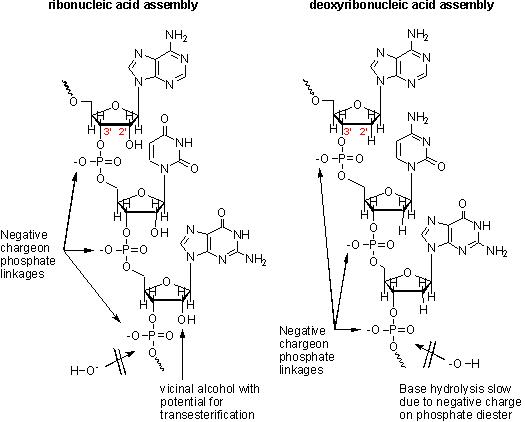
Phosphate Backbone on RNA and DNA

In his much-referenced 1987 paper entitled “Why Nature Chose Phosphates” (1), Frank Westheimer observed that phosphate diesters have a very useful property as a linking group for nucleic acids. The charged oxygen on (RO)2P(=O)O- serves several purposes.  The presence of a charged linker renders DNA and RNA compatible with the hydrophilic environment inside the cell. The charge prevents the nucleic acid polymers from migrating to more hydrophobic environments found inside of cell membranes. And equally important, the monobasic anion serves as a kinetic barrier protecting the millions of phosphate linkages in a DNA strand from cleavage under neutral or basic hydrolytic conditions over the lifetime of the organism.

The hydrolytic stability of phosphate diesters is not to be underestimated. Westheimer points out that dimethylphosphate anion has a half-life of 1 day at 110 C in 1 N base. He cites the rate constants at 35 C for the saponification of (CH3O)2PO2- is 2.0 E-9 (1/mol sec);  (CH3O)3P=O is 3.4 E-4 (1/mol sec); and for ethyl acetate 1.0 E-2 (1/mol sec).

However, the very simplicity and current prevalence of phosphate ion in the environment does not go far in explaining how phosphate might have found its way into metabolic and structural use.  In prebiotic times, the occurence of phosphate is in doubt (2).  But not just the occurrence of phosphate is in doubt. The relative abiotic inertness of phosphate towards esterification and the formation of other metabolically useful species raises the question of the original oxidation state of phosphorus during the onset of early life.

While phosphate is found in certain meteorites, Pasek suggests that a more ubiquitous meteoric phosphide mineral species such as schreibersite, (Fe, Ni)3P, found in iron meteorites may have provided the necessary reactive precursors for metabolic evolution (2). Pasek cites growing evidence of a late meteoric bombardment period at 3.8-3.9 GA.

Schreibersite hydrolyzes to a variety of oxidized species including phosphite. Phosphite has the advantage of being substantially more water soluble than phosphate, providing a larger molar concentration in seawater.  Schreibersite reacts with acetate to form acetylphosphonate. In fact, a variety of organophosphorus compounds may be formed on exposure of schreibersite and its hydrolysis products with organic materials.

Lowly phosphate isn’t sexy like the newer anions triflate and BArF. But its seemingly mundane properties are key to the function of metabolism and genetics.

(1)  F.H. Westheimer, Science, 1987, 235(4793), 1173-1178.  (2) Pasek, M.A. PNAS, January 22, 2008, vol 105, no. 3, 853-858.

The Disappointment Locker

Never have so many voted so overwhelmingly for so little as the members Academy of Motion Picture Arts and Sciences did for The Hurt Locker, this years Best Motion Picture.

Th’ Gaussling sat through a screening of The Hurt Locker last weekend. I must say that it was competently produced and directed. Without a doubt, the cast and crew did a fine bit of journeyman film making. However, an outstanding bit of film making it was not. It should have been titled Opportunities Lost.

What is so tragic about this movie is that all of the elements of an outstanding motion picture were there. An action packed setting, the threat of explosive death, flawed characters, intrigue, and comraderie. But somehow the director was unable to pull it together. Despite all of the raw materials available for a cliff hanger, director Kathryn Bigelow managed to patch together a picture that utterly lacks the fizz and crackle of a thriller. It’s as emotionally flat as a pancake.

Here is my primary beef with The Hurt Locker. It lacks application of the fundamentals of storytelling. While there is a lead character, the emotional hook that connects a viewer with the character is missing.  The viewers emotional connection to the lead character, Sergeant First Class William James, is lost through a series of missed opportunities. The director tries to paint this character as a man of steel or a “wildman”. But never convincingly. Even the attempt to hook you in with his half-hearted try to befriend a camp rat (an Iraqi kid) was botched.

The film makers tried to give this picture a documentary feel with the handheld photography. But it doesn’t catch. There are movies out there that use this method successfully- District 9, Cloverfield, and especially Saving Private Ryan.  But to do this successfully, in my opinion, the director must focus on a the characters.  One of the characters in The Hurt Locker was, by default, Iraq. But the development of even this “character” was poor.

To be compelling, the director must use some narrative trick to put the viewer on the spot with the characters. Either through a first person presence by a principle character as with Private Ryan, Cloverfield, District 9, or Apocalypse Now, or some other storytelling device like good character development on sympathetic characters. View the  Blackhawk Down and look at the difference.  In Blackhawk Down, there was better development of Somalia as a kind of character. It was not a sympathetic character, but it certainly had more depth.

OK. They did a few things right. They did not fall into the ridiculous cliche about the trick detonators. You know the scenario, there are many wires around the bomb and if the wrong one is cut, the detonator fires immediately. This is a regrettable dramatic device introduced foisted generations ago on ignorant audiences to raise the suspense level during the bomb defusing scene. Well guess what, audiences are still ignorant but at least the writer & film makers had some integrity this time. The EOD guy was portrayed doing the proper thing- looking for the initiator. That is where the drama is.

All in all, I would recommend viewing this movie if you have NetFlix so the financial investment is low. But I wouldn”t spend $19.95 on a DVD.

Zoning and Hard Times

Many have written about the essential fragility of the economic situation of most American workers. We save too little and accumulate too much high interest debt.  Our consumption in every context seems unsustainable. The fragility of the monetary system with its lack of dependence on gold and the cosmic-scale debt that our country has racked up has many people worked into an existential lather.

The hard reality is that a worker can lose his/her job and all of the forms of stability that comes with it. We have become absolutely dependent on the economic system of the “employment” by people and organizations. We exchange our labor for payment on an hourly or salary basis and hope to sustain a stable and predictable lifestyle therefrom.

When a person loses their job, the reality of maintaining shelter and keeping everyone fed and clothed pops straight up into view. Because we have structured our culture and economic system on sustenance by employment, our ability to improvise is weak. Our ability to get another cashflow stream going is limited and most people pursue solutions that consist of finding other employment.

What workers in America lack is something that is available in much poorer countries. When an American worker loses their job, either they must find another job or start a business to sustain a living income. But if an American worker wants to start a business making something or retailing, chances are that local zoning codes will bar them from operating out of their home.

There are certain kinds of business activity that people can do out of their residence. Many people do office type work like accounting, consulting, writing, and other information intensive services out of a home office. Baby sitting, daycare, sewing, and small scale construction contracting are commonly based in a residence.

But if you want to repair cars, retail specialty parts of all kinds, or manufacture widgets at the microscale, chances are that your activity will be banned either by municipal ordinance or by a home owners association.

If you visit a city in a poorer country- say, Thailand- what you will see are large sections of housing where people combine their occupation with their residence. I recall being lost on foot somewhere in Bangkok a few years ago, wandering through neighborhoods where families lived in small shops that had a metal overhead door for street access by potential customers. At sundown, the shop activity ceased and the stove came out and a pot of soup was put on the heat. Fans, televisions, and music would blare into the sweltering streets along with the aroma of food.

Poor as these folks might be, they have something that American city dwellers absolutely lack. They have the ability to consolidate their resources to provide shelter and an income. By day a family might sell parts for small gas engines or some particular range of plumbing fittings. By night they repair to the back room for supper and relaxation.

An American facing the prospects of no job and left with only industrial skills is in a bit of a pickle.  While they might have very valuable skills, chances are that these skills are not readily transferable to common home-based activities. Someone with retail experience, on the other hand, might be able to put together a small shop.

What would stop an American city dweller from starting a home retail business is the issue of zoning and code compliance.  If an unemplyed person wanted to sell articles of clothing in a converted garage shop, there would be a long list of problems with the town board and the neighborhood. There would be applications and appeals, neighborhood input, and public hearings for a variance to the code. Zoning, parking, fire codes, and handicap access are just the start.

Then there is the matter of neighbors and their firm theories on property value. US culture has long been aloft on an arc of gentrification. People invest heavily in their homes and view their shelter not just as something that keeps out the weather. We festoon them from a vast array of manufactured decorative goods. We slather them with paint and adorn them with “accessories”.  

We have come to rely on our homes as repositories of personal wealth. And this notion, evolved from countless proposals before countless town boards, has become a complex web of building codes and ordinances controlling seemingly every degree of freedom to act that you can imagine.

Go to a town board meeting anywhere and look for those who seek to influence the board. Much of the time they are people related to real estate and development. Much of the gentrification we see has its roots with developers seeking to provide a sense of exclusivity. 

The result is that wealth creation by the appreciation of residential property value has been given a privileged position over wealth creation by the productive use of that property.

Our ability to sustain ourselves through hard times is constrained by rules to meant to protect property value and provide a basis for notions of the residential ideal. Americans are poorly prepared to be poor. We have an infrastructure that is not well adapted to allowing the unfortunate unemployed the option to scratch out a living from their homes. So pervasive is the residential ideal that the options for shelter are few in gentrified areas of the country. We have zoned ourselves into a corner based on bourgeois notions of aesthetic tidiness.

Gravity Anomaly Along the Colorado Mineral Belt

The Colorado mineral belt (CMB) is a swath of metalliferous mineral veins and faults spanning 15 to 30 miles in width and running ~250 miles in length between Dolores and Jamestown, Colorado. This NE trending zone encloses most, but not all, of the significant occurrences of gold and silver deposits found to date in Colorado.

Significant finds like the Cripple Creek district have been found outside the CMB, but these are exceptions to the trend. The large gold/silver/tellurium lode in the Cripple Creek diatreme is the result of a volcanic past that stands somewhat apart from the vein deposition processes that produced the CMB lodes.

What is especially intriguing about the CMB is that it is coincident with a significant gravity anomaly. It turns out that a particularly deep negative gravity anomaly exists in the Colorado Rocky Mountains. A few papers on this effect can be found on the web. In particular, a paper (ref 1) by Mousumi Roy at the University of New Mexico offers some details on the  extent of the gravity anomaly and some possible reasons for the effect.

At first blush it might seem odd that a negative gravity anomaly should coincide with a region known for heavy metal deposits. After all, dense matter has greater mass per unit volume, and if there is a lot of volume, then one might expect the acceleration of gravity to be a tiny bit greater than some reference value.

While this line of reasoning has merit, it turns out that despite the presence of thin metalliferous veins in the region, the overall density of rock below the CMB formation is somewhat low. A density contrast exists in the CMB formation and the surrounding rock. A large, low density formation in the crust and/or upper mantle would cause the local acceleration of gravity to be slightly below that of the reference geoid value.  The structure of the density contrast is the subject of some scrutiny and has been addressed by Roy and others.

A large low density mass below the surface is expected to have some buoyancy. A buoyant mass is one that would exert an upward distortion on the crust. The Colorado Rocky Mountains are part of a region characterized by numerous past episodes of mountain building. Whether mountain building was the result of large scale tectonic interactions or more localized effects of density contrasts, the fact remains that a gravity anomaly exists coincident with the CMB.

The mechanical effect of the upthrust of the lower members of the crust to form the Colorado Rocky Mountains has been that a series of faults and fractures have formed. These void spaces have provided networks for the flow of mineral rich hydrothermal fluids over geological time.

High pressure, high temperature aqueous fluids are prone to cooling and depressuriation as they work their way upwards into cooler and less constricted formations. At some point these fluids throw down their solutes and suspensions in the form of solids that occupy the void network. Eventually the flows become self-sealing and circulation halts leaving veins filled with chemical species that were selectively extracted and transported from other formations.

The earths hydrothermal fluid system is continuously extracting soluble components and transporting them to distant locations where solubility properties force their deposition. But this process does not always produce solid, compacted veins. Void spaces can be left behind at all scales, from microscopic size to large chambers. These spaces are called “vugs”. Rock with a large fraction of void spaces is referred to as “vuggy”. It is possible to walk up to a mine dump in the CMB and find hand samples of vuggy rock. It is not unusual to find crystals of pyrite or other minerals lining the internal spaces of the vugs.

1.  McCoy, A., Roy, M., L. Trevino and R. Keller, Gravity models of the Colorado Mineral Belt, in The Rocky Mountain Region – An Evolving Lithosphere: Tectonics, Geochemistry, and Geophysics: American Geophysical Union Geophysical Monograph 154 (eds. Karlstrom, K.E. and Keller, G.R.), 2005.

[Note to the reader: Th’ Gaussling is just a chemist, not a geophysicist. But like many others, I have the ability to read and learn. When I learn something new and interesting, I like to write about it. It reinforces the learning.]

SF ACS Meeting, Not

It has been 4 or 5 years since I have given a talk at a national ACS meeting. It was with great enthusiasm then that I registered and submitted my abstract last fall. There is not a lot we industrial guys can get up and talk about.  A few weeks ago I confidently decided to follow up on the disposition of my talk and was dismayed to learn that it was declined.

D’oh!!!

I am very disappointed. To my knowledge I followed all of the rules and chose a section that fit the topic.  While the ACS registration website does a good job of collecting your information, it is rather lacking in providing a means of feedback or status to speakers.

Since I have not yet been contacted by a human being, or an automated notification for that matter, I can only surmise that the theme of the section was a mismatch with my topic. Oh yes, I received a limp email “sorry” from somebody at the online help desk.

I wanted to talk about the unexpected energetic decomposition of a class of compounds and some DSC and TGA studies I have done.

Okay, I’m dismayed with certain organs of the Nat’l ACS and their inscrutable ways. But I am willing to admit that I missed some cue or other stagegate that kept me off the boat. But for cryin’ out loud! What was it?? Whose shoes do you have to shine to get an answer?

So, I’ll use the time to get more data and aim for the Boston meeting. A friend was helping with some Hartree-Fock calculations. I was able to correlate onset temperatures with certain periodic trends experimentally. Perhaps we’ll have a better theoretical understanding of the bonding issues by the next meeting.

Update.  Made contact with a person. The sections website is a bit lacking in detail, but with persistant surfing names and email addresses can be found elsewhere.

Antimatter Storage

We had an ACS local section meeting recently in the clubhouse of the Air Force Academy golf course.  The featured speaker, a DoD chemist, gave an interesting talk on his work on some of the basic issues relating to the storage of positrons or anti-electrons. In the interest of fairness, since I am writing under a pseudonym, I’ll not wave his name about.

The speakers background is P-Chem and in particular, spectroscopy of isolated species in cryogenic matrices. He pointed out that an atom or molecule or cluster in an inert cryogenic matrix is in a dissipative environment and thus isolated from solvent interactions that might otherwise mask other kinds of phenomena.  So it is possible to spectroscopically examine the solid phase environment of the cryo matrix. In other words, an imbedded subject  molecule might find itself in an isotropic or ansiotropic environment, depending on the matrix. Infrared spectroscopy could give clues as to the symmetry of the local environment.

It turns out that ortho-hydrogen is an interesting matrix in which to study an important aspect of antimatter storage technology.  In order to collect positrons, one has to first find a source of them. While they can be supplied by some kind of nucleosynthesis, an easier route experimentally is to find a radioisotope that emits positrons.

It does not take too long for the would-be keeper of antimatter to move to the problem of storage. If you’re going to have anti-matter, you must think carefully about where you’re going to store it.  But there is another issue.  The challenge in collecting positrons from nuclear decay begins with slowing them down. As they are emitted they are travelling at relativistic velocities. Positrons, like “regular” beta particles are emitted in a fairly broad band of energies, so slowing them down via some kind of electromagnetic trap would result in very high losses. Instead, a moderator is envisioned to bleed off speed.

Positrons do not automatically annhilate with the first electron cloud they encounter. In fact, positrons were observed early on by the tracks of ionization they left in bubble and cloud chambers. So positrons can move through matter some distance without annhilation.

Electrons and positrons can pair up to give a transient neutral form of matter called positronium. There are two forms of positronium- singlet and triplet- with the difference being the relative alignment of their spins in either a parallel (triplet) or an antiparallel (singlet) arrangement.  Singlet positronium has the shortest lifetime at 125 picoseconds and triplet at a relatively long lived 145 nanoseconds.

Back to ortho-hydrogen. Positrons can interact with lattice defects in a solid, resulting in early annhilation losses. It turns out that ortho-hydrogen at 2.3 K can be warmed to 5 K and be annealed to a single crystal structure, largely free of defects. Therefore it is possible to prepare a solid moderator free of positron quenching defects.

This is where the speakers research stands at present. The have uncovered a potential positron moderator that would be part of a collection and storage system.  The speaker freely admitted that practical antimatter storage in a container is 100 years in the future. But given the high energy densities available from antimatter, the Air Force is committing modest funds to exploring the issues.

There is work being done to study the positronium Bose-Einstein condensate. It is complicated by the short lifetime of positronium. But fortunately there are ways of storing positrons in storage rings. The annhilation of positronium as a BE condensate would afford coherent 511 keV gamma rays. This would be the basis of a gamma ray laser.

Agilentus, Angry God of the Quadrupole

I’m going home now.  Just spent a few hours trying to make a parameter change its state on the GC side of  my spiffy new Agilent GC/MS.  Modern instruments are a confederation of subsystems that must give a thumbs up before a software magistrate will allow the instrument to initiate a run. If it is a hyphenated instrument, then all the more so.  All of the flow rates and temperatures and dozens of software settings must be in the proper state before the method can be executed. 

One of the first things you learn after acquiring a complex piece of apparatus is that the help menu is limited in scope.  The mere definition of a mode or a key or a parameter is hardly enough when an annunciator declares that the boat won’t move because the flippin’ gas saver mode is on. The gas saver feature is meant to reduce helium losses from the splitter when the instrument is idle.  What is especially irksome is when an obscure  feature declares that it suddenly can’t  play ball on the (N+1)th run.

My assistant is a truly gifted chromatographer.  She learned analytical lab management in pharmaceutical cGMP and EPA lab settings. What she can do with GC or HPLC is a thing of beauty.  I, on the other hand, have become a grumpy instrument Luddite. It’s not that I don’t like chromatography. In fact I really dig it.  What I get grumpy and dispeptic about is having to claw up the learning curve of yet another software package and then use it enough to retain some kind of fluency.

So, in order to save face with my staff, I have to figure this thing out myself.  Modern chromatographic instrumentation is now configured around the needs of documentation requirements. Creeping featurism. Long gone are the days of sauntering up to the instrument and jamming a sample in it without having to answer a lot of irksome questions about method names and directory gymnastics. Software packages are designed to provide a robust paper trail on the results of all samples injected. It’s all gotten very “Old Testament”.

What is needed is a simplified mode of operation for boneheads like myself. For my process development work I just want resolved peaks, a peak report, and – please god- mass spectra of the components. I do not need a fancy schmancy report. I just need some numbers to scribble in my notebook and report in order to understand what happened in the reactor.

So there it is. A lamentation on chemistry.

Amine Question of the Day

Here is an interesting question. What fraction of the organic nitrogen in your body is ultimately from the Haber-Bosch Process?  Any guesses?  This question arose during dinner discussion following a rousing seminar on frustrated Lewis pairs. There is no connection to frustrated Lewis pairs, but the speaker raised the question.

Oh, I don’t have an answer. This happens in science.  I’m guessing ~50 %, depending on the extent of protein containing corn products consumed. Any meat science people out there?

8th Grade Science as a Path to Madness

So it happens that my kid is in 8th grade and is studying chemistry for the first time in earnest. As luck would have it, the kid’s teacher is of Haitian extraction and is on some kind of leave of absence either due to illness or possibly because 3 family members perished in the quake. I don’t know. This fellow seems to be a good teacher.

His replacement, however, is not very good. In fact, his replacement is … awful.

For the first time, I had a serious discussion with a principal about a teacher’s performance. The principal is apparently aware of the substitutes classroom foibles and sins of omission. The principal’s own son is a student in that class and so he has a personal interest in the matter.

So, after some time with the kid at the whiteboard in our basement last night, it dawned on me that I had completely forgotten how utterly strange atomic theory and the chemical phenomena that derive from it really are. It is all quite abstract and maybe even a little weird.

The curriculum gives some emphasis to understanding the concept of pH. Alright. But this requires some ideas about logarithms and exponents. Then there is the matter of chemical equilibrium. While kids are wrestling with the math, you are also trying to tell them that only a very small number of water molecules actually come apart into ions. But the kids need to be comfortable with the notion of ions and charge.

But, what makes hydrogen ion different from hydroxide ion, really?  And why does hydroxide ion have the negative charge? How is it that acids corrode iron to form H2, but hydroxide does not? What does it mean to be an acid? What does it mean to be a base?

You can try to use structural models of sulfuric acid rather than line formulae like H2SO4 to appeal to the idea that these are little things with attachments that do things. One could argue that it is a bit more concrete that way- little structures with parts that are detachable. But as soon as you start drawing structures, you run into a rats nest of intermeshed concepts relating to bonds and lone pairs. Then there is the bloody octet rule, covalency, and orbitals!!!

For crying out loud!! How does anybody learn this stuff?? The learner has to absorb 20 abstract concepts almost simultaneously to begin to “get” chemistry.  Even worse, if a chemist/parent teaches the kid about a concept, almost certainly it will not mesh with curriculum, leading to confusion and tears for the teacher and the student.

I taught orgo to college sophomores, but evidently 8th grade chemistry eludes me. I’m just too dense to grasp the level of abstraction they will accept. Oh!  To have an hour with Piaget!

Thorium

A short drive from my office is the Fort St Vrain power plant. The present electrical generating facility is powered by natural gas. But a generation ago it was a nuclear plant powered by a high temperature gas cooled reactor (HTGR). What’s more, the reactor used fissile uranium with fertile thorium.  The output of the plant was ca 330 MW electric and it operated from 1976 to 1989.

The utility eventually decommissioned the helium cooled reactor and converted to natural gas. Today, as before, the plant looks like a planetary humidifier, billowing great clouds of steam condensate into the thin dessicated air of the high plains. The link above outlines the trials and tribulations the utility experienced with some of the auxillary hardware. They had to learn the principle of KISS the hard way.

A thorium-based nuclear reactor uses a fissile element like U-235 to provide a source of neutron flux from which to jumpstart in-situ breeding of U-233. The absorption of a neutron by Th-232 gives Th-233 which beta decays to Pa-233 which decays again to U-233.  Remember, beta decay causes the atomic number to increase by one, but the atomic weight stays the same.  The resulting U-233 is fissile and serves as a fuel.

Thorium as a fuel has pluses and minuses. On the plus side, thorium is more abundant than uranium. And Th-232, the predominant isotope, is the desired fertile material. This is in contrast to natural uranium which offers less than 1 % abundance of fissile isotope U-235. A large part of our nuclear infrastructure involves separation of this isotope to a more concentrated form. After isotopic separation the uranium must then be converted to a suitable chemical form.

The refractory nature of thorium oxide reportedly makes fuel element manufacture somewhat problematic. Interestingly, it is the refractory nature of thorium oxide that makes it valuable for use in thoria lantern mantles. The high melting point of thoria allows a gossamer web of glowing thoria (and ceria) to sit in place in the lantern burner and radiate bright white light.

On the minus side, there is no established fuel supply infrastructure to provide thorium oxide to industry. In fact, there is virtually no thorium trade in the United States today, with the latest annual US sales volume amounting to a paultry $350,000 according to the USGS. Some of the nuclear chemistry is of the thorium cycle is problematic as well.

The natural history of thorium mineral placement is rather different than that of uranium. Uranium migrates fairly readily, depending on its oxidation state and pH of mobilized hydrothermal fluids. As a result, uranium can be found in porous or fractured formations that have a history of water migration.  From what I can tell in the geological literature, thorium concentration results largely from magmatic differentiation in the distant past. There is considerable diversity in the details of each occurrence of thorium, so one should be careful of generalizations.

There is a notable monazite (a common thorium mineral) placer district across the central North and South Carolina border region. These monazite placer deposits sit in ancient stream channels and are the result of alluvial dispersion.

Colorado has two notable thorium mineral deposits. The Wet Mountains SW of Canon City and the Powderhorn district near Gunnison have substantial deposits of thorium as well as lanthanide elements. In fact, rare earths are commonly associated in monazite. Monazite is a phosphate mineral with a variety of thorium and lanthanide cations present. It is useful to recall that the rare earth elements include Sc, Y, the lanthanides, and the actinides. In Colorado, the significant uranium deposits are not coincident with thorium deposits. Uranium is found in sedimentary deposits of the Colorado Plateau, in the tuffaceous sediments of the Thirty-Nine Mile volcanic field, and in vein lodes along parts of the Colorado mineral belt.

There is considerable variability in the elemental associations found in rare earth deposits. Monazite seems to be fairly consistant in regard to the presence of Th and lanthanides. Scandium, however, is often absent or quite scarce in monazites from the assays I have seen in the literature. 

Perhaps the richest thorium district in the lower 48 states is in the Lemhi Pass district along the lower Idaho-Montana border. A company called Thorium Energy reportedly holds substantial claims of thorium rich deposits at Lemhi.