Afghan Talibanistan

Afghanistan is a country that spontaneously generates Taliban like the USA generates bowling leagues. Afghanistan is a country that produces most of the worlds opium (morphine) and depends heavily upon this form of produce. In case you’ve forgotten, heroin is acylated morphine. 

Afghanistan is a tribal confederation. The country has a very complex history of bloody invasion and occupation. Afghanistan is still gripped by fundamentalist religion and fierce tribalism- a fulminate and gunpowder combination. 

The USA exists as a democratic state today only as the result of a lengthy and self-imposed European evolution from medieval monarchy to democratic constitutional government over, say, 7-800 years from the signing of the Magna Carta to the US constitution. This is one metric. 

Afghanistan has not produced what the rest of the world would recognize as modern institutions and democratic ideals. Afghanistan did not produce a Magna Carta nor an intellectual renaissance producing steam power, electricity, metallurgy, or modern concepts of economics. In fact, much of Afghanistan outside of Kabul shows precious little interest in modernism of any sort.

So, the question is this- What do we hope to accomplish by our invasion of Afghanistan? Exterminate Al Qaeda? At its core, Al Qaeda is an idea. You cannot redirect intrenched ideas with an army.

Other than whack-a-mole military operations fighting insurgents who are armed by powers hostile to the US, we are left with trying to instill a sense of national identity by the installation of basic democratic ideals and institutions in what is little more than a tribal confederation. Afghans have no discernable history of gladly adopting western ideals. And the Afghans adhere to a religion that is poorly compatible with western ideals as well. How do US troops know if the bullets flying by are from the Taliban or from Al Qaeda guns? Just like Viet Nam, much of the indigenous population supports the insurgents either naturally or by coercion.

So, realistically, what does minimally acceptable success in Afghanistan look like? Would we recognize it if we saw it? How much residual Talibanism is acceptable to the occupying powers?

Philly Cheese Steaks

I guess I’m just slow. I finally figured out that you can buy sliced roast beef at the supermarket deli and make a passable Philly Cheese Steak sandwich with very little hassle.

Heat a non-stick pan to high heat with a tbsp of oil. Add diced onion, bell pepper and mushrooms and stir fry for 1-2 minutes. Then add a few oz of diced deli roast beef slices with a dusting of seasoning and brown to taste. Collect the meat and veggies to a sandwich sized pile and cover with a slice of cheese. Place a sliced roll or slice of bread over the cheese for a minute while the cheese melts. Scoop the bread covered meat and invert. Like Anthony Bourdain would say- tastes like it died screaming!

Retrocurricular Translocation of Post-Modern Emphasis in Chemical Pedagogy

I couldn’t resist a sarcastic allusion to post-modernism, whatever the hell that is. What could possibly be under such a bullshit heading? Well, all of my tramping around chemical plants from Europe, Russia, North America, and Asia as well as local mines and mills keeps leading me to an interesting question. Exactly who is being served in the current course of chemistry education? Is it reasonable that everyone coming out of a ACS certified degree program in chemistry is on a scholar track by default? Since I have been in both worlds, this issue of chemistry as a lifetime adventure is never far from my mind.

What are we doing to serve areas outside of the glamor fields of biochemistry and pharmaceuticals? There are thriving industries out there that are not biochemically or pharmaceutically oriented. There is a large and global polymer industry as well as CVD, fuels, silanes, catalysts, diverse additives industries, food chemistry, flavors & fragrances, rubber, paints & pigments, and specialty chemicals. There are highly locallized programs that serve localized demand. But what if you live away from an area with polymer plants? How do you get polymer training? How do you even know if polymer chemistry is what you have been looking for?

Colleges and universities can’t offer everything. They attract faculty who are specialists in areas of topical interest at the time of hire. They try to set up shop and gather a research group in their specialty if funding comes through. Otherwise, they teach X contact hours in one of the 4 pillars of chemistry- Physical, inorganic, organic, and analytical chemistry- and offer the odd upper level class in an area of interest.

Chances are that you’ll find more opportunities to learn polymer chemistry as an undergraduate in Akron, OH, than in Idaho or New Mexico.  Local strengths may be reflected in local chemistry departments. But chances are that in most schools you’ll find faculty who joined after a post-doc or from another teaching appointment. This is how the academy gets inbred. The hiring of pure scholars is inevitable and traditional. But what happens is that the academy gets isolated from the external world and focused on enthusiasms that may serve civilization in distant ways if at all. The question of accountability is dismissed with a sniff and a wave of the hand of academic freedom. Engineering departments avoid this because they are in constant need of real problems to solve. Most importantly, though, engineers understand the concept of scarcity in economics. Chemists will dismiss it as a non-observable.

One often finds that disconnects are bridged by other disciplines because chemistry is so narrowly focused academically. It would be a good thing for industry if more degreed chemists found their way into production environments. I visited a pharmaceutical plant in Taiwan whose production operators were all chemical engineers. Management decided that they required this level of education. But, why didn’t they choose chemists?  Could it be that they assumed that engineers were more mechanically oriented and economically savvy?

Gold mines will hire an analyst to do assays, but metallurgists to develop extraction and processing. Are there many inorganic chemistry programs with a mining orientation? Can inorganikkers step into raw material extraction from a BA/BS program or is that left to mining engineers?

In my exploration I am beginning to see a few patterns that stand out. One is the virtual abdication of  US mining operations to foreign companies. If you look at uranium or gold, there are substantial US mining claims held by organizations from Australia, South Africa, and Canada.

So, what if? What if a few college chemistry departments offered a course wherein students learned to extract useful materials from the earth? What if students were presented with a pile of rock and debris and told to pull out some iron or zinc or copper or borax or whatever value may happen to be in the mineral?

What if?? Well, that means that chemistry department faculty would have to be competent to offer such an experience. It also means that there must be a shop and some kilo-scale equipment to handle comminution, leaching, flotation, and calcining/roasting. It’s messy and noisy and the sort of thing that the princes of the academy (Deans) hate.

What could be had from such an experience? First, some hours spent swinging a hammer in the crushing process might be a good thing for students. It would give them a chance to consider the issues associated with the extraction of value from minerals. Secondly, it would inevitably lead to more talent funneling into areas that have suffered from a lack of chemical innovation. Third, it might have the effect of igniting a bit more interest in this necessary industry by American investors. The effect of our de-industrialization of the past few generations has been the wind-down of the American metals extraction industry (coal excluded).

If you doubt the effect on future technologies of our present state of partial de-industrialization, look into the supplies of critical elements like indium, neodymium, cobalt, rhodium, platinum, and lithium. Ask yourself why China has been dumping torrents of money into the mineral rich countries of Africa.

I can say from experience that some of the most useful individuals in a chemical company can be the people who are just as much at home in a shop as in a lab. People with mechanical aptitude and the ability to use shop tools are important players. Having a chemistry degree gives them the ability to work closely with engineers to keep unique process equipment up and running efficiently.

Whatever else we do, and despite protestations from the linear thinkers in the HR department, we need to encourage tinkerers and polymaths.

This kind of experience doesn’t have to be for everyone. God knows we don’t want to inconvenience Grandfather Merck’s or Auntie Lilly’s pill factories. Biochemistry students wouldn’t have to take time away from their lovely gels and analytical students could take a pass lest their slender digits become soiled. Some students are tender shoots who will never have intimate knowledge of how to bring a 1000 gallon reactor full of reactants to reflux, or how to deal with 20 kg of BuLi contaminated filter cake. But I hasten to point out that there are many students with such a future before them and their BA/BS degree in chemistry provides a weak background for industrial life.

A good bit of the world outside the classroom is concerned with making stuff.  I think we need to return to basics and examine the supply chain of elements and feedstocks that we have developed a dependence upon. American industry needs to reinvest in operations in this country and other countries, just like the Canadians, South Africans, and Australians have. And academia should rethink the mission of college chemistry in relation to the needs of the world, rather than clinging to the aesthetic of a familiar curriculum or to the groupthink promulgated by rockstar research groups. We need scholars. But we also need field chemists to solve problems in order to make things happen.

Linkenschmutz

Links found whilst thrashing about the internets on my computer machine.

RCS Rocket Motor Components supplies, well, rocket motor components for the serious “non-professional”. RCS offers propellants, casting resins (i.e., polybutadiene), bonding agents, tubes, and other pieces-parts for the rocket builder. Good stuff, Maynard.

It turns out that my fellow Iowegian and former US President Herbert Hoover published a translated and annotated version in 1912 of De Re Metallica by Georgius Agricola (1556). Hoover’s translation can be found on the web and a copy is on display at the National Mining Hall of Fame and Museum in Leadville, CO. This work by Agricola is nothing short of amazing. A series of images of the text in the original Latin can be found as well.

It is interesting to note that Agricola (1494-1555)  and Paracelsus (1493-1541) were contemporaries in central Europe. Agricola, a Saxon, spent much of his time in Joachimsthal and Chemnitz whereas Paracelsus,  Swiss, is famous for being a bit of a wanderer. While I have not encountered a reference indicating whether these two polymaths had any knowledge of one another, they very much exemplify the meaning of Renaissance.

This USB temperature logger is pretty cool. I can hear it calling for me.

Here is a collection of links to monographs on Radiochemistry from LANL.

Topspin

After a long absence I climbed onto the Bruker 300 NMR and locked in for some actual lab work. Expecting to just to shim up and hit “zg”, I was pleasantly surprised to find that the software had finally been updated. Topspin had been loaded and with it a new and improved graphic user interface. Wow. I feel like I have come out of a long walk in the forests of Mordor and into a garden party. I’m sure there are better systems out there, but this will do nicely for a while.

Polanski Nabbed

So they finally nabbed Polanski. It’s about time. Back in 1977 or so when I made a meager living as a movie projectionist, I ran a movie called The Tenant, starring and directed by Roman Polanski. It was a dark psychological story about a man living in an apartment previously occupied by a woman who committed – or was driven to – suicide. In my view, Polanski should get a few years tacked onto his sentence just for making this grim stinker. OK, I’m indulging in sarcasm. Shelly winters and a few other notables were in it. But they were unable to bring it to life.

I recall that the lead character, Trelkovsky, tried to jump to his death from his (2nd floor?) apartment window, but tragically survived the fall. So, he drug himself up the steps and tried one more time, only to fail once again. There is more, but I won’t waste time over it.

Over a short period of 4 days we sold perhaps 12 tickets, and of those, more than a few customers walked out. In an attempt to cut his losses, the owner of the theater pulled it and booked something else. Little did we know that a movie called Star Wars would soon be wound onto our 6000 ft reels and beaming quietly from twin Norelco 35 mm projectors onto our single screen. The Tenant was evicted from our theater.

In pursuit of better slag- Fluorspar

On Saturday morning the kid and I arrived in Jamestown, Colorado, in search of mill sites and mine tailings. It does have a post office, but unlike many mountain towns it has managed to remain free of yuppie development. No Aspenization … yet.

This mining district lies on the northeastern extreme of the Colorado Mineral Belt. Once a hotbed of gold and silver mining, the area also produced considerable U3O8 and separately, fluorspar. Au and Ag ore bodies were enriched in copper, zinc, lead (galena), fluorite (CaF2), gold, silver, arsenic and tellurides.

UraniumCore announced in December of 2006 its purchase of 60 % interest in 88 claims in Colorado, including 46 unpatented claims in the Jamestown area. As seems to be the case in most minerals exploration activity in Colorado that I am aware of, the action is being driven by Canadian, Australian, and South African companies. The prinicpals heading up UraniumCore are Canadian.

While my brother-in-law is Canadian and while I would actually like to retire in BC, I can’t help but say that I would like to see more US companies involved in mineral exploration. There has to be a back story here.

Initially we tried to visit the 11 acre Burlington fluorspar mine site. This site was the focus of some environmental trouble for the locals in Jimtown. Unfortunately, the site was thoroughly fenced off, so interesting photos were not to be had. According to one website, Honeywell has completed remediation of the site.

Driving back towards Jimtown from the Burlington mine the kid spotted some old timbers jutting out of the hillside, so we stopped. Following what could only be a tiny stream of tailings runoff (having orange iron sediment) we found the remains of a mill site along a small creek.

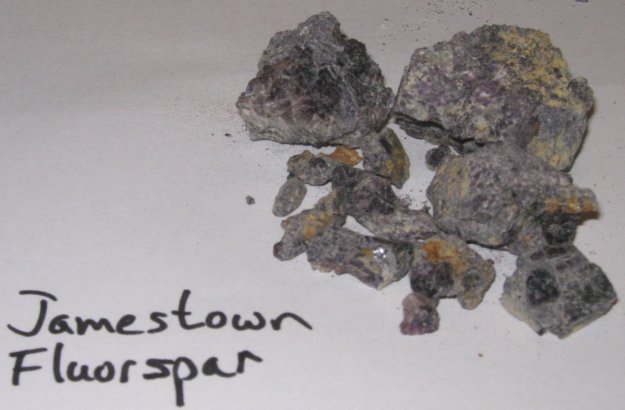
Jamestown Fluorspar 9-26-09 near Burlington Mine

Jamestown Fluorspar 9-26-09 near Burlington Mine

On the tailings pile we found some purple fluorspar and some rocks which under magnification, resemble gold ore I have seen elsewhere. There was the familiar sulfide odor in the area indicating the presence of surfaces of unoxidized sulfide minerals.

Fluorspar is used in iron and steel manufacture in quantities of up to 10 kg/ton of steel. Limestone and dolomite are added to molten iron in the steelmaking process (fluxing) to bring impurities out into a slag phase. We synthetic chemists have an analogous situation with “rag layers” or emulsions. Near as I can tell, slag resembles lava in the sense that it is a molten silicate.

Metallurgists apparently have to provide conditions for extraction and phase separation of unwanted components in a melt. A slag phase may be rich in silicates among other things. According to references I have seen, fluorspar is added to the mix as a fluxing agent to “increase the fluidity” of the slag, which I interpret as causing a decrease the slag viscosity. Whether this is purely a rheological effect or also a sequestering effect is inclear at present to me.

2009 Nobel Prize in Chemistry. The Winner is …

I don’t have a clue who is in serious contention for the 2009 Nobel prize in Chemistry. Yeah, there are a bunch of old guys out there who deserve it. But who are the contenders this year? I have all but stopped reading C&EN and JACS, so I am unaware of who this years darlings of chemistry really are.

I’d really like to see Harry Gray share it. I’d like to see Whitesides and Bergman get a trip to Sweden as well. But I’ll admit that I’m well out of the loop. Any thoughts out there? I’m sure that I’ve slept through the discovery, development, and implementation of  several new disciplines, each with it’s own journal and series of conferences. It’s inevitable.

10/4/09.   OK, I’ll guess Craig Venter for Chemistry and Stephen Hawking for Physics.

10/7/09.  Wrong Again!!!! See later post for update.

CSB Reports

Being a reactive hazards person, I try to keep up on the reports posted by the US Chemical Safety Board (CSB). In my view, the CSB does exemplary work in root cause analysis of what are often very complex events leading to disaster. I wholeheartedly recommend that people in the process side of chemistry peruse the many reports and videos posted on the CSB website.

The development of any technology in the real world involves what I refer to as

“the discovery of new failure modes”.

While it is possible to anticipate many kinds of failure modes, it often happens that plant operations will present the opportunity to line up the planets in a particular way that was left out of the failure analysis.

A recent account from the CSB is the report on the T2 Laboratories accident in late 2007 in Jacksonville, FL.  This accident killed 4 employees and injured 32 in many of the adjacent businesses. The explosive yield was estimated by the CSB investigators to be equivalent to 1450 lbs of TNT.

What is most instructive about this incident is the extent to which the thermokinetic behaviour was unknown to the owner/operators. This accident illustrates that thermal decomposition modes leading to runaway can happen despite a large number of successful runs.

I won’t go into too much detail since the report itself should be read by those interested in such things. But the upshot is that the reactor contents (MeCp dimer, Na, and diglyme) accelerated to a temperature that lead to the exothermic reaction of sodium metal and solvent diglyme. The reaction contents accelerated, raising the temperature and pressure to the rupture disk yield pressure of 400 psi. However, the acceleration was far too energetic for this safety device. The vessel exploded, hurling fire and fragments off the site. Just prior to the explosion, the owner/engineer directed the operators to leave the control room, saying prophetically, “there is going to be a fire”.

While the owners did perform some process development and did have the used vessel professionally inspected, what was left out was a study of the aptitude of the reaction to self-heat into a runaway condition. The company rightly anticipated the exothermicity of the sodium reaction with MeCp monomer and in fact, relied on the exotherm to raise the rxn temperature to a level where the economics would be more favorable. But what nobody at T2 anticipated was the runaway potential of the reaction of the sodium with the diglyme. No doubt they thought that the cooling jacket would prevent temperature excursions leading to a runaway.

The various glymes are often chosen as reaction solvents owing to their diether character as well as their high boiling points. Troublesome compounds or reactions requiring a polar solvent can be dissolved at high temperature and reacted in this high boiler. In certain cases, reactions can be run in a glyme and the product conveniently distilled out of the reaction mixture. Perhaps this is what they were doing in the MCMT process, I don’t know. This level of detail was not provided in the report.