Manufacturing Consent

The Palin phenomenon is an exercise in manufacturing consent. It is happening before our eyes. The GOP media machine is tunneling under the democratic ramparts and allowing the gravity of doubt to bring the walls crashing down.

While the conservatives are beavering away underground in the muck, the eternally frenzied media is handing the conservatives exactly what they want- air time on the talking points of their choosing. Since media people view the world as an everlasting stream of dramatic sequences, they are naturally drawn to the Palin freakshow like flies to a steaming road apple.

An electorate that put GW Bush in office twice is certainly an electorate that could be moved to put Palin in office. A President Palin wouldn’t be the end of the world, 2012 allusions aside, but it would definitely be emblematic of US culture. And that’s an emblem I would rather not wear.

Flight Profile of Cactus Flight 1549

The YouTube video below is a reconstruction of the flight of US Airways Flight 1549, referred to as Cactus. It is interesting to note how the pilot acted to conserve his altitude by careful energy management. After the dual engine flameouts the pilots established an optimum glide to maximize flight time. They did not bank the aircraft anymore than they had to- banking without power consumes altitude. While one pilot was flying the airplane the other was consulting the manual for emergency restart of the engines. The captain evidently knew right away that the only option for maximum survivability was to set the plane in the river.

Near the end the pilots found themselves coming in a bit fast so they brought the nose of the aircraft up and porpoised ~250 ft or so before locking on 130 kts indicated for their glide to the surface. They were mindful of bringing the aircraft to the site of the accident as slowly as possible. KE = (1/2) mv^2. 

Note how he dips the tail in the water first while keeping the wings absolutely level. This brought the aircraft into the water along the longitudinal axis and thus averted a cartwheeling accident. The engines become powerful drag devices once they are in water.

Uranium roll fronts

As a kind of hobby Th’ Gaussling has been surveying the literature on uranium occurrences in North America. Uranium is found in many interesting locations and as a result of several distinct kinds of ore forming processes.

Prospector with Geiger Counter

From Ballard &Conklin, Uranium Prospectors Guide, 1955 Harper & Brothers

For the most part, uranium ore body formation is the result of aqueous transport and deposition.  Uranium is found as a lode in vein formations in precambrian  igneous/metamorphic structures as in the case of the Schwartzwalder mine near Denver. In fact, there are many lode occurrences that contain a variety of uranium minerals in the Colorado mineral belt.

What seemed counterintuitive to me was the extent to which uranium is found in sandstone. Evidently I had developed a bias for connecting heavy metal occurrences with igneous/metamorphic formations.

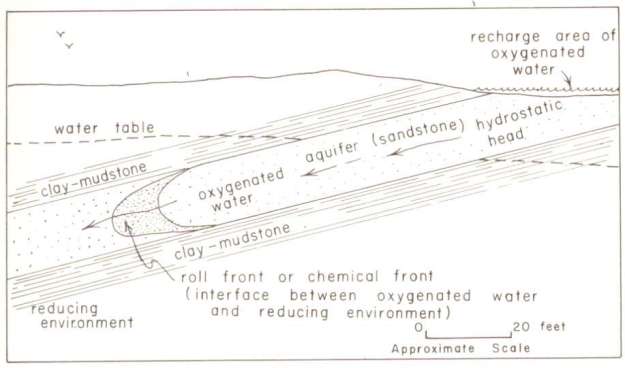
Uranium occurrences in sandstone take on certain characteristics as a result of ore forming processes. Uranium is often found in concentrated bodies called “roll fronts” or “ore rolls”. A roll front is a body of concentrated mineral with a lenticular cross section and is found in confined strata sandwiched between impermeable clays, shales, or mudstones.

Roll Front Cross Section

Adler & Sharp, Guidebook to the Geology of Utah, No. 21, Utah Geological Society, 1967, p. 59.

The action of oxygenated meteoric water (i.e., rain and surface water) migrating through a porous sandstone stratum will selectively mobilize mineral species that are soluble. In the case of uranium, the relatively insoluble U4+ compounds are oxidized to more soluble U6+ species which are then mobilized and flow in the formation.

Eventually, as the water flow encounters reducing conditions, U6+ gets reduced to U4+ and deposition occurs. Sandstone with organic material may be a net reducing environment and provide the necessary carbonaceous reductants to do the deed.

As the U6+ enriched aqueous flows encounter reducing conditions, deposition of U4+ insolubles occurs in a manner determined by fluid mechanical forces. The result is an elongated and tapered ore body confined to a narrow stratum.

Uranium roll fronts are common in many uranium districts. The Uravan uranium belt in the Colorado Plateau is a good example. Uranium is found concentrated in tuffaceous formations as well. An example of this is the uranium occurrence found in the 39 Mile Volcanic Field in the central Colorado mountains.

What is interesting to ponder is the geological effect of plant metabolic byproducts like oxygen. Oxygen directly contributes to a natural process that lead to the concentration of a scarce element like uranium. Plant life facilitating nuclear power. Hmmm.

The Passing of Irwin “Ike” Klundt

I just received the sad news that my friend, boss, and mentor, Dr. Irwin “Ike” Klundt died in Tucson, AZ, of cancer. Ike retired in the early 1990’s as VP of Sigma-Aldrich. He was an organic chemist from eastern Washington state. He joined Alfred Bader in the 1960’s (?) and helped build Aldrich into what is is today. He started the Aldrichimica Acta and appeared in it many times in the capacity of awarding a prize to honor prominent chemists. Ike also managed the publication of the catalog and invented the Aldrich “Coffeepot” Kugelrohr.

I first met Ike when I taught for a year at Ft Lewis College in Durango, CO. He was an adjunct prof and I was a visiting prof. Ike was loved by all and was a useful hand to have around for the department.

Ike was a good hearted soul who enjoyed the company of others and actively worked to help younger chemists develop their careers. He loved the science and business of chemistry and the people who worked in this field of ours. Ike was forced out of Aldrich soon after Bader was given the boot as the once entrepreneurial company began to behave like a normal publicly traded company- you know, the ones that eat their young.

The chemical field is poorer for the loss of Ike Klundt. He was one of the human beings of the trade and he will be missed.

Placer Gold Mining in the Wilderness

I recently had the occasion to sit and talk to an independent gold miner. This fellow had spend many seasons in the Yukon doing placer mining and had a few useful things to say about it.

In my friends experience the Alaskan placer mining season is very short- just 100 days or 2400 hours per year.  In that time you have to get your operation in place and process enough gravel and sediment through the sluices or centrifuge to isolate enough gold to make the process profitable. Sluicing and centrifugation are just forms of classification and your system must be able to separate gold particles in a manner consistant with the particle size range prevalent in the claim.

It is not uncommon for gold to be heavily represented in the 400 mesh range, or ca 0.037 mm particle size. In the old days, miners recovered fine particulate gold using amalgamation. Some large operations like Ashanti Gold in Cripple Creek use cyanide heap leaching to isolate the fines.

Sluicing operations in Alaska require considerable cash input and preparation. Sluicing generates considerable suspended solid and turbidity in the streams and the EPA, BLM, and wildlife agencies will have to be satisfied that the environmental impact is understood and minimized. Permitting is therefore a major hurdle for potential sluicing operations beyond the small scale.

My friend said that continuous centrifugation was necessary to capture the 400 mesh gold fines in the district he worked. As the capital equipment requirements increase, the volume of sediment to be classified must be scaled up to bring a satisfactory return on investment. Manpower and ancillary equipment requirements increase correspondingly. Soon you have a camp to maintain, payroll, and a crew to feed. In remote locations, air cargo transport is necessary to bring in the machinery and supplies. There is no Home Depot down the road to supply duct tape. Just like on a trip to Mars, you have to anticipate all needs and haul it in ahead of time.

A modest mining effort soon becomes a large logistics and financing problem. It’s a wonder that anybody still does this kind of thing. But, yet, they do.

The joy of logistics

It is amazing how complicated and labor intensive logistics can be for manufacturers. Customers often have strict requirements on how materials are to arrive at their facilities. Some customers have preferred shipping companies and will require that you use them. Others don’t care. Some want you to pre-pay and add the freight to the invoice. Some will accept FOB shipping point terms and pay the shipper themselves. 

International shipments are even more complex. Multimodal freight forwarding companies will take charge of the shipment and get it on a boat or plane. Once across the pond, they’ll get the shipment through customs and plugged into the local ground transport.

If you’re shipping internationally, unless the customer is a known quantity, you’d better get prepayment or a letter of credit from their bank.  Cash is king.

It becomes complex if you allow yourself to be a custom shipper. Some companies simplify things by offering a one size fits all shipping policy. This is best if you can get away with it, but more often than not, custom service means custom shipping.

There is much more to chemical business than just the chemical part. Chemistry students planning to enter the fabulous world of chemical industry should be advised that if they are going to step out of the lab, then the full spectrum of business related problems and challenges will be available to them. It is a great opportunity for some and a gigantic nuisance for others.

Hamthrax

So, the slang name for the H1N1 swine flu is “hamthrax”. Pretty funny. I suppose it could be called spamthrax as well.

As a kid I lived for a time in an Iowa town that had a Hormel Spam processing plant. During the winter in particular, the town of Fort Dodge, Iowa, would smell like cooked Spam. Ft Dodge sits atop the Des Moines River valley. During the cold months the valley would fill to the brim with the odor of Spam. It was an odd experience to drive into town and be overwhelmed by the smell of potted spiced meat.

Ft Dodge was (is) also known for the vast gypsum deposit that sits underneath the area. The word was that hair from the hogs at Hormel was blended with the gypsum to add strength to the sheetrock that was produced. I don’t know if this is true, but it made a great story for countless toe-headed farm kids who drove by the gypsum plant and pondered how they got the hair from the hogs and into the wallboard.

Mole Day Thoughts on Lab Life

I have come to the realization that, after a career of avoiding it, I really dig physical organic chemistry. While I do have the synthetikkers love for developing a synthesis, I really enjoy taking the rare opportunity to do a focused study on a single transformation or compound.  It is a stylized form of play that any developmental psychologist would recognize. Discovery is about learning, just like play, and many of the exploratory behaviors observed in play apply just as well to discovery (well, except for hitting and crying).

One way a scientist learns is by doing a search for boundary conditions. Where or how in parameter space does a thing change? What is the best solvent for the desired outcome? What effect does stoichiometry have? Does dry, inert atmosphere really make a difference? What are the best leaving groups? Yes, it’s just research. But there is more.

In order to claim that you have expertise with a substance or process, you must have an understanding of how a process or substance behaves under a variety of conditions. If faced with a product that is off spec and the prospect of having to rework or remake, it is very helpful to understand what conditions lead to the off-normal outcome. Either the chemist sleuths each upset for a cause, or the chemist goes in the lab and purposely exposes the process to off-normal parameters and analyzes the outcome, or both. After a while, patterns begin to arise and trends become apparent. This is play.

Seems bloody obvious. But in a production environment the opportunity to explore  parameter space is often not possible. Favor almost always finds the more practical, though short term, fixes. Production managers are not always chosen for their focus on the long term. They are short term oriented- a necessary predilection for timely delivery of product on a tight timeline.

Part of a good process development program is a study of how the process behaves in various upset conditions. This is important for understanding the thermal safety issues, but it also is a good time to take snapshots of how the composition of the process system behaves when it is out of whack.  A reaction profile under conditions of reagent mischarges or off-temperature can give many clues as to the operating window of the process. It can also tell you something about the best way to do an in-process check and define flags for particular types of upsets.

Many companies do this, but a good many find a way to gloss over such work.

Review of “The Lost Symbol”

I finished reading Dan Brown’s latest best seller The Lost Symbol. Brown famously authored The Da Vinci Code and Angels & Demons. Both of these novels were crafted to include all of the factors needed for NYT best seller status- secret societies, characters solving a mystery, the chase, intelligent and attractive main characters, cryptotheological inferences,  etc. Both of the early books were quite entertaining to read and hard to put down.

It is with some disappointment and regret that I must confess that I did not care for The Lost Symbol. I found it substantially formulaic and predictable.  Interestingly, a great investment in plot design was taken by noetic science as a type of incipient breakthrough for humanity, but no meat was to be found hanging on those bones. Instead, noetic science simply served as a weak plot device to place a secret laboratory near the Mall in Washington DC.

Then there is the lengthy apology to the Masons. In fact, the book is one long apology to Masonic culture and history; perhaps for slights inferred in past Dan Brown novels? Really, the book should be titled Dan Brown’s Interminable Apology to the Masons.

Again, the hapless Harvard Symbologist Tom Hanks Robert Langdon is caught up in a cryptological extravaganza requiring the decoding of a series of symbolic puzzles, usually under duress. Dismemberment, pyramids, Masonic Temples, reluctant protagonists,crypto fu, metaphysical fu, wealthy and eccentric characters, secretive government agencies, shadowy agents, and more.

In the final chapters, Brown takes the story into what I’ll call the “Dialog on Great World Systems” (with apologies to Galileo). Using the form of the Greek playwrights, he drags the reader through the egg batter and flour of extended and pedantic dialog between characters to serve up missing information and close all of the loose ends in the story.

Dan Brown the fiction writer reassures the reader that despite what fiction writers invent concerning Masonic rites and secret knowledge, they really are godly and patriotic fellows after all. But rather than leave it there, Brown attempts to ladle some theological pan drippings into the gravy by suggesting that the Christian Bible is actually full of symbolism.  Indeed, as the gazillionaire and noeticist siblings suggest, it is mostly symbolic. D’oh!

And, along that vein, the story asserts that Noetic research has uncovered that “ancient knowledge” is substantially correct, including that encrypted into the Bible, and with that realization, mankind is now on the cusp of a new era of civilization. Interesting story idea, but it never develops the noetic stuff in a satisfactory way.