Snow already. The mountains got snow well down below timberline yesterday. More to come tomorrow. Happy day.
Solid oxidane falling from the sky onto local granite formations
Leave a reply

Snow already. The mountains got snow well down below timberline yesterday. More to come tomorrow. Happy day.
I’m writing to applaud the Obama administration in its decision to stand down the long range anti-missile defense deployment in Poland and the Czech Republic. Naturally that pillar of conservatism, the Wall Street Journal (WSJ), lambasted the Obama administration for this decision. Playing to its fearful audience in the military-industrial-congressional complex, it pouted that
“The decision is a slap to America’s Polish and Czech allies, who had braved Russian intimidation in agreeing to host the sites.” WSJ Sept 20, 2009.
Hmmm. Let’s see. The strutting roosters in the Bush Administration put Poland and the Czech Republic in the awkward position of hosting an American/NATO missile base within spitting distance of mother Russia. And who was surprised when Russia pitched a fit over this? Irrespective of the stated purpose, real or not, the Russians went ape over the possibility of anti-ballistic missile capability being planted near its borders. Could it be that part of Russia’s strategic defenses include ICBM’s?
What tortured logic was used in coming to the decision that a missile base in former eastern-bloc countries would not set back US-Russian relations to 1960’s era levels of tension? Or did the Bush Administration people take this into account or even care?
“That is only one aspect of Mr. Obama’s mistake, however, because the Third Site was only partly about missile defense. No one ever believed that the basing of radars in the Czech Republic and 10 interceptors in Poland was a masterstroke of defensive strategic geometry … ” [italics by Gaussling]
“Rather, a central purpose of missile defense in Europe, on the doorstep of Russia, was alliance building. Its virtue was that it persuaded America’s allies that our common defense included a global ballistic missile defense system. In the near term it was to demonstrate that when it came to the threat posed by Iran, the U.S. and its NATO allies would stand together: Iran—aided and abetted by Russia—would not hold Europe hostage and the NATO powers would confront the threat of nuclear weapons in the hands of a radical Islamic regime. Mr. Obama’s biggest mistake is that, just as the Third Site was meant to build alliances, its cancellation will undermine them.” WSJ Sept 20, 2009.
I am hearing consistently that the proposed missile shootdown capability is hardly robust or proven effective. So we proposed to put a questionable system on the doorstep of Russia in the hope that the payoff would be better relations with the former eastern bloc states? What if Russia put a similar system in Venezuela or Cuba to protect these states from hostile aggressors? Oops! They tried something like that in Cuba a while back and it went badly.
Notice how the WSJ even admits that the proposed placement of the missiles was less than a master stroke. The fact is that US forces can pound Iranian targets from offshore or other locations if it comes to that.
The WSJ then goes on (below) to tie in strategic questions in Asia, fanning the flames of fear amongst its legions of wealthy and Calvinistic subscribers. The Iranian issue is a unique European strategic question so the connection with the Chinese power calculus in Asia stretches credulity. The WSJ has chosen to use the issue as a prosthetic with which to assert that this one decision collapses US credibility in general. US credibility in power projection is afloat 24/7 in the form of the US Naval men-of-war, it’s long range airpower capability, and substantial military intelligence capacity. Nonetheless, the WSJ already extrapolates a US failure to control Asian security.
“The simple reality is that, absent a missile defense that can stop Chinese ballistic missiles, the U.S. will be hard pressed to maintain security commitments in Asia given the advances China has made to its offensive nuclear forces. The U.S. Seventh Fleet, however capable, cannot withstand the kind of nuclear missiles and nuclear-tipped cruise missiles that China could employ against it. And because America lacks adequate conventional military means as well, the U.S. would have to resort to full-scale nuclear war to defend its Asian allies from an attack by China. [italics by Gaussling] While no one would ever envision hostilities rising to this level, no serious policy maker can prefer this state of vulnerability to the kind of stability a robust defensive system provides. And this isn’t even to discuss the threat posed by nuclear weapons in the hands of an unstable, unpredictable regime like Pyongyang.” WSJ September 20, 2009.
Good lord. What a bunch of cowards.
They’ve already predicted our demise in the Eastern Pacific. I guess we have to increase military spending. No wonder we can’t afford to tend to our own sick and infirm citizens. We have to prepare for an inevitable conflict in Asia. Shit. What was I thinking?
We’re finishing the third weekend of the 4 weekend run of our play, Room Service. After 6 weeks of rehearsal and 7 shows to date, the cast is getting a bit tired. Even the director is thinking about the next show.
Stepping on stage in character with a paying audience sitting there is a very sobering thing to do. Botched lines or less than enthusiastic performance reflects poorly on everyone. As a cast and crew, we all struggle to maintain the suspension of reality.
Backstage there is no goofing around or bullshitting. Everyone is focused on their parts and silent, mostly. There are a few remarks, but that is it.
I skipped over a few lines last night, but the other actor deftly patched the holes with plausible lines and I folded back into the script a few lines downstream. It was fairly seamless, but importantly I didn’t faint or stand there dumbstruck. My fellow players didn’t comment, thankfully.
I finally saw the movie 300. This picture is a fictionalized retelling of the Battle of Thermopylae (the Hot Gates). I quite enjoyed it, though I can see how others might not. The unique cinematography enhances the highly stylized approach to the story. It is a moving picture graphic novel.
The storyline is Greek Tragedy in motion. The distinctive imagery and staging mimic the style of scenes depicted on Greek pottery. I have no doubt that the great directors of the past would have used the same techniques if it had been available then. This manner of film making would have suited C.B. DeMille or John Ford.
The story is a bit rough on the Persians, however. But critics need to realize that this is a Spartan story about Spartan exploits. No doubt Persian story tellers had their own version.
I’m beginning to understand how a northern citizen might have felt in the years leading the the American Civil War. It must have been a time of realization. A time when it became apparent that within the geographic boundaries of the United States there were two incompatible nations. A nation is defined by more than geography- it is a unity of history and cultural attributes. The southern states who would eventually form the Confederacy were united in a way of life, a particular view of states rights, and an economic system that relied upon slave labor for favorable economics.
North and south fought a brutal war that finally ground the Confederacy into submission. The north prevailed by virtue of the ability to project sustained force. The south remained in the union, but latent anger and attitudes on racial dominance remain to this day.
Obviously, the electonic media have amplified the 9/12 march on Washington DC in the freakshow manner they are known for. But I sense that our country is experiencing a kind of phase transition in this period. The GOP is allowing itself to be represented by show business clowns like Glenn Beck and Rush Limbaugh. These and other entertainers are taking the GOP propaganda battle to our livingrooms and to drive-time broadcasting. But they are merely contractors. The media market is financially rewarding them for their performances. The greater the exaggeration and outrageous claims, the greater the audience share and value to the advertisers.
But these guys are not just obnoxious gasbags. They are very canny. Fans who listen with rapt attention as Limbaugh referred to Jimmy Carter as a hemorrhoid will dwell longer and for the same reason as gawkers will stare at the two headed snake or Eddie, the dog faced boy. This is a benchmark of our civilization.
I really thought that the GOP was more of a class act than the freakshow hawkers they have proven to be. The GOP has shown more aptitude for War Lord tactics than statesmanship. Conservatives respect power. The democrats have proven to be mere cows who stand immobilized while the mongrel dogs orchestrating GOP maneuvers have their way with large sections of the electorate.
If the Dems understood GOP-style power, they would have been hosting boot parties to kick GOPers while they are down. Instead, they tried the silly strategy of compromise. It is not in the nature of the contemporary GOP to accept that the voters put dems in power. It is just not in their radar.
While the current political freakshow entertains while it disappoints, the important lesson remains unspoken. The USA is not the advanced and enlightened civilization that it fancies itself to be. Insead, we appear to be naked and obese apes with too many weapons and imbibing too much high fructose corn syrup. Rather than buckle down and work hard at building civilization, we get arrogant and strut around with our hearts on our sleeves.
It seems to me that there is a kind embryonic New Confederacy movement stirring about now. The confederate disdain for taxes and centralized, federal government is alive and well. It’s just that nobody has actually said it in the open yet. But that may happen as disaffected middle aged, tea bagging WASP’s continue to get organized. Something is up.
This post has been updated. Th’ Gaussling, 6/4/16.
If you work with chemicals at the level of chemist in a production environment, chances are at some time in your career you’ll be called upon to help decide when a material is too hazardous to use in manufacture. It can be in regard to raw materials or as the final product. Your organization may have protocols or institutional policies or memories relating to certain classes of substances. Some companies, for instance, will not use diethyl ether in its processes. Others may require hydrocarbon solvents *absolutely* free of BTX. Some companies are so fastidious about worker exposure that the faintest whiff of solvent constitutes a breach. One world class company I know requires R&D chemists to include a process hazard analysis, review, and an inspection for all R&D reactions performed in the hood. Whatever the company, most have fashioned some kind of boundary as to what is permissible to have on site and what isn’t.
Large chemical companies tend to have large EH&S departments with well established SOP’s and protocols with regard to personal protective equipment (PPE) and the measurement of occupational exposure to substances. Larger companies may have an OSHA attorney on retainer and staff members specializing in regulatory compliance.
One might suppose that smaller chemical companies may not have the depth of hazardous material experience that the larger companies have for many reasons. Smaller companies may have smaller capital equipment and a smaller staff. But smaller companies may have a greater organizational freedom which can lead to a great variety of projects. A great variety of projects often means that a great variety of materials are used on site. As such, a smaller company might very well have considerable expertise in a wide variety of chemical substances and, consequently, a wide variety of hazards.
While a smaller chemical company may have considerable expertise in handling its hazardous materials, it may be lacking in infrastructure for administrative controls and regulatory compliance. A wise CEO watches this aspect as closely as the actual operations.
Whether large or small, eventually a company has to draw the line on what hazards it will bring on site. The chemist has some very sober responsibility in this regard. Through the normal ordeal of process development, the diligent synthesis chemist will find the optimum path from raw material to product. All synthesis consists of the exploitation and management of reactivity. But there is always the “deal with the devil”. In exchange for a useful transformation, properly reactive precursors must be prepared and combined. A mishap with a 1-5 liter reaction on the bench top is messy and possibly an immediate threat to the chemist. But that same reaction in a 50 gallon or 5000 gallon pot can turn into the wrath of God if it runs away. The chemists judgment is the first layer of protection in this regard. All process chemists have to develop judgment with respect to what reagents, solvents, and conditions are feasible. Economics and safety come into play.
A runaway reaction poses several kinds of threats to people, equipment, and the viability of the company. There is the immediate thermokinetic threat stemming from the PV=nRT, meaning that energy can be dumped into PV work leading to the high speed disassembly of your equipment. A prompt release of heat and molecules kicked into the gas phase may or may not be controllable. Especially if the runaway leads to non-condensable gases. A runaway has a mechanical component in addition to the chemical action.
An runaway may cause the reactor contents to be abruptly discharged. Several questions should be answered ahead of time. Where do you want the contents to go and what are you going to do with it once it is there? Catchpots and emergency relief systems are common and resources should be invested there.
A question that the wary chemist must ask is this: What if a cloud of my highly useful though reactive compound gets discharged into the air or onto the ground? Do the benefits of this reagent outweigh the downside costs? Even if a release is not the result of a thermokinetic disaster like a runaway, explosion, or fire, a simple release of some materials may be consequential enough to require the evacuation of a neighborhood. Once your materials have left the site in the form of a cloud or a liquid spill and you make the call to the fire department, you have lost control of the incident. Even if nobody gets hurt or exposed, the ensuing regulatory “administrative explosion” may knock you down.
A chemical process incident can have mechanical consequences, chemical release issues, and the matter of fire. Substances that are pyrophoric have automatic ignition problems that may be surprisingly easy to deal with, especially if they are liquid. Liquid transfer systems can be inerted easily and pyrophoric liquids can be transferred airlessly and safely. Pyrophoric solids are another matter. There are few generalizations I can make about pyrophoric solids. Inert solids pose enough handling issues without having the added complication of air/water sensitivity. All I can say about pyrophoric solids- waste or finished product- is that you will need specialized equipment and a big tank of LN2. Production glove boxes and Aurora filters are particularly useful. Also required is a space on the plant site where you can open up a container and let the contents burn if needed. If air gets into a drum of pyrophoric solids, it”ll begin to get hot. That is when you need to have an open spot where it can take off and not bring the facility down. Industrial parks are a bad place for such material handling.
When designing a chemical handling space, it is important to think about what happens in a fire. Flammable liquids are under the constant influence of gravity and will run to the low point on a floor. The question you have to ask is this: Where do I want the burning liquid to go? There are good choices and poor choices. Burning pools of organic liquids radiate considerable energy per sq ft per sec. The temperature of nearby objects will rise rapidly to the flash point and the ceiling spaces will accumulate smoke and hot gas. Drums and cylinders filled with flammable liquids or gases will eventually overpressure and release their contents adding to the mayhem. The release can be in the form of a BLEVE or a flood of flammable liquid leading to a widespread pool fire.
Such flammable liquid scenarios can begin many ways. Forklift and maintenance operations are particularly rich in opportunity for a fire. The physical location of flammable liquid storage must be well thought out. Ideally a warehouse fire should not be allowed to spread to capital equipment locations. This helps to keep workers out of harms way and contains the magnitude of the financial disaster as well. Since most chemical plants seem to grow organically over time, unfortunate choices are usually made in regard to incident propagation.
There are resoures available to quantitate the risks of such releases. The American Institute of Chemical Engineers (AIChE) is well organized and provides much literature on the topic of chemical plant safety. In particular I am thinking of Dow’s Chemical Exposure Index Guide, 1994, 1st Edition, AIChE, ISBN 0-8169-0647-5. This handbook takes the reader through calculations aimed at estimating the risk and likelihood of chemical releases.
Also available is Dow’s Fire & Explosion Index and Hazard Classification Guide, 1994, Seventh Edition, AIChE, ISBN 978-0-8169-0623-9. This handbook supports the use of a quantitative risk analysis chart for the use of a risk and hazard index for generating numbers associated with process activities for cost/benefit analysis. It is well worth the addition to your library.
When is a substance just too hazardous? Well, there are nitroglycerine plants in operation as well as phosgene factories. Most risks can be abated by properly thought-out processing and packaging. It really comes down to personal choice. Is that ammonium perchlorate plant that just offered me a job operated safely? Nitroglycerine, phosgene, and ammonium perchlorate all have properties that lead to demand for their use. Somebody is going to supply that demand. We chemists have to look inward and then act with our eyes wide open and our heads on a swivel. Myself? I wouldn’t work in a nitroglycerine factory, but I’m glad that someone does.’
[Added 6/4/16 by Th’ Gaussling] I happened to go back to this post and in doing so read a comment by “Bob”, which you can see in the comment section below. Here is a copy
“I actually believe that as a society should keep the safety rules relaxed a bit in academia. Academia, for better or worse, is our national chemical research institution”
So underpaid grad students, postdocs and staff working at a univeristy are less human, and less deserving of safety than their for profit brethren?
That’s diabolical Mr. Gaussling. Pure evil incarnate. For whose gain do you sacrifice their lives?
I want to address this now better than I did back then. To Bob I say this: Everyone has a right to a safe workplace. Academic institutions as well as industrial operations must use best practices in regard to worker safety. This is axiomatic. Plainly I did not articulate my contention as well as I could have. I will do so now.
We have to assume that junior chemists are likely grow to be senior chemists in an organization. The role of a senior chemist in industry for example, may be quite varied through her/his career. A senior chemist who has stayed in the technical environment will almost unavoidably have been confronted with a large variety of questions in regard to circumstances and outcomes relating to hazardous materials and tricky reactions. Moreover, a senior chemist is likely to have been promoted to a level that also involves supervision, the drafting of SOPs, work instructions, MSDS documents, emergency planning, laboratory design, etc.
In my view, a senior chemist as described above has an ethical and moral responsibility to coworkers, plant operators, material handlers, and customers to oversee chemical safety. A chemist at any level has a responsibility to make known to all involved what dangerous circumstance might arise with any given chemical operation. Either in relation to the hazardous properties of substances that may be released in mishandling, or in regard to hazardous processing conditions that can lead to danger.
I’ve used the word hazard(ous) and the word danger(ous). We need some clarity on this. If you Google the words and stop with the dictionary definitions you will be left with the shallow notion that they are synonyms. If you dig deeper, say at the website of the Canadian Centre for Occupational Health and Safety (OSH), you will find a definition of “hazard” that I find particularly useful. To wit:
A hazard is any source of potential damage, harm or adverse health effects on something or someone under certain conditions at work. [italics mine]
The same fuzziness in definition exists for the word danger(ous) as well. A definition I prefer is below:
A dangerous occurrence is an unplanned and undesired occurrence (incident) which has the potential to cause injury and which may or may not cause damage to property, equipment or the environment. [italics mine]
This definition is borrowed from the University College Cork, Ireland (UCC). I believe this is a good definition and it readily sits apart from the definition of hazard above.
The key difference is that a hazard is any source of potential of damage … under certain conditions.. whereas danger is a condition brought on by an unplanned or undesired occurrence. Next, lets consider these terms in the context of chemistry.
On the shelf in the fire cabinet is a glass bottle of phosphorus oxychloride, properly sealed and segregated. As the POCL3 sits on the shelf in the cabinet, I would argue that it is only hazardous. If, however, you pick up the bottle and in walking to the fume hood drop it causing it to break and spill the contents in the open, you’ve caused a dangerous situation. It’s an imminent threat to health and safety.
Conversely, let’s say that you carried the bottle to the hood, used it, then returned it to storage without incident. In the reaction the POCl3 is consumed and in the workup the residual acid chloride is quenched by water. Congratulations! You have taken a hazardous material, used it safely, passivated the actives during workup, and eliminated at least the acute hazard relating to POCl3.
In the first situation, a hazardous material was mishandled and became dangerous. In the second situation, the hazardous material was handled properly, consumed, and residuals passivated. In this case a hazardous material was used safely and to positive effect.
Seem trivial? Well, it’s not. This difference in meaning leads to a confusion that is especially acute among the non-chemist population. But my point lies takes us to the question of how students are taught to use hazardous materials.
I spoke of relaxing safety requirements in academia. An example of such a thing might be the use of diethyl ether. This useful solvent is banned outright in some chemical manufacturing operations across the country owing to the flammability. Even in their R&D labs. This is corporate policy handed down by those responsible for risk management, not scientists. In some industrial labs, woe is he who has an unexpected occurrence like a boil-over or a spill.
I believe that Et2O should remain in academic research labs for both the research value and for the development of valuable lab experience by students and postdocs.
You learn to handle hazardous materials by having the opportunity to handle hazardous materials.
Ether is only a simple example of what I’m trying to communicate. In order for chemists to graduate as experienced scientists with working familiarity in the properties of substances, they must have experience handling and using a large variety of substances, many of which may be substantially hazardous. And by hazardous I mean much more than just toxic. A substance may have a reactive hazard aspect that is a large part of it’s utility. To safely handle substances that pose a reactive hazard, a chemist needs to have experience in using it. And killing it. The chemist must try to gauge the level of reactivity and modify the use of the substance to use it safely. If you’ve made or used a Grignard reagent you know what I mean. Expertise in laboratory chemistry only comes through direct experience.
Hazardous reactive materials do useful things under reasonable conditions. Non-hazardous, unreactive materials find great utility in road and bridge construction.
If we regulate out all of the risk by eliminating hazardous materials in academic chemistry, what kind of scientists and future captains of industry are we producing? What we can do is to put layers of administrative and engineering protection in the space where the hazardous transitions to the dangerous. Academic laboratory safety is promoted by close supervision by experienced people. Limits on the amount of flammables in a lab space, proper syringe use, safe quenching of reactive residues, proper use of pressurized equipment, and a basic assessment of reactive hazards present in an experiment will go a long way to improving academic lab safety. Experienced people usually have a trail of mistakes and mishaps behind them. If we corporatize the academic research experience to a zero risk condition, we may kill the goose that lays the golden egg.
This is the week for wildlife encounters. While cycling yesterday we watched a hawk swoop down and grab its prey. Moments later the hawk flew away with a smallish (ca 12-14 “) snake in its talons and making its shrill cry. It landed on a nearby rooftop where it enjoyed its catch. I’m sure this kind of thing warms the heart of any homeowner lucky enough to host the feast.
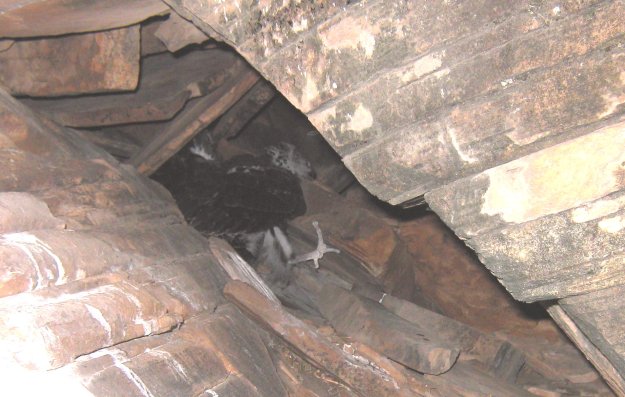
Fledgeling Vulture in Cave (Copyright 2009 all rights reserved)
This morning we climbed to a cave along a cliff face (on private land) to see a vulture nesting site. The cave was in the Fountain sandstone formation and was situated a good 4-500 ft above the roadway. The mother vulture was not present, but the two fledglings were in the cave. I say fledgeling, but I doubt that these young ones have flown yet. According to the land owner who has been carefully and quietly observing their progress, the youngsters have not yet flown.
Not seeing the young birds from a distance, we slowly climbed toward the cave entrance long enough to grab some snapshots.
The cave is actually a covered crevice that derives from a dislocated sandstone slab which quickly narrows to a very small cross section. With the camera flash, a photo of the young birds was captured in the dark recesses. This is rattlesnake country so we were not eager to venture too deep or linger in this crevice. The property owner mentioned finding a ball of rattlers under a rock partway down the hill. We had no interest in uncovering our own ball of rattlesnakes.
The young birds still had some of their down. This top photo was taken from ca 3 meters distance. Shortly after this photo the bird scrambled into the deeper recesses and out of sight. They make a curious hissing noise which is surely a sign of distress.
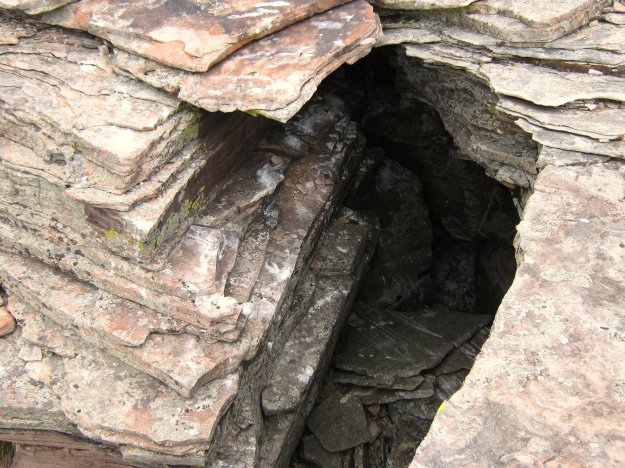
Buzzard Cave Entrance near Loveland, Colorado
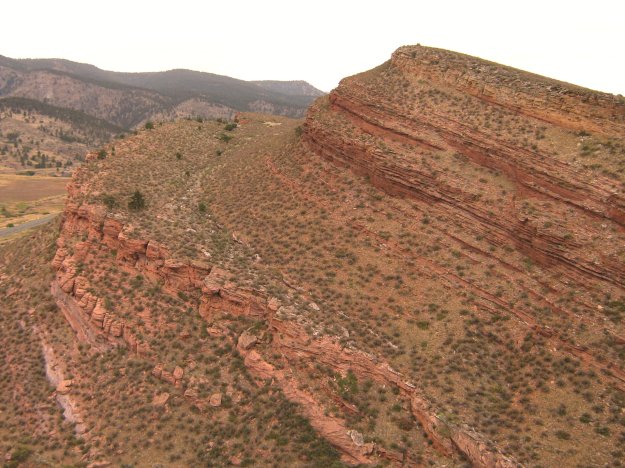
Fountain Formation near Loveland
The buzzard cave was found in the red sandstone of the Fountain formation, west of Loveland, Colorado. The Fountain Formation is the deepest of the sedimentary formations along the Colorado Front Range. It is seen only along the western margin of the Great Plains here owing to the uplifting effect of mountain building. In fact, this sandstone formation consists of the eroded debris of a previous iteration of the Colorado Rocky Mountains. The present iteration is often referred to as the Laramide Orogeny.
The photo above shows both the sandstone of the Fountain Formation in the foreground and in the upper left, in the background, the uplifted plutonic rock formation consisting of gneiss and schist.
During the Kennedy years, our modest farm in central Iowa was visited by a chinchilla salesman. I was a young child then and was intrigued by the topic of discussion at the kitchen table. The smooth talking slickster from the city made a presentation to my parents about the ever expanding fur coat market and how farmers could hitch their wagons to this opportunity.
I do not recall what kind of deal was reached, but I do know that soon thereafter we had a dozen south American rodents chinchillas in cages in our basement. These fluffy creatures were not friendly in the manner of a cat or a dog. They were silent, skittish, and capable of sinking their teeth into you. Of course kids are irresistably attracted to animals, especially those of the unusual and mysterious variety, and we were no exception.
The chinchillas (chinchillae? chinchillacea?) were constantly rolling in dust and gnawing at stones placed in their cages. We would watch this activity, captivated by the thick furred critters. Eventually we were allowed to pet them a bit, but always with the admonition that they were going to be made into fur coats. Except for horses, my father was rarely sentimental about animals. They were raised for just one purpose- to fatten and take to market. Cats and dogs were just a form of inedible and unmarketable livestock. To pull a 4-bottom plow, you needed maybe 1000 cats- a real nightmare if ever there was one.
The chinchillas eventually disappeared the following spring. Turns out that the traveling salesman fibbed to us. The lucrative market for chinchilla fur didn’t develop at the right time in the life cycle of our herd of chinchillas. Or ever, for that matter. The real opportunity in chinchilla farming was in selling animals and equipment to the unwary. I have no doubt that they were unceremoniously dispatched out in the field with the very Ruger .22 cal Single Six revolver that I inherited from my father. Caveat emptor.
About that same time, around the same kitchen table, a family friend sat and told us about the sailing boat he bought after selling his farm. He was going to spend his time sailing out of Jamaica, fishing and enjoying the lifestyle. We never heard from him again, but years later we eventually heard about him. He disappeared. The authorities concluded that he was the victim of pirates. Ex-pat Iowegian killed at sea and his boat taken. Caveat emptor.
A friend is a tenured prof at a local university and teaches the 9 AM organic section. My friend lamented the consumer behavior of students in O-Chem and mentioned getting slaughtered on some internet ratings site. Tenure is not an issue for this prof, but student evaluations are still a big deal.
The question my friend has trouble with is this jewel- “Is this going to be on the test”? This arouses considerable frustration and ill humor. Some profs have no taste for this cat & mouse stuff and will be upfront with what is on the exam. Others are more elusive and Darwinistic. One wonders if these lone standard bearers could have excelled on their own exams when they were in school.
We discussed the possibility of suitable replies that are courteous but firm. There is no need or benefit to a smackdown for insolence. Basically, students need to recognize the main themes of the chapters and answer reasonable questions therefrom. The key is to do the problems. That has always been the key to orgo.
Some have been scornful about “teaching from the book” and supplement their curriculum with content that suits their fancy. I think this is fine for certain upper level coursework. Where this strategy fails is when students need to comprehend the pillars of chemistry for later and more advanced concepts. Then other content becomes a kind of distracting indulgence. Chemistry is vertical.
The problem is that the academic expectations may ratchet up a few notches in college. Students who may be accustomed to getting good grades without too much sweat are often mortally threatened by the prospects of getting less than an A. But this is just a part of the total growth experience and a good prof will be sensitive to this frailty. The trick is to help these students find their own path and go for it.
My efforts in finding a particular actinide mine today failed miserably. Apparently, gentrification and McMansion horse operations have restricted the only access road for rabble like myself. Looks like I’ll have to get actual permission to visit the site. I’ll be more forthcoming with the identity of the mine when I can get a first hand account and pictures.
I did find some interesting pegmatite veins elsewhere. Pegmatite intrusions (or zones) may be enriched in interesting metals like rare earths. My samples could just be feldspar, but the xtal habit seems different.
This is the problem with being an “independent scholar” in this field. If I want an ICPMS or GDMS to get a sub-ppm level elemental assay, I have to fork over ca $400 a pop to get some numbers. An XRD is only good down to ~1 % phase purity. I could find a real geologist to pester, but that wears out fast. Gotta find a way to get some analysis done economically.
I spent some time panning for placer gold in a creek downstream of Ward. It was a complete bust. I drove away with a backache and wet feet. There are no lode mines visible in that area, so perhaps the absence of gold was determined by others long ago.
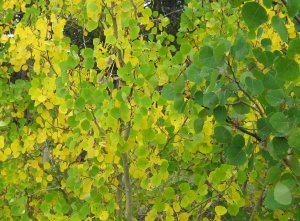
Aspen Starting to Turn Color September 2009
 Lamentations on Chemistry