Linkenschmutz

Links found whilst thrashing about the internets on my computer machine.

RCS Rocket Motor Components supplies, well, rocket motor components for the serious “non-professional”. RCS offers propellants, casting resins (i.e., polybutadiene), bonding agents, tubes, and other pieces-parts for the rocket builder. Good stuff, Maynard.

It turns out that my fellow Iowegian and former US President Herbert Hoover published a translated and annotated version in 1912 of De Re Metallica by Georgius Agricola (1556). Hoover’s translation can be found on the web and a copy is on display at the National Mining Hall of Fame and Museum in Leadville, CO. This work by Agricola is nothing short of amazing. A series of images of the text in the original Latin can be found as well.

It is interesting to note that Agricola (1494-1555)  and Paracelsus (1493-1541) were contemporaries in central Europe. Agricola, a Saxon, spent much of his time in Joachimsthal and Chemnitz whereas Paracelsus,  Swiss, is famous for being a bit of a wanderer. While I have not encountered a reference indicating whether these two polymaths had any knowledge of one another, they very much exemplify the meaning of Renaissance.

This USB temperature logger is pretty cool. I can hear it calling for me.

Here is a collection of links to monographs on Radiochemistry from LANL.

Topspin

After a long absence I climbed onto the Bruker 300 NMR and locked in for some actual lab work. Expecting to just to shim up and hit “zg”, I was pleasantly surprised to find that the software had finally been updated. Topspin had been loaded and with it a new and improved graphic user interface. Wow. I feel like I have come out of a long walk in the forests of Mordor and into a garden party. I’m sure there are better systems out there, but this will do nicely for a while.

Polanski Nabbed

So they finally nabbed Polanski. It’s about time. Back in 1977 or so when I made a meager living as a movie projectionist, I ran a movie called The Tenant, starring and directed by Roman Polanski. It was a dark psychological story about a man living in an apartment previously occupied by a woman who committed – or was driven to – suicide. In my view, Polanski should get a few years tacked onto his sentence just for making this grim stinker. OK, I’m indulging in sarcasm. Shelly winters and a few other notables were in it. But they were unable to bring it to life.

I recall that the lead character, Trelkovsky, tried to jump to his death from his (2nd floor?) apartment window, but tragically survived the fall. So, he drug himself up the steps and tried one more time, only to fail once again. There is more, but I won’t waste time over it.

Over a short period of 4 days we sold perhaps 12 tickets, and of those, more than a few customers walked out. In an attempt to cut his losses, the owner of the theater pulled it and booked something else. Little did we know that a movie called Star Wars would soon be wound onto our 6000 ft reels and beaming quietly from twin Norelco 35 mm projectors onto our single screen. The Tenant was evicted from our theater.

In pursuit of better slag- Fluorspar

On Saturday morning the kid and I arrived in Jamestown, Colorado, in search of mill sites and mine tailings. It does have a post office, but unlike many mountain towns it has managed to remain free of yuppie development. No Aspenization … yet.

This mining district lies on the northeastern extreme of the Colorado Mineral Belt. Once a hotbed of gold and silver mining, the area also produced considerable U3O8 and separately, fluorspar. Au and Ag ore bodies were enriched in copper, zinc, lead (galena), fluorite (CaF2), gold, silver, arsenic and tellurides.

UraniumCore announced in December of 2006 its purchase of 60 % interest in 88 claims in Colorado, including 46 unpatented claims in the Jamestown area. As seems to be the case in most minerals exploration activity in Colorado that I am aware of, the action is being driven by Canadian, Australian, and South African companies. The prinicpals heading up UraniumCore are Canadian.

While my brother-in-law is Canadian and while I would actually like to retire in BC, I can’t help but say that I would like to see more US companies involved in mineral exploration. There has to be a back story here.

Initially we tried to visit the 11 acre Burlington fluorspar mine site. This site was the focus of some environmental trouble for the locals in Jimtown. Unfortunately, the site was thoroughly fenced off, so interesting photos were not to be had. According to one website, Honeywell has completed remediation of the site.

Driving back towards Jimtown from the Burlington mine the kid spotted some old timbers jutting out of the hillside, so we stopped. Following what could only be a tiny stream of tailings runoff (having orange iron sediment) we found the remains of a mill site along a small creek.
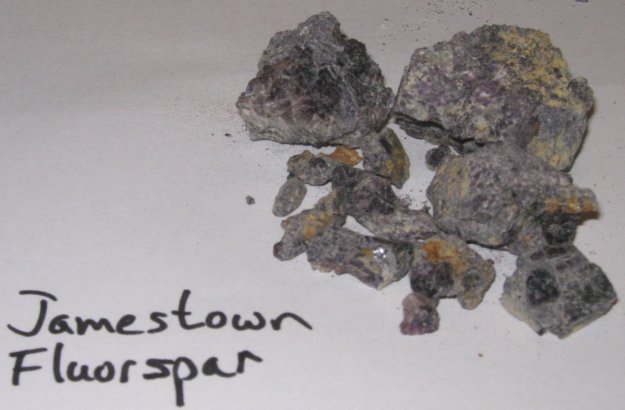
Jamestown Fluorspar 9-26-09 near Burlington Mine

Jamestown Fluorspar 9-26-09 near Burlington Mine

On the tailings pile we found some purple fluorspar and some rocks which under magnification, resemble gold ore I have seen elsewhere. There was the familiar sulfide odor in the area indicating the presence of surfaces of unoxidized sulfide minerals.

Fluorspar is used in iron and steel manufacture in quantities of up to 10 kg/ton of steel. Limestone and dolomite are added to molten iron in the steelmaking process (fluxing) to bring impurities out into a slag phase. We synthetic chemists have an analogous situation with “rag layers” or emulsions. Near as I can tell, slag resembles lava in the sense that it is a molten silicate.

Metallurgists apparently have to provide conditions for extraction and phase separation of unwanted components in a melt. A slag phase may be rich in silicates among other things. According to references I have seen, fluorspar is added to the mix as a fluxing agent to “increase the fluidity” of the slag, which I interpret as causing a decrease the slag viscosity. Whether this is purely a rheological effect or also a sequestering effect is inclear at present to me.

2009 Nobel Prize in Chemistry. The Winner is …

I don’t have a clue who is in serious contention for the 2009 Nobel prize in Chemistry. Yeah, there are a bunch of old guys out there who deserve it. But who are the contenders this year? I have all but stopped reading C&EN and JACS, so I am unaware of who this years darlings of chemistry really are.

I’d really like to see Harry Gray share it. I’d like to see Whitesides and Bergman get a trip to Sweden as well. But I’ll admit that I’m well out of the loop. Any thoughts out there? I’m sure that I’ve slept through the discovery, development, and implementation of  several new disciplines, each with it’s own journal and series of conferences. It’s inevitable.

10/4/09.   OK, I’ll guess Craig Venter for Chemistry and Stephen Hawking for Physics.

10/7/09.  Wrong Again!!!! See later post for update.

CSB Reports

Being a reactive hazards person, I try to keep up on the reports posted by the US Chemical Safety Board (CSB). In my view, the CSB does exemplary work in root cause analysis of what are often very complex events leading to disaster. I wholeheartedly recommend that people in the process side of chemistry peruse the many reports and videos posted on the CSB website.

The development of any technology in the real world involves what I refer to as

“the discovery of new failure modes”.

While it is possible to anticipate many kinds of failure modes, it often happens that plant operations will present the opportunity to line up the planets in a particular way that was left out of the failure analysis.

A recent account from the CSB is the report on the T2 Laboratories accident in late 2007 in Jacksonville, FL.  This accident killed 4 employees and injured 32 in many of the adjacent businesses. The explosive yield was estimated by the CSB investigators to be equivalent to 1450 lbs of TNT.

What is most instructive about this incident is the extent to which the thermokinetic behaviour was unknown to the owner/operators. This accident illustrates that thermal decomposition modes leading to runaway can happen despite a large number of successful runs.

I won’t go into too much detail since the report itself should be read by those interested in such things. But the upshot is that the reactor contents (MeCp dimer, Na, and diglyme) accelerated to a temperature that lead to the exothermic reaction of sodium metal and solvent diglyme. The reaction contents accelerated, raising the temperature and pressure to the rupture disk yield pressure of 400 psi. However, the acceleration was far too energetic for this safety device. The vessel exploded, hurling fire and fragments off the site. Just prior to the explosion, the owner/engineer directed the operators to leave the control room, saying prophetically, “there is going to be a fire”.

While the owners did perform some process development and did have the used vessel professionally inspected, what was left out was a study of the aptitude of the reaction to self-heat into a runaway condition. The company rightly anticipated the exothermicity of the sodium reaction with MeCp monomer and in fact, relied on the exotherm to raise the rxn temperature to a level where the economics would be more favorable. But what nobody at T2 anticipated was the runaway potential of the reaction of the sodium with the diglyme. No doubt they thought that the cooling jacket would prevent temperature excursions leading to a runaway.

The various glymes are often chosen as reaction solvents owing to their diether character as well as their high boiling points. Troublesome compounds or reactions requiring a polar solvent can be dissolved at high temperature and reacted in this high boiler. In certain cases, reactions can be run in a glyme and the product conveniently distilled out of the reaction mixture. Perhaps this is what they were doing in the MCMT process, I don’t know. This level of detail was not provided in the report.

Missiles of September

I’m writing to applaud the Obama administration in its decision to stand down the long range anti-missile defense deployment in Poland and the Czech Republic. Naturally that pillar of conservatism, the Wall Street Journal (WSJ), lambasted the Obama administration for this decision. Playing to its fearful audience in the military-industrial-congressional complex, it pouted that

“The decision is a slap to America’s Polish and Czech allies, who had braved Russian intimidation in agreeing to host the sites.”  WSJ Sept 20, 2009.

Hmmm. Let’s see. The strutting roosters in the Bush Administration put Poland and the Czech Republic in the awkward position of hosting an American/NATO missile base within spitting distance of mother Russia. And who was surprised when Russia pitched a fit over this?  Irrespective of the stated purpose, real or not, the Russians went ape over the possibility of anti-ballistic missile capability being planted near its borders. Could it be that part of Russia’s strategic defenses include ICBM’s?

What tortured logic was used in coming to the decision that a missile base in former eastern-bloc countries would not set back US-Russian relations to 1960’s era levels of tension? Or did the Bush Administration people take this into account or even care?

“That is only one aspect of Mr. Obama’s mistake, however, because the Third Site was only partly about missile defense. No one ever believed that the basing of radars in the Czech Republic and 10 interceptors in Poland was a masterstroke of defensive strategic geometry … ” [italics by Gaussling]

“Rather, a central purpose of missile defense in Europe, on the doorstep of Russia, was alliance building. Its virtue was that it persuaded America’s allies that our common defense included a global ballistic missile defense system. In the near term it was to demonstrate that when it came to the threat posed by Iran, the U.S. and its NATO allies would stand together: Iran—aided and abetted by Russia—would not hold Europe hostage and the NATO powers would confront the threat of nuclear weapons in the hands of a radical Islamic regime. Mr. Obama’s biggest mistake is that, just as the Third Site was meant to build alliances, its cancellation will undermine them.”  WSJ Sept 20, 2009.

I am hearing consistently that the proposed missile shootdown capability is hardly robust or proven effective. So we proposed to put a questionable system on the doorstep of Russia in the hope that the payoff would be better relations with the former eastern bloc states? What if Russia put a similar system in Venezuela or Cuba to protect these states from hostile aggressors? Oops! They tried something like that in Cuba a while back and it went badly.

Notice how the WSJ even admits that the proposed placement of the missiles was less than a master stroke. The fact is that US forces can pound Iranian targets from offshore or other locations if it comes to that.

The WSJ then goes on (below) to tie in strategic questions in Asia, fanning the flames of fear amongst its legions of wealthy and Calvinistic  subscribers. The Iranian issue is a unique European strategic question so the connection with the Chinese power calculus in Asia stretches credulity. The WSJ has chosen to use the issue as a prosthetic with which to assert that this one decision collapses US credibility in general.  US credibility in power projection is afloat 24/7 in the form of the US Naval men-of-war, it’s long range airpower capability, and substantial military intelligence capacity. Nonetheless, the WSJ already extrapolates a US failure to control Asian security.

“The simple reality is that, absent a missile defense that can stop Chinese ballistic missiles, the U.S. will be hard pressed to maintain security commitments in Asia given the advances China has made to its offensive nuclear forces. The U.S. Seventh Fleet, however capable, cannot withstand the kind of nuclear missiles and nuclear-tipped cruise missiles that China could employ against it. And because America lacks adequate conventional military means as well, the U.S. would have to resort to full-scale nuclear war to defend its Asian allies from an attack by China. [italics by Gaussling] While no one would ever envision hostilities rising to this level, no serious policy maker can prefer this state of vulnerability to the kind of stability a robust defensive system provides. And this isn’t even to discuss the threat posed by nuclear weapons in the hands of an unstable, unpredictable regime like Pyongyang.”  WSJ September 20, 2009.

Good lord. What a bunch of cowards.

They’ve already predicted our demise in the Eastern Pacific.  I guess we have to increase military spending.  No wonder we can’t afford to tend to our own sick and infirm citizens. We have to prepare for an inevitable conflict in Asia.  Shit. What was I thinking?

Backstage

We’re finishing the third weekend of the 4 weekend run of our play, Room Service. After 6 weeks of rehearsal and 7 shows to date, the cast is getting a  bit tired.  Even the director is thinking about the next show.

Stepping on stage in character with a paying audience sitting there is a very sobering thing to do. Botched lines or less than enthusiastic performance reflects poorly on everyone. As a cast and crew, we all struggle to maintain the suspension of reality.

Backstage there is no goofing around or bullshitting. Everyone is focused on their parts and silent, mostly. There are a few remarks, but that is it.

I skipped over a few lines last night, but the other actor deftly patched the holes with plausible lines and I folded back into the script a few lines downstream.  It was fairly seamless, but importantly I didn’t faint or stand there dumbstruck.  My fellow players didn’t comment, thankfully.