S.O.L.

I’ve been too busy inserting Mg into R-X bonds to pay attention to the www. The DSC is on the fritz and the ethernet is playing games with my TGA.  I need to run an FTNMR and a GCMS of my cpd ASAP. Luckily the HPLC is still spewing out results. I treated my headache with NSAID’s but my ADD is flaring up. The Jeep is in the shop, DOA, and I’m PO’d.  I need to gin up a procedure for the ARC and RC-1 tests. And, worst of all, I’m out of concentrated givashit. SSDD.

So there.

MRI MRI on the Wall

What the world needs is a good $1000 MRI scan. Why can’t we talk about how to bring down the cost of MRI scanners so that one can be parked in a non-magnetic quonset at Wal-Mart?  After all, the next wave of clinical business innovation has to crack the problem of how to provide lower octane health care.   To be sustainable, the system requires a selection of non-premium services that are modern and sensitive, but are robust and inexpensive enough to operate at $1000 a pop.

Health care organizations need to stop sending the message to Siemens, Fujitsu, GE or whomever else makes MRI scanners that they need to offer more premium scanners with expensive features because others are paying for it.  This is an amped up case of creeping featurism. What about moderate resolution with a basic package of options?   Perhaps this is already happening?

Someone needs to offer the “Kia” of MRI scanners- a moderately priced system with enough features to be useful to 80 % of patients. If the 1 kilobuck scan turns up nothing, then the Doc ratchets up the horsepower another notch.  This is the kind of thinking that is needed to keep the cost of treatment in line with inflation.

Mantle of Insanity

Recently I went to a local outfitter of camping gear to look for Coleman Lantern Mantles. As I was scanning the shelves a cherubic faced clerk came up to me and asked if I needed help. I said I was looking for lantern mantles.

When we arrived to the endcap where they were hanging, I asked him if they were still making radioactive mantles. He looked at me as though I were a bit of a loon. When I pressed the question, he balked and summoned his manager.

The manager, another youngster who was much more of an alpha male, scoffed at my question and tried to assure me that such a thing was absurd. Why in the world would mantles be radioactive? I tried to assure the youngster that, yes indeed, mantles were radioactive at one time because they contained thorium. At this point the manager was becoming visibly annoyed at his time lost addressing the questions of an obvious crackpot.

I recognized the patronizing tone he took and turned and left the store. As a child of cold war science, I have witnessed mantles sitting in a cloud chamber with ionized cloud streamers zipping every whichway from the innocent looking woven bag. Today, schools are terrified of chemicals and radiation science. Mr Manager missed out on a real experience by being born into the post-cold war world of bland science education.

So, my GM counter sits in my office clicking from the occasional background radiation piercing the GM tube. Eventually I’ll find a source to give it something more interesting to detect.

Rhodium Coins Now Available

It has finally happened. The Cohen Mint in NYC began offering a Rhodium coin in May 2009. This silvery PGM, once familiar only to a few Poindexters in the catalyst lab, has now become one of the coins of the investor realm. Available as a one gram coin, the initial price came in below $100 ea. Today, as Rh bullion prices jet upwards, these coins should be following the market upwards as demand for automotive catalytic converters inevitably rises.

The Cohen Mint also produces palladium and platinum coins in small but affordably weighted denominations.

I cannot estimate the relative merits of hoarding Rh or Pd relative to Au, Ag, and Pt, other than to say that these two metals seem to be somewhat less volatile in pricing relative to the three more widely traded precious metals.

Gold, silver, and platinum are substantially placed in the jewelry market as well as the investment market as the physical metal and paper instruments. This kind of exposure to global trading makes their pricing a bit twitchy and subject to global neurosis.

Given the scarcity of Indium and Neodymium, I wouldn’t be surprised to see coins made from them. Or at least as foils wrapped around a chocolate center. \:-)

Gaussling’s 12th Epistle to the Bohemians. Elements Rock.

Some acquaintances have asked about my new interest in geology. What’s the deal with rocks and mining? 

What interests me is not so much the economic value and extravagant production of certain minerals and precious metals. What is of interest is the question of how it came about that there is such a thing as an ore body.  An ore body is a geological formation which is defined by a localized concentration of certain substances. How does it happen that chemical elements can become concentrated from a more distributed condition?

Celebrity astronomers are often seen on cable channels pedantically nattering on about “Star Stuff”.  OK, Dr. Skippy, what is star stuff and what does it do? What are the particulars about the local star stuff, ie., the earth? This is the realm of cosmochemistry and geochemistry- elective classes the TV glamour boys apparently skipped.

The nucleosynthesis of the heavy elements (C to U) and their subsequent ejection from exploding stars is an inherently dispersive process. Eventually, here and there, some heavy matter will aggregate to form a protoplanetary cloud which can then produce planetary bodies. Inevitably, some of the heavy matter is pulled into massive bodies dominated by the presence of thermonuclear fuels- that is, hydrogen and helium. Sufficiently large accumulations of these two highly abundant elements will compress and initiate a self-sustaining fusion reaction of hydrogen to form the (n+1)th generation of stars. All told, some heavy matter accumulates to form of planetary bodies while some of it siphons into the next generation of stars.

It is within the ability of gravity to concentrate matter into smaller volumes of space as a dense, bulk phase. The geometric shape that allows all of the mass to be as near the center of mass as possible is the sphere.  This is why we don’t see planets shaped like cubes, pyramids, or ponies. 

Once cooled well below incandescence, the matter in a sufficiently constituted and situated planet may begin to self-organize into chemical phases. Along the lines of the Three Bears allegory, Earth is parked in an orbit that is just right for the presence of liquid water. Irrespective of the needs of life, liquid water is critical for the eventual concentration of some elements into ore bodies.

Earth has a gas phase blanketing a liquid phase which wets much of the bulk rocky phase of the planet. A generous portion of water circulates in the maze of fractured recesses of the planetary crust. In the case of Earth, we know that our planet has a fluid core within a solid shell. This molten phase in the core energizes a kind of convective heat engine that will drive the shuffling motion of tectonic plates and episodic volcanic mass transfer on the surface. 

Matter has gravitationally self-organized at the planetary scale on the basis of density. But what is perhaps most interesting to a chemist is the phase composition of the planetary solid matter. On cooling, a body of magma will sequentially produce precipitates representing different chemical substances. Over geological time this igneous rock may experience modification by the hydrothermal action of hot water under high pressure. Depending on its circumstances, parts of the formation may be depleted of soluble constituents or it may receive a deposit of new mineral species.

On the scale of planets, the earth has self-organized into bulk phases of matter- Solid, liquid, and gas. But at a much smaller scale, the earth self-organizes into domains of chemical substances. This is evident by simple inspection of a piece of granite. A piece of pink granite shows macroscopic chemical domains of potassium feldspar, quartz, and mica. While these three mineral components of granite are compounds and not pure elements, they nonetheless represent self-organization of species based on chemical properties.

The forces that drive chemical differentiation in mineral formation are ultimately thermochemical in nature. Large differences in Ksp lead to partitioning and phase separation of distinct substances. Subsurface formations may be approximately adiabatic on a short time scale, but over deep time they can slowly cool and equilibrate to yield a sequence of fractional crystallizations of metal carbonates, oxides, silicates, and aluminates giving rise to a complex bulk composition.

Speaking only for myself, coming to an understanding of how mineral deposits form is a kind of hobby.  If I wanted immediate answers to specific questions, I suppose the most expedient thing would be to consult a geochemist. But where is the adventure in that? The answers are not the fun part. The real adventure is in the struggle to find the best questions. As it often happens, once you can frame the problem sufficiently, the answer falls out in front of you. Whoever dies with the greatest insight wins.

A Day Trip to the Caribou Mining District

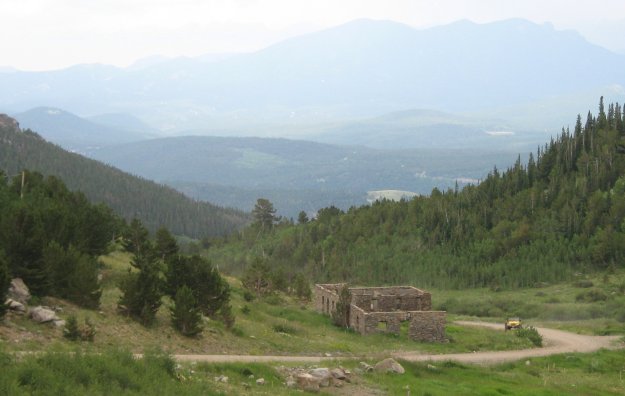
The ghost town of Caribou, Colorado, sits a few miles west of Nederland. As a group the mining towns of Caribou, Nederland, and Ward reside at the northeastern extreme of the Colorado Mineral Belt. This mineral rich formation cuts diagonally across the state, terminating near Durango in the southwest part of Colorado.

Every western state  has its mining districts.  The eastern reaches of the USA have hard rock mining districts as well. The Appalachians have a long history of hard rock mining. An example of eastern hard rock mining activity is the Foote spodumene mine in the Kings Mountain district in North Carolina.

The Ghost Town of Caribou, Colorado (Copyright 2009 all rights reserved)

The Ghost Town of Caribou, Colorado (Copyright 2009 all rights reserved)

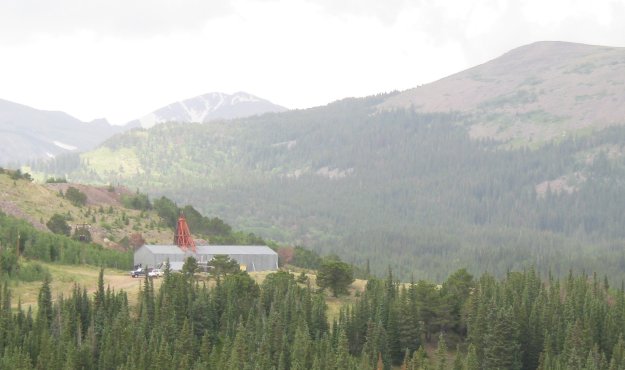
While the Caribou district was previously known primarily for silver and tungsten, current hard rock mining operations by Calais Resources is targeting silver and gold. A blurb on the Calais website says that they do not use cyanide extraction in Colorado.

Calais Resources Comstock Shaft (Copyright 2009 all rights reserved)

Calais Resources Comstock Shaft (Copyright 2009 all rights reserved)

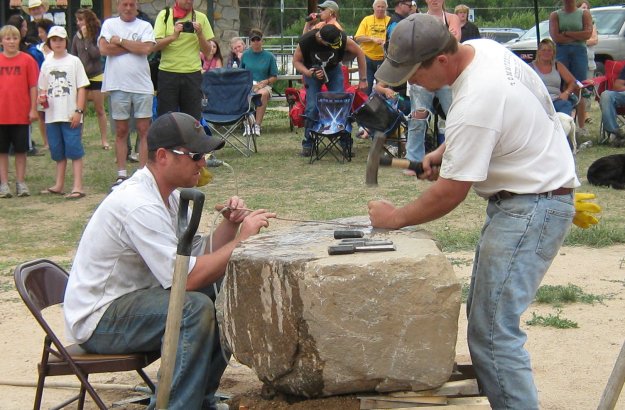
 This weekend the town of Nederland is celebrating its mining history with a miners festival. There were feats of strength and skill on display.

Hand drilling competition in Nederland July 2009

Hand drilling competition in Nederland July 2009

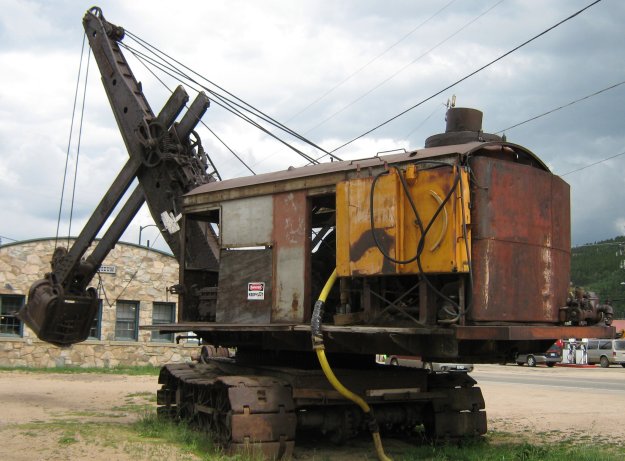
 Across town at the Mining Museum, a 1923 Bucyrus 50-B steam shovel was in operation. This 130,000 lb beast was powered by an antique air compressor this afternoon because the boiler is not servicable. It turns out that this very machine was one of 25 taken to the Panama Canal to move dirt and rock. All were scrapped at the canal but this one. The canal was finished in 1914, so it must have been used for modification of the canal workings.

This machine was in service at the Lump Gulch Placer a few miles south of its present location until 1978.  Bucyrus is still an ongoing concern in the mining equipment business.

Bucyrus 50-B Steam Shovel (Copyright 2009 all rights reserved)

Bucyrus 50-B Steam Shovel (Copyright 2009 all rights reserved)

As one drives into the Ward area from the north, the rock type evident in the road cuts changes. South St. Vrain canyon is largely granitic in nature. As one moves south into the Mineral Belt, the road cuts plainly reveal that a new dominant mineral type is present. Hematite or other iron oxide species are extensively represented in the rock.

My reading indicates that many metal ore bodies are the result of extensive hydrothermal modification of fractured or disturbed formations. Metal sulfide saturated, superheated water penetrates a disturbed formation leaving precipitates forming vein structures. In this way, many metal species are mobilized on the basis of solubility properties and are transported and concentrated leaving deposits enriched in a variety of useful metals.

The superheating of deep ground water and the subsequent partitioning and concentration on the basis of physical properties like solubility and volatility are what make the recovery of many elements possible. Without these concentration mechanisms many scarce elements would be too diluted in the parent formation to be feasibly isolated commercially.

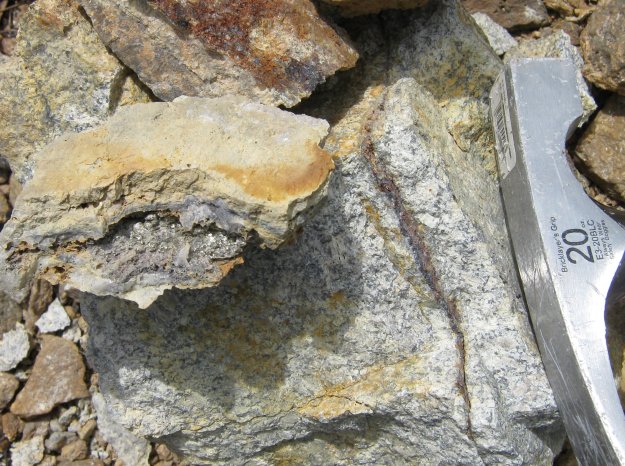
Pyrite vug from a tailings pile (Copyright 2009 all rights reserved)

Pyrite vug from a tailings pile (Copyright 2009 all rights reserved)

What Th’ Gaussling has found is that, while a PhD in Organic Chemistry isn’t entirely useless as a background for understanding rocks, it is closer to useless than I’d like. Edgemicated as I may be in a skinny band of chemistry, I have a lot yet to learn about minerals and petrology.

Converting NYC’s Central Park into Manhattan Airport

There is a website by the Manhattan Airport Foundation dedicated to the proposition that Central Park in New York City be converted into a regional airport. From their press release-

NEW YORK, NY, July 15, 2009 – For the past three years The Manhattan Airport Foundation has been quietly laying the groundwork to provide New Yorkers with a most fundamental urban amenity: access to viable air transportation. And today, TMAF releases its much-anticipated Stage One call for entries to a hand-picked group of top architecture firms worldwide in what is sure to be one of the most closely-watched design competitions in recent memory.

This has to be some kind of a joke. What a horrible place for an airport. Even if the people of NYC consent to the loss of a large greenspace in the middle of their high density glass and steel jungle, there is the issue of air traffic. Do these people understand how loud jet aircraft can be? Someone should remind them that Hong Kong was so anxious to be rid of their mid-town airport that they built an artificial island to put it on. Imagine jet traffic lumbering in on final approach over the tops of the buildings in Manhattan? It might even drown out the sound of honking taxis.

Even better, imagine the noise of jets on departure, clawing for altitude at full power trying to get out of the Manhattan airspace? Imagine the the roar of jet engines reflecting off of the skyscrapers from 777’s and other heavies on their takeoff rolls. Power failure on takeoff? The skyscrapers downrange will absorb the impact energy.

Yep, this has to be a gag of some kind. Imagine someone actually trying it? Pffft!

Is Private Sector Buggery Better than Gov’t Incompetence?

Healthcare in the USA is wildly expensive and is growing more so at a rate that exceeds inflation. This is well known. The battle for healthcare reform in DC is bogging down under the weight of private interests and infighting.  Soaring rhetoric from both left and right is mistaken for intellection and reason. It is evident that the fix to the problem was started before there was a clear understanding of the variables.

If you look at healthcare as a manufacturing activity with labor, capital equipment, and materials as input and some sort of health benefit as the output, you can start to see what cost inputs may begin to dominate. Of course this is very simplistic, but hang with me.

A round of health care involves attention by highly trained and expensive labor. A health care worker can only attend to one person at a time, though that worker may have many patients under his/her supervision. If a patient is stabilized, the care worker can also attend to other patients and achieve some sort of parallel production for better cost containment. In the heirarchy of medicine, the docs are managers who provide oversight to nurses who manage the patients. Docs also do consultations, examinations, and perform surgery, so they are not pure people managers- they get their hands dirty. Docs are a unique class of management all by themselves.

To exaggerate the effects of labor costs, imagine if you had a doc or a nurse picking strawberries, how expensive would the strawberries be? Even if Dr. Picker was very fast, the berries would be expensive. To have reasonably priced berries you have to find workers who will do the work at a lower wage. Lower wages derive from an abundance of willing labor.

In the end, medical schools control the scarcity of physicians by controlling enrollment. And the enrollment is defined by the curriculum, faculty size, and the particulars of the coursework- availability of clinical experiences, lab space, equipment, etc. But, you have to wonder what would happen to medical costs if there was less labor scarcity.

The most important resource a medical school has, other than faculty, might be the university hospital. What if more hospitals had medical schools rather than the other way around? I don’t think that the existing medical schools have absorbed all of the bright candidates out there.

Health care is a kind of economic chimera. The recipient of medical treatment is not the person in control of the costs. Physicians prescribe the type and extent of resources and the insurance companies release the funds. The medical establishment receives payment for services irrespective of outcome. Insurance companies profit by denial of services. The patient is left to sort out how to get the best value from available treatment.

American medicine is very much influenced by technological triumphalism.  New and expensive materials and devices hit the market all of the time. The question every potential marketer of medically related items must ask is- will the docs use or prescribe it? The most powerful instrument in medicine is the physician’s pen. The question for drug and equipment makers is, how do you get the docs to use their pens to your advantage?

The view that a disease or an injury is a sales opportunity is what drives for-profit clinics and hospitals. Without chronic disease, accidents, and sporadic outbreaks of mayhem, growth and profit in the healthcare industry might be more static.

So in the end, who do you trust? Do you put your faith in the private sector whose avowed goal is to profit on your illness? Or do you trust the government which, though accountable to its citizens, is prone to profound organizational inertia and a lackluster draw to talented staff?  This is the balance of opposing forces the fools in Washington are trying to sort out. Howard help us all.

Vintage Magnetic Separator for Tungsten Ore

Th’ Gaussling took a drive through some local mining territory today. I made my way up Left Hand Canyon through Ward and then on to Nederland, Colorado, careful to dodge the high altitude bicyclists.  Either they are unaffected by the low O2 partial pressure, or oxygen starvation has dulled their senses. I do not have the metabolism for it.

While there is a fair amount of mining history in Nederland, it is most recently famous for having a dead guy in a box of dry ice stored in a Tough Shed. Not to be missed is the annual Frozen Dead Guy Days with its charming coffin races. I’m sure there are a few tarpaper homesteads still around. It’s our own little bit of Appalachia.

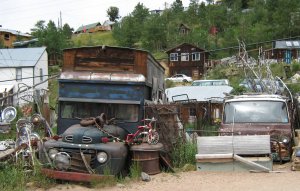
RV Heaven in Ward, Colorado

RV Heaven in Ward, Colorado

Western Boulder County was once a bustling mining district producing  mostly silver with some gold and tungsten. Mines were serviced by smelter and milling operations and were located near available streams. While a great many mines remain, nearly all trace of the mills has been long lost. What tourists and casual observers of mining history may not appreciate is the critical function of the mill. Without crushing and extraction, the mines would have no way to pull the pay out of paydirt.

On a side note, southern Boulder County- between Boulder and Golden- had one of the most significant early uranium mines – the Schwartzwalder Mine.  A geologist who studied the operation told me that the Schwartzwalder mine has been shut down by the owner, Cotter Corp., and is flooded.

Southwest of Ward is the town of Nederland. The town has a modest mining museum with some unique pieces of equipment on display indoors and two steam shovels on static display ouside. It’s worth a stop.

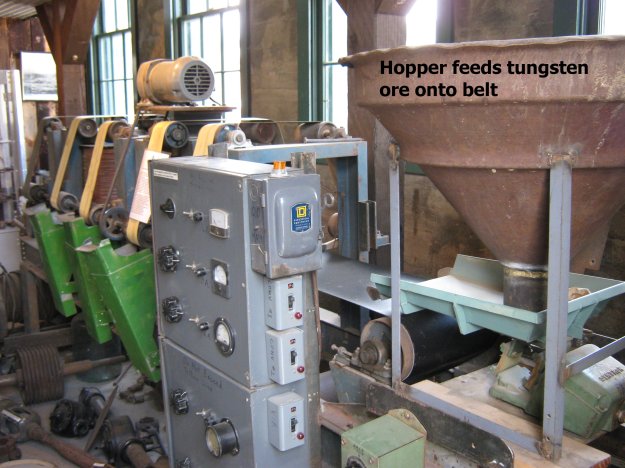
Magnetic Separator for Tungston Ore, Nederland Mining Museum

Magnetic Separator for Tungston Ore, Nederland Mining Museum

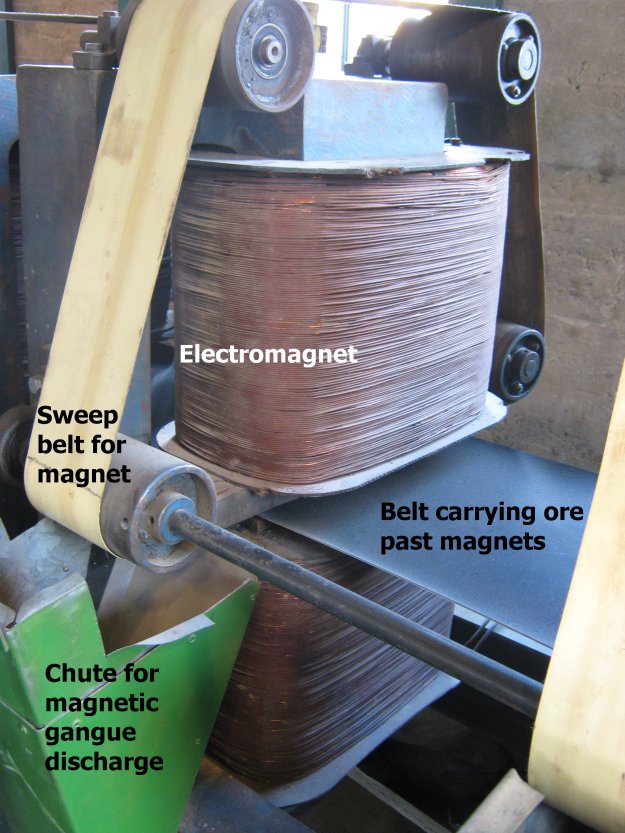
Of particular interest is a curious looking machine in the back of the museum. The photo above shows this machine- it is a magnetic separator designed to remove magnetic iron gangue from milled ore and was built by a local miner. The machine was donated by Joe and Joann Chavez. It is believed that Joe built the device in the early to mid 1940’s.

The machine moves milled ore on a main belt underneath the pole faces of 5 successive electromagnets. Around the upper magnets is a sweeping belt that is situated between the magnet pole face and the underlying ore. As the main belt delivers a constant stream of ore to the magnets, the sweeping belt constantly moves accumulated magnetic material away from the magnet and into chutes that discharge the unwanted material to a separate mass stream. The purpose of the lower magnet is a little unclear.

Magnetic Separator Detail

Magnetic Separator Detail

Separating iron minerals from other minerals can be difficult. Iron is more or less ubiquitous in many formations. In any serial refining process it is important to remove unwanted material as early in the stream as possible. The less mass that has to be taken through later-stage energy and chemical intensive processes, the better the economics. Magnetic separation, if it is applicable, is fairly simple. But if considerable comminution is required beforehand, then the energy costs begin to add up.

Three empirical laws describe the cost of comminution or size reduction. Basically, energy consumption (and cost) follows some power law with the surface area generated. If one can cheaply concentrate medium sized grains of solids before further milling has to occur, a cost savings might be had as inferred from Rittinger’s, Bond’s, or Kick’s Laws.

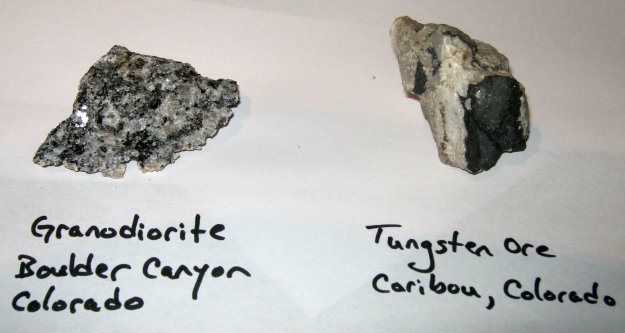
Samples of Granodiorite and Tungsten Ore

Samples of Granodiorite and Tungsten Ore

Along much of the route from Nederland to Boulder the predominant rock seen in the canyon is granodiorite. This mineral is similar to granite but is more mafic in nature, meaning that it contains less potassium feldspar and more plagioclase which is richer in Na and Ca. According to Wikipedia the Rosetta Stone is carved from granodiorite. A softer stone would have been easier to carve- I would have picked sandstone if I were the chisler.

The Rosetta Stone sits at the British Museum in London and is surprisingly large- it’s as big as a section of residential sidewalk.

Hillbilly Engineering- A Homebuilt Kugelrohr

In the mid 1990’s I had the good fortune to do a 1-year sabbatical replacement teaching gig at Ft Lewis College in Durango, Colorado. Of the several colleges in which I was lucky enough to be a faculty member, this school was absolutely the best. The chemistry department had a vitality that I had not experienced elsewhere, and sadly, would not be fortunate enough to repeat.

From my office high up on the mesa next to town I could hear the whistle of the steam locomotives of the Durango-Silverton Narrow Gauge Railroad. On friday afternoons a campus Native American group would sit around a single drum outside of Berndt Hall, each striking a hypnotic beat on the preserved skin while chanting and singing in the Ute language. While they were chanting the steam locomotives in the town below would blow their whistles, announcing their arrival for the tourists. The sound of it was an otherworldly experience I have not forgotten.

A prof I got to know at Ft Lewis, Dr. Irwin “Ike” Klundt, was a retired VP from Aldrich. He was to become a mentor and friend. It turns out that Ike was the inventor of the coffee pot kugelrohr that Aldrich offered in its catalog. West Bend, the appliance company, had a coffee pot manufacturing operation in Milwaukee, WI, where Aldrich was then headquartered. Ike learned that they would always have a few off-spec units coming from their mfg line, so he arranged to snag a few of these units. He recognized that these pots were built to contain heat and would be dandy ovens for his application. The large metal coffee pots were delivered to a one man shop somewhere in Milwaukee where the they would be converted to ovens for the Aldrich kugelrohr still, or “bulb-tube” short path distillation device to be more precise.

To provide agitation around the axis of the distillation train, an automotive pneumatic windshield wiper motor provided the needed reciprocating motion. It had a built-in tube that would serve to couple the bulb tube train to the vacuum line. The reciprocating motion of the motor removed the need for a sealed bearing as in the case of a rotary evaporator.

Aldrich sold a geat many of these units. In later years the kugelrohr was modified to enhance safety and ease of use. Aldrich has never been shy about pricing, so the price went way up as well.

I was thinking about this bit of history yesterday as I was operating my home-built kugelrohr. Sometimes shortpath distillation is needed and yesterday was the day for it. Using Ike as my inspiration, I horizontally configured a Buchi rotovap into a kugelrohr distillation unit with a still pot and a bulb tube receiver.

On a hotplate with a temperature indicator, I placed an 8 inch diameter sheet metal 90 degree elbow from Home Depot. The elbow, modified with a bit of aluminum foil, would serve as my hot air bath. The elbow and hotplate assembly is scooted over to the rotovap so that the still pot bulb is isolated in the “oven”.  A dry ice/acetone cooling bath for the receiver bulb was made from the bottom of a plastic jar. It was notched on opposite ends to accomodate the receiver joints.

The setup works just like a Buchi-brand kugelrohr, but doesn’t carry the price of a luxury ocean cruise. I know that larger companies would not allow this kind of thing. They would frown on a chemist using his time to kludge together a piece of improvised equipment. Their safety people would not allow the operation of a device that was not purpose manufactured. But when you work for a small company this is one of the things you have to do, and I enjoy every minute of it.