The western wildfires currently in progress are having a huge effect on the clarity of the atmosphere here in the greater Denver area. The California wildfire in particular is discharging vast quantities of smoke into the atmosphere. Here, one thousand miles downwind, we are enjoying hazy days and spectacular sunrises and sunsets owing to the smoke in the air. Last night as the moon reached the meridian, it resembled a moon in partial eclipse in terms of the reddish aspect of its appearance. The long carbon footprint of California is casting a shadow upon us.
The Tejas Republic
Well, shoot. Some Texicans are spoutin’ off about secession again. I’m kinda s’prised it took this long fer their sentiments to get voiced out in the open. Havin’ lived there fer a few years, I could see it comin’ a while back.
So let’s see. Before they split, we’ll set up a US Hong Kong-type city state in Houston so’s we git the port a’ Houston with its petrochemical complex and NASA. Then we’ll make sure we keep the military bases in San Antonio, sorta like Gitmo, and move the Pantex nuclear weapons reservation from the panhandle to the north. After that, we’ll slap a duty on their exports, divert the Rio Grande into Arizona for irrigation, make Galveston Island a US naval station, and claim the oil reserves in the gulf. They can have their West Texas crude.
It’s like a whole nother Central American country!
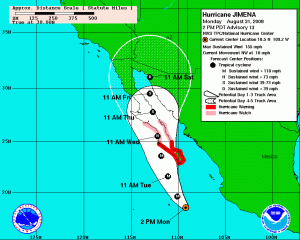
Hmmm … LA or Phoenix to Get Tropical Storm?

Hurricane Jimena
Day Trip to the Central City Mining District
The Central City mining district had its origin with the Pikes Peak gold rush. Placer gold deposits found in Denver area streams were quickly played out. Miners followed streams like Clear Creek up the canyon to their source, staking claims on the placer deposits in the streams along the way. Eventually, the placer deposits played out causing miners to search for the lode deposits along the hillsides. Underground hardrock mining was the inevitable outcome of placer depletion.
The Pikes Peak gold rush began in 1859 and is named after the high mountain peak that is visible from 100 miles into the eastern plains. While the immediate area of Pikes Peak produced little or no gold, it was a useful point of reference for arriving miners and settlers.
In many ways, the various gold rushes in American history are simply examples of economic bubbles 19th century style. The discovery of a resource that can generate substantial streams of cash will attract large numbers of wealth seekers. Not surprisingly, chance favored the early arrivals in the bubble. Many a weary participant gave up, hoping only to break even. Others realize that there is more stability in providing supplies and services to the miners.
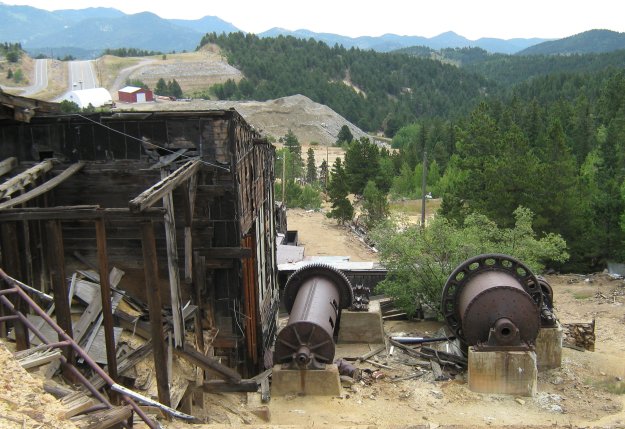
Abandoned Mill Workings Along Russell Gulch Road (Copyright 2009, all rights reserved)
While mineshafts, adits, and tailings piles still mark the landscape in most mining districts, what has been lost for the most part are the mills. The photo above shows the remains of a mill operation between Central City and Russell Gulch. Mills were a crucial link in the generation of wealth from mining activity.
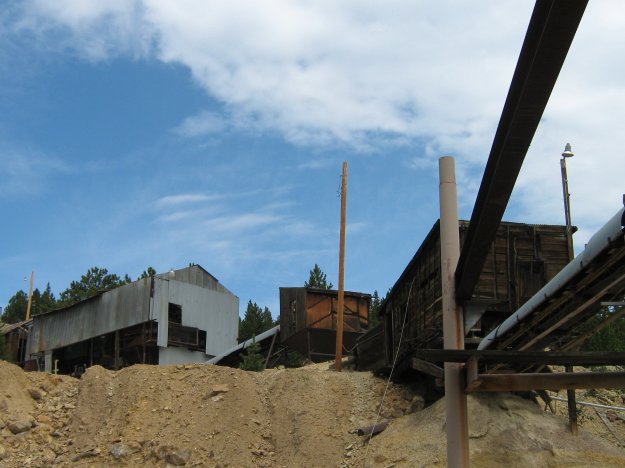
Mill Along Russell Gulch Road
Mills were constructed near the richer lodes and were configured in various ways. Some processing buildings were built along the hillside and early mills had chutes with which to convey material within the facility. Later mills had conveyors to transport materials.
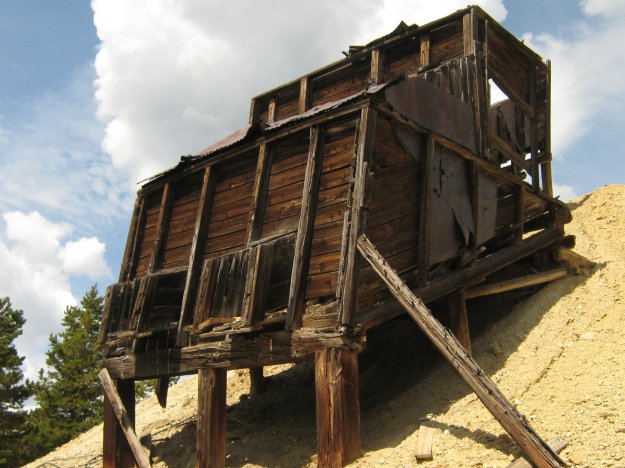
Remnant of Surface Workings, Central City, CO (Copyright 2009, all rights reserved)
Cominution was a key operation of the mill. Large rocks had to be reduced in size to expose greater surface area for value extraction. Stamp mills were very common and consisted of a powered camshaft that lifted and dropped a train of heavy cylindrical hammers on the ore. The output of the stamp mill was treated in various ways depending on the nature of the gold bearing ore.
Gold ore near the surface might be of a more highly oxidized nature from exposure to oxygen entrained in meteoric water. In that case, sulfur would have already leached from the formation leaving a higher level of metallic gold. Such ore was more amenable to extraction by amalgamation. Stamp mills could be constructed with mercury covered copper plates on the output side of the stamps. The mercury would amalgamate the gold particles from the mill feed, selectively trapping them on the plate. The amalgam would then be scraped off the plates and the mercury removed by the application of heat to evaporate the mercury.
Gold ore from deeper deposits resisted direct amalgamation, however, and roasting was used to free the sulfur (and tellurium) from the value. Highly sulfurized ores would be roasted to liberate the gold from the sulfur in the matrix. The resulting calcined ore might be milled or just subject to mechanical agitation to dislodge the gold particles in a sluice or by amalgamation (source- discussions with mining museum people. I would like to find better documentation, however).
The extent to which amalgamation was used in gold recovery is largely forgotten or left unmentioned. The USGS has excellent documentation on this topic. Chlorination by the application of Cl2 and cyanide extraction were introduced by the end of the 19th century as well, but that will be the topic of another post.
The folded rock in the photo below is shown only because it is visually interesting. Note how the various layers show signs of differential erosion. Nothing astonishing, just a reminder that seemingly ordinary things can be very interesting if one stops to have a look.
I’m going to get hit by a car one of these days from stopping at roadcuts. I can only hope it is over fast.
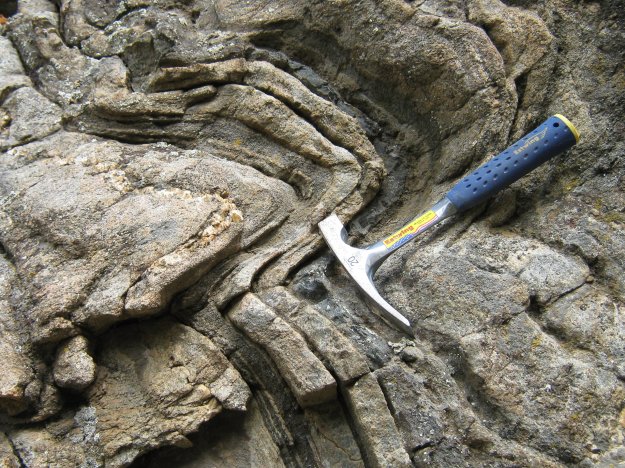
Folded Rock Formation, Roadcut on CO 119 near Blackhawk

Question to Democrats: WTF??
I really do not understand the manner in which the Democrats are responding to the outrageous lies and fascist propaganda that the Republicans are dealing out. Democrats- WTF??
Democrats should deal with Republicans in the same manner that they were treated in the days of DeLay and Armie. The Republicans of congress are egg sucking dogs who only understand one thing- the sharp crack of a 2×4 between the eyes. The ruthless application of blunt power. Rough ’em up while they’re down – metaphorically at least. Because the inglourious basterds will certainly not offer bipartisanship when they are the majority again.
American politics is disgusting sometimes. Especially now.
Placebo Makers Seek New Markets
August 27, 2009. Guapo, AZ. The American Placebo Manufacturers Association concluded their annual meeting today. The meeting was hosted by the McCain Center for Advanced Placebo Research at Pultroon University. The meeting included a symposium series on placebo research as well as an exhibition featuring state of the art placebo pill presses.
Noteworthy was a report on a general rise in placebo effectiveness seen across the industry. While the cause is uncertain, it was agreed that the trend was good for the industry.
In general, the conferees were divided into two camps – those advocating OTC availability and those for prescription-only. The prescription-only speakers made a strong economic case for prescription control of placebos.
“The only way to maintain profitable operation is to control the distribution by physician prescriptions” said Dr. Robert Stiphey, Director of Fauxpharmacy at Flaton Pharmaceuticals. Stiphey is convinced that an over the counter offering of placebos would lead to a rapid collapse in prices and drive premium placebo manufacture to Central America or Asia. “OTC distribution would be a financial disaster” Stiphey remarked.
Spiratu Health Systems is a New Jersey based health care company planning a placebo based system of clinics and hospitals along the Atlantic coast. Emily Eubangelotos, President of Spiratu Health Systems, said that two fauxpharmaceutical clinics opened in the Atlantic City area in the second quarter with more openings planned over the next two years. “We’re offering a low cost alternative to high priced medicine” Eubangelotos said.
Veternary placebos have been on the market for many years. A black market has developed in the human use of these animal placebos. Indeed, some of them have proven to be actual drugs capable of arresting disease and pain in humans. Placebo manufacturers have lobbied for years to keep blackmarket veternary placebos off the streets.
Of Jeeps and Nissans
I paid to have the TDC crank sensor replaced on the Jeep recently. I guess I should pay more attention to these things- I had no freakin’ idea this sensor existed. Just clueless. Evidently this is a weak link in the design of the Cherokee. I’m glad it didn’t fail when I was 4 wheelin’ recently. Crikey! Extracting that thing from near timberline would’ve been a minor ordeal.
Today’s automotive adventure is to go to the Nissan dealer so I can have a bloody key made. Turns out that there is more to the modern ignition key than just bumps on a metal tab. These keys contain a transponder chip that is somehow interrogated for the proper code by RF. It immobilizes the car if the proper key is not present.
It is a nothing more than a way to increase the cash flow to dealers over the life of the car. No doubt it is just a bone Nissan threw to its dealer corps. I’d like to throw something at all of them …
And the SHIPLOP Prize goes to …
Wow. Just got a bottle of obnoxious stuff (an isothiocyanate) from Alfa Aesar. The liquid was in a bottle in a bubble bag in a bag in a can (with padding) in a bag in a box (with peanuts) in a bag in a box =>
box(bag(box(bag(can(bag(bubble(bottle(liquid))))))))
If only the exterior layer was refractory the bottle might withstand reentry from orbit. This one takes the prize for the most shipping layers of protection. At least it isn’t radioactive.
Manganese on my mind
I spent much of the weekend reading up on, of all things, manganese chemistry. It turns out that there is a tourist mine in Salida, Colorado, that offers a glimpse of a manganese mine. It is rather dramatically called the Lost Mine and the tour includes a 4WD ride to the site. This tour is on the master list of future visits – my teenage kid groaned when I let this news slip out. Pretty funny.
What piqued my interest is a rock I picked up at a rockshop in Leadville recently. It is a low grade sample of dispersed rhodochrosite with a bit of pyrite grown into it. Rhodochrosite is a light pink to rose colored semi-precious crystalline mineral and also happens to be the state mineral of Colorado. It is fairly scarce and increasingly sought after for collection and for jewelry.
The light pinkish color of rhodochrosite stems from the oxidation state of Mn- Rhodochrosite is MnCO3. Depending on the ligand, the Mn (II) will have a high spin d5 electron configuration. The high spin d5 configuration requires a forbidden electron transition consisting of a jump between d orbitals and a spin flip on absorption of hv. Since this is a low probablility occurance, the molar extinction is low and accordingly, the color of the xtal is faint.
A fellow at the CC&V mine lamented that the ore body they process for heap extraction is loaded with manganese. He said that once they move the rock from the pit, the Mn levels cause it to become a pollutant (or some other term) as defined by the EPA. Manganese seems to be relatively abundant in parts of the Rockies.
Some Thoughts on Hazardous Goods
When a customer orders a chemical from a chemical company, a series of events are triggered leading to the shipment. Every company has a unique business system for order fulfillment. Variable as the details may be though, certain aspects are shared by all companies.
There are special considerations for chemical goods that other manufactured items may not have. Chemicals must be packaged and shipped according to the nature of the material and to certain types of hazards that are present. The type of packaging is not just governed by good sense, but also by transport regulations.
Some substances are covered under regulations meant to control illicit drug manufacture or distribution. Diethyl ether, iodine, phosphorus, phenylmagnesium halide, phenylacetone, ephedrine, acetic anhydride, and many more seemingly ordinary chemical products are constantly under watch by authorities from behind the curtains.
Some substances may be used for explosives and munitions manufacture or use and prospective customers are screened accordingly. Other substances have been identified by the authorities as substances of interest. Phosphorus trichloride is one that comes to mind. Zirconium and titanium powders and components are subject to limitation also.
The kinds of regulatory constraints depend upon the compound of interest and whether or not it is an item for export or import. Import and export controls are in place for many reasons. The control of dangerous goods or illegal substances is an obvious goal. But the act of goods crossing the border is an opportunity for governments to temper the effects of international competition on behalf of homeland businesses through the imposition of duties.
International or domestic shipping of chemicals is rife with complications owing to the potential hazards of the cargo. Chemicals are classified according to their hazard and certain hazard classifications are barred from air transport or constrained to maximum package quantities. What is not transportable by air is usually fine for surface or ocean shipping, but these modes have their limitations as well. Fortunately, the regulations are internationally harmonized for the most part.
Woe is he whose container of hazardous goods is damaged or leaks at a foreign port of entry. Such an event may trigger remedies by the local authorities that will not only be very expensive, but will block the delivery of the material for a long time. This is why a smart manufacturer ships FOB -Free on Board. Once the order is on the truck and rolling off your mfg site, it is the responsibility of the customer thereafter.
For ocean shipments, the captain of the vessel has the final say as to what goes on the boat. Accordingly, your shipping container full of metal alkyls (Dangerous When Wet) will get loaded only at the pleasure of the skipper. It is not unheard of for the boat to sail without such cargos. More likely than not your container will get on the boat, but it will be placed at the top of a stack along side the railing. If there is a leak, over it goes.
A company that practices just-in-time inventory control with hazardous goods that come or go by boat must be prepared for delays and long transit times relative to air transport. It is always best to work with a logistics company that specializes in intermodal international shipments.