Home Theater

Th’ Gausslings basement is slowly being transformed into a home theater. I patched together a $450 Epson projector with a $38 DVD player and an old stereo with a faulty CD unit that had fallen into disuse to give a system that throws a decent image.  Once I put up the screen I scavenged from some inlaws, the image quality and brightness will improve a bit. But as it stands, the image brightness and resolution on a clean and smooth wall are certainly passable.

Now that the components have been assembled, I’ll begin to put up curtains, seating, and masking to isolate the image from the unused raster from the projector.  In order to conserve the lamp lifetime, I’ll avoid connecting video feed from the satellite TV system to slow the accumulation of hours on the projector lamp.

One thing that burns my a** is having to pay for excess capacity. A bit of hillbilly engineering provides a rudimentary but serviceable system. Used theater seats can be found on the internet for $100-300 each. A theater space can be partitioned off with adjustable hanging curtains to provide a dark viewing environment and beneficial acoustics.

Handy Chart for the 2008 Top 200 Drugs

I ran across this handy pdf file from the website of Prof. Njardason at Cornell. It is a graphic compilation of the top selling drugs (in the USA?). Just click on the image and a pdf will download.  The site has compilations for the last several years as well.

A few of the drugs on the list are protected under patents that will expire in the next few years- Lipitor, Crestor, Lexapro, Advair, Singulair, Plavix, etc. Hours after the license to print money expires, the generic barbarians and visigoths will storm the gates and unceremoniously slaughter these cash cows. The horror, the horror.

Bruker’s New 1 Gigahertz NMR Spectrometer

June 1, 2009, Bruker announced the release of the AVANCE 1000 NMR Spectrometer. This 1000 MHz (1 GHz) instrument features a standard 54 mm bore within a 23.5 Tesla superconducting magnet. The magnet technology offers subcooling (below the bp of He) in the magnet, which Bruker claims to be necessary for the stability of the magnetic field. Bruker also offers nitrogen-free magnets that are able to keep the helium boil-off rates to a minimum. While it would be nice to avoid having to manage two cryogenic liquids, I wonder what the pay-back time is for the chiller equipment?

Imagine the hassles, begging, and incredulous stares that the users will have to contend with to to get some 1 GHz NMR time? I wonder if anyone will do 1-D experiments with it?

The AVANCE  1 GHz instrument is priced at a cryogenic ~$16,000,000 per copy with an 18-24 month lead time. I’ll have to stick with Anasazi Instruments for a while at least.

Separately, a link at the Bruker website will take you to the University of York where a site dedicated to one groups NMR work with parahydrogen is detailed. A technique called SABRE, Signal Amplification by Reversable Exchange, is described. The exposure of an NMR sample to parahydrogen (singlet H2) results in the transfer of polarization to the sample and subsequent increase in sensitivity.

The workers describe the operation of a device used for the conversion of triplet orthohydrogen to singlet parahydrogen as a ready source of this peculiar “isomer” of dihydrogen. Parahydrogen is the dominant form at 20 K, but drops to 25 % abundance at room temperature. Exposure of a mixture of ortho and parahydrogen to a paramagnetic catalyst does the conversion to achieve enriched singlet H2.

According to one on-line source, the conversion of ortho- to parahydrogen evolves 527 kJ/kg. I’d watch out.

July Lenticular Clouds

Warmer weather in Colorado brings cloud formations that are characteristic to the summer season. Summer in the Colorado front range typically brings convective activity that boils up cumuloform clouds, some of which accelerate into anvil shaped storm cells that bring rain and hail.

What are not often seen in the summer, at least for a hack weather observer like Th’ Gaussling, are lenticular clouds. These are characteristic of the cooler seasons. Indeed, since I have been following weather here (late 1970’s), I have never witnessed lenticular clouds in July, at least until yesterday. Very curious.

HR 2868- Good intentions gone sour

There is a fine line between good sense and paranoia and HR 2868 has definitely crossed over into deep paranoia. This resolution, sponsored by Rep. Thompson (Mississippi), Rep. Waxman of CA, Rep. Jackson-Lee of TX, Rep. Markey of CA, and reps Clarke and Pascrell, is an amendment to the Homeland Security Act of 2002.  Its purpose is

“to extend, modify, and recodify the authority of the Secretary of Homeland Security to enhance security and protect against acts of terrorism against chemical facilities, and for other purposes.”

Well, how could anyone be against such a noble sounding piece of code? The sponsors are struggling to protect the homeland against attack on chemical facilities. Facilities whose hazardous material inventories could be maliciously released to cause harm to the surrounding neighborhoods of innocent and helpless citizens.

Sec. 2102 (a) (1) allows the Secretary to designate any chemical substance as a “substance of concern” and establish a threshold quantity for each substance of concern.

There are many goodies and zingers in this bill. Sec. 2115 (a) (1) (A) requires that the Secretary issue regulations for substantial background checks to establish personnel surety in covered chemical facilities. The security check will be deep and will serve as a reservoir of information collected by company on citizen employees and subject to inspection on demand by the Secretary.

Sec. 2116 (a) (1) states that any person may commence a civil suit against any person “who is alleged to be in violation of any standard, regulation, condition, requirement, prohibition, or order which has become effective pursuant to this title; or … “.  This citizen lawsuit provision will open the floodgates to lawsuits on companies running chemical plants and in so doing, under the rules of discovery, break through the IP protection afforded by trade secrecy.

This proposed law also provides for close oversight by the Secretary of Homeland Security as well as civil penalties (Sec. 2107 (b) (1)) of up to $50,000 per day of violation.

OK. Nobody wants acts of terrorism to happen and especially not on the site of a chemical plant. But to legislate the transformation of chemical plants into a “Fort Apache” scenario in the absence of a history of attacks on US plants is to invite needless cost and complication to an industry that is already heavily regulated. This is plainly the result of irrational fearfulness on the part of congressional sponsors. And Congressmen are in a position to convert their fears into law.

Compliance with this law will require considerable effort and expense to be carried by industry. The downside to being out of compliance is too expensive. Over time companies may opt out of processes that use chemicals of concern simply to reduce the risk of noncompliance as determined by government audit.

The chemical industry uses hazardous chemicals of many varieties. Hazardous chemicals are often reactive chemicals. And reactive chemicals are useful chemicals.

The entire chemical industry is built around the exploitation of reactive attributes in order to cause a desired change in chemical composition. The unintended consequence of this legislation is that useful but reactive chemicals may be inherently prone to identification as chemicals of concern. The effect would then be that key substances at the core of a given technology platform would be regulated on the basis of what a terrorist could do with it rather than its value to technology and to civilization.

What constitutes adequate security? Who is to say what security measures are satisfactory? The security industry seems to attract the paranoid who see threats behind every shrub. To have such people deciding what chemical is acceptable for use in manufacturing is unacceptable.

Palin to run for President of Confederacy

July 3, 2009, Wasilla, Alaska.  Governor Sarah Palin announced her intent to resign from the office of Governor of Alaska. The governor took great care to explain that her continued presence in office was costing taxpayers considerable tax money as well as time lost as she responds to inquiries into her personal affairs.

Standing with her family by her side Gov. Palin said at the outdoor press conference that her family had unanimously voted in agreement that she should stand down from her position as Alaska Governor eighteen months ahead of her term limit. Governor Palin then announced that she would be meeting with leaders of the GOP over so-called articles of confederation. 

When  asked to clarify what she meant by “articles of confederation”, the Governor declined to elaborate.

In response to repeated inquiries, R. Eric Lee, a spokesman for the RNC, held a short phone conference and denied any knowledge of  “articles of confederation” or any movement toward a confederacy “by or on behalf of the GOP”.  

“Anyway,” Mr. Lee continued, ” Speaker Newt Gingrich advises that the word ‘confederation’ is inaccurate and obsolete.”  Lee refused to answer any further questions and promptly halted the interview.

Cyclic Endo Dig

Several times a week a few of us take a morning bike ride 12 miles out into the countryside. Being exceptionally clever, I decided to take a shortcut through the weeds to avoid a busy intersection. This morning, while bombing through the brush, I plowed into an irrigation ditch and flew over handlebars and landed ass-over-teakettle. Of course, chemists will recognize this as an example of a cyclic endo dig.  Naturally, when something like this happens, the first thing you do is look around to see if anyone witnessed the crash.

Robustness Challenge Tests

I and my assistant have spent the last month devising experiments that are meant to chart out the stability or robustness of a small set of compounds whose manufacture has been problematic. This has been a kind of a process development activity wherein we are trying to understand what the specific sensitivities of this molecule are and how they might impact process stability.

My job these days is reactive hazards analysis and process safety. We have been trying to dream up experiments that tease out particular weaknesses a compound may have in normal or plausible off-normal conditions. While the compounds in question do not have apparent issues with reactive hazards, the skill set needed to find reactive hazards is useful in finding economic hazards as well.

An economic hazard would be something that threatens the profitability of a process. A production instability is simply a low threshold for a transition to off-normal processing conditions. Sometimes a process instability is physically dangerous and sometimes it is only an economic threat.

I have to say that this has been very enlightening so far.

Out of the ditch and on the road

I have decided to continue scribbling in this blog. Th’ Gaussling has cut loose some psychic energy sinks that have been bogging me down.  There are too many problematic characters in my work life to welcome them gladly into a volunteer life as well. Many of us (i.e., large, irritable animals) aren’t cut out to be happy and compliant volunteers.

Writing is something I need to do on a regular basis. Writing in a private diary isn’t nearly exciting enough. I enjoy the trickle of commentary and the colorful characters out there in the blogosphere.

Mollie Kathleen Mine, Part 2.

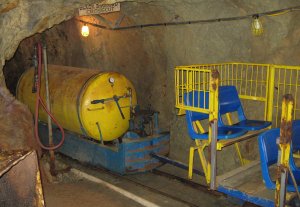
Underground Air Locomotive

Underground Air Locomotive

In Part 1 of my post on the Mollie Kathleen Mine in Cripple Creek, Colorado, I described the ride down to the 1000 ft level.  Having been in mines considerably less developed, I was impressed with the quality of the skip lift equipment and the general state of the mine workings above and below ground. The mine make heavy use of pneumatic equipment to minimize ignition sources.  The air locomotive above features a pressure tank which energizes an air motor to drive the contraption. It works quite well.
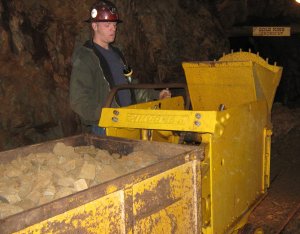
Mechanized Mucking with Pneumatic  Equipment

Mechanized Mucking with Pneumatic Equipment

Once at the bottom of the shaft, the mine appears to be little more than a hallway with steel tracks on the floor. In fact, it is a series of hallways, or drifts, and shafts. The goldbearing formation that the Mollie Kathleen mine has penetrated is a volcanic formation called a diatreme and it is composed of highly disturbed rock from ancient volcanic activity. The district contains gold in varying abundances. Certain features of the formation are more enriched than others.

In general, one does underground hardrock mining to exploit a network of veins enriched in value, in this case, gold.  By definition, an ore is a body of rock or mineral that contains commercially exploitable value such as gold. 
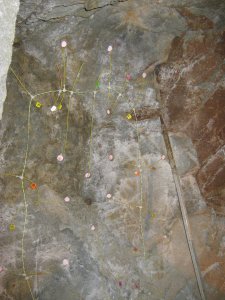
Blasting pattern prior to a shot

Blasting pattern prior to a shot

Solid rock is fragmented with explosives and loaded into ore carts. The rubble accumulated from blasting activity is called “muck”. Muckers were very important workers in a mine and the mines productivity hinged on their ability to load the ore carts as fast as possible. Until carbide lamps arrived, miners toiled in very low light levels in candle or kerosene lamplight.

With the advent of better technology came more effective and safer blasting agents, fuse cord capable of adjusting the timing of a blast sequence, and more efficient ejection of fragmented rock.  Near the center of the photo above is a pattern of holes filled with blasting agent. Well, except for one hole in the center of the pattern. This empty hole is placed specifically to provide for space for expansion relief.  A shot is timed to trigger the charges around the empty hole first, followed by concentric detonation of the blast pattern. Finally, a set of charges low in the pattern lift the muck out of the hole and onto the floor.
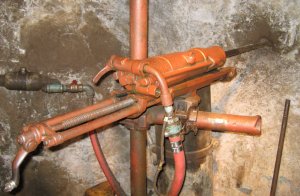
Pneumatic hammer for pounding a drilling steel into the rock wall.

Pneumatic hammer for pounding a drilling steel into the rock wall.

According to the tour guide, the Mollie Kathleen mine is fairly rich in gold but lacks access to a milling facility. Without milling and refinement, there is no point in pulling the ore out of the ground. So, until a scheme for beneficiation of the ore comes along, the gold will have to sit in the formation and make money for its owners as a tourist attraction.

As is common in mine tours, the staff is well versed in the history and mechanics of getting ore out of the formation. What seems to be glossed over or wholly ignored is the process of getting purified gold out of the ore. Being a chemist, I was naturally interested in the isolation process. The refining process I was able to “extract” from the mine tour operators was a simple but inefficient method.

Gold ore was pulverized and heated to high temperature in a way that resembles calcination. Diffuse wisps and pieces of elemental gold in the ore would melt and agglomerate so as to produce larger pieces of gold. The roasted ore could then be exposed to a mechanical/slurry agitation process that would dislodge the now larger pieces of gold and classify them by density much like the gold panning process.

The roasting process apparently oxidized the tellurium in the ore, resulting in a purification. The question is, did the roasting process just oxidize the free tellurium or did it free the gold from the gold telluride (Calaverite)?

Another process can be used to extract gold from the ore. It grossly resembles the mercury amalgamation method. Metallic lead is combined with gold ore and heated to some high temperature in a special container. A lead-gold alloy is formed which can be poured away from the gangue. The molten alloy is then exposed to air oxidation, forming litharge (PbO) and metallic gold which phase separate and can be separated mechanically. Assayers use a process called fire assay or cuppelation to extract refined gold for an assay.

Chlorine extraction was used to oxidize metallic gold to the soluble NaAuCl4 salt which could reduced by contact with carbon or by electrolysis. Chlorine water was used prior to the cyanide extraction methodology now in common practice.
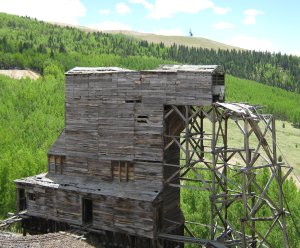
Old Headworks by the Mollie Kathleen Mine

Old Headworks by the Mollie Kathleen Mine