Tripping the Web Fantastic

First, my apologies to John Milton for my self-indulgent bastardization of a line of his prose.

Gaussling’s TOE (theory of everything) suggests that the universe will continue to exist until every strange occurrence that can happen, will happen. Perhaps the Hindu’s thought of this first … I don’t know. Anyway, we are one bit of strangeness closer to doom now that Snoop Dogg and Buzz Aldrin have cut a hip hop song. If I weren’t too cheap to pay for a download, I’d comment further on it.

Roger Ebert has captured the words I have been searching for to describe Bill O’Reilly and his ilk. My hat is off to Mr. Ebert for getting it right.  I think it is time to thin out the herd.

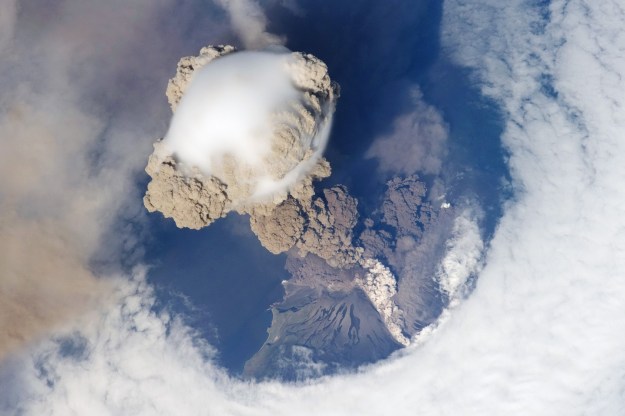
Eruption of Sarychev Volcano as seen from ISS

Eruption of Sarychev Volcano as seen from ISS

The photo above is from Nasa’s Earth Observatory web site and was taken by an ISS astronaut. Note the whitish pyroclastic flow radiating to the 5 o’clock direction. The Sarychev volcano is located on the Kuril Islands north of Japan.

Touring the Mollie Kathleen Mine, Part 1.

By way of a prelude to this post let me say that, as a child, I was plagued with nightmares about elevator shafts. A tallish building in a nearby city had an elevator that, in the style of WWI-era buildings, was comprised of an open cage controlled by a matronly operator. On each floor the entrance to the elevator shaft was guarded by a collapsible metal gate that allowed the visitor to see, hear, and smell the greasy workings of the elevator in all its cabled creepyness.

I would stand next to the gate as the elevator went about its single-minded business and peer down into the dark shaft with its writhing black cables, fascinated yet deeply in tune with the prospects of what a fall down this hole would mean.  Like most young boys, I had bitter experience with the unblinking and impersonal side of gravity.

It was this memory that flashed into my mind yesterday as I stood in a manlift the size of a large domestic refrigerator, crammed tightly into the cramped cage with 6 other people. We looked like a can of vienna sausages.  The lift was a double-decker, with an identical cage of sausages below.
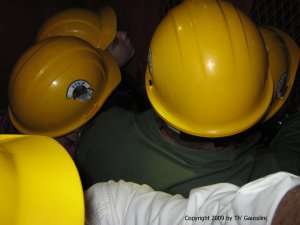
Crammed in Manlift

Crammed in Manlift

There we stood- a squashed parcel of humanity and hard hats in the orange lift, dangling above a 1000 ft column of air. Outside I could see the town of Cripple Creek, Colorado, sitting in the valley 400 ft below us. In two minutes, we would be 600 ft below the level of the town. As we began the descent and as daylight fell to darkness, I felt a my autonomic system select “Panic Mode”. But it was too late, we were committed. After 30 seconds, a graveyard calm replaced my momentary panic and all was well.
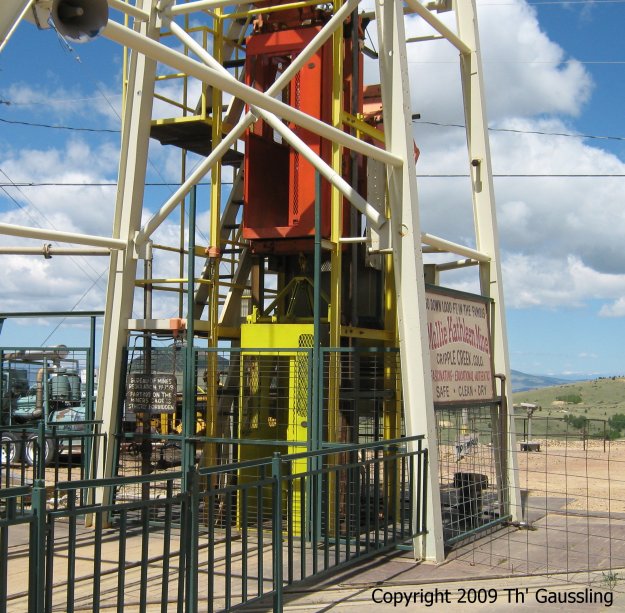
Double Decker Manlift at Mollie Kathleen Mine

Double Decker Manlift at Mollie Kathleen Mine

This was my first entry into the Mollie Kathleen Mine outside of Cripple Creek, CO. The tour begins in a drift 1000 ft below surface level. A “drift” is just a horizontal tunnel in an underground mine. I have toured a number of mines and caves and the common attribute to all of them is the absolute silence that is found underground. Today’s tour would be different.

The Mollie Kathleen Mine sits on the side of a mountain adjacent to the mammoth Cripple Creek and Victor (CC&V) open pit gold mine. The operators of both mines have independent claims to different parts of the same confined geological formation. The Mollie Kathleen is one of a great many underground mines in the area, of which only a very few are in operation today. It is presently open only for tours.  The CC&V mine is the only large gold mining operation in the area.

The CC&V mine is an open pit operation. Large hauling trucks carry 300 ton loads of ore rubble from the pit to nearby crushers which reduce the rock to 3/4 inch pebbles in preparation for the cyanide extraction process on the heap.  The rubble is the result of large scale bench blasting with ANFO blasting agent.

The CC&V does blasting on a regular basis. That day, while we were underground about 1-3 miles distant (my estimate), they set off a blast. We were down in the mine when the underground rumble hit. There was no ramp-up to maximum force- it began as a loud, strong rumble seemingly from every direction. We stopped in our tracks and instinctively looked at the ceiling trying to decide if this was a normal or off-normal event and, oh golly, will the the tunnel collapse? After 30 to 40 seconds the rumble subsided and the mine was silent again except for a few heartfelt expressions of relief. Clearly there was no danger for anyone, but the abruptness and the magnitude of the explosion only serves to remind one of the compromises made and the options lost while working underground.
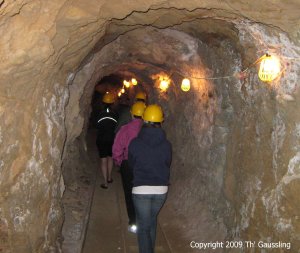
1000 Ft down into the Mollie Kathleen Mine

1000 Ft down into the Mollie Kathleen Mine

The tour guide was a young ex-miner from Montana who explained mining practices and demonstrated the numerous pneumatic tools used by hard rock miners.  In part 2, we will look at some of the mine workings and other features of the Mollie Kathleen Mine.
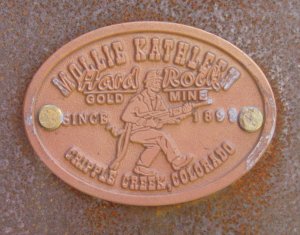
Hard Rock Placard. Photo Copyright 2009 Th' Gaussling.

Hard Rock Placard. Photo Copyright 2009 Th' Gaussling.

The Bitter Barn

At the recent San Francisco APA meeting, a call was made to define bitterness as a pathological condition. The proposed acronym is PTED – Post Traumatic Embitterment Disorder. I guess it covers the range from pissy to postal. Maybe our pharma friends can find an enzyme to inhibit for the treatment of PTED. Better yet, perhaps there is an animal model out there- say, badgers or wolverines. Sounds like a market opportunity!

Proterozoic Contact

My search continued today for an exposed contact between the upthrusted proterozoic igneous rock of the Rock Mountains and the Fountain sandstone formation. I returned to an obscure roadcut site I had examined a few months ago. Three (male) cyclists outfitted in expensive cycling couture (Spandex) were standing there nibbling on dainty little energy snacks next to the spot I needed to be as I pulled up and exited my vehicle with a rock hammer in hand. One seemed taken aback momentarily as I walked towards them with the chisled masonry hammer. It didn’t dawn on me until after they left why they were acting strangely- I startled them. Sorry fellas!  \;-)

With rock hammer in hand I scrambled up a steep and unstable scree slope adjacent to what appeared to be disturbed layer next to a gneiss formation. Down below, along the roadcut, a contact was visible between the gneiss and what appeared to be schist.  This dark material has a preponderance of mica with little gross evidence of stratification. I wrongly concluded that I was not near the proterozoic contact.

But as I followed this discontinuity further up the mountain I found clear evidence of a stratified sedimentary formation adjacent to the igneous rock. On a ledge high above the road I found an actual contact between what appears to be modified sandstone and gneiss. I found a sample that has the gneiss fused onto the layered rock that fractures into thin sheets much like sandstone or shale. Regrettably, I left the camera in the Jeep.

What appears to have happened is that the sandstone layer has been thermally modified along the interface due to the intimate contact with the upthrusted igneous rock. I had half-expected to see a simple interface between sandstone and an igneous rock. Instead, what I seem to be seeing at this site is a modified sedimentary layer that shows evidence of some localized metamorphic modification.

A nearby thin layer of rock in the interface zone appears to be glassy or vitrified, as though it has been partially melted. I do not interpret this to be a result of weathering. A rapidly approaching lightning storm forced me to cut my exploration short and run for cover.

So, I have some hypotheses beginning to take shape. Now the question is, how do I falsify my interpretations? I certainly have much to learn about petrology.

Freeman Dyson- Climate Skeptic

An excellent entry into interesting and high quality articles on the net can be found at Arts & Letters Daily. I found an interview of physicist Freeman Dyson. In the interview, the writer is trying to understand how someone of Dyson’s stature could be skeptical of anthropogenic global warming. Basically, Dyson is skeptical of the models used and is skeptical of the assumption that the pre-industrial climate is automatically a valid baseline climate. Dyson accepts that there may be more desirable climate scenarios and that climate change is not automatically bad.

What is lost in most of the public discussion is the history of climate over the past million or so years. The fossil and geological record does not support the assumption that the global climate is static. We’re presently 10 or 12 thousand years past the latest glaciation episode in a series of glaciation episodes. As I recall, the interglacial periods in North America have averaged something like 10-15 thousand years.

What happens to atmospheric CO2 levels as the temperature rises or falls? Does rising atmospheric CO2 lead to a temperature rise or is it a result of a temperature rise? I have not encountered an adequate explanation taking into account the temperature sensitivity of carbonate equilibrium.

CO2 is not an inert substance. It reacts strongly with water to form carbonate.  Obviously CO2 will get absorbed by the biosphere. Do the atmospheric models take the various carbon sinks into account? Perhaps a reader knows.

Water vapour is a potent greenhouse gas and is certainly more abundant than CO2. It must account for some aspect of atmospheric temperature change. Do cloud aerosols and sea spray absorb significant CO2? It’s kinda complex.

National Organic Symposium. Wender Wednesday.

My final attendance at the National Organic Symposium was Wednesday evening. An award was presented to editor-in-chief, Scott Denmark, on behalf of the monograph series Organic Reactions. The original editor was none other than Roger Adams. Denmark presented a retrospective slide show on the history of Organic Reations.

The speaker for the evening was Prof. Paul Wender from Stanford.  Wender presented a long but fascinating talk on his work with several complex molecules including bryostatin. I have to say that I was rather blown away by this work. I guess I’ve been living on a desert island.

Wender has the great fortune of having access to facilities and people who can do complex chemical synthesis and biological assays and all of the other wondrous things that are necessary to rapidly expose a valuable biopharmaceuticals. The payoff is that questions relating to the biological activity of particular derivatives can be answered rapidly and productive leads can be isolated and further cultivated.

This confederation of resources is perhaps as important to Wender’s productivity as anything. My point is that to be a Wender, you need more than just smarts and money. You need a network of like-minded coworkers whose particular strengths can mesh with yours to produce these kinds of results.  I think that his ability to pull together these kinds of resources is just as impressive as his native ability with chemistry.

National Organic Symposium. Tuesday Morning.

Bad day for Th’ Gaussling to be away. The hounds are snapping at my heels at work.

I managed only to see Eric Jacobsen‘s talk on catalytic urea chemistry. Jacobsen’s system is pretty much a chiral proton ligand that can carry along a nucleophilic counter anion. Configured differently, urea’s and thiourea’s with BARF groups on the nitrogen can coordinate with chloride. This can lead to the abstraction of chloride to give a carbenium ion that can then participate in a enantioselective Pictet-Spengler type reaction. 

Jacobsen’s system resembles a radically stripped down enzyme in terms of 3-point binding interactions by hydrogen bonding.  Where Jacobsen went askew is the use of calculations to justify his mechanistic model. The models did not include solvent interactions when affording only 0-2 kcal/mol (!!) differences in energy. Naturally this did not set well with certain distinguished members of the Audience.  The ΔΔG’s did not correlate with the ee’s at all either.

A certain J.D. Roberts took great exception to Jacobsen’s molecular modeling results, resulting in the spectacle of a Harvard Professor frantically qualifying his slides and words as he back pedalled for all he was worth. There was some actual contrition there on the stage. It was quite a thing to see. There but for the grace of God go I.

National Organic Symposium. Monday Morning.

The speakers for the morning of June 8th were Bob Grubbs and Magid Abou-Gharbia. As usual, Bobby Grubbs’ talk was concerned with the latest wonders of olefin metathesis. We saw ATM’s of molecular Cheerios. Pretty cool, actually. Grubbs got the trip to Stockholm for a reason and the work of his group continues to produce molecular wonders.  He was able to demonstrate the production of rings with degrees of polymerization in excess of 5000.  Using NMR and a carefully chosen ring monomer, they could sort out linear polymers from cyclic polymers. Linear polymers will thread a crown ether while the cyclic form will not. By attaching a crown ether (24-crown-8 ??) to polystyrene beads, they could collect and physically separate the linear from the cyclic forms. They were also producing brush polymers.

Prof. Magid Abou-Gharbia, Temple University, gave a talk with lots of fascinating insights into some current thinking on industrial drug discovery. At least from the point of view of a former Wyeth guy. I have been away from the pharma-related work for a number of years now and haven’t really missed it. But his talk has revived enthusiasms in me that have been in a long slumber. 

Anyway, he described the development of the anti-depressant Effexor and their efforts to keep the molecule simple and free of excessive stereocenters. Studies of the metabolism of Effexor lead to the discovery of the des-methyl analog, now called Pristiq.

Concerning High Throughput Synthesis (HTS)-

“… you’re going to get a lot of decorated molecules, but they are not going to be biopharmaceutically useful.”

Abou-Gharbia lamented the languishing of natural products chemistry. He gave some examples of Rapamycin work, which according to his presentation, was originally isolated from a soil sample from Easter Island.  Much productive work apparently has been derived from the modification of this macrocycle. It’s all in the literature.

One of the main take-away lessons from Abou-Gharbia is that workers shouldn’t get too focused on SAR. His advice was that structure-property relationships need an early examination as well. Dual optimization. If the bioavailability is low, then the in vivo activity will not match the in vitro activity- an expensive and time consuming realization.