
This evening I begin my first acting class. What is odd about this is that I’ve been in 17 productions already since about 2011 and, oh yes, retired from acting about 5 years ago. But, on a lark, I’ve decided to heed the advice of a director years ago and take a class out of curiosity. Our text is by Stanislavski.
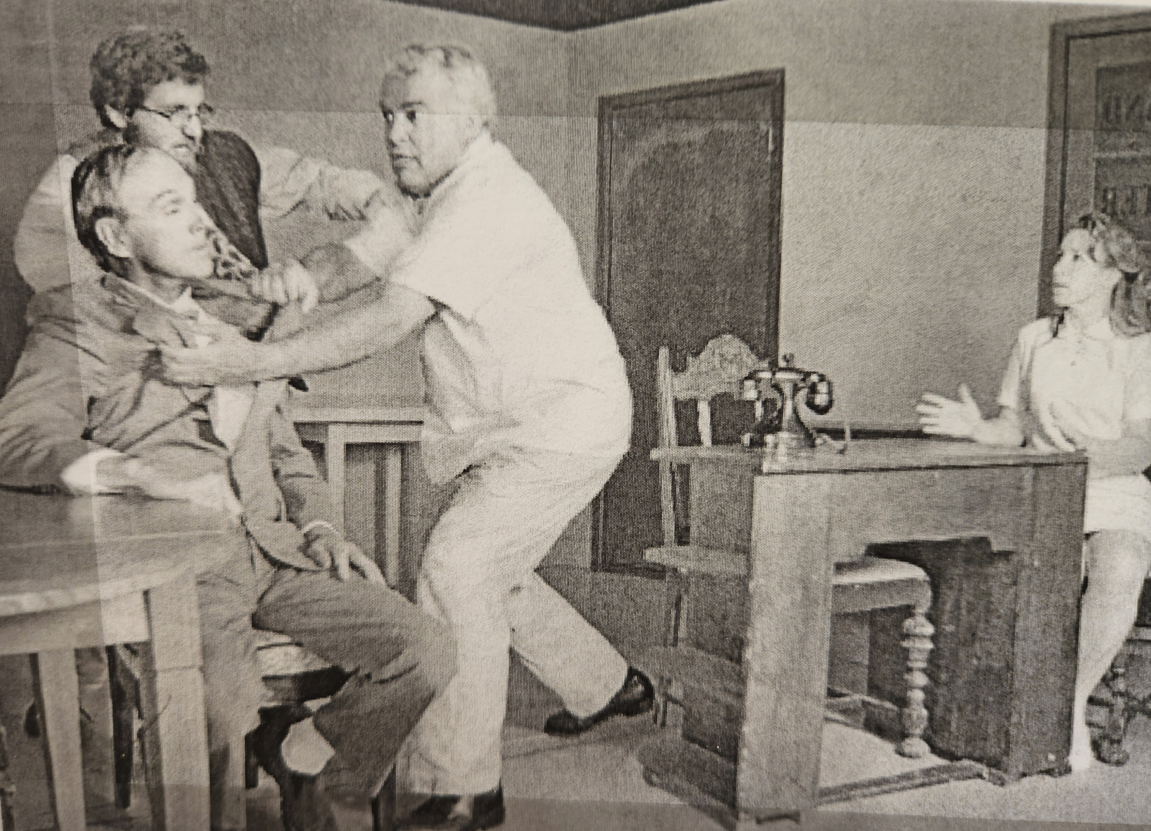
I’ve been on the community theater stage enough to have lost most of my fear of it. I’ve played a drunken Scotsman, several British detectives, sheriff Tate in To Kill a Mockingbird, a mute king in Once Upon a Mattress, a bishop and a cardinal in A Man for All Seasons, and someone in Harvey, among other plays.
Acting is quite a bit more involved than one might think. Obviously, you must memorize your own lines, but you must also know many of the lines of others in order to recognize your cues. The goal is to suspend disbelief and give a convincing portrayal of your character and contribute to the overall emotion of the scene.
One of the most difficult situations to come along on stage is when you or another actor forgets their lines. Unless somebody says something quick, a dark and silent pause washes over the audience, damaging the 4th wall. The other actor may cover for you by continuing with the dialog hoping you can pick up on it. Sometimes the other actor may skip a whole page of dialog leaving you to recognize the unexpected gap and carry on.
The best actors I’ve been around are able to fill a lapse with improvised language that covers the slip up long enough for the other actor to catch up. I’m taking the class because I was never good at improvising to cover a memory lapse. But no matter how good the other actor is, you still must slip back into dialog as seamlessly as possible. Inconceivably, audiences don’t always notice slip ups.
Improvising lines as opposed to sticking with the playwright’s text is very unappreciated and frowned upon. On a fundamental level, the playwright owns the content and every word is put there on purpose by the writer. On a practical level, other actors depend on you to say their cue lines properly. It is a good way to become unwelcome.
Another difficulty for me were the rapid back and forth dialogs with the other actor as would happen an argument. The scene is very satisfying when done fast and with verve, but a total loss of dramatic effect when done slowly.
Theater is a blast and theater people are fun to hang out with.
 Lamentations on Chemistry