
I’ve long had difficulty with the validity of advice that says “always stand up for what you believe.” Superficially, it is inspirational to those working in a difficult and discouraging situation. It is meant to convey encouragement that a person should strive not to give up on a difficult goal. Keep chipping away at the problem. You can eat an elephant, but only by one bite at a time. There are many aphorisms that tie into this sentiment. A crisp analysis of this is not like a problem in algebra, you know, a problem with a unique solution. If you share the person’s subjectivity, then perhaps there is no problem.
Standing up for what you believe is often used to proclaim a refusal to give up some action or view. It can telegraph moral clarity and devotion to an ideal.
What are we to think when a leader stands up and proclaims that they intend to stand firm on their convictions? Irrespective of whether or not you agree with them, doesn’t their proclamation to stand fast say something about flexibility in the face of contrary evidence or logic? If new thinking comes along, wouldn’t we want a leader who can turn the boat around to a better heading?
We don’t want wishy-washy or indecisive leaders- don’t we really want action based on the best thinking? In a democracy it is our job to put the best thinkers in the important slots.
The weakness of this advice comes into view when you consider whether any given goal is “worthy” or not. Is there objective information or reason supporting going after a goal or maintaining a belief? Even if a belief or goal is objectively valid, is it something worth committing your life to? Will it really lead to the desired end? On the personal level, someone may be convinced that a goal is indeed worthy and is backed with good intentions, tight reasoning or what appears to be justifying evidence.
A person may be genuinely convinced that their goal or belief is worthy irrespective of objective fact or analysis. They would be making a subjective decision to stay on the path for reasons of comfort or aesthetics. As long as your path is not harmful to those around you, why not?
People possessed of divine certitude in their politics or religion, for example, will often claim that a particular hill really is worth dying on. They are willing to defend their beliefs to their last breath, a few in the literal sense but most metaphorically speaking. Righteous though they may seem, are we obliged to stand by and let the firmly held but baseless or insane beliefs of others swerve our democracy into an autocratic swamp of fringe beliefs and looney political theories?
The societal problems are supposed to be addressed by voting based on rational thought and conveyed through freedom of speech. Today in the US, large and well-funded forces are focused on eliminating time-tested elements of democracy based on firmly held beliefs.
The practical difficulty in the US is that monied interests have the cash to buy media time to persuade the masses. Repetition of untruthful assertions and fearmongering are highly effective. Recruiting and inciting people into the dark side of politics is all too easy as the GOP has shown for decades. And yes, I’m taking sides.
This is my theory: From the view at 30,000 feet we can broadly divide thinking into two manifolds- analytical thinking and devotional thinking. Analytical thinking is that in which conclusions or practices are based on consideration of established secular principles, measurable evidence and the science behind cause and effect.
Devotional thinking is rationale based on adherence to doctrine- be it religious or political. A particular doctrine guides a person’s beliefs, emotions and actions or conclusions, maybe even in the face of contrary evidence.
Analytical thinking is my preference but it can go awry. Conclusions may be drawn from faulty evidence or previous thinking that is factually incorrect or poorly conceived. Worse, human thinking is subject to stranding in the cul-de-sac of confirmation bias. Many of us get stuck in this appealing comfort zone indefinitely. Beliefs or opinions are often cherished and difficult to release.
So, what do you say to a person who adheres to a belief that can be objectively contradicted with arguments based on data or rational analysis? How far along are we obliged to indulge a person in a faulty belief? Should we be supportive and encourage them to “stand up for what you believe” knowing full well that they are on a fool’s errand or their belief leads to actions troublesome for others?
This is where politics comes in as useful. In principle, poor thinking can be outvoted. A majority of poor thinkers with bad ideas is a problem as history shows. Assuring the survival of liberal democracy takes continual monitoring. Oh yes, the continuance of liberal democracy is axiomatic in my view.
No doubt this ground has been plowed by philosophers for centuries. But, I don’t call myself a philosopher.
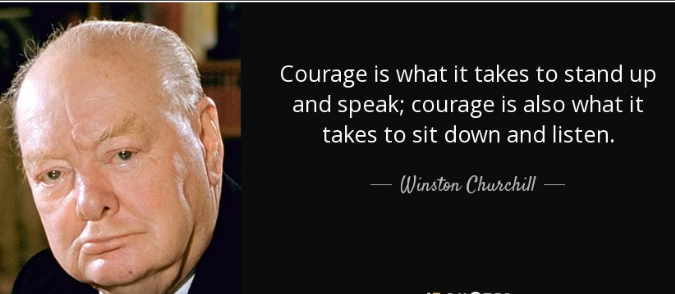
Is it really our place to correct a person’s belief? Who am I to reset an adult’s thinking? If someone is operating on the basis of incorrect information, like a definition or a piece of data, it could be argued that correcting them would be an act of kindness. If someone is just full of harmless baloney, then perhaps they should be left to wander through life as is.
This situation has been part of the human condition forever. Everyone has the right to be an idiot now and then. But what happens when their idiocy becomes a problem for others or too self-destructive to stand by and watch in civil society?
Speaking for myself only, I’m inclined to ignore those who espouse ignorant or magical beliefs. I’ll steer clear of the flat-earthers or Baptists, for instance, as not worth the effort to engage. With homeopathy believers, in a moment of weakness I might engage with some words about basic chemical principles relating to dose/response relationships. With the anti-vaccine crowd … this a tough one. All too frequently I go non-linear and become scornful of those harboring misplaced fear or anger towards vaccination. I’ll start gibbering and sputtering if I don’t quit thinking about it.
Speaking of goofy beliefs, I’ve had a longstanding issue with most religions, the big 3 in particular. To me, standing up for something that derives from magical thinking and no evidence seems foolish. Writings of dubious origin and translated or edited over the millennia could be as source of fiction or a mixture of truth and fiction. Followers of religion operate under the belief that their religious doctrines are set in stone and are the basis for all moral behavior.
Religion finally boils down to being a theory of the universe. The big 3 religions have always struck me as transparently anthropomorphic rationalizations of the universe using iron age thinking. I used to engage with others on this for fun but it’s nothing but aggravation now.
Does science give us the ultimate view of the universe? We only get pieces of it directly. The universe most of us know is substantially based on our what our brains perceive via stimulation of the nervous system. What we can see is limited to a very narrow slice of the electromagnetic spectrum, maybe one octave wide. Light waves exist many octaves distant on either side of the visible range. On the high energy side, there is the gamma ray universe shining brightly from nuclear reactions in stars and other objects. On the low energy side is the radio universe shining away by larger scale mechanisms. Adjacent to the visible spectrum is the x-ray and ultraviolet spectrum. On the opposite side are infrared and microwaves. All can reveal insights based on how they interact with matter. We exploit imaging, spectroscopy and mathematics to understand the universe outside of the solar system.
But maybe the reality we experience is just a type of baseline hallucination that we think of as our “normal” consciousness.
Science is unable to help with the desire to know the supernatural. Science requires observation, quantification, measurement and analysis. I suppose that if you could start classifying and counting miracles per square kilometer, you could begin to understand the effects of location and type of miracle. Anyway …
Gosh. It seems that I’ve painted myself into a corner.
 Lamentations on Chemistry