US President Donald J, Trump has declared that the illicit synthetic opioid Fentanyl has been declared a weapon of mass destruction, WMD. Fentanyl precursors have been added to the Convention against Illicit Traffic in Narcotic Drugs and Psychotropic Substances of 1988. This WMD status is from casting about for justifications to be at war with Venezuela or other countries.
When you are in control of the world’s most powerful military, there must be tremendous temptation to use it to clobber someone. When you’re a hammer, everything looks like a nail.
Intermediates added to the Convention against Illicit Traffic in Narcotic Drugs and Psychotropic Substances of 1988:
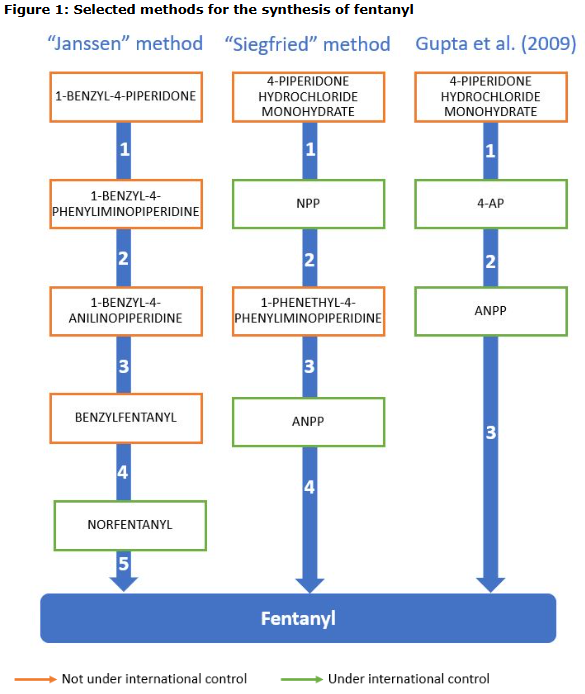
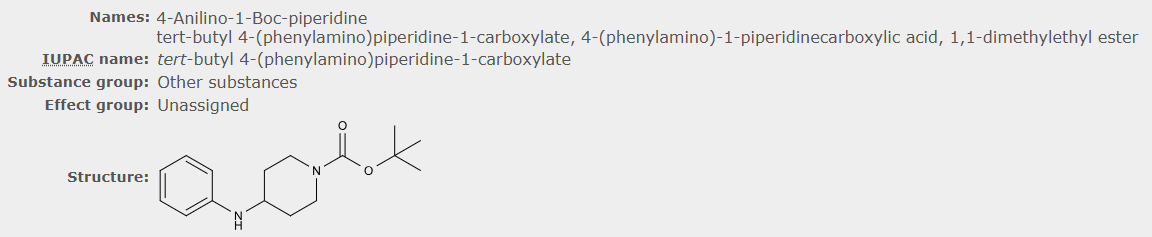
“In 2017, two main precursors namely N-Phenethyl-4-piperidone (NPP) and 4-anilino-N-phenethylpiperidine (ANPP) were placed under international control. Since that time, traffickers have adapted their approach to use alternative precursor chemicals for fentanyl manufacture. Three of these precursor chemicals, norfentanyl, 4-AP and 1-boc-4-AP, have now been placed under international control.
The WMD designation is clearly about legally mobilizing the military to interdict transport of fentanyl into the USA. The choice of fentanyl as a drug to manufacture by the cartels comes down to the extremely high potency and the relative ease of manufacture. The high potency, 2 milligrams for a lethal dose, means that it can be highly diluted with another drug and add to the overall potency. The high potency also means that a great many doses can be transported in small containers that may be easier to disguise and transport.
The obvious downside to fentanyl distribution is for the user. How careful are the people who spike intermediate quantities of substances, e.g., heroin or coke, so as not to provide a toxic product when repackaged for individual doses? Fentanyl should be redesignated as a highly potent toxic substance outside of the health care industry. As a drug distributor you probably don’t want your customers falling over dead from your product. That’s bad for repeat business. Regardless, user safety is unlikely to be a major concern to the distribution chain.
Sodium borohydride (NaBH4) can be used in the synthesis of fentanyl, so it is on the DEA Special Surveillance List. Sodium borohydride is a very useful and relatively safe hydride reducing agent that I and hundreds of thousands of others have used over the years in chemical synthesis. Sorry to see possible restrictions on its use.
The problem with this “designation of fentanyl and precursors” is that making a designer drug not cited in some list based the structure of fentanyl is that potent analogs can be dreamt up and produced if the right raw materials are available. Any organic or medicinal chemist should be able to come up with a list of candidates. Using existing drugs as a rough guide, producing obscure analogs is a skill set used by pharma companies frequently: Methyl, ethyl, butyl, futile … as the saying goes.
Wouldn’t it be nice to make some headway on the demand side too?
Fentanyl anecdote-
A few months ago I had surgery that involved my being anesthetized with fentanyl. I’ve been dosed with fentanyl several times and can report that it works well. What I didn’t note until the last instance was that it caused my face to itch badly for about 1 hour after surgery. Turns out this is a normal side effect and is not harmful. I had to wonder if addicts whose heroin was spiked with fentanyl had to suffer from both opioid-caused constipation and an itchy face. They have my sympathies there.
[Note: This is a much-updated revision of a previous post from March 24, 2023. I’ve brought in just a tiny bit of protein structure and how it relates to opioid receptors- but only slightly. I’m thinking of you, dear reader. I’ve succumbed to my compulsion to include chemistry tutorials in my posts.]
First, a lot of chemists could say a lot of things on this topic. This is what I have to say. This essay is not written for medicinal chemists or molecular biologists. They already know this stuff. This is for everyone else. Learning usually requires an expansion of your vocabulary and this is no different.
When it comes to illicit drug synthesis I’ve always been a bit of a Puritan. As an organic chemist I’ve always felt that it is morally indefensible and a waste of talent for a chemist to make or help make dangerous and illegal drugs. Putting potent, illegal drugs on the market is like leaving a hand grenade in a playground.
For myself and for many others, what is fascinating about drug molecules is how structural features on a drug molecule confer pharmacological effects on biological systems. The molecular-level effects are referred to as a structure/activity relationship, or SAR. The chemical structure of a drug molecule makes all of the difference in how a drug functions. Among the key features are water solubility, acidity/basicity, hydrogen bonding, resistance to metabolic degradation, and the manner in which charge is distributed on the drug molecule. As a reminder, in order for two molecules to react they must bump into one another in a particular way. And not just that, but bump into a particular spot oriented properly and with sufficient energy.
Drug molecules do not swim directly to the site they are intended to go. They must take a random walk through flowing, jostling biofluid molecules and a certain minimum dose must survive the ordeal before they are metabolized, excreted or both. Some pharmaceuticals, called “pro-drugs“, are constructed in a way that relies on the action of metabolic processes to change them into the active drug. This is because they have some kind of chemical vulnerability and must be whisked into the body in disguise. Many drugs are bind to blood proteins and may remain unavailable for their action.
What the protein can do depends in large part on the sequence of amino acids that it is comprised of and how it relaxes into a largish, kinked and contorted chain with helices and pleated sheets. A protein polymer is made of a chain of amino acids that can interact with other molecules or with itself. Some lengths of a protein may lie flat and be somewhat rigid while other lengths may coil into a helical form. A protein molecule made of these features can then bunch up into a wad of protein that holds a particular shape. Along the surface of this shape are bumps, folds and crevices. In these places, there may be exposed amino acids that can attract acidic or positively charged parts of a molecule. Other spots may attract basic features like nitrogen with its lone pair of electrons. Still other places will attract molecular features with poor water solubility or just low polarity.
Drugs are used to activate or inactivate the function of a protein. Living things use proteins in several ways. In the case of drug action, proteins are large chemical structures that can make or break chemical bonds. proteins that do this can do it catalytically, that is, one enzyme molecule can perform its function repeatedly. That’s not all. There are features along the length of a folded enzyme chain that can attract, bind and even deform a molecule that is bound to it. In doing so, a chemical transformation can occur at physiological temperatures that might otherwise occur only under more chemically forcing conditions. This ability of enzymes is crucial to life itself.
Another function of proteins is the ability to change their shape to open or block the passage of smaller ions and molecules through it. The cell walls in our body consist of a double layer of fatty, detergent-like molecules that are water repelling on one side and water attracting, or ‘hydrophilic’, on the other. The water repelling, ‘hydrophobic’ side consists of a long chain of 2 or 3 hydrocarbon chains that comingle with one another.
In order for a drug to function it must bump into the target biomolecule like an enzyme (protein) and at a particular location on the enzyme. Some drugs may remain unchanged and just spend a lot of time bound to the active site of an enzyme, preventing the intended biomolecule from doing so. Others may permanently bind to a protein or other molecule, thereby blocking it from doing its job for the life of the enzyme. And others, like aspirin, may leave behind a fragment of itself permanently blocking the active site of an enzyme. Some drugs prevent a protein or enzyme from working and are called antagonists. Others may activate it and are called agonists. What you aim for depends on the system you are trying to manipulate.
A dip into proteins
An atom, ion or molecule that binds with a metal or a protein is called a “ligand“. A ligand, pronounced ‘LIGG und’ by organikkers and inorganikkers, or ‘LYE gand‘ by waterchemists biochemists, can connect with a protein through one or more attachment points. The greater the number and strength of the attachment point(s), the more time the ligand will spend being attached. A ligand may even become permanently attached. Ligands purposely or externally provided for a desired outcome are considered as “drugs”. Ligands that cause an undesired outcome may be referred to as toxic. Not all ligands are aimed at human proteins, however, such as the beta-lactam antibiotics which bind with certain bacterial enzymes. This is a fascinating topic all by itself, but it is left as an exercise for the dear reader.
Ligands or drugs can have specific structural features that are associated with its activity or potency. This assembly of molecular features on the ligand is called a “pharmacophore“. An enzyme will have small region on its surface that can accommodate the “docking” of a ligand with the right shape and polarity
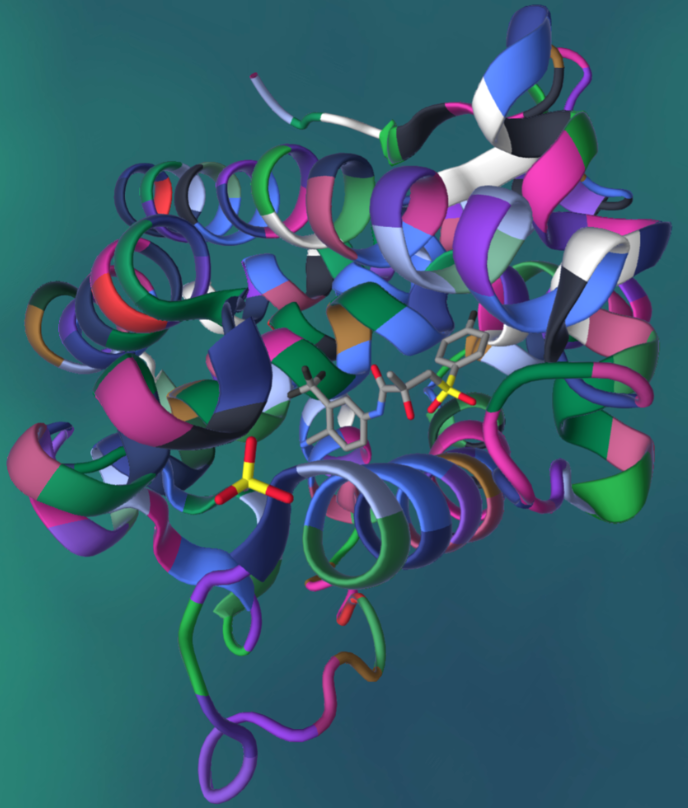
Source: Wikipedia. This image is from x-ray data showing a ligand snugly fitting into a pocket on a protein. Crystal structure of W741L mutant androgen receptor ligand-binding domain and (R)-bicalutamide complex. An example of a protein–ligand complex.
In the image above, a close look will show a drug molecule sitting in a space that is complementary to its shape and polarity. If it turns out that this space is where the normal biological ligand docks in order for the enzyme to do something to or with it, then the enzyme behavior has been altered. The drug molecule being bound by the enzyme blocks the site that is normally occupied by the biological ligand. The biological ligand may enter the site to be chemically altered, or it may be the natural signaling agent that activates or deactivates the enzyme. The activation/deactivation may be permanent or not.
Another possibility for ligand-type activity is that of a cofactor. When the cofactor docks to an enzyme, the shape of the enzyme changes -a common effect- and another docking site is activated, enabling the enzyme to function. Some cofactors are vitamins or are made from vitamins.
The amino acid chain making up the enzyme is folded up in a particular way depending on the amino acid sequence. The overall shape of the enzyme consists of ridges, bulges, clefts and can also include a hole straight through the structure. Each of the 20 amino acids available is unique by way of its particular kind of chemical functional groups that are attached. If we imagine the exterior ‘surface’ of the protein, the amino acid chain twists and turns giving a lumpy surface topography. The different amino acids with their unique attached side-groups can jut out from the chain and be accessible to external molecules.
Different substances that share these features may comprise a family of substances having similar activity. In the case of opioids like fentanyl, this active site is referred to as an “opioid receptor“. There are a several variants of opioid receptors distributed throughout the human brain.
Opioid receptors are transmembrane proteins. They sit immobilized within the cell membrane with their external receptor protuberances gently swaying in the warm biofluid currents. They lie in wait for a shapely substate to happen by and nestle into its special cleft and be rewarded with a small release of Gibbs Energy.
The lipid bilayer of a cell membrane, comprising comingling long-chain hydrocarbon tails, is very hydrophobic (water repelling). Transmembrane proteins are compatible (likes dissolve likes) with that environment and can exist imbedded within the cell membrane. In this position, with access to both interior and exterior sides of the membrane, the protein is set up to be a receptor. A receptor is a protein that by virtue of its shape and polarity can recognize complementary shapes and polarities of a specific range of signaling molecules such as a hormone and transmit or release a chemical signal to the other side of the membrane.
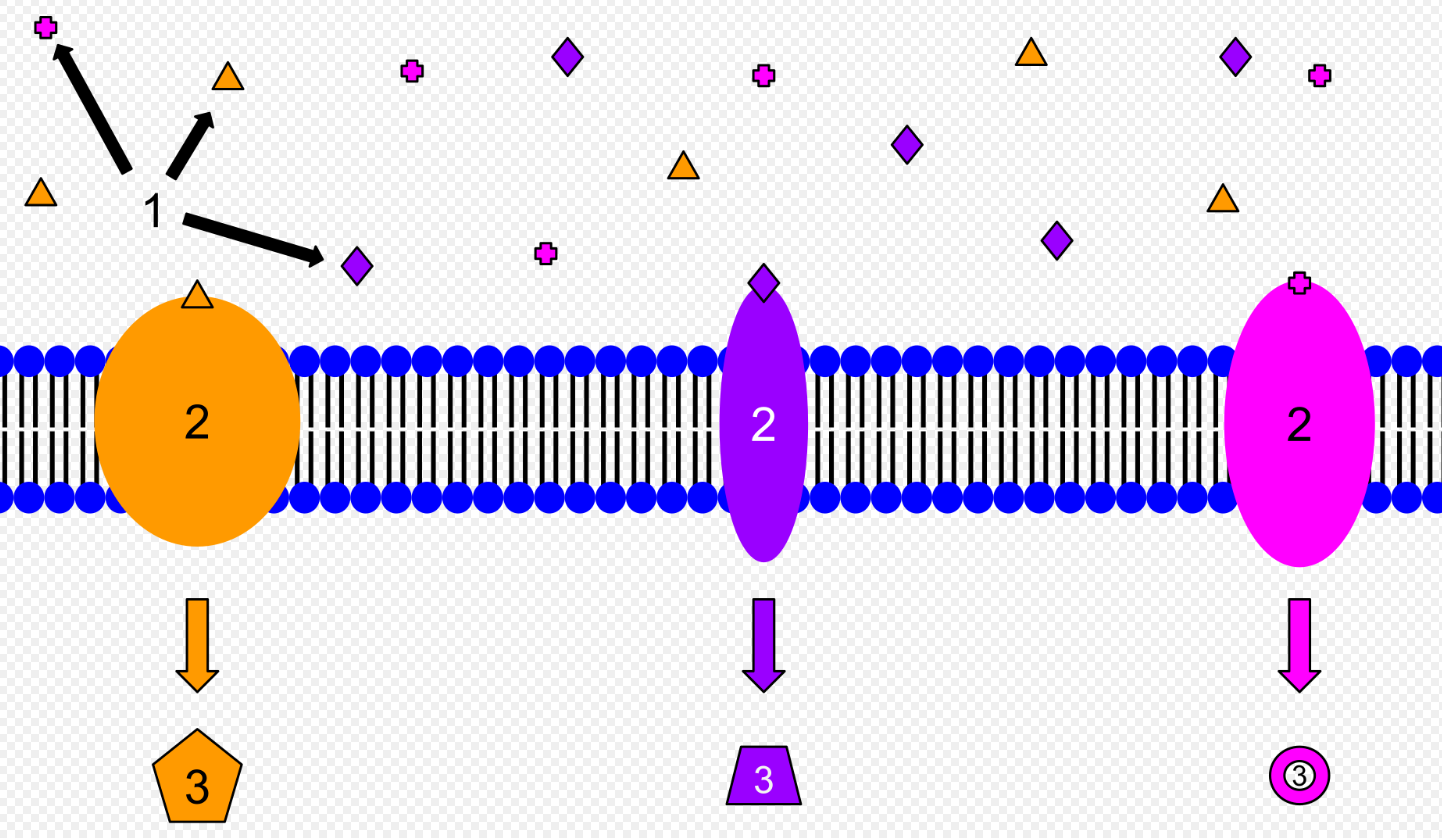
Source: Wikipedia. The enzymes above are called transmembrane proteins. The opioid receptors are of this variety.
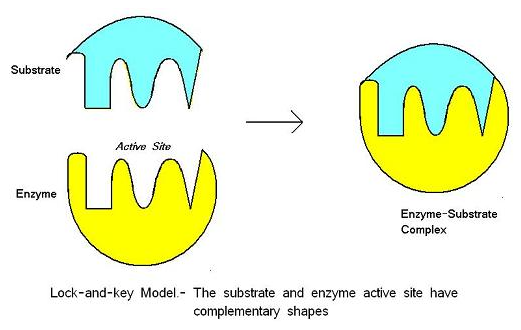
Source: Wikipedia. Complementary shapes. This illustrates ‘recognition’ of opioids by opioid receptors. Different but similar shapes can also be complementary but with varying degrees of affinity. Close resemblance in shape allows drugs to function.
End biochem section
According to the DEA, fentanyl is the most serious drug threat the US has ever faced. In the 12 months ending January, 2022, there were 107,375 deaths from drug overdoses and poisonings. Of those, 67 % involved synthetic opioids like fentanyl.
Fentanyl is not found in nature. It is made in a reaction vessel or a bucket by a person. It is totally synthetic in origin and is prepared from other manufactured substances. The molecule is relatively simple and there are many places on it where new functional groups can be attached to produce designer analogs. Due to its startlingly high potency, a large number of doses can be made in fairly small batch equipment.
The explosion of fentanyl use is mind boggling. Drug cartels have taken to producing it themselves for greater profit and a more secure supply chain. The common syntheses are fairly simple, high yielding and, in the case of fentanyl, there are no stereochemical issues other than the atropisomerism of the amide bond. As far as purification goes, this isomerism is difficult to control and it is hard to believe that it is considered a problem by the “cooks” who make it.
A quick search of Google failed to bubble up information on what chemical form of illegal fentanyl commonly shows up on the street, whether as a free-base form or a salt. Like most amines, the free-base could be salted out of a reaction mixture by addition of an acid to a solution of free-base fentanyl in an organic solvent to produce the insoluble salt crystals. This solid material is then recovered by filtration. This is a common method of recovering amines from a reaction mixture.
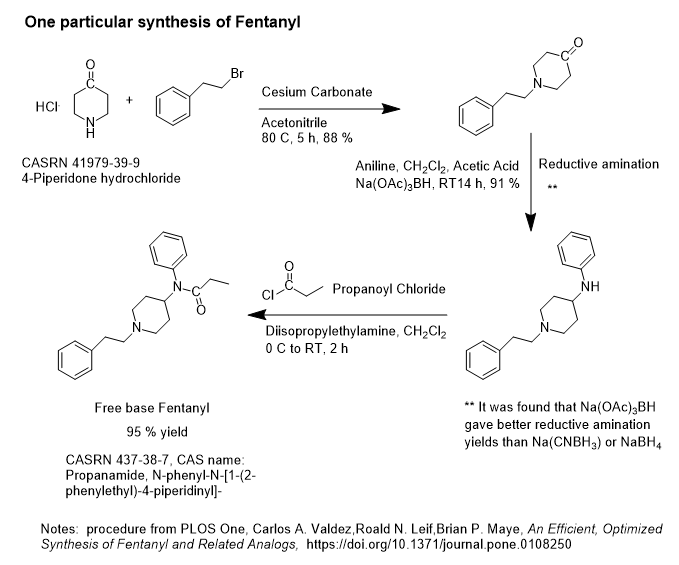
It is worth looking at a synthesis of fentanyl to see what kind of chemistry is performed (see below). There is nothing remarkable about this synthesis- it’s just an example. A key raw material is the 4-piperidone hydrochloride on the upper left of the scheme. It is a piperidine derivative which is a feature of many drug substances. This one has 2 functionalities– the nitrogen and the C=O at the opposite end of the ring. Connections will be made at each end as the synthesis proceeds. The hydrochloride feature results from how the manufacturer chose to sell the product. Ammonium salts are frequently more shelf stable than the free amine.
The first step in the process below combines 4-piperidone hydrochloride with phenethyl bromide in the presence of cesium carbonate in solvent acetonitrile. In this transformation the nitrogen displaces the bromide to form a C-N bond connecting the fragments. Cesium carbonate is a base that scavenges acid protons. According to Wikipedia, cesium carbonate has a higher solubility in organic solvents than do the sodium or potassium analogs. Cesium carbonate is commonly used when a base stronger than sodium carbonate is needed. In order for the reaction to go forward, the HCl must be neutralized to liberate the free base. It is hard to imagine that the folks doing an illegal preparation are using a cesium base due to higher cost. The displacement of the bromide by nitrogen releases hydrobromic acid as well which must be removed from the mixture. Bromide is chosen because it is a good leaving-group. para-Toluenesulfonate, or tosylate, has been used as well.
Next, aniline must be added to the piperidone ring where the C=O is located. We have to end up with a single C-N bond connection from the aniline nitrogen to the C=O double bond then remove the oxygen and replace it with a hydrogen atom. Aniline is quite toxic and volatile with an LD50 of 195 mg/kg (dog, oral). It stinks too. This sequence is referred to as a “reductive amination“, meaning that the oxygen is replaced by single bonds to nitrogen and hydrogen. Adding hydrogen to a molecule is referred to as a reduction. The authors of the work commented that of three hydrogen donors tried, sodium triacetoxyborohydride gave the best yields. These borohydrides donate hydrogen as the negatively charged hydride, H:–.
Acetonitrile is a polar aprotic solvent that allows enough solubility to the reagents and intermediates so as to help the reaction along. Reductive amination classically proceeds through a C=N (imine) intermediate which then undergoes a hydrogen reduction of the bond to give the amine product.
The two-nitrogen intermediate is then fitted with a 3-carbon fragment bearing a C=O to the aniline nitrogen connected to the benzene ring. With this transformation, the amine nitrogen becomes an amide nitrogen. The fragment added is called propanoyl chloride (pro-PAN-oh-ill KLOR-ide) and involves the displacement of the chloride with the nitrogen producing hydrochloric acid. The purpose of the diisopropylethylamine base is to serve as an acid scavenger. The solvent was dichloromethane which is not uncommon for this kind of reaction. It has a low boiling point for easy removal by distillation and a slight polarity for dissolving substances that are somewhat polar. It is also inert to the reaction conditions.
It takes a high level of education, training and resources to design and perfect a process like the one above. However, it can be executed by most people after a bit of training. You don’t have to be a chemist to follow the procedure. The trick will be to avoid poisoning yourself from aniline or fentanyl exposure in the process.
However illegal fentanyl is made, the raw materials going into it must combine to give one unique final product. There are not an infinite number of pathways to fentanyl. However, structural variations of the raw materials could be chosen using the same basic reaction conditions to produce a spectrum of designer analogs. If specific molecules are outlawed, analogs can readily pop up to skirt regulations.
The people who make illicit fentanyl are sourcing the raw materials from somewhere. Unlike heroin, there are no natural substances in the manufacture of fentanyl. Heroin is just plant-based morphine that has been acetylated. Acetic anhydride is the choice commercial reagent for this. The acetic anhydride supply chain can be traced. Fentanyl, however, requires a supply chain for numerous fine chemicals. In the US, many substances are flagged by suppliers in a way that could cause the authorities to investigate the buyer. Furthermore, US commercial suppliers often could do a Dun & Bradstreet credit check on you to gauge your suitability as a customer. Commercial chemical suppliers will not ship to a residential address or PO box. So it takes a bit of business structure to get chemicals sent from established chemical suppliers to your address.
The way to avoid this hassle is to import from somewhere like Asia. Given the high potency of fentanyl, the mass of raw materials in a shipment could be very low. Most organic chemicals are whitish or colorless and can be mislabeled. The lower the molecular weight of a substance, the lower the mass that will be needed for the process. There are no high MW reagents in the scheme above.
Herein lies the problem with fentanyl. It requires raw materials that have legitimate uses in the chemical/pharmaceutical industry and these substances can received by unscrupulous operators who can repackage and divert shipments to the bad guys in countries along the Pacific coast of the Americas. It is just simple smuggling.
The estimated lethal dose of fentanyl for humans is 2 milligrams. According to one source, “The recommended serum concentration for analgesia is 1–2 ng/ml and for anesthesia it is 10–20 ng/ml. Blood concentrations of approximately 7 ng/ml or greater have been associated with fatalities where poly-substance use was involved.” Overdosing with fentanyl is reportedly treatable with naloxone. But this is only effective if your unconscious body is found by a sympathetic bystander and help is called in promptly. This is a very slender reed from which to hang your life.
It is left to the reader to look further into the pharmacology and therapeutic window details fentanyl. Suffice it to say that dosing yourself with illicit opioids is a stupidly risky business. The illegal opioid risk is multiplied by other additives or the possible presence of designer analogs which may be 10 to 100 times more potent. End-use safety is not a priority of those who make and distribute these opioids.
Given the estimated 2 mg lethal dosage, fentanyl should be regarded as a highly toxic substance. As long as there is demand for potent opioid substances, someone will provide it. When the oxycodone supply tightened recently, heroin demand rose. It’s a deadly whack-a-mole situation. The only answer is reduced demand.
The news service Reuters recently published an article on the ease with which the raw materials for the production of the opioid Fentanyl. From their $3600 expenditure on raw materials they estimate they could have produced $3 million worth of Fentanyl.
For an estimated 74,702 Americans in 2023, Fentanyl provided them with a narcotic experience prior to death. The lethal dose is reported to be 2 milligrams for an adult. It is 20 to 40 times more potent than heroin.
Outside of medical use Fentanyl should be described as a highly (neuro)toxic substance rather than just an opioid. Yes, it is an illegal narcotic, but it is also a potent deadly poison. Hidden with other illegal drugs in pill form, it is just a highly toxic contaminant.
On January 5, 2024, I posted a piece titled “A Bit of Fentanyl Chemistry” which is reproduced below. It turns out that the Janssen synthetic chemistry I wrote about then is quite close to what the investigators at Reuters had in mind for their story. In the world of chemical commerce, a process using easily available raw materials is highly favored.
My take-home message from the Reuters story is that unless China seriously clamps down on those who export the raw materials, all that is left to do is to suppress demand. The import of Fentanyl raw materials is aided by deceptive packaging and small quantities needed. Worse, Fentanyl raw materials have other uses in pharmaceutical chemistry and are too useful to completely shut down. The death and incarceration that Fentanyl can bring in the US does not appear to be sufficiently convincing to the at-risk American population. Nothing new here.
=========================
A recent raid on a clandestine drug lab in the Hatzic Valley east of Vancouver, BC, netted 25 kg of “pure” fentanyl and 3 kg which had already been cut for street use. Precursor chemicals used to manufacture the fentanyl were also seized. Along with the drug, the raid also seized 2,000 liters of chemicals and 6,000 liters (about 30 drums) of hazardous chemical waste, according to an RCMP news release 2 November, 2023.
The police said that the seizure represented 2,500,000 street doses.
In August of 2023 the police in Hamilton, Ontario, announced the results of Project Odeon. This was a large-scale sweep of illicit drug production in the Hamilton and Toronto area. From January 1, to July 30, 2023 there were 606 incidents related to suspected opioid overdoses and 89 suspected drug related deaths in the Hamilton area. Twelve people were charged for a total of 48 criminal charges. The police disclosed the following items that they seized-
An operational fentanyl drug lab at 6800 Sixteen Road, Smithville.
A dismantled fentanyl drug lab at 4057 Bethesda Road, Stouffville.
Approximately 3.5 tons of chemical byproduct from fentanyl production.
800 gallons of chemicals commonly used in the production of fentanyl
Lab equipment commonly used in the production of fentanyl
64.1 kg of illicit drugs, including 25.6 kg of fentanyl, 18 kg methamphetamine, 6 kg of ketamine
A loaded, Glock firearm and ammunition and four extended magazines
Over $350,000 of seized proceeds, including cars, jewelry, furniture and cash
Fentanyl is a synthetic drug first prepared in 1959 in Belgium by Paul Janssen (1926-2003). Janssen was the founder of Janssen Pharmaceuticals, now a subsidiary of Johnson & Johnson. In addition to fentanyl, the Jenssen team developed haloperidol, the ultrapotent carfentanil, and other piperidine based congeners. Piperidine itself is a DEA List 1 substance in the US.
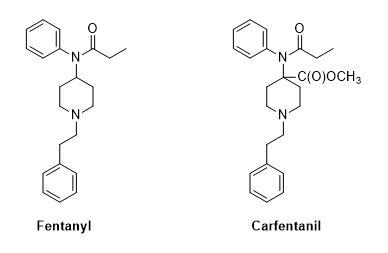
Carfentanil is just modified fentanyl. Graphics: Will O. de Wisp
The elephant in the room with fentanyl is its extraordinary potency as an opioid. In pharmacology, potency is a quantitative measure of the amount of dose needed to elicit a specific effect on an animal or human in terms of dose weight per kilogram of body mass. Potency is subject to variability across a population and rises to an asymptote which can be difficult to pin down. For these reasons potency is reported at 50 %. For highly potent drugs like fentanyl, the measure is expressed as milligrams or micrograms of dose per kilogram body weight (mg/kg or mcg/kg body weight). One milligram per kilogram is one part per million (ppm).
When matters of toxicity arise, it is important to remember the maxim that “the dose makes the poison”. This observation traces back to Paracelsus in the mid-sixteenth century.
“All things are poison, and nothing is without poison; the dosage alone makes it so a thing is not a poison.”
Fentanyl acts much like morphine in regard to its affinity for one particular opioid receptor. Morphine is commonly the “standard” with which other opioids are compared. For instance, fentanyl is said to be 50-100 times more potent than morphine. Only 2 mg of fentanyl is equivalent to 10 mg of morphine. Carfentanil is more potent still at 10,000 times the potency of morphine.
Morphine is an agonist which activates the μ-opioid receptor. Activation of this receptor with morphine produces analgesia, sedation, euphoria, decreased respiration and decreased bowel motility leading to the earthly delights of constipation. Fentanyl is thought to interact with this receptor as well.
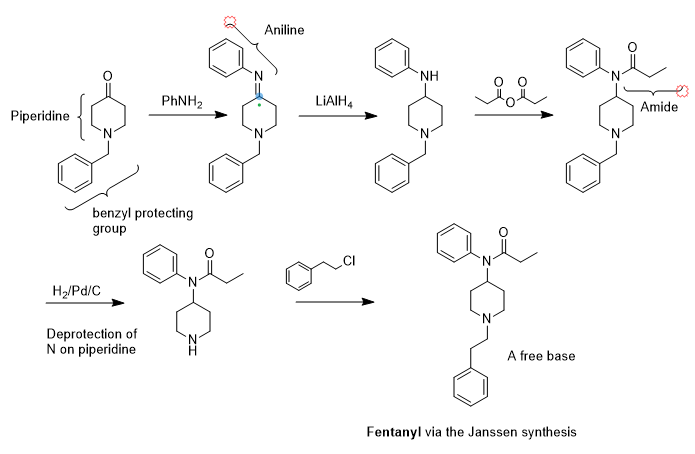
Original fentanyl synthesis by Janssen. Graphics: Will O. de Wisp
So, how is fentanyl synthesized? See the synthetic scheme above. I’ll just comment on the Janssen synthesis and some issues. I have no idea of how it is made out in there by the Mexican cartels and in ramshackle American trailer parks. The synthesis above has some steps that may be undesirable for backwoods or jungle operations like hydrogenation. In the first step, aniline will be needed to make the phenyl imine. It’s pretty toxic and stinks to high heaven. Next, lithium aluminum hydride is needed to reduce the imine double bond to an amine. This innocent looking grey powder is very hazardous and should only be used by an experienced chemist. It is also available as a solution in tetrahydrofuran. The next step is the formation of the amide with propionic anhydride. While the reaction entails a simple reflux, you still have to isolate the product. Once you have recovered the amide, the benzyl protecting group on the piperidine nitrogen must be removed. It allowed amide formation exclusively on the upper aniline nitrogen and has served its purpose. Finally, the piperidine nitrogen must be festooned with a phenylethyl group and phenylethyl chloride was used to afford the fentanyl product.
In chemical synthesis generally, substances are prepared in a stepwise manner and with as few steps as possible to give high isolated yields. To begin, one must devise a synthesis beginning with commercially available raw materials as close to the target as possible. If the product has many fragments hanging off the core structure, it’s best to solve that problem early. Synthetic chemistry is almost always performed in a non-interfering solvent that will dissolve the reactants and allow the necessary reaction to occur. A low boiling point is preferable for ease of distillation. An important side benefit from a solvent is that it will absorb much of the heat of reaction which can be considerable. Left on its own, a reaction might take its solvent to the boiling point by self-heating, generating pressure and vapor. The benefit from evaporation or reflux boiling is that as a solvent transitions from liquid to vapor there is a strong cooling effect which helps to control the temperature. An overhead condenser will return cooled solvent to prevent solvent loss.
You can do any chemical synthesis in one step with the right starting materials. Unfortunately, this option is rarely available. The next best option is to take commercially available starting materials through a known synthetic scheme. People who run illicit drug labs are never interested in R&D. They want (and need) simple chemistry that can be done by non-chemists in buckets or coke bottles at remote locations. Chemical glassware can be purchased but sometimes the authorities will be notified of a suspicious order. This is especially true with 12 liter round bottom flasks.
The most difficult and risky trick to illicit drug synthesis is obtaining starting materials like piperidine compounds in the case of fentanyl and its congeners. In the case of heroin, acetic anhydride shipments have been investigated for a long time because it is used to convert morphine to heroin- an unusually simple one-step conversion. Solvent diethyl ether is similarly difficult to get outside of established companies or universities. Many other common drug starting materials are difficult to obtain legally in the US or EU by the criminal element. However, China is thought to be a major supplier of starting materials outside the US and EU. Countries with remote coastlines, loose borders, lackadaisical or corrupt law enforcement reduce the barriers for entry of drug precursors.
China in particular has a large number of chemical plants that make diverse precursors for legitimate drugs. Unfortunately, some of these precursors can also be used for illicit drugs or existing technology adapted for this use. Precursors can be sold to resellers who can do as they please with them. Agents may represent many manufacturers and can mask the manufacturer’s identity and take charge of the distribution abroad. Shady transactions become difficult for authorities to detect and trace. The identity of illicit precursor chemicals are easily altered in the paperwork to grease the skids through customs. Resellers can repackage chemicals to suitable scale, change the paperwork and jack up the price for export. It has been my experience that many if not most Chinese or Japanese chemical manufacturers conduct business through independent export agents. However, behind the curtains there often a byzantine web of connections between companies and agents, so you may never know who will manufacture your chemical. As an aside, this complicates getting technical information from the manufacturer since the agent will not disclose a contact at that manufacturer.
Highly potent drugs like fentanyl must be taken in very small dosages which means that kilo-scale batch quantities of drug result in many individual sales per kilo. Small quantities of highly potent drugs are more easily smuggled than bulky drugs like weed with its strong odor.
There is a down-side to the illicit manufacture of drugs like fentanyl. It is quite toxic at very low dosages and must be handled with the greatest of care lest the “cook” and other handlers get inadvertently and mortally poisoned. Good housekeeping helps, but I have yet to see a photo of a tidy drug lab.
Fentanyl can be sold as a single drug but perhaps is cut with a solid diluent that some random yayhoo decided was Ok to use. Other drugs of abuse like heroin may be surreptitiously spiked with fentanyl to kick up the potency. In either case, a given dosage may or may not be safe even for a single use. There is no way for a user to know. Also, the concentration or homogeneity of mixed solids may be subject to wide variation. For more than a few people, their first fentanyl dose will be their last.
A recent raid on a clandestine drug lab in the Hatzic Valley east of Vancouver, BC, netted 25 kg of “pure” fentanyl and 3 kg which had already been cut for street use. Precursor chemicals used to manufacture the fentanyl were also seized. Along with the drug, the raid also seized 2,000 liters of chemicals and 6,000 liters (about 30 drums) of hazardous chemical waste, according to an RCMP news release 2 November, 2023.
The police said that the seizure represented 2,500,000 street doses.
In August of 2023 the police in Hamilton, Ontario, announced the results of Project Odeon. This was a large-scale sweep of illicit drug production in the Hamilton and Toronto area. From January 1, to July 30, 2023 there were 606 incidents related to suspected opioid overdoses and 89 suspected drug related deaths in the Hamilton area. Twelve people were charged for a total of 48 criminal charges. The police disclosed the following items that they seized-
An operational fentanyl drug lab at 6800 Sixteen Road, Smithville.
A dismantled fentanyl drug lab at 4057 Bethesda Road, Stouffville.
Approximately 3.5 tons of chemical byproduct from fentanyl production.
800 gallons of chemicals commonly used in the production of fentanyl
Lab equipment commonly used in the production of fentanyl
64.1 kg of illicit drugs, including 25.6 kg of fentanyl, 18 kg methamphetamine, 6 kg of ketamine
A loaded, Glock firearm and ammunition and four extended magazines
Over $350,000 of seized proceeds, including cars, jewelry, furniture and cash
Fentanyl is a synthetic drug first prepared in 1959 in Belgium by Paul Janssen (1926-2003). Janssen was the founder of Janssen Pharmaceuticals, now a subsidiary of Johnson & Johnson. In addition to fentanyl, the Jenssen team developed haloperidol, the ultrapotent carfentanil, and other piperidine based congeners. Piperidine itself is a DEA List 1 substance in the US.
Carfentanil is just modified fentanyl. Graphics: Will O. de Wisp
The elephant in the room with fentanyl is its extraordinary potency as an opioid. In pharmacology, potency is a quantitative measure of the amount of dose needed to elicit a specific effect on an animal or human in terms of dose weight per kilogram of body mass. Potency is subject to variability across a population and rises to an asymptote which can be difficult to pin down. For these reasons potency is reported at 50 %. For highly potent drugs like fentanyl, the measure is expressed as milligrams or micrograms of dose per kilogram body weight (mg/kg or mcg/kg body weight). One milligram per kilogram is one part per million (ppm).
When matters of toxicity arise, it is important to remember the maxim that “the dose makes the poison”. This observation traces back to Paracelsus in the mid-sixteenth century.
“All things are poison, and nothing is without poison; the dosage alone makes it so a thing is not a poison.”
Fentanyl acts much like morphine in regard to its affinity for one particular opioid receptor. Morphine is commonly the “standard” with which other opioids are compared. For instance, fentanyl is said to be 50-100 times more potent than morphine. Only 0.1 mg of fentanyl is equivalent to 10 mg of morphine. Carfentanil is more potent still at 10,000 times the potency of morphine.
Morphine is an agonist which activates the μ-opioid receptor. Activation of this receptor with morphine produces analgesia, sedation, euphoria, decreased respiration and decreased bowel motility leading to the earthly delights of constipation. Fentanyl is thought to interact with this receptor as well.
Original fentanyl synthesis by Janssen. Graphics: Will O. de Wisp
So, how is fentanyl synthesized? See the synthetic scheme above. I’ll just comment on the Janssen synthesis and some issues. I have no idea of how it is made out in there by the Mexican cartels and in ramshackle American trailer parks. The synthesis above has some steps that may be undesirable for backwoods or jungle operations like hydrogenation. In the first step, aniline will be needed to make the phenyl imine. It’s pretty toxic and stinks to high heaven. Next, lithium aluminum hydride is needed to reduce the imine double bond to an amine. This innocent looking grey powder is very hazardous and should only be used by an experienced chemist. It is also available as a solution in tetrahydrofuran. The next step is the formation of the amide with propionic anhydride. While the reaction entails a simple reflux, you still have to isolate the product. Once you have recovered the amide, the benzyl protecting group on the piperidine nitrogen must be removed. It allowed amide formation exclusively on the upper aniline nitrogen and has served its purpose. Finally, the piperidine nitrogen must be festooned with a phenylethyl group and phenylethyl chloride was used to afford the fentanyl product.
In chemical synthesis generally, substances are prepared in a stepwise manner and with as few high yielding steps as possible. To begin, one must devise a synthesis beginning with commercially available raw materials as close to the target as possible. If the product has many fragments hanging off the core structure, it’s best to solve that problem early. Synthetic chemistry is almost always performed in a non-interfering solvent that will dissolve the reactants and allow the necessary reaction to occur. A low boiling point is preferable for ease of distillation. An important side benefit from a solvent is that it will absorb much of the heat of reaction which can be considerable. Left on its own, a reaction might take its solvent to the boiling point by self-heating, generating pressure and vapor. The benefit from evaporation or reflux boiling is that as a solvent transitions from liquid to vapor there is a strong cooling effect which helps to control the temperature. An overhead condenser will return cooled solvent to prevent solvent loss.
You can do any chemical synthesis in one step with the right starting materials. Unfortunately, this option is rarely available. The next best option is to take commercially available starting materials through a known synthetic scheme. People who run illicit drug labs are never interested in R&D. They want (and need) simple chemistry that can be done by non-chemists in buckets or coke bottles at remote locations. Chemical glassware can be purchased but sometimes the authorities will be notified of a suspicious order. This is especially true with 12 liter round bottom flasks.
The most difficult and risky trick to illicit drug synthesis is obtaining starting materials like piperidine compounds in the case of fentanyl and its congeners. In the case of heroin, acetic anhydride shipments have been investigated for a long time because it is used to convert morphine to heroin- an unusually simple one-step conversion. Solvent diethyl ether is similarly difficult to get outside of established companies or universities. Many other common drug starting materials are difficult to obtain legally in the US or EU by the criminal element. However, China is thought to be a major supplier of starting materials outside the US and EU. Countries with remote coastlines, loose borders, lackadaisical or corrupt law enforcement reduce the barriers for entry of drug precursors. China in particular has a large number of chemical plants that make diverse precursors for legitimate drugs. Unfortunately, some of these precursors can also be used for illicit drugs or existing technology adapted for this use. Precursors can be sold to resellers who can do as they please with them. Agents may represent many manufacturers and can mask the manufacturer’s identity and take charge of the distribution abroad. Shady transactions become difficult for authorities to detect and trace. The identity of illicit precursor chemicals are easily altered in the paperwork to grease the skids through customs. Resellers can repackage chemicals to suitable scale, change the paperwork and jack up the price for export. It has been my experience that many if not most Chinese or Japanese chemical manufacturers conduct business through independent export agents. However, behind the curtains there often a byzantine web of connections between companies and agents, so you may never know who will manufacture your chemical. As an aside, this complicates getting technical information from the manufacturer since the agent will not disclose a contact at that manufacturer.
Highly potent drugs like fentanyl must be taken in very small dosages which means that kilo-scale batch quantities of drug result in many individual sales per kilo. Small quantities of highly potent drugs are more easily smuggled than bulky drugs like weed with its strong odor.
There is a down-side to the illicit manufacture of drugs like fentanyl. It is quite toxic at very low dosages and must be handled with the greatest of care lest the “cook” and other handlers get inadvertently and mortally poisoned. Good housekeeping helps, but I have yet to see a photo of a tidy drug lab.
Fentanyl can be sold as a single drug but perhaps is cut with a solid diluent that some random yayhoo decided was Ok to use. Other drugs of abuse like heroin may be surreptitiously spiked with fentanyl to kick up the potency. In either case, a given dosage may or may not be safe even for a single use. There is no way for a user to know. Also, the concentration or homogeneity of mixed solids may be subject to wide variation. For more than a few people, their first fentanyl dose will be their last.

 Lamentations on Chemistry