
Tag Archives: Fracking

Drilling Wastewater Capacity is Running Out in the Permian Basin

BNN Bloomberg published an article by David Wethe about a crisis building up in the Permian Basin shale-oilfield in west Texas. Drilling is facing the possibility of shutting down unless the new wastewater disposal wells are found. Wastewater is generated at a rate of 16 million barrels per day in the area and is pumped into disposal wells. The water can be up to 10 times saltier than seawater. These wells are seeing increasing backpressure indicating they are nearing capacity. Without disposal well space, oil drilling cannot continue to move forward. Associated with the disposal wells are earthquakes in the region.

From the article-

The Texas Railroad Commission, which regulates drilling in the largest US oil state, in December announced cuts to water disposal in certain areas after a 5.4-magnitude quake rocked the region. 

“We are one earthquake away from having a whole different dynamic” in the shale sector, Railroad Commissioner Jim Wright told the Oilfield Water Markets Conference in Fort Worth this week. Drilling will “come to a screeching halt” unless the industry develops “seismic-resilient” disposal techniques or alternative uses for the 16 million barrels (672 million gallons) of wastewater injected underground in the Permian region on a daily basis.

The water-recycling sector only has the capacity to process about 30% of the waste flows for reuse in fracking, Amanda Brock, CEO of Aris Water Solutions, told the conference. 

Credit: https://www.bnnbloomberg.ca/shale-oil-drillers-are-running-out-of-places-to-dump-toxic-wastewater-1.1922000

Houston-based Oil & Gas producer Apache Corporation was cited by the Texas Comptroller website as an example of applied water conservation.
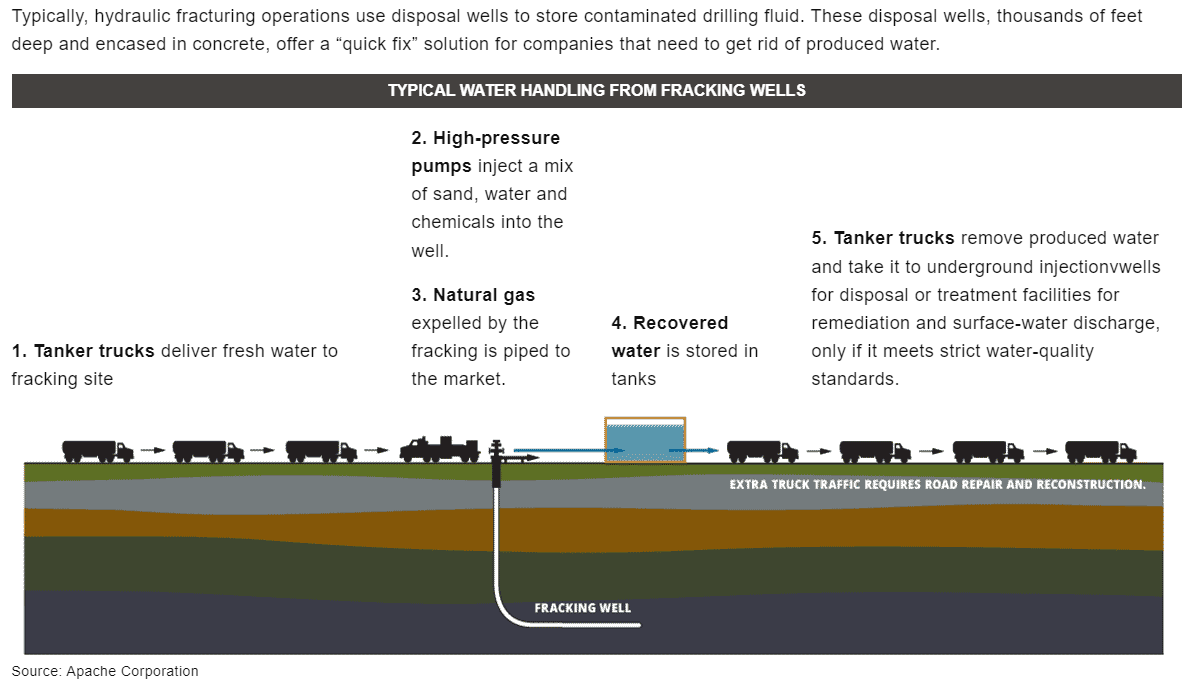
Credit: https://comptroller.texas.gov/economy/fiscal-notes/2015/october/fracking.php

According to Apache, hydraulic fracturing, or fracking, can use 340,000 barrels of water per well. In order to conserve water, they treat and reuse water recovered from previous well completions. They also use brackish water from the local Santa Rosa aquifer which they collect in lined containment basins which can be transferred by pipes to other drill sites.

Say what you will about oil & gas companies, but this seems pretty progressive to me. The financial pressures on exploration and drilling people is immense. Compounding it is the highly volatile oil & gas market adding to the risk. It is no wonder that opening a new oil field is called a “play.”

Somehow Apache found the motivation and the funds to conserve water in an industry not known for progressive actions like this. The scheme does not seem technically difficult at first blush. It does, however, require up-from money to be allocated to the recycling infrastructure. Should the day come when recycling of water becomes mandatory, Apache will be in a good spot.
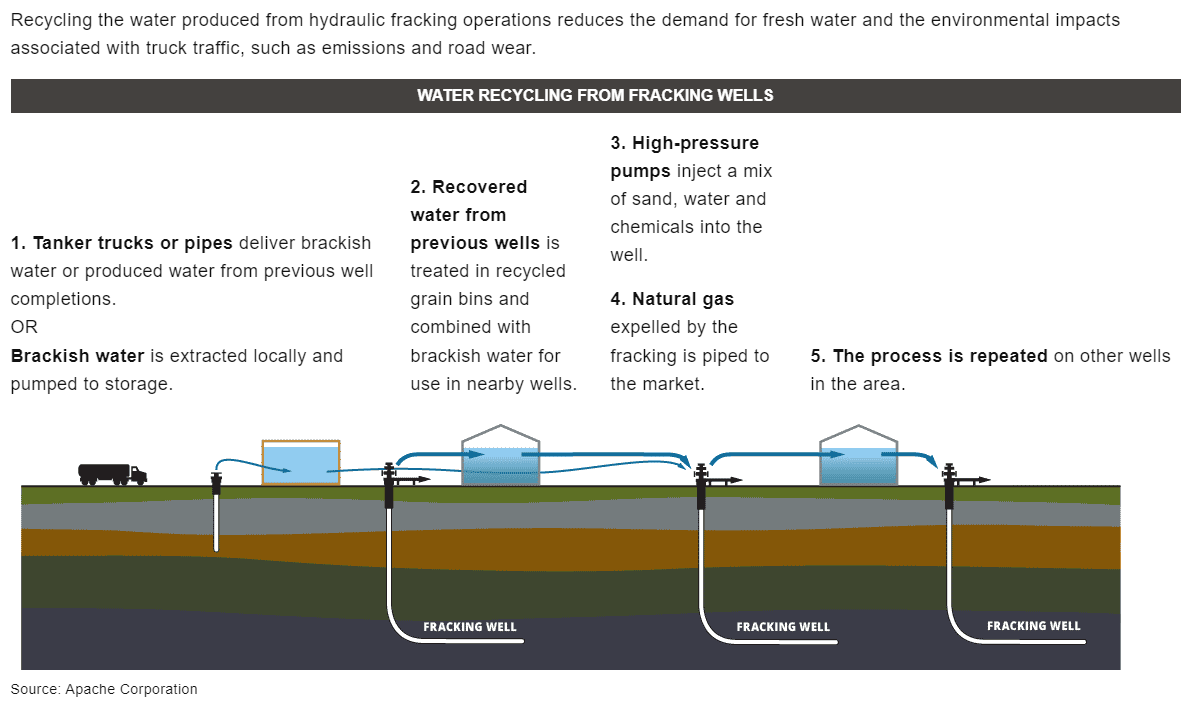
Credit: https://comptroller.texas.gov/economy/fiscal-notes/2015/october/fracking.php

Hydraulic fracturing is a very contentious subject. Proponents cite the urgent need for oil & gas energy in the economy. This is meant to justify what environmental damage may come from it with their chosen practices. Opponents cite the adverse effects of leakage of both fracking fluid and produced water to potable groundwater. A pathway for drilling fluid migration also opens a pathway for oil & gas seepage as well. One EPA draft-document from 2011 is available for scrutiny. It is in regard to fracking activity in the Marcellus Shale area of Pennsylvania.

It is interesting to note that Radium-226 was identified in the water samples. Ra-226 is the most stable decay of the radium isotopes (alpha decay, half-life 1600 years) and derives from the uranium-238 decay chain. Ra-226 alpha decays to radon-222 (alpha, half life 3.8 days) followed by numerous alpha and beta decays to Lead-206 which is stable.

Drilling muds are highly engineered fluids that have very specific properties. They must have closely controlled density and rheology in order to perform properly. Returning drilling mud is stripped of drilling chips and sent back down the hole for recycling. Managing your drilling mud is an important part of the art and science of drilling for oil. I am unaware of the significance of ground contamination by drilling mud.

Online you can find a long list of substances used in hydraulic fracturing. There is a large variety of formulated commercial products, possibly containing multiple chemicals, that are used in fracking fluids in the US. Determining the actual chemical hazards at any given fracking site will require knowledge of what they are using. Safety Data Sheets may or may not be helpful in uncovering the chemical composition of a fluid. The hazards associated with fracking fluids naturally depends on the identities of the chemicals present, the amount of chemical and the way it is presented in the environment. Dose makes the poison as Paracelsus said in 1538.

Note to the wise: If you plan on raising a stink about “chemicals” in the local fracking activities, try to find out what chemicals are being used. Chemicals can vary widely in their toxic potency and health effects. Be armed with specific information to the extent possible. If you stand there angrily gibbering on about “chemicals” it will be seen as loudmouthed histrionics. Hand waving arguments can be brushed off with handwaving dismissal. If you can talk about specific chemicals, then you can bring the issue into a sharper focus and demand facts.
Fracking with PFAS

According to an article in The Hill, the organization Physicians for Social Responsibility published a detailed report on the state of PFAS usage in oil and gas drilling operations including fracking. Note that many if not most states allow drillers to claim that the components of their drilling fluids are a trade secret and exempt from public disclosure. The quantities mentioned in the report are astoundingly large in magnitude. They report that “between 2013 and 2022, drilling operations have injected at least 261 New Mexico wells with 9,000 pounds of per- and polyfluoroalkyl substances (PFAS) for use in fracking,” Further, the article states that “During the same period, oil and gas companies injected more than 8,200 wells with a total of 243 million pounds of fracking chemicals — likely including PFAS — kept undisclosed due to “trade secret shields,” per the report.

[Note: A reader rightly pointed out that 9000 lbs divided by 261 wells works out to only 34 lbs/well in New Mexico. My thinking was that adding PFAS release to an untenable situation where oil & gas operate under loose environmental constraints already was a step too far. The aforementioned 243 million lbs of fracking chemicals gives no indication of how much, if any, PFAS is included. I understand why additives are blended in with drilling fluids and there are many strong technical and economic reasons for it. There must be boundaries on how much pollution we produce- even with oil & gas production.]

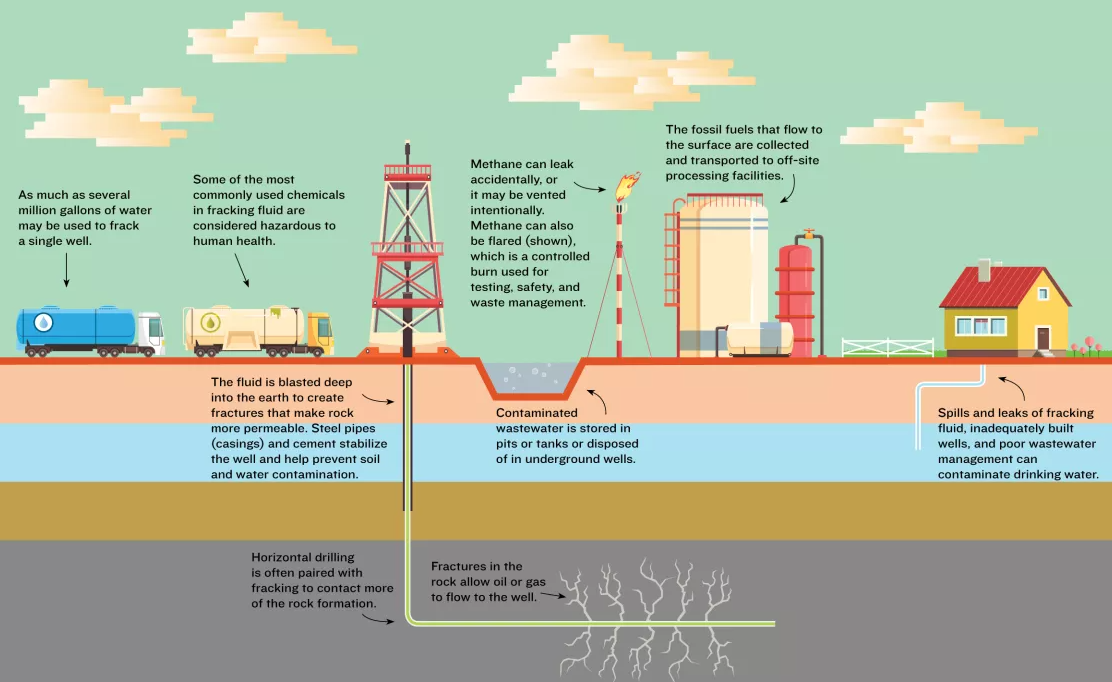
Graphic from NRDC. https://www.nrdc.org/stories/fracking-101#work

Fracking involves the injection of water, sand and certain chemicals at high pressure to fracture and prop open fissures produced in the formation for increased recovery of oil and gas. This is not a new technique. However, the oil and gas industry has seen to it that they can enjoy trade secrecy and immunity from much regulatory oversight while engaging in their operations. Their injection of chemicals into the ground has been subject to precious little oversight in terms of what and how much they can/should pump into the ground. Underground there is no air oxidation, weathering or photodegradation to break down the substances they pump into the ground. The immediate threat may be nil, but over the upcoming centuries, our descendants may drill into groundwater formations that have been contaminated by earlier petroleum operations. We should tread easily being mindful of our future civilization.

This blatant side-stepping of transparency by oil & gas is made possible through lobbying the local, state and federal government. If they get any push back, they drag out the old saw about jobs, jobs, jobs. No official, elected or appointed, wants to be seen acting against jobs. So, all manner of dubious ideas go forward with the blessing of our officials. We citizens fail to vote in sensible regulation because jobs, jobs, jobs. It doesn’t matter that jobs in oil & gas are famously in the feast or famine category, oil & gas companies always get their way.

Everyday I drive by unmanned oil tank batteries silently doing their automated jobs. The work force is reduced to truck drivers or supervisors visiting only periodically. The roughnecks and the crew who laid the pipes are long gone. At work I frequently train new employees who have left oil & gas because it was too unsteady.

Recently a few states have signed legislation to ban products containing forever chemicals within their state. No mention of well injection chemicals, but at least this is a start.

Re: Energy Modernization Act. NC Senate! Have a look at Class I felony G.S. 95-197.

An article by Lucy Nicholson/Reuters writing for News Week reports that the North Carolina Senate will introduce a bill called “Energy Modernization Act. SENATE DRS25123-RIxz (01/22)”. A part of this bill will enact the extraordinary authority to make disclosure of fracking fluid information without permission a felony- i.e., a criminal act. Normally, cases of disclosure of commercial confidential information is a civil matter leading to injunction and/or monetary awards.

A quick look at bill shows the following language:

SECTION 7.(a) Article 27 of Chapter 113 of the General Statutes is amended by 26 adding a new section to read: 27

Sponsors: Senators Rucho, Newton, and Brock (Primary Sponsors).

§ 113-391A. Trade secret and confidential information determination; protection; 28 retention; disclosure to emergency personnel.

… [refer to page 11, line 39]

(d) Penalties for Unlawful Disclosure. – Except as provided in subsection (c) of this section or as otherwise provided by law, any person who has access to confidential information pursuant to this section and who discloses it knowing it to be confidential information to any person not authorized to receive it shall be guilty of a Class I felony, and if knowingly or negligently disclosed to any person not authorized, shall be subject to civil action for damages and injunction by the owner of the confidential information, including, without limitation, actions under Article 24 of Chapter 66 of the General Statutes. [italics by Gaussling]

There are numerous exceptions for government officials who have a need to know this information in the course of their responsibilities as well as emergency medical personnel who demonstrate a need to know.

One has to ask why the Senators wrote law to render disclosure of commercial information relating to fracking fluids a Class I felony as well as an act being subject to civil litigation. Do they believe this is in the public interest? This act will make it difficult for people to monitor ground water for tell-tale components of drilling or fracking fluids because the composition of the injected fluid is confidential. If you are not allowed to identify the input fluids, how can you claim that contaminants found are related to fracking?

Does this law also mean that being in possession of a material safety data sheet (MSDS), a shipping document required by law, could constitute a violation? Oh, even better, will the MSDS contain enough information to be useful to workers, emergency responders, or fire inspectors on the scene and without delay? Or will the material be listed as a mixture of Stuff A, Stuff B, and Stuff C? And by the way, don’t get this shit in your eyes.

So, Senators Rucho, Newton, and Brock. What about the Class I felony G.S. 95-197? Doesn’t that contradict some language in your law?

I    G.S. 95-197 Withholding hazardous substance trade secret information.

It seems like the sponsors are helping someone render future litigation and recovery of damages much more expensive and complex. Does this help your constituents? I mean, you know, the ones who are not corporate entities.