
Local laws mandating that 10 minute water breaks be given to construction workers every 4 hours have been eliminated by Tejas Governor Greg Abbott and the legislature under HB2127 titled “Texas Regulatory Consistency Act.” The bill was put forward by Rep. Dustin Burrows, R-Lubbock. The bill is seen as an effort to push back on progressive local laws by cities like liberal-leaning Austin and Dallas where ordinances have been put into place to protect construction workers against the oppressive heat of Texas. Abbott said the bill will “provide a new hope to Texas businesses struggling under burdensome local regulations.”
Hyperbole, /haɪˈpɝː.bəl.i/, noun; a way of speaking or writing that makes someone or something sound bigger, better, more, etc. than they are
In Section 2 of the bill, it says the legislature finds that: “(1) the state has historically been the exclusive regulator of many aspects of commerce and trade in this state; (2) in recent years, several local jurisdictions have sought to establish their own regulations of commerce that are different than the state’s regulations; and (3) the local regulations have led to a patchwork of regulations that apply inconsistently across this state.“
The State claims to be the exclusive regulator of commerce and trade in the state pursuant to Section 5, Article XI, Texas Constitution. HB2127 was written to more closely define what kinds of codes local governments are free to do.
Given the state’s interest in commerce and trade, Section 6 removes any ambiguity in that regard. Labor regulations come under the heading of commerce and trade, so the state is the only lawgiver here.
HB 2127, SECTION 6.
Subchapter A, Chapter 1, Business & Commerce Code, is amended by adding Section 1.109 to read as follows:
Sec. 1.109. PREEMPTION. Unless expressly authorized by another statute, a municipality or county may not adopt, enforce, or maintain an ordinance, order, or rule regulating conduct in a field of regulation that is occupied by a provision of this code. An ordinance, order, or rule that violates this section is void, unenforceable, and inconsistent with this code.
Backers of the bill say that under OSHA, employers already have a duty to provide a safe workplace work place. A spokesman for the Associated Builders and Contractors of Texas said that “local rules impose a rigid scheme that, unlike OSHA guidelines, does not allow the flexibility needed to tailor breaks to individual job site conditions.”
However, according to David Michaels who led OSHA from 2009 to 2017, “Under OSHA law, it is employers who are responsible to make sure workers are safe,” said Michaels, now a professor at the George Washington University School of Public Health. “And we have compelling evidence that they are doing a very poor job because many workers are injured on the job, especially in Texas.”
Michaels also said that OSHA can issue a citation for a heat-related injury or death, but only after it has taken place. He also points out that OSHA has no national standard for heat related injury.
However, OSHA does have the General Duty Clause for situations where there are no specific standards applicable.
29 U.S.C. § 654, 5(a)1: Each employer shall furnish to each of his employees employment and a place of employment which are free from recognized hazards that are causing or are likely to cause death or serious physical harm to his employees.”
29 U.S.C. § 654, 5(a)2: Each employer shall comply with occupational safety and health standards promulgated under this act.
29 U.S.C. § 654, 5(b): Each employee shall comply with occupational safety and health standards and all rules, regulations, and orders issued pursuant to this Act which are applicable to his own actions and conduct.
The legislation to remove local laws regarding construction labor hazards was apparently motivated by the desire of the GOP to slap down islands of liberalism in Texas.
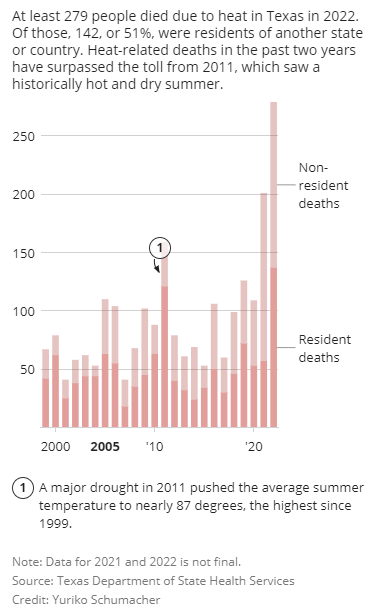
The chart above shows that known heat-related deaths in Tejas are up sharply in the last 2 years. Migrants and the homeless are hit particularly hard by hyperthermia.
I can understand the desire to smooth out the spotty nature of regulatory sovereignty across any state. It is really a matter of state vs local control and there shouldn’t be any confusing overlap of authority. Texas has chosen primacy over commerce and trade, of which labor is a part of. Somewhere in the process of this, someone noticed that regulations on water breaks mandated by municipal statute will be invalidated.
News stories came out with the shocking news that people working outdoors will not be guaranteed water breaks. The absence of statutory regulation on water breaks does not mean that workers will be denied water. Any employer who wants to retain employees will not deny water to employees. What has been invalidated are mandatory 10-minute water breaks every 4 hours. A workday is usually broken down into a break midmorning and midafternoon with lunch at around noon. These are 3 opportunities to grab a drink of water. A mandatory break after 4 hours past arrival places the break around lunch and quitting time anyway for an 8-hour day, so it is hard to imagine what advantage it gives for an 8-hour day. For longer days it would be beneficial. Employers who would deny water to employees should be punished.
Construction site managers object to rules that would interfere with things like concrete deliveries and crane work. Both are time sensitive activities. Even in the rough and tumble construction field, most companies will do the right thing and allow access to water at all times.
Texas HB2127 itself is silent on the matter of water breaks for workers. It simply reasserts authority already provided in the state constitution, namely as the, ” … exclusive regulator of many aspects of commerce and trade … ” and supersedes local statutes that overlap with what the state sees as its sovereignty. It seems a little sly, but not fundamentally corrupt.
So, the question becomes, will the State of Texas legislate mandatory water breaks for workers in hot environs? Given the rabid pro-business leanings of the state, it seems doubtful.
Am I taking the side of the Republicans on this? Goddammit, I hate to say it, but I suppose I am.
 Lamentations on Chemistry