
In two-dimensional Euclidian geometry the shortest path between two points in a plane is a straight line. In a right triangle, one of the three internal angles, has an angle of 90o. The longest side is the hypotenuse connecting the ends of the other two legs. The square of the hypotenuse is equal to the sum of the squares of the other two sides. It’s the Pythagorean Theorem.
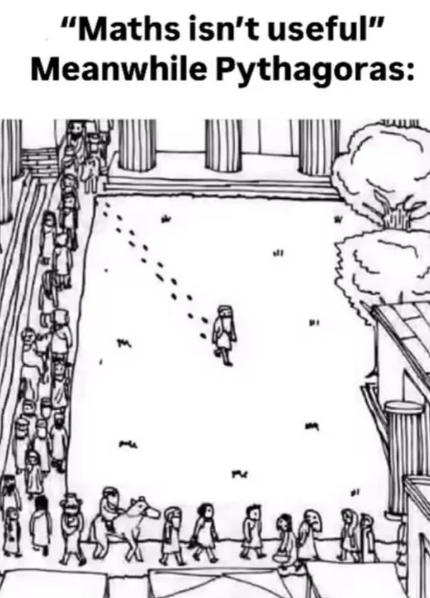
We know from high school geometry that the hypotenuse is the shortest distance between two points in a plane. This is exploited all the time on college campuses in a practical way. That would be walking across the grass in a direct line to class or lunch. The grounds keepers aren’t happy about it, but this was accepted long ago as an inevitability.
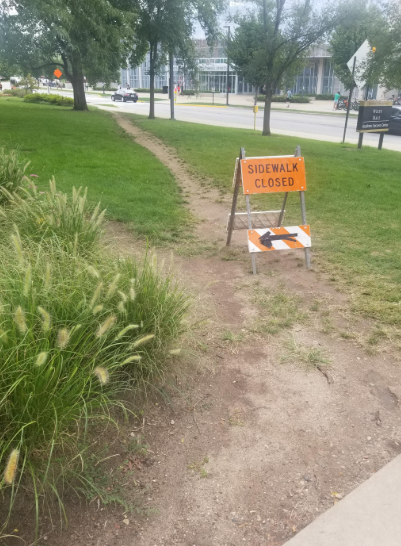
Stretching this axiom to the multidimensional realm of consciousness, the gap from the beginning of a thought to a conclusion could also be a kind of straight-line hypotenuse. But like walking on a hypotenuse across the grass, there are occasional fact and thought-obstacles that require a detour. Obstacles can be in the realm of physical reality or cultural norms and legality. Our consciousness must estimate the relative risk of one or more pathways. Align this with concessions to social norms and the law, we have the beginnings of a hairball.
My primate brain immediately searches for a conceptual hypotenuse when presented with a dilemma. What is the shortest and most efficient path to the best solution? First, one must define the current state and the desired end state. This is just old-fashioned gap analysis. What’s different is that thought processes are often clouded by mental illness and thoughts including conditioned response, preconceived notions, false or inaccurate information and personal animosity.
Any brainstorming session is really a hunt for a hypotenuse.
 Lamentations on Chemistry