
I’m happy to speak highly of a retired petroleum geologist who produces excellent geology video content for YouTube. His name is Myron Cook, and he lives in Wyoming; he loves the geology of Earth. He is a very prolific videographer and is known as the “Bob Ross” of geology for the genteel narration of his field trips in Colorado, Wyoming, and Utah. His manner of speaking and folksy explanations are suitable for the general public, but he manages to avoid patronizing oversimplification of geology. What is nice is that all of the formations he explains can be visited.
His videos are well-produced 20-40 minute intro-level geology seminars, combining his aerial photography, whiteboard talks, and field trip adventures into geologically interesting terrains on the Colorado Plateau and up into Yellowstone and the Bighorn Mountains in Wyoming. He is particularly adept at explaining sedimentology, an area in which I previously held little interest, but for no good reason. That has since changed.
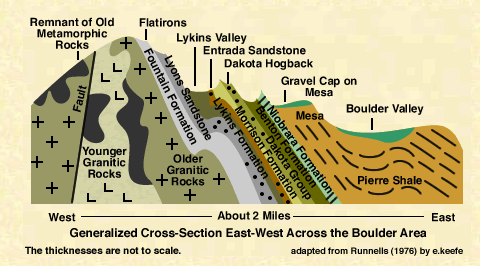
If you live along the Colorado Front Range like I do, you’ll recognize the Boulder Flatirons, Red Rocks Amphitheater, and the Garden of the Gods in Colorado Springs. These steeply dipping conglomerate formations sit at the juncture of the Great Plains and the eastern foothills of the Rocky Mountains. They are part of the Fountain Formation, which extends steeply downward and toward the east. The formation is named for the Fountain River, where the layer was identified.
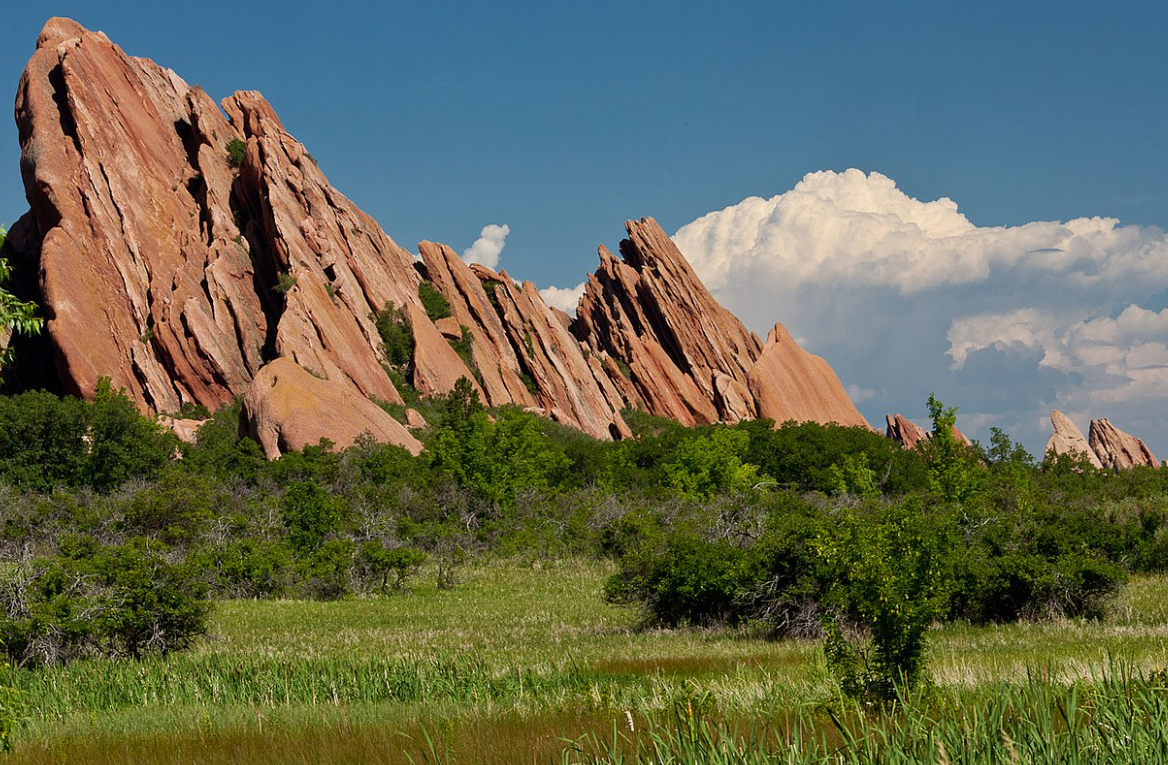
Myron Cook has an excellent YouTube introduction to the Fountain Formation of Colorado. The rocks of the Fountain Formation are thought to be 290 to 340 million years old.
Mr. Cook began a video by asking the question “Is the Fountain Formation composed of sediment from the Rocky Mountains?” Well, sort of, but first consider how the adjacent sediment layers are situated. Next to the Front Range, numerous layers of sedimentary rocks lie pancaked together and aligned substantially vertical. The rule of thumb in sedimentary geology is that the oldest sediments are at the bottom and they accumulate going upwards. There are scattered apparent exceptions, but they are few and do not negate the rule.
The Fountain Formation is an alluvial fan formation of coarse red feldspar-rich granitic arkose. All of the exposed sandstone and conglomerate layers lying a few miles eastward from the Fountain Formation are likewise tilted upwards. These sedimentary exposures are not limited to the Front Range but also appear on the western slope of Colorado.
Vocabulary Update
How is ‘alluvial’ different from ‘fluvial’?
Fluvial (The Process): Relates to the erosion, transport, and deposition by active river channels. Examples include river channels, canyons, and waterfalls.
Alluvial (The Deposit): Refers to the material laid down by water, often outside the main channel during floods. Examples include alluvial fans, floodplains, and sandbars.
Usage: “Fluvial” describes the system or environment, whereas “alluvial” describes the sediment type or landform.
Source: Google (search terms: ‘alluvial versus fluvial’)
There is nothing strange about arkosic alluvial fans, except that in this case, it dips so steeply that much of it sits directly in contact with the granitic/metamorphic basement rock which is at a depth of about 10,000-11,000 ft of sediment below eastern Denver. If the alluvial fans were recent, they wouldn’t rest on the basement rock. Instead, they sit roughly two miles below many sedimentary layers. In general, the lower the sediment layer, the older the formation. Exceptions exist, and for very interesting reasons. The Fountain Formation is very old.
Another plug
If you have not visited Utah, you’re really missing out on a vast landscape of stunningly beautiful red sandstone formations. Even if geology does not do it for you, the sheer beauty of the many red river canyons, cliffs, arches and oddly eroded features should rouse the coldest of souls. Let your spouse drive so you can take in the view, just don’t say that.
Back to it
The present Rocky Mountains are thought to have begun in a third mountain building episode roughly 55 to 80 million years ago (MYA) called the Laramide Orogeny. These earlier mountain ranges are called the ‘Ancestral’ Rocky Mountains. This orogeny was the result of tectonic activity lifting mountains in New Mexico, Colorado. into Wyoming and Utah. Going north along the Rockies are other named orogenies.
The occurrence of mountain building of the Rocky Mountains far from a coastal subduction zone is rather odd. One of the more popular explanations is that subduction of the Farallon plate is unusually shallow, creating compression and uplifting far inland from the coastal subduction zone. When you push a rug or tablecloth, you’ll note that the rug or cloth will cause ripples in the direction of motion. This is similar to mountain building. It could also cause repetitive mountain building. This NASA link describes the subduction of the Farallon plate.
The Fountain Formation is much older than the present Rockies. This formation is believed to have come from the erosion of the Ancestral Rocky Mountains. But which one? One source makes reference to two prior ancestral ranges. The earliest is referred to as the Precambrian mountains and not much is known about it. It predates the Western Interior Seaway.
A second iteration of the Rocky Mountains from the next Laramide orogeny rose ca 300 MYA in the Late Pennsylvanian and Early Permian geologic periods. It was eventually eroded flat and carried away as sediment by wind and water. Sediments, i.e., sand & mud, are layered in ways that are consistent with alluvial fan formation.
Finally, 55 to 80 MYA the current iteration of Rocky Mountains arose from the Laramide Orogeny. In numerous places in or near the Rockies fossilized clams and oysters can be found at the surface. This further supports the past presence of the Interior Western Seaway.
I just remembered that I’m not writing a book. Ciao!!
 Lamentations on Chemistry