Tag Archives: Lithium

Economic Foams and Lithium

While cockeyed optimists are working toward a new age of electric vehicles in the glare of an admiring public, I find myself standing off to the side mired in skepticism. What are the long-term consequences of large-scale electrification of transportation?

The industrial revolution as we in the west see it began as early as 1760 and continues through today. Outwardly it bears some resemblance to an expanding foam. A foam consists of a large number of conjoined bubbles, each representing some economic activity in the form of a product or service. A business or product hits the market and commonly grows along a sigmoidal curve. Over time across the world the mass of growing bubbles expand collectively as the population grows and technology advances. Bubbles initiate, grow and sometimes collapse or merge as consolidation and new generations of technology come along and obsolescence takes its toll.

The generation of great wealth often builds from the initiation of a bubble. The invention of the steam engine, the Bessemer process for the production of steel, the introduction of kerosene replacing whale oil, the Haber process for the production of ammonia and explosives, and thousands of other fundamental innovations to the industrial economy played part in the growing the present mass of economic bubbles worldwide.

After years of simmering on the back burner, electric automobile demand has finally taken off with help from Tesla’s electric cars. Today, electric vehicles are part of a bubble that is still in the early days of growth. The early speculators in the field stand the best chance of winning big market share. A major contribution to this development is the recent availability of cheap, energy dense lithium-ion batteries.

Of all of the metals in the periodic table, lithium is the lightest and has the greatest standard Li+/Li reduction potential at -3.045 volts. The large electrode potential and the high specific energy capacity of Lithium (3.86 Ah/gram) makes lithium an ideal anode material. Recall from basic high school electricity that DC power = volts x amps. Higher voltage and/or higher amperage gives higher power (energy per second). Of all the metals, lithium has the highest reduction potential (volts).

Rechargeable lithium batteries have high mass and volume energy density which is a distinct advantage for powering portable devices including vehicles. Progress in the development of lithium-ion batteries was worth a Nobel Prize in 2019 for John B. Goodenough, M. Stanley Whittingham and Akira Yoshino.

All of this happy talk of a lithium-powered rechargeable future should be cause for celebration, right? New deposits of lithium are being discovered and exploited worldwide. But cobalt? Not so much. Alternatives to LiCoO2 batteries are being explored enthusiastically with some emphasis on alternatives to cobalt. But, the clock is ticking. The more infrastructure and sales being built around cobalt-containing batteries, the harder it will become for alternatives to come into use.

One of the consequences of increasing demand for lithium in the energy marketplace is the effect on the price and availability of industrial lithium chemicals. In particular, organolithium products. The chemical industry is already seeing sharp price increases for these materials. For those in the organic chemicals domain like pharmaceuticals and organic specialty chemicals, common alkyllithium products like methyllithium and butyllithium are driven by lithium prices and are already seeing steep price increases.

Is it just background inflation or is burgeoning lithium demand driving it? Both I’d say. Potentially worse is the effect on manufacturers of organolithium products. Will they stay in the organolithium business, at least in the US, or switch to energy-related products? It is my guess that there will always be suppliers for organolithium demand in chemical processing.

A concern with increasing lithium demand has to do with recycling of lithium and perhaps cobalt. Hopefully there are people working on this with an eye to scale up soon. A rechargeable battery contains a dog’s lunch of chemical substances, not all of which may be economically recoverable to specification for reuse. In general, chemical processes can be devised to recover and purify components. But, the costs of achieving the desired specification may price it out of the market. With lithium recovery, in general the lithium in a recovery process must be taken to the point where it is an actual raw material for battery use and meets the specifications. Mines often produce lithium carbonate or lithium hydroxide as their output. Li2CO3 is convenient because it precipitates from aqueous mixtures. It must also be price competitive with “virgin” lithium raw materials as well.

Lithium ranks 33rd in terrestrial abundance and less than that in cosmic abundance. Unlike some other elements like iron, lithium nuclei formed are rapidly destroyed in stars throughout their life cycle. Lithium nuclei are just too delicate to survive stellar interiors. The big bang is thought to have produced a small amount of primordial lithium-7. Most lithium seems to form during spallation reactions when galactic cosmic rays collide with interstellar carbon, nitrogen and oxygen (CNO) nuclei and are split apart from high energy collisions yielding lithium, beryllium and boron- LiBeB. All three elements of LiBeB are cosmically scarce as shown on the chart below.
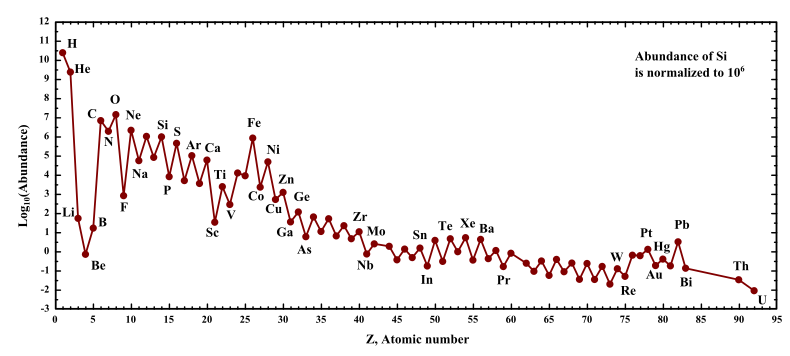
Solar system abundances relative to silicon at 106. Source: Wikipedia, https://en.wikipedia.org/wiki/Cosmological_lithium_problem#:~:text=all%20heavier%20elements.-,Lithium%20synthesis%20in%20the%20Big%20Bang,more%20than%201000%20times%20smaller.

Lithium is found chiefly in two forms geologically. One is in granite pegmatite formations such as the pyroxene mineral spodumene, or lithium aluminum inosilicate, LiAl(SiO3)2. This lithium mineral is obtained through hard rock mining in a few locations globally, chiefly Australia.
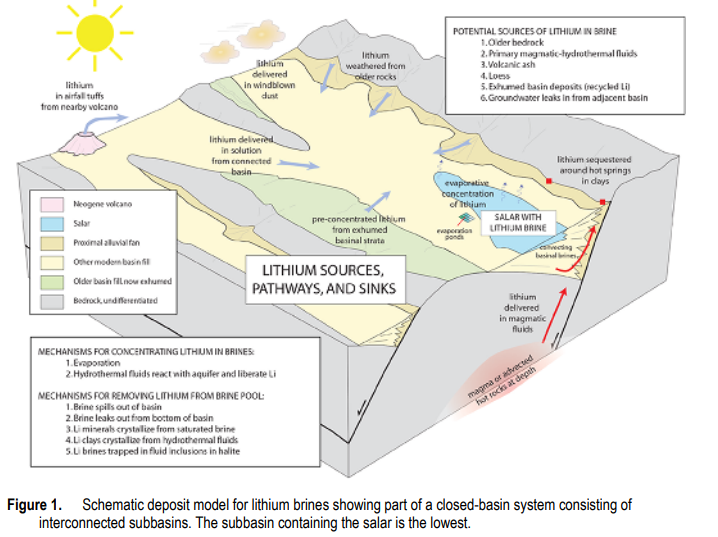
Source: “A Preliminary Deposit Model for Lithium Brines,” Dwight Bradley, LeeAnn Munk, Hillary Jochens, Scott Hynek, and Keith Labay, US Geological Survey, Open-File Report 2013–1006, https://pubs.usgs.gov/of/2013/1006/OF13-1006.pdf

Chemical Definition: Salt; an ionic compound; A salt consists of the positive ion (cation) of a base and the negative ion (anion) of an acid. The word “salt” is a large category of substances, but for maximum confusion it also refers to a specific compound, NaCl or common table salt. In this post the word refers to the category of ionic compounds.

The other source category is lithium-enriched brines. The US Geological Survey has proposed a geological model for brine or salt deposition. According to Bradley, et al.,

All producing lithium brine deposits share a number of first-order characteristics: (1) arid climate; (2) closed basin containing a laya or salar; (3) tectonically driven subsidence; (4) associated igneous or geothermal activity; (5) suitable lithium source-rocks; 6) one or more adequate aquifers; and (7) sufficient time to concentrate a brine.”

Lithium and other soluble metal species are extracted from underground source rock by hot, high pressure hydrothermal fluids and eventually end up in subsurface, in underwater brine pools or on the surface as a salt lake or a salt flat or salar. These deposits commonly accumulate in isolated locations that have prevented drainage. An excellent summary of salt deposits can be found here.
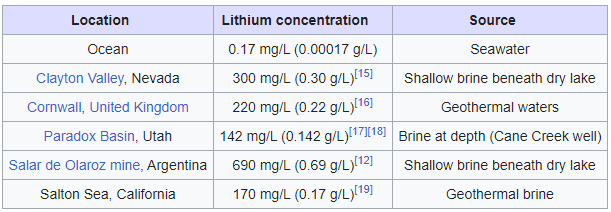
Source: Wikipedia, https://en.wikipedia.org/wiki/Brine_mining

Critical to any kind of mineral mining is the definition of an economic deposit. The size of an economic deposit varies with the market value of the mineral, meaning that as the value per ton of ore increases, the extent of the economic deposit may increase to include less concentrated ore. If you want to invest in a mine, it is good to understand this. A good opportunity may vanish if the market price of the mineral or metal drops below the profit objectives. Hopefully this happens before investment dollars are spent digging dirt.

Lithium mining seems to be a reasonably safe investment given the anticipated demand growth unless страшный товарищ путины invasion of Ukraine lets the nuclear genie out of the bottle.

Just for fun, there is an old joke about the definition of a mine-

Mine; noun, a hole in the ground with a liar standing at the top.
US Lithium Battery Recycling

It was announced that a US company will be supplying critical components for Electric Vehicle (EV) batteries to Panasonic. Redwood Materials, Inc., is set to supply EV battery cathode components from its facility in Kansas City. Redwood Materials was founded to close the battery recycle loop by JB Straubel. Straubel was a co-founder and former CTO of Tesla.

A lithium-ion battery doesn’t just rely on lithium. Other substances work together with lithium and the whole composition will vary between manufacturers. The Wikipedia entry for lithium-ion batteries lists the Panasonic cathode material as LiNiCoAlO2. Panasonic works in cooperation with Tesla to supply batteries using Lithium Nickel Cobalt Aluminum Oxide cathode batteries. As alluded to above, Redwood will be supplying cathodes made of recycled battery materials.

The lithium battery electrolyte is almost always contains a lithium salt such as LiPF6, lithium hexafluorophosphate, in a non-aqueous organic carbonate electrolyte like ethylene or propylene carbonate. These two carbonates function as high boiling, polar aprotic dispersants. The substances are cyclic carbonate ester compounds and have a high dielectric constant. The high dielectric constant means that the molecules are polar enough to coordinate Li+ ions to aid in electrolyte mobilization of the Li salt. The electrolyte may also contain a solvent like diethyl carbonate to decrease viscosity and lower the melting point. The PF6 anion is a large, charge diffuse, weakly coordinating anion that helps keep the lithium cation mobilized and loosely bound in the polar aprotic carbonate solution. This anion is inert enough and lends solubility in organic solvents making it useful for many applications. Ammonium salts with PF6 anion are often used as ionic liquids. Weakly coordinating anions are used to allow the corresponding cation to be partially unsolvated and therefore more available for reaction chemistry.

Both in producing power and in recharge, when electrons are being passed around between chemical species and changing oxidation states, it means that chemical changes are occurring. When chemical changes (reactions) are happening, it means that heat is being absorbed or evolved. In the emission of heat, the amount of heat energy per second (power) produced can be large or small. It is critical that the temperature of the battery not exceed the boiling point of the lowest boiling component which may be the carbonate dispersant, as in ethylene carbonate (bp 243 C) or viscosity modifier like diethyl carbonate (bp 126 C). A liquid phase internal to the battery flashing to vapor can overpressure the casing and rupture the battery. A liquid changing into a vapor phase wants to increase its volume by from ~650 to 900 times or beyond. To make matters worse, a chemical reaction generally doubles its rate with every 10 degrees C of temperature rise. Runaway reactions generate runaway heat production.

Lithium batteries have flammable components such as ethylene carbonate (flash point 150 C) and diethyl carbonate (flash point 33 C) that could be discharged and ignited if the battery bursts open, possibly leading to ignition of the surroundings, be it in your pants pocket or in the cargo hold of a passenger aircraft.

The Toxco Story – Parts 1 & 2

This is a guest post written by a good friend and colleague who retired as an executive from the specialty chemical industry. He is an author and editor of a respected book on Grignard chemistry. It is an honor for me to post his recollections on this site with his permission.

========================================

The TOXCO Story – Part I

I suppose this story begins during the Cold War. The US had developed a triad of defense capabilities to deter Soviet aggression. We had the Air Force B-52 bombers armed with atomic weapons, the submarine based Trident missiles, and the land based ICBMs–first the liquid fuel Atlas rockets and later the solid fuel Minuteman missiles hidden is silos in North Dakota and elsewhere.

Then came 1989, the destruction of the Berlin Wall, the subsequent collapse of the Soviet Union and, suddenly, the Russians were no longer the dreaded foes whom we once feared. Maybe it was time to “stand down” our hair-trigger defense posture.

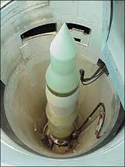
Those solid fuel Minuteman rockets were designed to be launched on short notice. Firing them required a significant amount of electricity. This was to come from the electric power grid. But our military, recognizing that this source of power could be compromised in the tense times leading up to a nuclear confrontation, needed a backup. As a result, each missile silo was equipped with a diesel powered electric generator, just in case.

But things could go wrong. The diesel fuel might be contaminated, or sabotaged by Russian saboteurs, or any of a number of other problems. So, in an overabundance of precaution, the military insisted on a “backup to the backup”. And what could be better or more reliable as a source of electricity, than a battery. To be sure, these would have to be BIG batteries, bigger and more powerful than any produced thus far, but they would be certain.

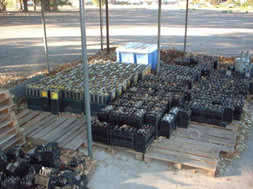
And so, the Defense Department commissioned the production of the world’s largest and most powerful batteries. These were based on lithium-thionyl chloride chemistry[1]. Each primary cell contained sheets of elemental lithium, surrounded by gallons of thionyl chloride, a reactive liquid which on contact with water produces a mixture of sulfuric acid and hydrochloric acid—really nasty stuff. These primary cells were each about the size of a coffin and it took three, ganged together to generate the power needed to initiate a missile launch. The government contracted for thousands of them and Union Carbide supplied them.

Apparently, at some point, there was a fatal incident involving a 10,000 amp Minuteman battery being drained and replaced[2] and this contributed to a decision in the early-mid 1990s to dispose of these hazardous items. The DOD issued a Request for Proposals (RFP) which caught the attention of a group of businessmen and entrepreneurs in southern California.

Operating in Orange County, California, headquartered in Anaheim, near Disneyland, were three affiliated companies. Adams Steel was in the ferrous metal recycling business-old washing machines, refrigerators, scrapped cars. Before you scrap a car, you remove the lead-acid battery and the catalytic converter. The battery, containing lead metal, lead salts and sulfuric acid is a hazardous waste and its disposal is regulated by the EPA. The catalytic converter contains precious metals such as platinum, rhodium and iridium. These two items (batteries and catalytic converters) were handled by Kinsbursky Brothers. Non-ferrous metals (common ones such as copper and aluminum and non-common ones like tantalum and gallium from electronic devices) were processed by Alpert & Alpert. The companies had worked together for a number of years.

Principals at Adams Steel and Kinsbursky decided to form a joint venture to bid on the lithium battery disposal opportunity. They created TOXCO for this purpose. It was headed by Terry Adams (the youngest sibling in the Adams family) and Steve Kinsbursky. And they won the bid. The government would pay TOXCO millions of dollars to dispose of these batteries that the government had paid millions of dollars to manufacture some years earlier. Your tax dollars at work.

So, how do you dispose of a lithium-thionyl chloride cell weighing hundreds of pound and filled with dangerous and explosive ingredients? Well, if you are a mechanical engineer, trained at USC (as Terry Adams was), you take a mechanical engineering approach the problem. You have to neutralize the thionyl chloride and the lithium by reaction with water. And reactions take place more slowly (and more safely) at lower temperatures. So, the answer is to chill the cell in liquid nitrogen down to 77°K, put it in a large container filled with water and chop it apart with big mechanical knives (like you chop an automobile into small pieces for scrap). This actually works. Provided you’re certain that the cells have been fully discharged first. But don’t take the military’s word for it. If you do, there may be an embarrassing incident, as there was in 2000, during the disposal process.[3]

Next question. Where do you do this disposal? The TOXCO team discovered that there was an underused industrial site in Trail, British Columbia, on the Canadian side of the Idaho border. It had been part of the Cominco Smelter operations and was one of the most heavily polluted sites in North America[4]. What better place to site a hazardous battery disposal plant? If something went wrong, who would notice?

And so, TOXCO went into business, disposing of lithium batteries, successfully (except for a few incidents like the one incident alluded to above).

One of the by-products of this process was a stream of aqueous lithium salts. These had value and could be recovered and that put TOXCO into the lithium chemicals business. But that’s part II of this story.

The TOXCO Story – Part II
(the Lithchem Story)

This story also begins in the Cold War. Even as the atomic bomb (the uranium and the plutonium fission bomb) was being engineered into reality at Los Alamos in the mid 1940s, plans were being made for the next generation weapon—a fusion bomb.

The first H-bomb, based on the concept of fusing light nuclei, was tested at Eniwetok in the South Pacific in 1953. Improvements in the initial “clunky” design quickly followed. One way to boost the power of the explosion was to surround the core of the bomb with a layer of lithium deuteride, LiD. Lithium is, well, the element lithium, atomic number 3 in the Periodic Chart. And deuterium is the name for “heavy hydrogen”, an atom of hydrogen, atomic number 1, but also containing an uncharged neutron[5]. Provided that the lithium used was of atomic weight 6, the fusion of the lithium(6) and the deuterium(2) would produce two nuclei of helium(4), plus lots of energy.

This would only work if you used lithium-6. Unfortunately, the lithium available to us on this planet in mineral form, deposited around the globe, is a mixture of lithium-6 and lithium-7 (the same element, but with one extra neutron). And God, in His infinite wisdom, chose to endow the earth with mostly lithium-7. Of the naturally occurring deposits of lithium, 93% is lithium-7.

So, if you need to use just Li-6, you have to separate it out from the more abundant, naturally occurring Li-7. And the US government proceeded to do just that. Starting in the 1950s, they processed millions of pounds of lithium containing minerals to extract the less abundant isotope that was required for its military purpose. For every hundred pounds of lithium salt they processed, they got, at most, 6 pounds of lithium-6 salt[6].

And what do you do with the “leftover” 94+ pounds. Well, you can’t just turn it back into the lithium chemicals marketplace. For one thing, it’s “depleted” lithium (missing its naturally occurring share of Li-6.) This would be easily noticed by someone using the lithium for routine chemical purposes. The extent of “depletion”, that is, of extraction of the Li-6 would be measureable, and that information was a secret[7]. Moreover, if the quantity of depleted Li were ever realized, that number could be used to infer the number of LiD containing bombs, and that too was a secret.

So, for more than five decades, for more than half a century, the US government simply stockpiled the “by-product” depleted lithium in a warehouse, in the form of the simple salt, lithium hydroxide monohydrate, LiOH•H2O. Millions of pounds of it. Packaged in poly lined, 55 gallon fiber drums.

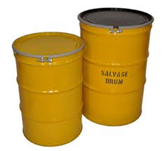
In later years, the cardboard drums began to deteriorate. Some of them were damaged during handling and relocation. Sometime in the 1980s the decision was made to repack the inventory in bright yellow steel “overpack” drums.

Now comes the early 1990s. The Cold War is over. Our nuclear secrets, at least those from the 1950s, are far less precious. And the Clinton administration is looking through Fibber McGee’s closet[8] to see what can be disposed of, and maybe generate a revenue stream for the government in the process.

What they discover is 100,000,000 pounds of “depleted” lithium hydroxide monohydrate, with a potential market value approaching $1 per pound. And so, it goes out for bids.

The terms of the sealed bid auction were that the final sale would be split 70-30 between the highest bidder (who would get 70% of the inventory) and the second highest bidder (who would get 30%, but at the high bid price).

This was a perfect set up. At that time there were only two lithium companies operating in the US who could handle this quantity of inventory—Lithium Corporation of America[9] and Foote Mineral Company[10]. And both of them knew that there was no incentive for overbidding since even the loser would get 30% of the supply.

And that’s where Lithchem appeared on the scene. The TOXCO team was already in the “recovered lithium” business. All they had to do was bid one penny more per pound than the other two majors and they would be awarded the lion’s share of the inventory. They incorporated Lithchem for that purpose. I’m told that LCA and Foote each bid the same number, somewhere in the 20+ cents per pound range, and Lithchem bid one cent more. As a result, Lithchem became the proud owner of 70,000,000 pounds of depleted lithium hydroxide monohydrate.

Now what? The principal use of LiOH is in the manufacture of high performance lithium greases, used in heavy industrial applications-heavy trucks, railroads, etc. Much of the market for lithium greases is in the third world and quality is less of a concern than price.

Still, to be sold on the open market, the LiOH from the government stockpile had to meet certain specifications. Some of the yellow drums contained beautiful white crystalline powder. Others contained dead cats and cigarette butts. It was “government quality” inventory.

One condition of the bid was that the winning bidder had to remove the inventory from its location in a government warehouse (in southeast Ohio[11]) within 12 months of the successful bid. I had the occasion to visit that warehouse, before the stock was removed and it was a memorable sight.

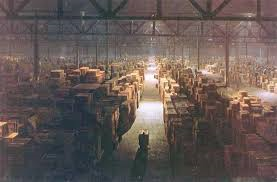
If you recall the final scene in the movie “Raiders of the Lost Ark”, the Ark of the Covenant is being stored in a gigantic government warehouse, filled floor to ceiling with identical gray boxes. A warehouse stretching far into the next county. Now replace those gray boxes with yellow overpack drums, stacked 6 or 8 high, stretching far into the next county. That’s what it was like. That’s what 70,000,000 pounds of LiOH hydrate looked like.


[1] The lithium – thionyl chloride primary cell has a high voltage (3.5 V) and a high current density.

[2] Battery Hazards and Accident Prevention,  By S.C. Levy, P. Bro

[3] In November 2009 a fire broke out at the Trail BC facility in a storage shed containing lithium batteries slated for disposal. It was their sixth fire in fifteen years. Prior to that, a major fire in 1995 destroyed 40,000 kg of batteries at the facility. Three fires occurred in 2000, including one caused by some lithium batteries. This was during the summer when negotiations were underway between Toxco and Atochem for the acquisition of the Ozark business. http://www.cbc.ca/news/canada/british-columbia/trail-battery-recycling-fire-leaves-questions-1.805780

[4] http://en.wikipedia.org/wiki/Teck_Resources

[5] Elements with the same atomic number but different weights are called isotopes. Heavy hydrogen (with an atomic weight 2) is an isotope of hydrogen (atomic number 1). Another example is carbon-14, useful for radiocarbon dating. It’s a heavier version of the more common version of carbon, C-12.

[6] Actually less than 6 pounds. The extraction process was less than perfectly efficient. The actual yield of Li-6 was a closely guarded national secret.

[7] In depleted lithium (with the Li-6 removed), the relative abundance of lithium-6 can be reduced to as little as 20 percent of its normal value, giving the measured atomic mass ranging from 6.94 Da to 7.00 Da.

[8] http://en.wikipedia.org/wiki/Fibber_McGee_and_Molly#The_Closet

[9] Acquired by FMC in 1995 and now known as FMC Lithium.

[10] Now part of the Chemetall Group, a division of Rockwood Holdings.

[11] At the time, it was stored at the DOE enrichment facility in Portsmouth, Ohio.

Lithium as a Chemical

Today we hear about lithium batteries ad nauseum. Everyone is anxious to achieve a bright battery-powered electric future for happy motoring. Mineral exploration has revealed a few new sources of lithium and mines are increasing production. Battery factories are ramping up and R&D keeps turning out tweaks in battery technology. Many are betting on or prophesying the eventual phase-out of hydrocarbon fueled motor vehicles.

Lithium is quite scarce and is the 25th most abundant element on earth with about the same crustal abundance as chlorine although this may vary with the source. For the most part, lithium is fairly widely dispersed in the earth’s crust but it is subject to concentration by hydrothermal transport, forming evaporite deposits or briny ground water. Lithium is also a component of the mineral spodumene which can be found in pegmatites within some host formation. An uncommonly rich site was at the Foote Company Mine in the Kings Mountain Mining District of North Carolina. This operation produced lithium carbonate, Li2CO3. This is a common finished product because it can be removed from a solution of lithium chloride by treatment with sodium carbonate to precipitate the poorly soluble lithium carbonate.

This light metal has many chemical uses apart from batteries. For instance, organolithium reagents are a vital part of the chemical industry clocking in at about $1 billion per year in sales. Organolithium reagents are an indispensable part of organic synthesis. Switching to a reagent with a different metal usually does not work well, giving poor results or the wrong reactivity.

Today we’re seeing organolithium prices rise dramatically with little expectation that it will ever come back and no clue of how it plays out in the future. If a few select lithium reagents, e.g., LiAlH4 or n-butyllithium, go off the market, it will be a bad day for the organic synthetic industry as well as for chemical R&D in general. It is an unexpected consequence of the switch to reduced carbon EVs.