
“Technological triumphalism” is a term that surfaces infrequently, encapsulating the belief in our capacity to resolve almost any issue through the innovative use of technology. While technological progress has led to countless pivotal breakthroughs, such as antibiotics and the transistor, it has also given rise to means that magnify age-old human tendencies towards negative behaviors. As our tools and methods evolve with technological advancements, so too do our desires and avarice, often intensified by the fresh opportunities new technologies present.
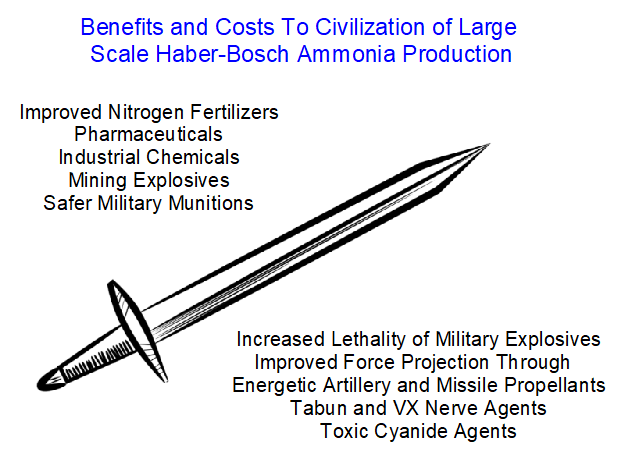
As an example of technology bursting on the scene producing both good and bad consequences, consider the Haber-Bosch process for the industrial manufacture of ammonia. An industrial feedstock like ammonia can split into several streams. On the plus side, cheap and available liquid or gaseous ammonia for fertilizing crops was a boon for mankind in terms of increased food production. Also, the combination of ammonia and nitric acid leads to the production of the solid fertilizer ammonium nitrate.
Another and wholly different product stream involving the oxidation of ammonia (Ostwald Process) is nitric acid production, HNO3. It is required for the manufacture of industrial intermediates, high explosive nitroaromatics like TNT, picric acid, nitroesters like nitroglycerine and even more powerful explosives. Explosives are neither inherently good or bad, their merits depend on how they are used. When used for construction or mining, explosives are a positive force in civilization. However, they cast a long dark shadow when used to destroy and kill.
Fritz Haber
A good example of unanticipated consequences of a technology uptick is found in the story of the German chemist Fritz Haber. Haber won the 1918 Nobel Prize for Chemistry for the invention of the Haber-Bosch synthesis of ammonia. It is estimated the 1/3 of present global food production relies on the use of ammonia from the Haber-Bosch or similar processes. Haber has been widely praised for his part in the invention of catalytic ammonia production using atmospheric nitrogen. These are important developments, but … [Wikipedia]
As a German nationalist, Haber was also known for his considerable contributions to German chemical warfare through WWII. Haber was responsible for the production of Zyklon A and Zyklon B.
It is claimed that neither Fritz Haber nor Carl Bosch were fans of National Socialism in Germany in the 1930’s. Haber claims to have done his WWI gas warfare work for Kaiser Wilhelm as a German patriot. Intimidated by German laws aimed at Jews and Jewish colleagues, Haber (a Jew converted to Catholicism) left Germany in late 1933 for a position as director of what is now the Weizman Institute in what was at that time Mandatory Palestine. He died while enroute in the city of Basel, Switzerland, at age 65.
Chemical warfare in WWI began with an idea from volunteer driver and physical chemist Walther Nernst who suggested in 1914 the release of tear gas at the front. This was observed by Haber who later suggested chlorine gas be used instead because of its density. Haber personally supervised Germany’s first release of chlorine gas at the Second Battle of Ypres in WWI. Supervising the installation of the 5730 tanks of chlorine were chemist Fritz Haber, chemist Otto Hahn, physicist James Franck and physicist Gustav Herz. Of the 5 scientists mentioned above, Nernst included, all would receive a Nobel Prize in their lifetimes.
‘Haber defended gas warfare against accusations that it was inhumane, saying that death was death, by whatever means it was inflicted and referred to history: “The disapproval that the knight had for the man with the firearm is repeated in the soldier who shoots with steel bullets towards the man who confronts him with chemical weapons. […] The gas weapons are not at all more cruel than the flying iron pieces; on the contrary, the fraction of fatal gas diseases is comparatively smaller, the mutilations are missing”.’ Source: Wikipedia.
The Future
Ask yourself this- will your descendants in the year 2124 share in the creature comforts coming from the extravagant use of resources as we have? Doesn’t the word “sustainability” include the needs of 4-5 generations down the line?
There are wants and there are needs. For many of us in the 21st century, most our needs in the US are more than satisfied along with surplus income to satisfy many of our wants. Will our descendants a century from now even have enough resources to meet their needs after our continuing wanton and extravagant consumption of resources of the last 150 years?
Our technology stemming from the earth’s economically attainable resources has done much to soften the jagged edges from nature’s continual efforts kill us. After each wave of nature’s threats to life itself, survivors get back up only to face yet more natural disasters, starvation and disease. This is where someone usually offers the phrase “survival of the fittest”, though I would add ” … and the lucky“.
What will descendants in 100 or 200 years require to fend off the harshness of nature and our fellow man? Pharmaceuticals? Medical science? Fuels for heat and transportation? Will citizens in the 22nd century have enough helium for the operation of magnetic resonance imagers or quantum computers? Will there be enough economic raw materials for batteries? Will there be operable infrastructure for electric power generation and distribution? Lots of questions that are easy to ask but hard to answer.
If you are immune from concern for future generations, then this essay is a waste of your time.
Come to think about it, does anyone worry this far in advance? The tiny piece of the future called “next year” is as much as most of us can handle. Is the world a much smaller place than it used to be or is the scale just better understood?
A plug for climate change
Even the sky is smaller than we think. At 18,000 feet the atmospheric pressure drops to half that at sea level. This means that half of the molecules in the atmosphere are at or below 18,000 feet. This altitude, the 500 millibar line, isn’t so far away from the surface. From the 58 Fourteeners in Colorado, it is only 4000 ft up. Not that far. The breathable, inhabitable atmosphere is actually quite thin. The Earth’s atmosphere tapers off into the vacuum of space over say 100 km, the Kármán line. While this is more of an arbitrary designation than a physical boundary between the atmosphere and space, the bulk of the atmosphere is well below this altitude. With this in mind, perhaps it seems more plausible that humans could adversely affect the atmosphere.
The lowest distinct layer of the atmosphere is the troposphere beginning as the planetary boundary layer. This is where most weather happens. In the troposphere, the atmospheric temperature begins to drop by 9.8 °C per kilometer or 5.8 oF per 1000 ft of altitude. This is called the dry adiabatic lapse rate.
With increasing altitude, the atmospheric temperature gradient decreases to about 2 oC per kilometer at ~30,000 ft in the mid-latitudes where the tropopause is found. The tropopause is where the lapse rate reaches a minimum then the temperature remains relatively constant with altitude. This is the stratosphere.
Over the last 200 years in the West at least, advances in medicine, electrical devices, motor vehicles, aerospace, nuclear energy, agriculture and warfare have contributed to what we both enjoy and despise in contemporary civilization. The evolving mastery of energy, chemistry and machines has replaced a great deal of sudden death, suffering and drudgery that was “normal” with a longer, healthier life free of many of the harmful and selective pressures of nature. Let’s be clear though, relieving people of drudgery can also mean that they may be involuntarily removed from their livelihoods. It is quintessentially American to sing high praises to capitalism. It is even regarded as an essential element of patriotism by some. On the interwebs capitalism is defined as below-
Capitalism is an economic system based on the private ownership of the means of production and their operation for profit.
As I began this post I was going to cynically suggest that capitalism is like a penis- it has no brain. It only knows that it wants more. Well, wanting and acquiring more are brain functions, after all. Many questions stand out, but I’m asking this one today. How fully should essential resources be subject to raw capital markets? It has been said half in jest that capitalism is the worst economic system around, except for all of the others.
I begin with the assumption that it is wise that certain resources should be conserved. Should it necessarily be that a laissez faire approach be the highest and only path available? Must it necessarily be that, for the greater good, access to essential resources be controlled by those with the greatest wealth? And, who says that “the greater good” is everybody’s problem? People are naturally acquisitive, some much more than others. People naturally seek control of what they perceive as valuable. These attributes are part of what makes up greed.
Obvious stuff, right?
The narrow point I’d like to suggest is that laissez faire may not be fundamentally equipped to plan for the conservation and wise allocation of certain resources, at least as it is currently practiced in the US. Businesses can conserve scarce resources if they want by choosing and staying with high prices, thereby reducing consumption. However, this is not in the DNA of business leaders. The long-held metrics of good business leadership rest on the pillar of growth in market share and margins. Profitable growth is an important indicator of successful management and a key performance indicator for management.
Firstly, a broader adoption of resource conservation ideals is necessary. Previous generations have indeed practiced it, with the U.S. national park system serving as a notable example. However, the scarcity of elements like Helium, Neodymium, Dysprosium, and Indium, which are vital to industry and modern life, raises concerns. The reliance of Magnetic Resonance Imaging (MRI) operators on liquid helium for their superconducting magnets poses the question of whether such critical resources should be subject to the whims of unregulated laissez-faire capitalism. While some MRI operators utilize helium recovery systems, not all do, leading to further debate on whether the use of helium for party balloons should be permitted to continue, given its wasteful nature.
Ever since the European settlement of North America began, people have been staking off claims for all sorts of natural resources. Crop farmland, minerals, land for grazing, rights to water, oil and gas, patents, etc. Farmers in America as a rule care about conserving the viability of their topsoil and have in the past acted as a group to maintain it in good condition. But, agribusiness keeps making products available to maximize crop yields, forcing farmers to walk a narrower line with soil conservation. Soil amendments can be precisely engineered with micronutrients, nitrogen and phosphate fertilizers to reconstitute the soil to compensate for higher yields. Herbicides and pesticides are designed to control a wide variety of weeds, insect and nematode pests. Equipment manufacturers have pitched in with efficient, though expensive, machinery to help extract the last possible dollars’ worth of yield. Still other improvements are in the form of genetically modified organism (GMO) crops that have desirable traits allowing them to withstand herbicides (e.g., Roundup), drought or a variety of insect, bacterial, or fungal blights. The wrench in the gears here is that the merits of GMO have not been universally accepted.
Livestock production is an advanced technology using detailed knowledge of animal biology. It includes animal husbandry, nutrition, medicines, meat production, wool, dairy, gelatin, fats and oils, and pet food production. There has been no small amount of pushback on GMO-based foods in these areas, though. I don’t watch this in detail so I won’t comment on GMO.
The point of the above paragraphs is to highlight a particular trait of modern humans- we are demons for maximizing profits. It comes to us as naturally as falling down. And maximizing profits usually means that we maximize throughput and sales with ever greater economies of scale. Industry not only scales to meet current demand, but scales to meet greater future demand.
Extracting a resource to its exhaustion has been prevalent in history. The question is, is it inevitable or can or should it be throttled back?
Essentially everyone will likely have descendants living 100 years from now. Won’t they want the rich spread of comforts and consumer goods that we enjoy today? Today we are producing consumer goods that are not made for efficient economic resource recovery. Batteries of all sorts are complex in their construction and composition. Spent batteries may have residual charge left in them and have chemically hazardous components like lithium metal. New sources of lithium are opening up in various places in the world, but it is still a nonrenewable and scarce resource. This applies to cobalt as well.
Helium is another nonrenewable and scarce resource that in the US comes from a select few enriched natural gas wells. At present we have an ever-increasing volume of liquid helium consumption in superconducting magnets across the country that need to remain topped off. This helium is used in all of the many superconducting magnetic resonance imagers (MRI) and nuclear magnetic resonance (NMR) spectrometers in operation worldwide. Quantum computing will also consume considerable liquid helium as it scales up since temperatures below the helium boiling point of 4.22 Kelvin are required.
As suggested above, today’s MR imagers can be equipped with helium boil off prevention recovery devices that recondense helium venting out of the cryostat and direct it back into a reservoir. One company claims that their cold head condensers are so efficient that users do not even have to top off with helium for 7-10 years. That is a good thing. Hopefully it is affordable for most consumers of MRI liquid helium.
In the history of mining in the US and elsewhere, it has been the practice of mine owners to maximize the “recovery” of ore when prices are high. Recovery always proceeds to the exhaustion of the economical ore or the exhaustion of financial backing of the mining company. Uneconomical ore will remain in the ground, possibly for recovery when prices are more favorable. It is much the same for oil and gas. As with everything, investors want to get in and get out quickly with the maximum return and minimum risk. They don’t want their investment dollars to sit in the ground waiting for the distant future in order to satisfy some pointy headed futurist and their concern for future generations.
It is not normally in the nature of for-profit corporate C-suite executives to aim for resource conservation. People answerable to a board of directors have a fiduciary responsibility to maximize wealth generation for the shareholders. The world of industry is the world of growth. The world of “let’s make enough to get by” is not the world of people who rise to the C-suite. Unfortunate but true.
What is needed in today’s world is the ability to conserve resources for our descendants. It requires caring for the future along with a good deal of self-control. Conservation means recycling and reduced consumption of goods. But it also means tempering expectations of wealth generation, especially for those who aim for large scale production. While large scale production yields the economies of scale, it nevertheless means large scale consumption as well, In reality, this is contrary to the way most capitalism is currently practiced around the world.
Sustainability
The libertarian ideal of applying market control to everything is alleged to be sustainable because in appealing to everyone’s self-interest, future economic security is in everyone’s interest. If high consumption of scarce resources is not in our self-interest, then will the market find a way to temper it? As prices rise in response to scarcity, consumption will drop. ECON-101 right? Well, what isn’t mentioned is that it’s today’s self-interest. What about the availability of scarce resources for future generations? Will the market provide for that? What does “sustainability” really mean? Does it mean that today’s high consumption is sustained, or does it mean resource conservation?
Is the goal of energy sustainability to maintain the present cost of consumption but through alternative means? Reduced consumption will occur when prices get high enough. As the cost of necessities rises, the cash available for the discretionary articles will dry up. How much of the economy is built on non-essential, discretionary goods and services? The question is, does diminished consumption have to be an economic hard landing or can it be softened a bit?
Some chemical elements
Here is where we transition into some chemistry. Our transition into a more electric world requires the use of certain chemical elements that may be unfamiliar to many. Certain elements are critical such as copper, aluminum, steel, silicon, germanium, gallium, neodymium, lithium, indium, boron and some others. And each element requires industrial plants and mining to produce them. Mining and refining generally use large quantities of electric power and water. Most all of the equipment in the mines and industry rely on steel machinery which itself requires a cascade of resources to produce.
As of the date of this writing, we are already down the timeline by many decades as far as the R&D into alternative electrification. What we are faced with is the need for a rapid and very large scaling-up of renewable electric power generation, transmission and storage for the anticipated growth in power consumption for electric vehicles.
Price elasticity is where an increase in price fails to result in a drop in demand. Necessary or highly desirable goods and services may not drop in demand if the price increases at least to some level. As with the price of gasoline, people will grumble endlessly about gas prices as they stand there filling their tanks with expensive gasoline or diesel. Conservation of resources has to overcome the phenomenon of price elasticity in order to make a dent without shortages.
A meaningful and greater conservation of resources will require that people be satisfied with lesser quantities of many things. In history, people have faced a greatly diminished supply of many things, but not by choice. Economic depression, war and famine have imposed reduced consumption on whole populations and often for many years. When the cause is released, people naturally return to consumption as high as they can afford.
The technological triumphalism reflex of civilization has allowed us to paint ourselves into a resource scarcity corner. We are reliant on new technology that itself is reliant on more mature technology.
Added 10/30/24.
The habit of relying on future technological breakthroughs to solve current problems is universally seen as a positive expression except for those culturally disconnected from modernism such as the Amish, etc. The problem arises when we blunder forward, oblivious to consequences of the technology. Unforeseen consequences are notably difficult to visualize early in development and may be interpreted by some as negativism.
In chemical manufacturing we are accustomed to a performing PHA- Process Hazard Analysis -when starting up a new process. In a PHA meeting we list all of the potential points of failure in the process equipment and then brainstorm every possible failure mode and possible links to other equipment. It usually takes most of a shift and it is essential that engineers and plant operators are present to lend their expertise. As potential failures are identified they are rated according to their likelihood and seriousness. Each entry that calls for a dated action item by persons responsible for solving the problem.
What the PHA also does is to alert those involved in designing processes of problems that may be general in nature and worth remembering for the next process.
Social Media- An invention gone bad?
Did the persons who introduced the various social media platforms in the early days consider the possible malevolent use and consequences of their online products? Was anything other than the rapid development of their platform and getting online as fast as possible even considered? Was there a devil’s advocate in the building at the time? Once money is invested in a business plan or invention, the desire to go to market becomes insurmountable.
If the question is “could trolls and other online troublemakers have been avoided from the beginning?”, then perhaps the early social media developers should have some accountability to those who download the app. If not, what should be the developer’s role in solving the problem of online trolling or fraud?
As with so many useful things in the marketplace that have a dark side, weapons for instance, doesn’t the user have some responsibility for proper use? Well, yes and no. Someone who knows about guns should have the responsibility for its use, that’s yes. Going very dark, what about leaving a loaded and chambered pistol on a playground. Is it reasonable to expose children to the danger from mishandling? Should they be expected to know what the loaded pistol could do? Clearly not.
The core of the issue seems to be the matter of when a seemingly innocuous invention is released for global use and is unexpectedly misused by some users. Is the developer responsible for damages resulting from the misuse? Can the developer be forced to harden their product to attenuate the abuse?
Could it be that clamping down on trolls on a given app will involve a reduction of clicks or eyeballs? Would advertisers overlook this or negotiate a lower price?
It is doubtful that anyone in 1975 was begging for a Facebook to come on the market. Dot matrix printers were a marvel then. Eventually, when available, Facebook would take the world by storm. Demand appeared when people became aware of it. Is it a triumphal bit of technology? Both were built to exploit existing telecommunications technology and data collection systems. Facebook is a system that converts views and clicks into money over the internet. Facebook is a product that delivers our eyeballs and data to advertisers. Similar to a newspaper or television. Fb is triumphal to advertisers and Meta.
Conclusion-
Is there really such a thing as general Technological Triumphalism? I’m beginning to think that it might exist only as squinted at from 50,000 feet. In the very early 20th century, physicians longed for a magic bullet to cure infections apart from the toxic mercurials then in use. They needed a Technological Triumph, and it arrived in pieces through experiments over time. Along came sulfa drugs, then penicillin and both of these were explored for more potent analogs. As medicinal chemistry advanced, entirely new classes of antibiotics were discovered. The lesson of penicillin coming from mold led to the exploration of microbial and fungal sources from all over the world, producing antibiotics affecting a variety of systems in gram (+) and gram (-) bacteria. Once an active candidate is discovered, it’s structure and stereochemistry are determined. Once the composition is known, modifications can be prepared to explore the efficacy of analogs and sort out the mechanism of its antibiotic properties.
Technological Triumphalism can be a philosophy that in its hazardous form can lead people to believe that if a technology goes surprisingly bad, certainly something can be invented to make it better. Fix one technology with another. The discovery of antibiotics was the result of answering a question that begged for a solution.
An example is the problem of CO2 in global climate change. Should we compensate for rising CO2 emissions by scrubbing the atmosphere or should we find a way to reduce emissions by driving fewer miles? The first is a technological solution and the other is more of a lifestyle change.
 Lamentations on Chemistry