
Tag Archives: PFAS

Fracking with PFAS

According to an article in The Hill, the organization Physicians for Social Responsibility published a detailed report on the state of PFAS usage in oil and gas drilling operations including fracking. Note that many if not most states allow drillers to claim that the components of their drilling fluids are a trade secret and exempt from public disclosure. The quantities mentioned in the report are astoundingly large in magnitude. They report that “between 2013 and 2022, drilling operations have injected at least 261 New Mexico wells with 9,000 pounds of per- and polyfluoroalkyl substances (PFAS) for use in fracking,” Further, the article states that “During the same period, oil and gas companies injected more than 8,200 wells with a total of 243 million pounds of fracking chemicals — likely including PFAS — kept undisclosed due to “trade secret shields,” per the report.

[Note: A reader rightly pointed out that 9000 lbs divided by 261 wells works out to only 34 lbs/well in New Mexico. My thinking was that adding PFAS release to an untenable situation where oil & gas operate under loose environmental constraints already was a step too far. The aforementioned 243 million lbs of fracking chemicals gives no indication of how much, if any, PFAS is included. I understand why additives are blended in with drilling fluids and there are many strong technical and economic reasons for it. There must be boundaries on how much pollution we produce- even with oil & gas production.]
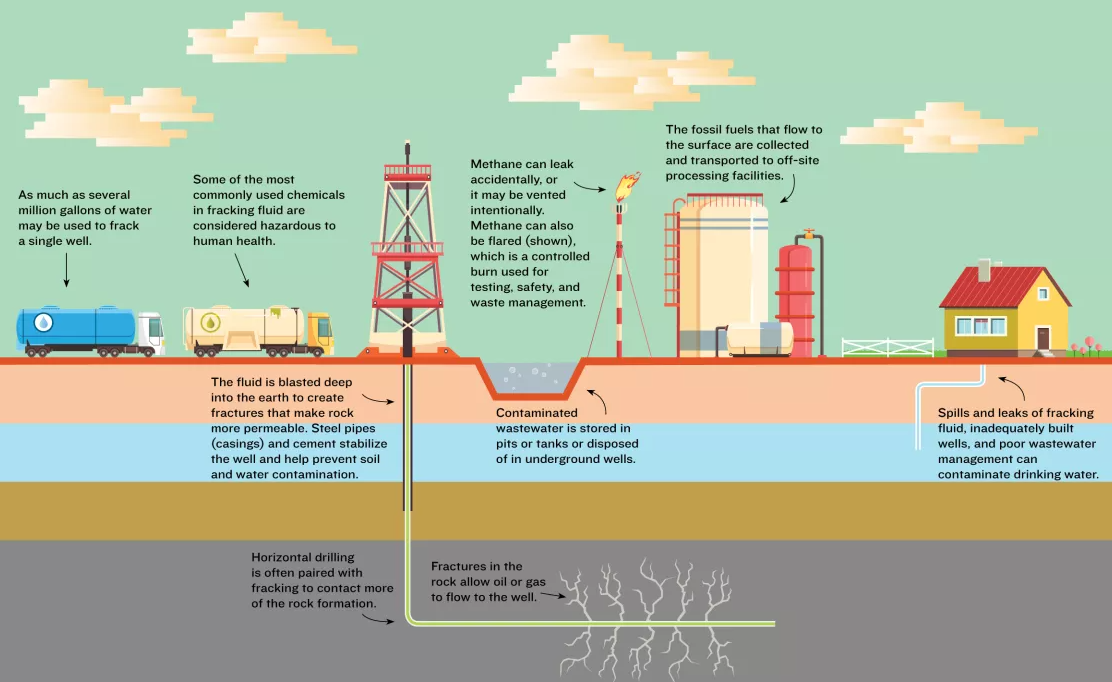
Graphic from NRDC. https://www.nrdc.org/stories/fracking-101#work

Fracking involves the injection of water, sand and certain chemicals at high pressure to fracture and prop open fissures produced in the formation for increased recovery of oil and gas. This is not a new technique. However, the oil and gas industry has seen to it that they can enjoy trade secrecy and immunity from much regulatory oversight while engaging in their operations. Their injection of chemicals into the ground has been subject to precious little oversight in terms of what and how much they can/should pump into the ground. Underground there is no air oxidation, weathering or photodegradation to break down the substances they pump into the ground. The immediate threat may be nil, but over the upcoming centuries, our descendants may drill into groundwater formations that have been contaminated by earlier petroleum operations. We should tread easily being mindful of our future civilization.

This blatant side-stepping of transparency by oil & gas is made possible through lobbying the local, state and federal government. If they get any push back, they drag out the old saw about jobs, jobs, jobs. No official, elected or appointed, wants to be seen acting against jobs. So, all manner of dubious ideas go forward with the blessing of our officials. We citizens fail to vote in sensible regulation because jobs, jobs, jobs. It doesn’t matter that jobs in oil & gas are famously in the feast or famine category, oil & gas companies always get their way.

Everyday I drive by unmanned oil tank batteries silently doing their automated jobs. The work force is reduced to truck drivers or supervisors visiting only periodically. The roughnecks and the crew who laid the pipes are long gone. At work I frequently train new employees who have left oil & gas because it was too unsteady.

Recently a few states have signed legislation to ban products containing forever chemicals within their state. No mention of well injection chemicals, but at least this is a start.

Simple PFAS Destruction Process Disclosed

An article titled Low-temperature mineralization of perfluorocarboxylic acids, Dichtel and Houk, et al., Science, 18 August 2022, Vol 377, Issue 6608, pp. 839-845, DOI: 10.1126/science.abm8868, came out yesterday with a method for defluorination and chain scission of per- and polyfluoroalkyl substances (PFAS). Blessedly, the article is available without charge.

The article describes the mineralization of reactive perfluorocarboxylic anions with NaOH in water and dimethylsulfoxide, DMSO, at 80 to 120 C and ambient pressure.

Ok. If the prefixes “per” and “poly” are unknown to you, read below, otherwise skip ahead.

==================

First, some clarification of the name “PFAS” for you non-chemists out there. The “P” in PFAS stands for either prefix “poly” or “per”. Both prefixes appear in common use. The prefix “per” is used to abbreviate the name when some atom or fragment is attached at every possible alkyl (see below) carbon connection point in a molecule or specified fragment of the molecule. The much lengthier proper name would have a number of the position of each separate fluorine atom on the molecule. “Per” and “poly” saves everyone from having to trip over a great many tongue-twisting syllables.

Hydrocarbons consist of only hydrogen atoms on a carbon skeleton. Hydrocarbon carbon atoms can have 0 to 3 hydrogen atoms attached to each skeleton atom. The exception would be methane, CH4, which has 4 hydrogen atoms attached. “Alkyl” refers to a subclass of hydrocarbon fragments or molecules that are absent multiple bonds between atoms of a carbon skeleton. A molecule with a carbon skeleton having no multiple bonds between carbon atoms and linked to hydrogen atoms only is called an “alkane”. An alkane fragment that is connected to something else is called an “alkyl” group.

Gasp! So, a perfluoroalkyl molecule or fragment would have 2 or more of its hydrogen atoms replaced with 2 or more fluorine atoms on a given carbon atom (see definition below).

From WikipediaAccording to the Organisation for Economic Co-operation and Development (OECD): “PFASs are defined as fluorinated substances that contain at least one fully fluorinated methyl or methylene carbon atom (without any H/Cl/Br/I atom attached to it), i.e. with a few noted exceptions, any chemical with at least a perfluorinated methyl group (–CF3) or a perfluorinated methylene group (–CF2–) is a PFAS.

The prefix “poly” is much simpler. It is meant to indicate that the word it is attached to has many units of something, as in polyfluoroalkyl, which means many fluorine atoms attached to alkyl carbon atoms. Or it could refer to a string of repeating units as in a polymer.

Outside of the narrow PFAS world, the prefix per in “perfluoroalkyl” would indicate in common usage that the alkyl fragment is completely saturated with fluorine atoms.

==================

If we were at the bar during happy hour slamming well drinks after a long day of shaking separatory funnels, washing glassware and trying to vacuum distill something useful out of tar, someone might have groused that the PFAS destruction process is simply a process where you heat the piss out of a DMSO/water mixture of NaOH and PFAS to destruction. Ok, the word they used is “mineralization” rather than the more chaotic sounding words “destruction” or “digestion”. Everyone has thermally decomposed a reaction mixture in the past. We would pause for a moment, shrug our shoulders and say “well, of course that works”. DMSO is a highly polar, high-boiling solvent which supports the formation of ionic decomposition products at elevated temperature. Kendall Houk even did some snazzy DFT calculations on decomposition mechanisms. Now, that is how to develop a new approach to decomposition! Get out the big stick of quantum mechanical computing power and swing it around! The rascals Dichtel and Houk worked it out first so we’d raise our glasses and drink in their honor. Here’s to you, boys and girls!

As we stagger out to the Uber for the ride home, somebody mutters “I wonder how far along the patent application is and who will be the assignee?”