What is the deal with Russia? Why do the Russian people tolerate the lack of basic freedoms we in the West are accustomed to? Dissatisfaction with their government has been there since the beginning. Hundreds of millions have been deprived of liberty and prosperity following Russian revolution.
The history of early 20th century reveals the Bolshevik Revolution in Russia and the formation of the Union of Soviet Socialist Republic (USSR). Later, after much blood and treasure was spilled after the revolution and then through the cold war, the Soviet Union collapsed after a brief attempt at openness. Many around the world saw the collapse as a positive thing and a sign of better times ahead, especially for the people of the former USSR. There was hope in the West for a transition to some variety of Russian-tinted democracy and for freedoms heretofore absent for the average citizens of the former USSR.
To Russians in power, the very idea of a democratic republic is alien and inconceivable. There is a baseline level of distrust and fear of the infectiousness of the democratic spirit among Russian/Soviet leadership. Even the population has been convinced that the moral collapse of the West would spread to their homeland without an iron-fisted leader.
For a part of the world that has been strangling under autocratic rule and economic stratification since before the time of the Tsars, there has not been a historical Russian-style power sharing agreement between the monarchy and the nobility or the serfs from which to build upon. After generations of polarization by Soviet propaganda focused on Western hegemony and the moral turpitude of the West, there was no likelihood of building upon a Western style democratic model. The Russian propaganda engine continues to this day as strong as ever but with the help of the internet, artificial intelligence and widespread political indifference or gullibility.
The decade of the 1990’s following the collapse of the former USSR was a time of redistribution of wealth for a lucky few. Large Soviet industrial sectors were absorbed by a few private interests, producing fabulously wealthy oligarchs. This did not go unnoticed by the populace, who simmered in anger over it because they expected a freedom and prosperity dividend from the collapse. Amidst the confusion and dissatisfaction with Russian President Yeltsin, there arose a growing sense that Russia needed a strongman leader. Many even spoke admiringly of Stalin.
The collapse of the USSR left an internal power vacuum that would soon be filled by former Soviet citizens. Boris Yeltsin was elected President of Russia in December 1991 and remained as President until 1999 when his selected successor Prime Minister and former FSB director Vlad Putin took over as acting president. Putin was elected president in May of 2000.
I’ve been trying to understand why present-day Russia seems so … belligerent. My focus to start with is Putin. Rather than being a one-of-a-kind freak of nature, Putin is rather ordinary as a dictator except that his regime has a nuclear triad. Until its invasion of Ukraine, Russia also had the benefit of whatever left-over respect it may have had from its Soviet military reputation. But that has changed dramatically.
Putin has long expressed the view that the collapse of the USSR was a tragedy. He wants to rebuild the stature of Russia into a global superpower. Soviet leaders held the view that in order for Moscow to be safe from attack by the West, the Slavic eastern European countries bordering Western Russia had to be under the wing of the Kremlin. It was this deep boundary in combination with the Russian winter that helped to wear down the invasions of Napolean and Hitler. Both armies were substantially weakened by traversing the extensive farmlands and steppes of Ukraine and Poland. It is difficult to believe that this thinking has changed since the collapse.
When the USSR collapsed it left much more than empty senior positions and titles to fill. The Soviet governing apparatus was abandoned when the Kremlin finally conceded that the USSR was economically unsustainable. Even a culture built upon bribery and corruption needs an all-encompassing structural skeleton to manifest its national identity and sustain an economy, security and a global presence. Even a corrupt government needs some sustainability.
Unfortunately for present day Russia, extensive government bribery and corruption in all sectors was already baked in from Soviet times. On a practical level, getting things done involved bribery. Bribes were expected and paid as a matter of routine in the military and all other areas of government. Today there have been show trials with certain high-level officials being tried, convicted and imprisoned on bribery charges. It gives the population bread and circuses to consume and hopefully optimism for a brighter future.
The USSR and later the Russian Federation did not have the benefit of English common law which evolved from the Magna Carta. Born of earlier conquest by the Rus, the Bolsheviks had nothing to build upon for a more democratic legal system like the American colonists had. Overall, Bolsheviks forcibly switched from monarchy to an autocratic socialist empire. Conquest of the tsarist Russian empire by the Bolsheviks was difficult because there were numerous groups vying for power, leading to the Russian civil war following the 1917 revolution.
Although Putin and the cranky Dimitry Medvedev have done a bit of nuclear saber rattling, the West has been concerned about Russian nukes since their very first test in the late 1940’s, so not much new here. Putin’s stern public warnings about nuclear retaliation were not necessary for the Western experts to be on alert. This apparent “virtue signaling” in the form of a public warning by Putin is just a part of Russia’s overall hybrid warfare approach. They’ll use every word and inflection uttered by Russian and Western media as well as the Kremlin to fortify their propaganda with doubt, suspicion and existential threats. They are also actively injecting propaganda into every media stream in the West they can manage. Putin’s dire public warnings about lowering the threshold for a tactical nuclear release were meant to cause a great clenching of public sphincters with the usual fear and loathing leading to internal political pressure for its enemies.
/*begin anecdote/*
Russia’s triad of Soviet-era nuclear weapons have been aging in storage. Are Russian nuclear bomb designs immune to shelf-life issues? By comparison, American-style nuclear weapons have a relatively short shelf-life because of their boosted triggers. According to one source, the entire US nuclear arsenal of nuclear triggers are boosted. American nuclear trigger designs have a short shelf-life stemming from tritium’s 4500 +/- 8 day half-life or 12.32 years (NIST, 2000). US fission triggers have a hollow core which contains a 1 to 1 deuterium-tritium mixture. This booster gas undergoes fusion during ignition in the center of the core and increases the fission yield by the release of abundant 14 MeV neutrons into the surrounding fissile material. With the use of a booster to breed neutrons, the critical mass of fissile explosive is reduced because more neutrons are dispersed to initiate a runaway fission while under intense compression. The reduced mass of fissile material in a bomb is also resistant to unintended ignition by a nearby source of neutrons, like a nearby nuclear explosion.
Tritium is 3H, with 1 proton and 2 neutrons. It undergoes a beta decay where a neutron decays to a proton and an ejected electron, forming 3Helium with 2 protons and a neutron. So, wouldn’t you know, 3Helium is a poison with a very high neutron capture cross section. An aging booster gas loses its tritium potency as well as gaining an effective neutron poison.
But for this application to work, an ongoing supply of tritium is required. Tritium must be produced in a breeder reactor or accelerator. In addition to its short half-life, tritium decay is problematic to monitor because of its low 5.7 keV average beta radiation energy. Tritium atoms or molecules can be detected and measured by mass spectroscopy, but its beta decay radiation requires special equipment to detect. Tritium emits very low energy, low penetrating beta particles which are limited to 6 mm of travel in air and are blocked by the dead layer of skin cells on the surface of the skin. Getting through the window of a Geiger-Muller tube is a problem. So, measurement of tritium activity requires a liquid scintillation detector or an ionization chamber. A sample of radioactive material is dissolved in a vial of scintillation cocktail and run through a scintillation detector which detects faint flashes of light corresponding particle emissions. Perhaps detectors using scintillation crystals like cesium iodide are available for tritium detection.
/*end anecdote/*
A History of Conflict
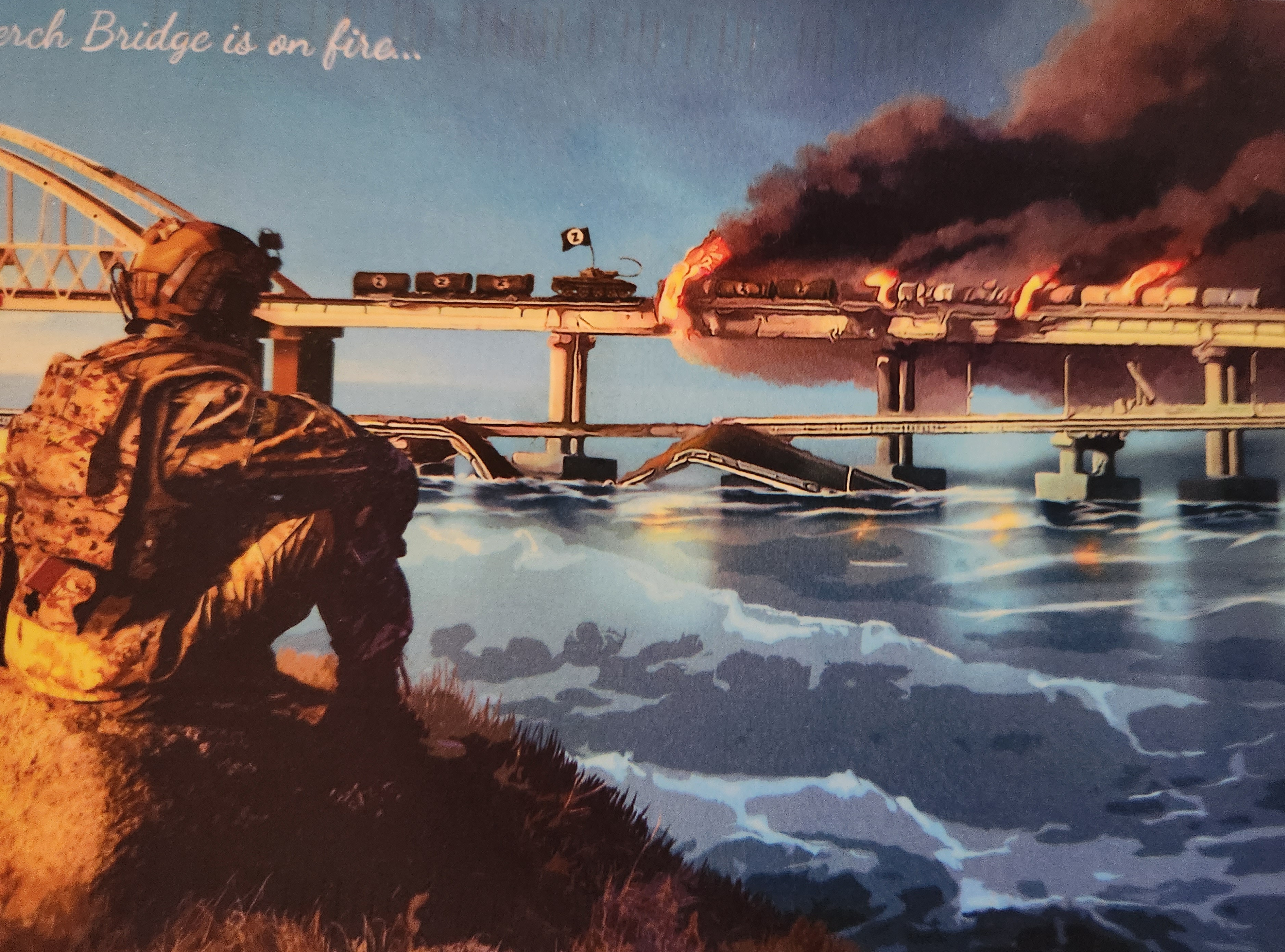
The lands of Eurasia have, over time, been overprinted with layers upon of layers of conflict over thousands of years. While it may seem reasonable to assume that the current national borders of Europe have finally overcome the urge for military conquest, this seems over-optimistic. The ease with which Putin dashed in to grab large tracts of Ukraine in 2014 show that land-grab invasions are not just left to the past.
The more you learn about the last 4000 years of history of the lands covering the British Isles to Portugal to Mongolia to north Africa and the Levant, the more apparent it is that battles of conquest and defense have overwhelmingly been the norm.
There have been so many armies who have fought bloody battles and died or prevailed on the Eurasian landscape since before Roman times, it is a wonder that there aren’t still great heaps of bones wrapped in rotted battle gear. As always, much remains below the surface in history.
Putin’s Botched War
The Putin-Ukraine war is a war of conquest begun by a dictator who somehow didn’t understand or foresee the accurate weapons made available to Ukraine by the USA and Europe. He misunderstood the willingness of the West to come to Ukraine’s aid, but also and maybe more importantly, the magnitude of the relative sophistication of Western armaments and war materiel. This was a major blunder. While Russian military intelligence should have kept the Kremlin updated on Western weaponry, Putin should have asked more penetating questions. But perhaps most importantly, he underestimated the combative spirit of the Ukrainians and their president.
How did Russia manage to fall so far behind the West in the art of war? A high reliance was placed on its giant fleet of tanks, armored personnel carriers and artillery. Much of this equipment was left over from WWII and the cold war. In contrast to its ground operations, Russia’s use of airpower in the early days of the war was weak and ineffective. Western military strategy has a high reliance on air power.
Russia was completely unprepared for the evolving drone tactics used against them. Drones were able to provide intelligence and pinpoint delivery of relatively small bombs at critical locations on launchers, vehicles, individual soldiers and in trenches. While Russian tanks were covered with reactive armor, the Ukrainian drones could place bombs in weak spots on the vehicles or even drop them through crew hatches to the interior where propellant and warheads could be ignited.
Post-War
To the discredit of both Russia and Ukraine, extensive use of land mines as well as cluster munitions has been made. The immorality of these munitions lies in what happens to the left-over mines and cluster bomblets remaining after the conflict. After the war, the lands are going to be recovered and farmed or rebuilt. Land mines and cluster munitions are well known to remain extremely dangerous for decades. Other conflict zones that have been so mined have left a legacy of death and mutilation for civilians.
At some point, the victor of the Putin-Ukraine war will want to salvage the scrap metal of the many thousands of vehicle carcasses left on the battlefields. One question relates to the explosive reactive armor (ERA) on the exterior of the destroyed tanks. ERA consists of a sandwich of a metal “flyer plate” facing the incoming projectile, a layer of high brisance explosive, and another metal flyer plate facing the tank armor. In order to respond to a high velocity kinetic or shaped charged projectile, a high shock-velocity, highly energetic explosive is needed for fast response to impact by a projectile. The ERA must be insensitive to small arms fire.
A great many videos of the destruction of tanks show that a tank can be destroyed and its crew killed by artillery or drones, but a large fraction of the reactive armor remains. The reactive armor contains enough high explosive to diffuse some of the incoming projectile’s energy release, yet seems to be rather insensitive to the shock of a hit a few feet away. This unexploded reactive armor will need collection and disposal.
Ukrainian farmers will need to level out the thousands of bomb craters in their fields so their equipment can traverse the ground. Obviously, Sappers or bomb disposal crews will need to de-mine the roads and pathways. Extensive trench systems will need to be filled in to recover the croplands. The environmental insult to the bombed-out battlefields is already substantial. The environmental toxicity of explosive residues may need evaluation.
Finally, in victory the brave people of Ukraine face the daunting prospect of rebuilding their homeland. Generations of children have been exposed to serious trauma and violence that no one should have to face. Their childhoods have been stolen from them and their educational prospects badly damaged.
If Russia prevails, the citizens of Ukraine face loss of their national identity and progressive Russification. All of the post-war issues given above will still be present, but the economic and social upheaval resulting from a vengeful Russian takeover will be traumatic. Many Ukrainian fighters and political leaders will no doubt be jailed, sent to gulags or perhaps defenestration.
A Russian victory in Ukraine signals bad times ahead for the rest of eastern Europe and the Baltic states. These countries, Poland in particular, already understand this and are preparing for this eventuality. Putin has previously expressed a kinship with the Slavic peoples of Eurasia and this may be part of his motivation for establishing a Russian empire.
The Fall of the American Empire
As bad luck would have it, this aggressive act of Putin’s Russia coincided with a political catastrophe in the United States. The Republican Party (GOP) in America has adopted the old Tea Party platform including libertarians and ultraconservative evangelical Christians to morph into a party of fanatical fascists, sometimes called Christo-Fascists. This is a reprehensible development that has taken decades to pull off. These Make America Great Again (MAGA) people have decided that American democracy doesn’t work. They favor a weak, authoritarian flavored democracy, similar to what Orban in Hungary has led.
The combination of the election of Donald Trump along with allowance of dark money OK’d by the US Supreme Court, the fanatical support of MAGA voters and a detailed coup strategy penned by the Heritage Foundation and funded by numerous billionaires has turned America around the corner towards an ultra-nationalist dictatorship. Trump ignores the courts, the legal role of the congress, and has lately taken a fancy to sending troops into US cities.
Some knowledgeable scholars have offered that American hegemony, in place since the end of WWII, is all but over. Some estimate that the American empire reached its peak influence perhaps 15 years ago and has been in decline since then but Americans haven’t paid attention. Trump, with his claims on Panama, Canada and Greenland as well as his manic desire to impose tariffs on globally has sent American credibility into the waste bin. The global economic upset caused by Trump has forced former friends to forge new alliances, leaving America behind.
Even if the stars lined up right and Trump and Vance disappeared tomorrow, a return to the previous status quo is unlikely to happen. The rapid trade disengagement by Canada suggests that they have had serious doubts with the USA already and this Trump fiasco was the last straw. There has been grumbling by other nations in the past that the American 4-year presidential cycle leads to excessive and frequent foreign policy changes that cause difficulties for them.
Trump’s “America First” declaration and radical disengagement with previous foreign policy has left an apparent power vacuum in the world. This has not gone unnoticed by anyone. Of course, the BRICS nations (Brazil, China, Egypt, Ethiopia, India, Indonesia, Iran, Russian Federation, South Africa, and United Arab Emirates) are taking advantage of this sea change and are considering moving from the US dollar as the principal reserve currency. America is willingly abandoning its historical global stabilizing ability in exchange for a more libertarian internal structure.

 Lamentations on Chemistry