
Note: Recently I posted an early revision of this essay by accident and had to pull it down. Trembling with embarrassment, I wiped the egg from my face and am now posting the intended version. A thousand pardons.
Imagine the frustration of the Russian President, Vladimir Putin, as he discovers the shortcomings of what was presumed to be a premier conventional military force. Decades of corruption and neglect have eroded the military from within. Meanwhile, their nuclear submarines continue to lurk in the depths of the Atlantic, assessing NATO’s day-to-day preparedness and gathering intelligence. Strategic nuclear forces are best used as a deterrent, or so the thinking has been. Coincidentally, their naval procession to Cuba, intended as a demonstration of power, was no doubt monitored by our network of acoustic sensors.
Runup to the invasion
Why did Putin begin his invasion of eastern and southern Ukraine in February 2014? Publicly he claimed to “de-Nazify” Ukraine. At the time, Ukrainian president Viktor Yanukovych was facing the Euromaidan uprising beginning in November 2013, over his rejection of closer integration with the EU. This large-scale protest was in response to Yanukovych’s refusal to sign the European Union-Ukraine Association Agreement rather than strengthening ties to Russia.
Putin’s essay
Just prior to the 2022 invasion the Kremlin published an article online by Putin going into great detail on his rationale for a “triune” state consisting of Russia, Belorussia and Ukraine. It was a “come to Jesus” appeal intended to show doubters that a common ethnic brotherhood existed that far exceed the differences between Ukrainians and Russians. He describes the current Ukrainian state as an anti-Russian project also serving the interests of other entities rather than ethnic unity with Russia.
“But the fact is that the situation in Ukraine today is completely different because it involves a forced change of identity. And the most despicable thing is that the Russians in Ukraine are being forced not only to deny their roots, generations of their ancestors but also to believe that Russia is their enemy. It would not be an exaggeration to say that the path of forced assimilation, the formation of an ethnically pure Ukrainian state, aggressive towards Russia, is comparable in its consequences to the use of weapons of mass destruction against us.” -V. Putin, 2022. [Italics mine]
It’s worth noting that in Russian occupied parts of Ukraine, Russification has been underway in order to make Ukrainians forget their culture and to assimilate into Russian culture. Children were kidnapped early in the 2022 invasion and taken to Russia for assimilation.
Referring to the Ukrainian ruling circles, “They began to mythologize and rewrite history, edit out everything that united us, and refer to the period when Ukraine was part of the Russian Empire and the Soviet Union as an occupation. The common tragedy of collectivization and famine of the early 1930s was portrayed as the genocide of the Ukrainian people.” V. Putin [Italics mine]
Here Putin combines the Ukrainian famine, the Holodomor of 1932-33, with the wider Soviet famine of 1930-33 as a unifying experience that should in his view bring people together in shared tragedy. Whether or not Stalin had intended to cause a genocide of Ukrainians during the Holodomor is still being debated. However, Ukrainians were forcibly prevented from leaving the territory and their agricultural produce was taken from them. The Soviets even took their seed for the next year’s crop (see: Timothy Snyder, “Bloodlands“, 2016, ISBN-13 : 978-0465031474). Whatever the case, the singular focus of Stalin’s first 5-year plan beginning in 1928, was to industrialize the Soviet Union. In Marxist-Leninist political theory, the more prosperous kulaks were class enemies of the poorer peasants. Kulaks were either arrested, executed, sent to the gulag, or to labor camps.
Russian military in the 2022 Putin/Ukrainian war
Within the many layers of rank in the Russian military, there is a notable absence. There is no non-commissioned officer (NCO) level like that found in the US military. Yes, they do have NCOs, but they are technical specialists, or enlisted professionals taken from conscripted or contracted soldiers, uninvolved with small unit leadership and training. That is left for the officer corps. The result has been poor and inconsistent training of recruits. Hazing has long been a problem for the new recruits. Many view the Russian system of military leadership structure as inherently weak and a stubborn vestige of the past.
Perhaps fortified by a misjudgment of their military posture, Putin launched a full-scale military invasion of Ukraine on February 24, 2022, into what has been a sovereign country under the pretense of neutralizing a non-existent threat from supposed Nazi troublemakers as a way to protect Russia. Russian forces quickly began to suffer significant losses in personnel and equipment. Moreover, these defeats have unfolded before an astonished global audience. Fortunately for Putin, his dictatorial foresight had led him to seize control of all media outlets within his borders in the years prior. He watched as his senior military commanders depleted his standing army. Under the pretense of “patriotism,” he drafted civilians and prisoners with the promise of attractive contracts to participate in his ill-conceived “special military operation.” Unfortunately, these soldiers became cannon fodder against the NATO fortified Ukrainian forces. Despite the overall drubbing the Russian military is taking and the half million casualties suffered, they retain the eastern and southern territories annexed prior to the Feb. 2022 invasion.
Putin pays a visit to Kim
Putin’s recent trip to North Korea, reminiscent of Soviet-era diplomacy, and his signing of a mutual assistance agreement with Kim Jong-un, prompted South Korea to reconsider its stance and contemplate supplying arms to Ukraine.South Korea, a manufacturing giant, currently has minimal incentive to engage with Russia as a neutral entity. Russia’s economy, struggling and cash-strapped, requires goods and services. It has been excluded from the international banking system and has seen a decline in amicable trade relations.
Now the word is that DPRK will be sending military engineers to the Putin/Ukraine war. While DPRK’s construction and engineering forces are not referred to as a fighting force, you have to believe that they will fight to defend themselves if they claim to be threatened. What the threshold for “threat” is will eventually be revealed.
Another threat made by Putin is that Russia will send arms to DPRK if the west continues to supply arms to Ukraine. The transfer of technology and materials in aid of the DPRK’s nuclear ICBM ambitions is sure to be the big prize Kim is after. Launching a payload is one thing, but accurate targeting is quite another. I suppose he can use GPS like everyone else does.
We’re hearing that wounded Russian soldiers are being sent back to the front, many with shrapnel from previous combat. I guess they figure that since they are wounded anyway, they might as well get the last bit of mileage left in them. This is certainly no less moral than leaving their dead behind or sending “meat curtains” of poorly trained troops to the front lines. Or, shooting their own soldiers if they retreat from the fighting.
Putin could stop the fighting and carnage in a day if he declared “mission complete” and withdrew his forces from Ukraine and returned claimed territory back to where it was the day of February 24, 2022, invasion. Well, this was the theory of Henry Kissinger. It seems likely, though, that the Ukrainians want back the territory lost in 2014 including Crimea.
Unfortunately for everyone, a withdrawal from Ukraine would be seen in Russia as Putin’s confession of gross incompetence and surely would result in a takeover and death or imprisonment for him.
The Kremlin has used “weaponized migration” elsewhere and is now trafficking immigrants across its western borders through Belorussia, into Finland, the lower Baltic states and Poland in order to overwhelm western border protection and to distract them as he transfers military forces east to the front. At the borders they have been creating a commotion causing western security resources to focus there. This is Russian hybrid warfare and is likely led by Russian intelligence services. Immigrants from various nations like Syria, Iraq and Somalia are given visas in an attempt to make it look like legitimate immigration. One of the goals of these roving throngs of civilians is to travel to western Europe to strain their economies and raise bureaucratic headaches for western governments like Germany. Naturally, saboteurs, spies and terrorists are likely planted in with the immigrants.
Russia has allegedly been jamming or spoofing GPS signals in the Nordic and Baltic Sea region causing interference with commercial air traffic. More Russian hybrid warfare. This affects not only air traffic but ground and sea navigation as well. Commercial air traffic can still fly under inertial navigation or by ground radar between airports and by terminal radar on approach and departure. Terminal radar guides aircraft into the airport instrument landing system (ILS) which is ground based and not affected by GPS. Airlines do monitor their aircraft with the help of GPS, however.
Fighting the last war
There is a saying, attributed to French Prime Minister George Clemenceau, warning generals not to enter conflict by fighting the last war. Putin began with fighting “the last war” with artillery and WWII-era tanks while keeping the Russian population calm with well-crafted fake news continuously delivered to the public. Unexpectedly, he did not seek air superiority starting the first day of the invasion before bringing in ground forces.
The propaganda in Russia today is that they are actually at war with NATO itself with extra blame on the US and UK. Russian war bloggers are even claiming that Ukraine’s drones and missiles can and are being controlled directly by NATO from remote locations. There are many voices on Russian television and in the blogosphere calling for the use of tactical nuclear weapons. Putin and Medvedev have also waved this big stick around as well.
In response to Putin’s unwarranted invasion, most of the free world made the decision to withdraw its financial and trade connections, especially with the purchase of oil and gas (O&G). O&G is a huge money maker for Putin’s dictatorship and funds much of Russia’s government. Interestingly, while initially very concerned, the Oligarchs have learned to stop worrying.
Economic effects
An urgent problem presently in the Russian oil industry is the matter of upkeep on imported technology like oil refineries. Russia previously hired foreigners to build and maintain most of its oil refineries and licensed proprietary unit operations. Many of the foreign businesses that supplied these services have left Russia. As the clock tick-tocks along, equipment breaks down or misses scheduled maintenance. Replacement parts have become very difficult to obtain. This has a huge influence on the country’s refinery output in particular and on other industry in general.
Russia’s loss of trading partners is having a deleterious effect. Tax revenues are down into the deficit range across the board and the Russian government is working to introduce new taxes on the people. There is even word that laws are being drafted to increase the range and cost of fines against citizens who fail to put in the required extra effort. According to Forbes, the State Duma is tightening laws relating to labor and business operations are forcing employees to work weekends and holidays, especially if the business is military related.
Nukes behind the curtains
Of course, Putin has his nuclear armaments to fall back on. Much was made previously of the Soviet’s continuum theory of nuclear weapons, whereby they didn’t recognize a firebreak separating conventional and nuclear warfare as the west does. Putin and former president Medvedev both have been rattling their swords, threatening to use their nuclear weapons if the west does not back down in supplying Ukraine with arms. Most think that they threaten to use tactical nukes only. Both sides are quite aware what a nuclear exchange between NATO and Russia would look like. That said, only the first use will be a difficult decision.
Nuclear response in kind by NATO to Russia’s first use in the Russia/Ukraine battle space could possibly be limited to tactical use, but it will have let the nuclear genie out of the bottle nonetheless. Both NATO and Soviet/Russian military institutions have certainly war-gamed a similar scenario to many possible outcomes. People safely distant from the fighting will have to decide the intensity of a nuclear exchange and at what point to release strategic weapons, if needed.
One thing seems clear- a strategic exchange will be WWIII and Russia’s seething hatred of the US will not allow North America to survive untouched by war. Given the geographic and military limitations of Russia and the broad stretches of open ocean around most of the US, shallow trajectory ballistic or cruise missiles launched from Russian submarines are likely to be at play. Maybe an EMP weapon will be used. (Hell, a nuke hidden in a bale of weed could get into the country.) It seems likely that Russian hybrid tactics will first begin to soften the defensive, electric power, transportation and communication structures of the US by interfering with software-controlled everything. Naturally, the fragile stock market will collapse promptly, and unemployment will skyrocket. Toilet paper will vanish as if by magic from the store shelves.
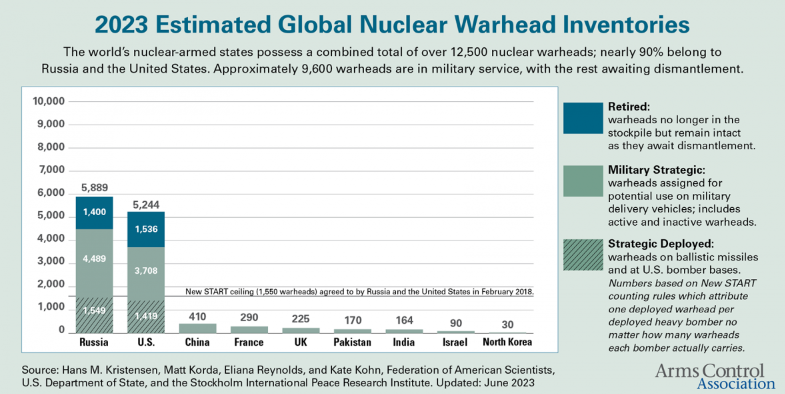
Both NATO and Russia have enough nuclear weapons to go back and bounce the rubble a few times at leisure with their ICBMs and SLBMs. The total warhead count in the world’s nuclear powers is shown below as tallied by the Arms Control Association. The total warhead count for each country includes both tactical and strategic weapons as well as retired warheads. Nuclear weapons have a shelf-life and require some refurbishment over time. For instance, the tritium booster gas in the pit is subject to decay with tritium’s short half-life.
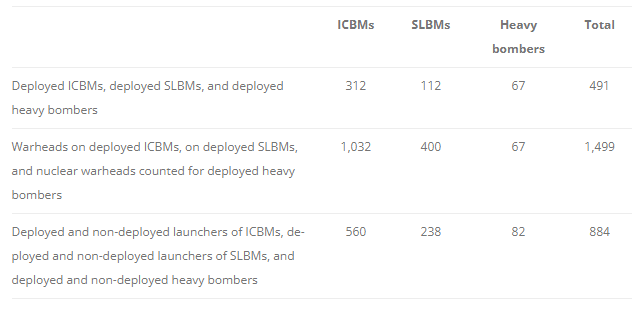
New START data on Russia’s strategic nuclear weapons inventory is shown below. As you can see, Russia’s strategic nuclear weapons inventory is poised to make quite a mess of their target areas from a great distance. On the strategic side (below), nuclear weapons can be delivered to a target across the world via strategic bomber, or a ballistic missile. Intercontinental Ballistic Missiles (ICBMs), Sea Launched Ballistic Missiles (SLBMs), and a collection of shorter range arial platforms could be used in combination.
Will Russia be tempted to try using a tactical nuclear weapon in Ukraine, even if NATO is sure to reply? At what point will a tactical exchange between Russia and NATO runaway to a strategic exchange? It seems unlikely given the terrible strategic downside of NATO retaliation. Certainly, if allowed to act unobstructed, Russia could make quite a nuclear mess in Europe and North America. However, NATO commanders will not allow their nuclear arsenal to be destroyed in storage.
The late Gene Sharp was known for his theory of non-violent resistance. Sharp argued that
“political power is not intrinsic to the power-holder,” but flows from outside sources that include perceptions of authority, available human resources; skills and knowledge; material resources; and intangible psychological and ideological factors. These sources all depend upon obedience, which arises for “various and multiple” reasons that include habit, fear of sanctions, perceived moral obligation, psychological identification with the ruler, zones of indifference, and absence of self-confidence among subjects. Obedience is essentially voluntary, and consent can be withdrawn. [Wikipedia]
Dictators do not often yield their power without violence, but now and then one will see the futility of fighting to the death against overwhelming resistance and abdicate after a face-saving attempt to stifle the uprising. This happened in the late 1980’s in eastern Europe leading up to the collapse of the Soviet Union under Gorbachev in 1991.
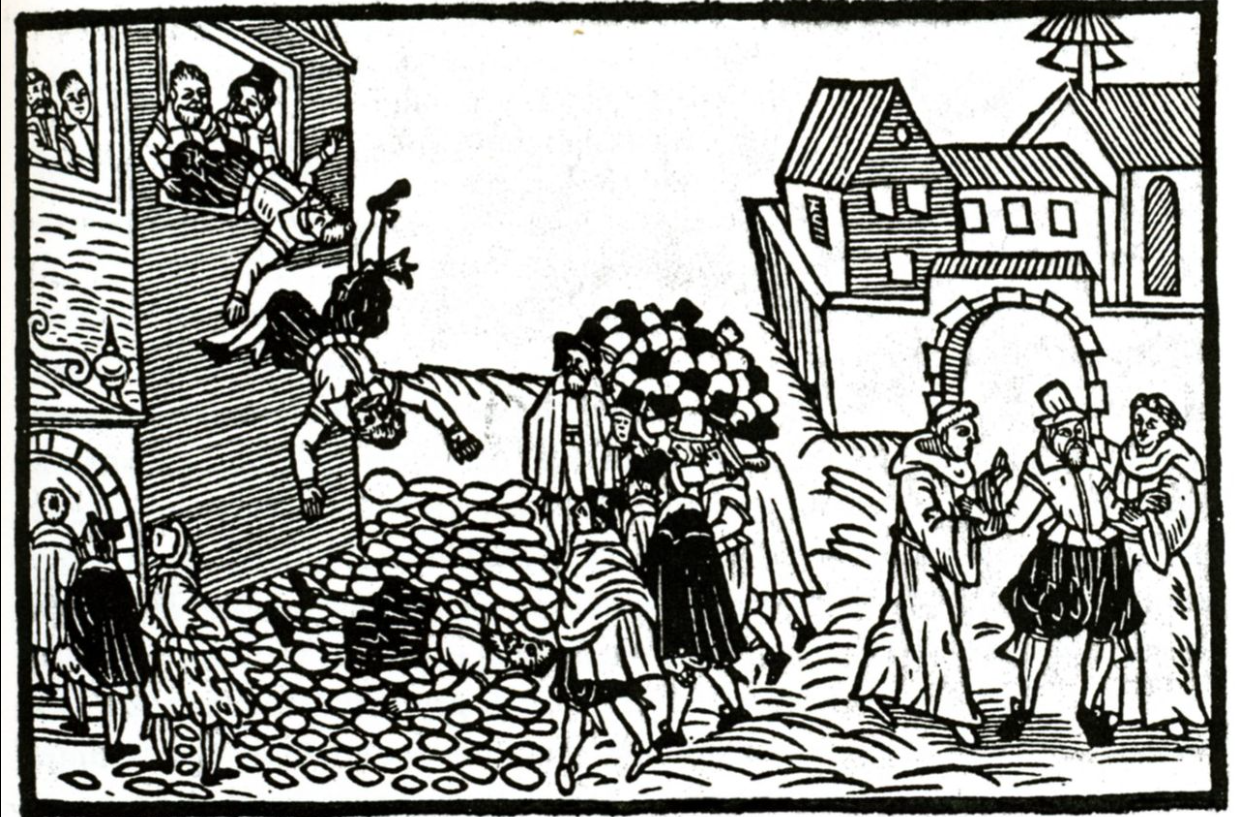
Russia will not change its ways until there is a decapitation at the upper few levels of its authoritarian police state. The population has been too passive for too long to expect a popular uprising like the Velvet Revolution in Czechoslovakia in 1989. Russian opposition leaders are either poisoned, defenestrated or sent to prison as a security threat. Only a military coup could pull off a major change in leadership, but then you have a military authoritarian state.
A time-honored way to generate and maintain unity in a nation is to direct blame and struggle towards a foreign power. Both sides in the post-WWII cold war, NATO and the USSR, used this to focus resources and political angst in their respective favor. Putin has managed to revive this “good vs evil” duality not only to secure his power, but also to drive ethnic Russians toward his goal of a Greater Russian Empire.
 Lamentations on Chemistry