Many Western observers often imagine a future in which, after Putin’s departure, Russia evolves into a more open and cooperative nation. Wouldn’t it be appealing if Russia joined the global community of states that embrace free trade and safe tourism? This vision reflects our own ideals, making it easy to assume that Russia might share them—but history suggests the reality may be far more complex.
A review of Russian history from Tsar Nicholas II to the present reveals a persistent pattern of authoritarian governance. Although Tsar Alexander II abolished serfdom in 1861 and introduced several liberal reforms, these changes faced strong resistance. Many reforms were ultimately reversed, as they diminished the power of the nobility, provoking significant opposition despite their positive perception in the West.
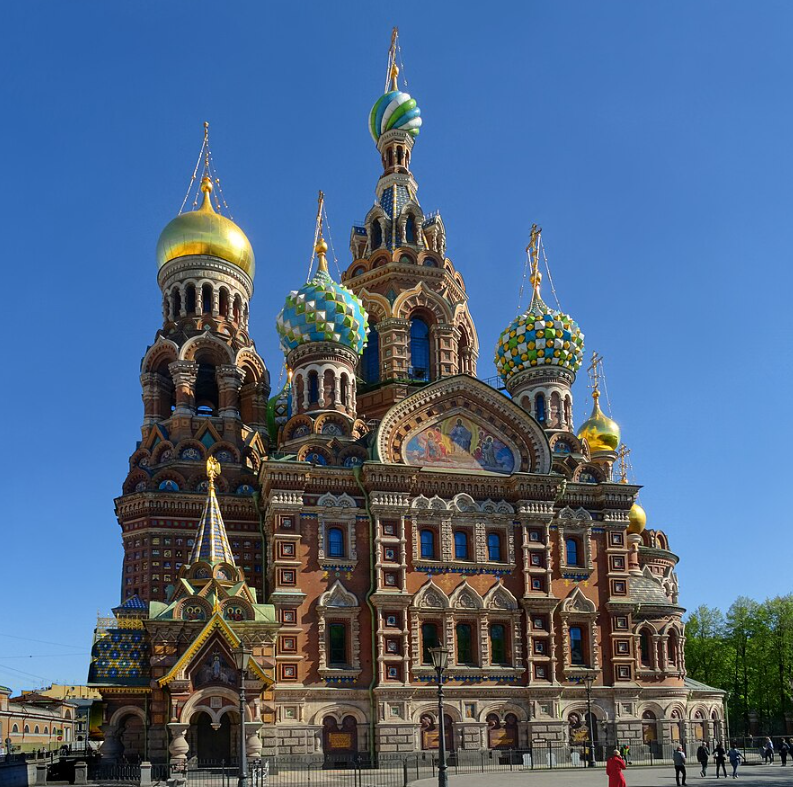
On March 31, 1881, Tsar Alexander II was assassinated in St Petersburg, Russia. His habit was to ride his carriage to a military roll call that day of the week. The route was along the Catherine Canal. An assassin threw a bomb under the horses and it exploded as the carriage rolled over it. The emperor’s carriage was bullet proof, a gift from Napolean III. Alexander exited the damaged carriage uninjured and paused to survey the scene. As he was doing this, a second assassin tossed another bomb at his feet which exploded, later killing him and killing and injuring many others in the vicinity. Afterwards a beautiful cathedral was built on this site called the Cathedral of the Savior on Blood.
Cathedral of the Savior on Blood. Included here only because it is a beautiful image. Image from Wikipedia.
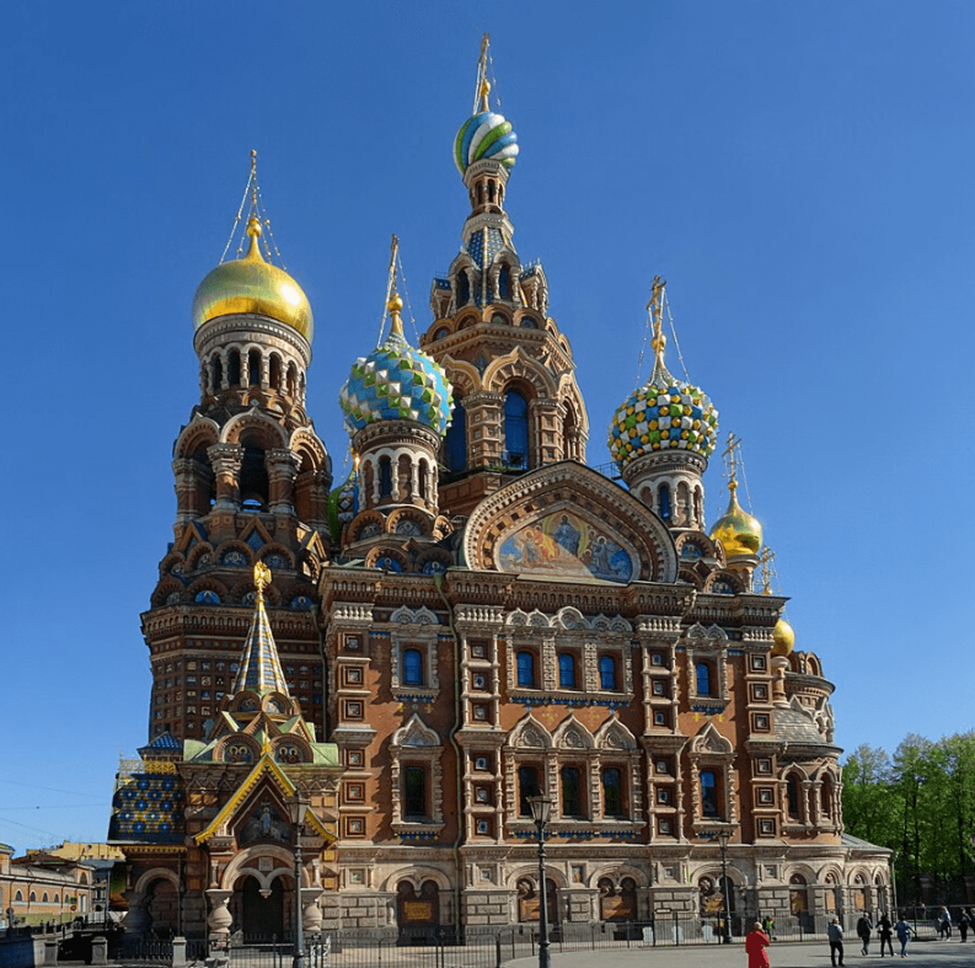
Cathedral of the Savior on Blood. Included here only because it is a beautiful image. Image from Wikipedia. I was awestruck when I visited.
If you end up in Saint Petersburg, which I whole heartedly recommend, this cathedral is well worth a visit. It’s newer and, in my opinion, perhaps even more beautiful than the famous Saint Basil’s Cathedral in Moscow along Red Square,
Following Tsar Nicholas II’s abdication in 1917, a provisional government briefly assumed power before being overthrown by the Bolsheviks during the October Revolution. The ensuing civil war ended with Bolshevik victory, elevating leaders such as Lenin, Trotsky, and Molotov. In November 1917, the Russian Socialist Federative Soviet Republic (RSFSR), the Russian Soviet State declared itself a sovereign state.
The revolution triggered widespread unrest, with numerous factions pursuing divergent objectives. The Bolsheviks relied on the Red Army, while the White Army comprised former imperial officers and Ukrainian anarchists opposed Bolshevik control as well. Additionally, thirteen foreign powers—including Austria-Hungary, Germany, and the Ottoman Empire—intervened against the Bolsheviks.
In 1922, the Russian Socialist Federative Soviet Republic ratified a constitution and formally established the Union of Soviet Socialist Republics (USSR), written in Cyrillic as CCCP.
Amid the turmoil of the Bolshevik Revolution, Russia ceded territories previously seized by Germany during World War I. The collapse of the Russian Empire sparked a protracted struggle among various ethnic groups and factions to reclaim land and assert authority. By 1923, the Russian Civil War had concluded.
Let me say that although the western block vigorously opposed the Soviet communism later in the Cold War, the break from monarchy by popular uprising to form the Federative Soviet Republic and later the Union of Soviet Socialist Republics was a remarkable achievement for that part of the world. To transition from a monarchy with serfdom to the USSR in ~60 years was a world-class achievement. The sad part was the rise of Stalinism and cementing in state authoritarianism as well as revolutionary expansion to global communism. Global socialism was an early goal of the Bolshevik leadership. Socialism was interpreted as a precursor to true communism.
So, why can’t they be like us? Because their history and cultural development never included exposure to free markets, private ownership, foreign travel and individual freedoms we in the west are accustomed to today. No Magna Carta setting limits on the power of the monarch and no parliament sharing power with the monarch. Russia did not participate in global travel as western European nations did which led to colonization and the extraction of wealth from their colonies producing gold, silver, spices, salt peter, slaves, etc. The wealth accumulation and theft of colonial resources set the pace for producing vibrant and wealthy countries in Europe, but not in many of the colonies. The American colonies are a famous exception.
Summary-
This summary only scratches the surface of the October Revolution and the subsequent civil war. For further detail, readers are encouraged to consult additional sources. The period was marked by extreme complexity and violence, resulting in an estimated 7–12 million deaths.
All of this Russian/Soviet history is meant to highlight that from the very beginning the Soviet state was born from the fire of violent conflict. The Soviet State prevailed in the end and many Soviet revolutionaries migrated into positions of power in the new USSR. It is difficult to believe that the leadership of the Bolshevik revolution and civil war were left unaffected by this conflict as they moved down the timeline building the USSR. It had to affect how they thought of power and how to keep it. Did this experience set the ball rolling for an centrally controlled authoritarian state? Was the tight control over the state emphasized by the early war experience? It is not just authoritarianism as offices and red tape, but it includes institutionalized paranoia and a lack of reluctance to use imprisonment and execution as tools of the state. The gulag system was built under Stalin. This brutal leader sent millions of people to the gulag system to labor. They weren’t executed outright because the state needed laborers to build the camps and to work on public works projects and build and operate factories. Starting in the 1930s, Stalin began to push for extensive industrialization all over the USSR. Agriculture in particular was industrialized, especially in Ukraine. This was behind the Ukrainian Holodomor of 1932-1933.
Given this history of conflict, authoritarianism, and systemic repression, it is unsurprising that Russia continues to exhibit traits of a closed and deeply security-conscious state,
Note: Not residing in Russia, I cannot grasp the full extent of the events and mood unfolding there. All that remains is to perch on a power pole across the polar cap and try to discern fact from fiction.
>>> Let’s ask a very basic question about today’s Russia. Why can’t Russia Putin play nice? <<<
Like most, I have anxiously watched Putin’s invasion of Ukraine. The prevailing Russian narrative is trying to say that the sovereign nation known as Ukraine has historically been a part of Russia or some earlier Russian empire, a view promoted by Putin. Following the Bolshevik Revolution, Lenin directed the Bolsheviks to seize the territory now recognized as Ukraine. The goal was to claim territory for the Soviet Union, but also territory that was extremely fertile. Stalin ordered that Ukrainian industry and agriculture were to be collectivized. An independent Ukrainian government was briefly established but just as quickly collapsed. After several years of intense Ukrainian resistance and significant suffering, Lenin conceded and established Soviet Ukraine, enabling its incorporation into the Soviet Union as a constituent republic.
In the current action, with the support of an extensive security apparatus, Vladimir Putin has resolved that what is now Ukraine will be assimilated into a growing Russian empire. The process will methodically transform its Ukrainian identity through Russification, transforming it into southwestern Russia. Ukraine is expected to become an agricultural hub and potentially a strategic forward base for further military operations into Poland the Baltic states, and likely Moldova.
Why does Putin desire Ukraine when there is considerable open land to the east and north? Well, it’s the geography. The land beyond to the north and east of Moscow consists of vast stretches of challenging subarctic taiga and arctic permafrost, much of which is now thawing, making it unsuitable for roads, urban development, agriculture, and industry. In contrast, Ukraine boasts rich, productive farmland with significant annual grain exports. Additionally, along its southern coast, including Crimea, Ukraine possesses the only warm water ports available in the region, other than possibly the Neva River to the north which are vital for commerce and the military.
Historically, western European colonization was driven by the prospect of trade opportunity including raw materials, cheap labor as well as power projection. Like all countries, Russia would like room for its prosperity to grow. It is desirable that agricultural and industrial capacity also rise. However, Russia has learned the hard way the value of having a buffer zone between Moscow and Western Europe. The relative ease with which both Napolean and Hitler crossed the Eastern European territory enroute to Moscow, Leningrad and other cities through greater Russia did not go unnoticed by Stalin. By absorbing the Eastern European territories after WWII, Stalin built a picket fence protecting the Soviet state.
As the Nazi’s Operation Barbarossa was failing and Stalin’s Red Army began pushing the Germans into a westward retreat, the Soviets took advantage of the opportunity to install Soviet political structure in captured Nazi territory like the Baltic states, Eastern Europe and the eastern half of Germany. While Stalin did not share Hitler’s enthusiasm for exterminating Jews, he did act to eliminate preexisting local political structures which included substantial Jewish presence. This meant executions and large-scale banishment of politically unreliable people to the Russian gulag system. Poland was hit particularly hard by both Hitler and Stalin because it was directly between Russia and Germany and had a large Jewish population.
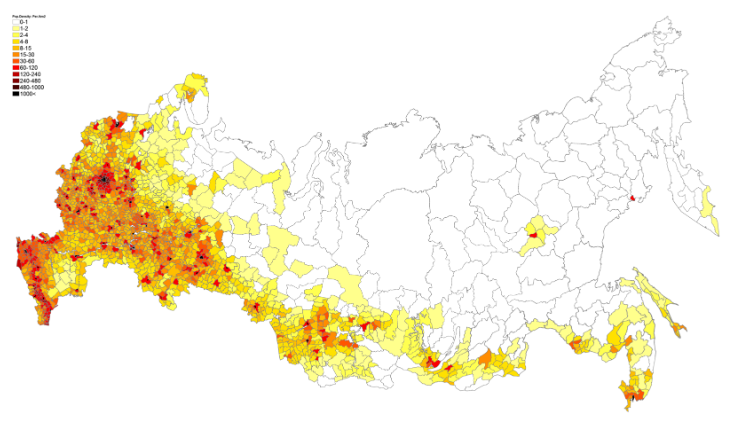
The above map shows the population density of Russia. A substantial fraction of Russians live in the southern and western regions of the country. If you assume that people are living there because it is at least somewhat livable, then the map shows the extent of land poorly suited for habitation.
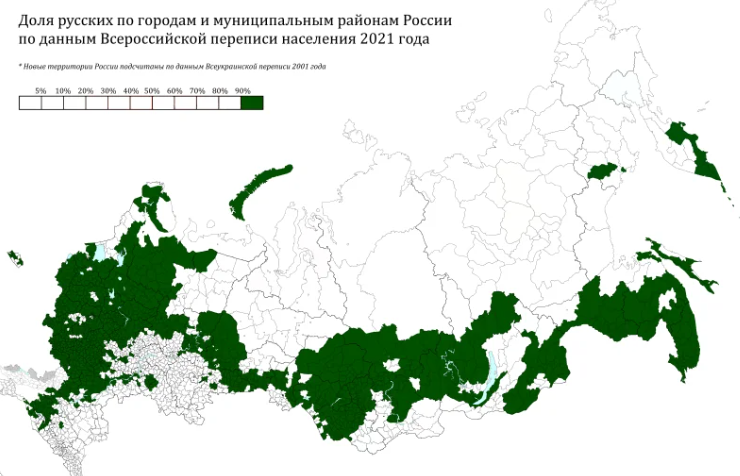
Map of Russia showing areas that are 90 % populated by ethnic Russians.
Russia has a great deal of acreage but the livable turf is much smaller.
Putin views the world partially from the old cold war perspective. It’s Russia against the aggressive, corrupt and immoral west, but without the fever dream of a Soviet-style socialist world. Putin’s state-controlled media endlessly repeats that the west wants what the Russians have and stokes the fires of fear. For the Soviets, “aggressive, corrupt and immoral” included resistance to Soviet influence.
In my many years of trying to be as informed as possible in many areas in a free and open society, not once have I heard anyone suggest “Gosh, I wish the USA could occupy Russia (or the USSR) as an American territory and take all of their stuff.” Imagine the scope of the folly in stupidity of such an attempt. It is mindbogglingly absurd to believe that one could or would want to do such a thing. Russia is for the Russians. Maybe one day they will hit upon a way to craft a free and open society.
The Soviets were ardent promoters of global socialism. Although not overtly socialist, Putin appears more focused on preserving Russian culture and dominance from across a substantial territorial buffer with the West. He asserts his aim to shield Russia from Western cultural influences and what he perceives as a “belligerent” military stance.
The “belligerent military stance” of the West amounts to NATO responding to Soviet adventurism and their habit of hybrid warfare. They would say the same thing from their perspective, but which side was the more authoritarian?
Historically, Russia has endured invasions by King Charles XII of Sweden, Napoleon, and later Hitler. The history of the Kievan Rus from 830 to 1241 is jammed with bloody feuds, wars and invasions. From the Principality of Moscow in 1281 to the end of the Tsardom in 1917, and even beyond into the era of the Soviet Union and into Putin’s time, near continuous conflict has plagued the Russian people. Fortunately, Russia’s northern geography and harsh winters have often played to its advantage, compelling invaders into prolonged conflicts and misery with eventual withdrawal. But not always.
Most nations would like to have global hegemony. Putin is fond of saying that Russia has suffered greatly from American and Western hegemony since WWII and hopes to put an end to it. He has reestablished a Soviet-like security state apparatus with strict media control when he assumed power after the 8 years of Yeltsin’s chaos following the collapse of the Soviet Union. He is trying to resume for present day Russia the former Soviet Union’s international status but largely without the manpower and resources of the former adjacent Soviet states.
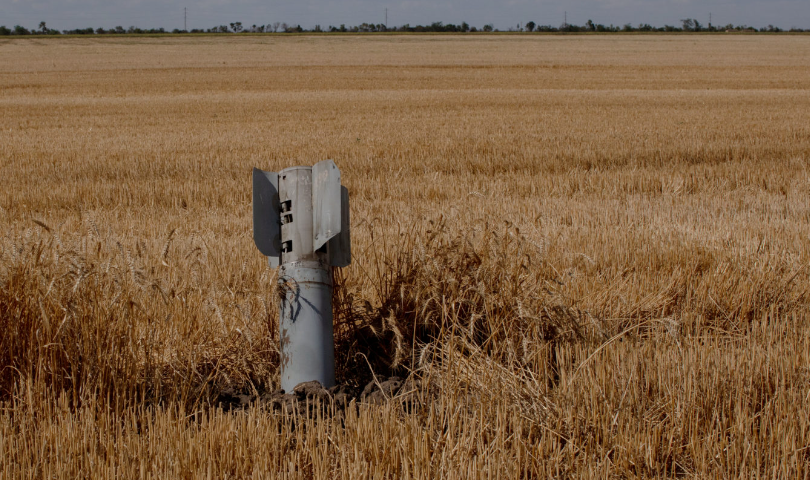
Source: The Fuller Project. Unexploded cluster bomb in Ukrainian wheatfield.
Like his Soviet predecessors, Putin both envies and worries about overreach of western hegemony and is moving to unseat the West. For that matter, so is China. This is only natural. I believe they resent western influence generally. The English language as the global lingua franca and the US dollar as the standard international currency are seen as an annoying affront to their own cultures, sovereignty and political significance. Again, this is only natural. And so is the temptation to use power projection or coercive propaganda to achieve their own hegemony. Casualties would be considered the West’s fault for being in the way.
Both Russia and China have long been critical of the West for internal propaganda purposes but to be fair there has been some valid criticism as well. In truth, the US has done some bone-headed things that we should not be proud of and that hardly serve to highlight our presumed “special” nature. But in fairness, most all cultures can look back at regrettable conduct in their history. Neither Chairman Mao’s China or Stalin’s USSR have sparkling clean histories either. Often the benefit of hindsight doesn’t come into focus until far down the timeline.
The Soviet Union in the person of Joseph Stalin, had brutalized Ukraine previously in an attempt to halt its independence. The Holodomor, meaning death by starvation, of 1932-33 is estimated by scholars to have killed 3.5 to 5 million people. This period of time is marked by forced collectivization of agriculture and industry in the USSR and Ukraine. Collectivization meant taking control of farmland owned by the peasants (especially the Kulaks), many times banishing them to the gulags never to be seen again. Already by 1931, Moscow had taken 42 % of the Ukrainian grain harvest, forcing some locations even to turn over seed for the following harvest. By early 1932 some districts in Ukraine were already experiencing famine. The governing committees in Ukraine in 1932 believed that the 6 million tons of grain demanded by Moscow was unachievable, yet they ratified the plan anyway.
The current brutal murder and devastation of Ukrainian citizens and their infrastructure and agriculture will take a generation or more to repair even if Russia prevails. Russia has done great damage to the Ukrainian environment in addition to the many casualties. Much of the country is cratered, littered with destroyed vehicles and war debris, denuded of vegetation, and rendered deadly by the landmines.
The great equalizer among the leading nations is Mutual Assured Destruction, or MAD, by virtue of the threat of the use of nuclear weapons for mutual annihilation. Sometimes just called “the bomb”, it was indeed invented by an international cast of scientists and engineers using American uranium and Plutonium and first used in successive releases by the US on Japan near the end of WWII in the Pacific theater. This will darken a stretch of American history indefinitely. Some continue to argue that the bombing was not necessary because Japan was soon to surrender, but it happened, and nothing can change that. However, to our credit, the US has never used it since and has actively sought with other nations to suppress the proliferation of nuclear weapons and remove the hair triggers for their use. That said, the US remains a no-first-use country but will participate in the principle of Mutual Assured Destruction as needed.
A Nuclear Sidebar
Very soon after the discovery of nuclear fission in December, 1938, in Nazi Germany by German-born chemists Hahn and Strassmann, and Austrian-born physicists Meitner and Frisch, the theoretical potential of using the vast energy output of nuclear fission for a bomb was quickly realized. On May 4, 1939, Frédéric Joliot-Curie, H. Von Halban and L. Kowarski in Paris filed for three patents using a fission chain reaction. Two involved power generation and the third was for an atomic bomb, patent No. 445686. Fission was experimentally discovered in Dec. 1938, theoretically explained in January 1939, and a patent for the atomic bomb was filed on May 4, 1939.
The point of this atomic interlude is to highlight the short time interval between the discovery of nuclear fission, conceiving the idea of the atomic bomb and filing for a patent by scientists. On August 2, 1939, a letter written by Leo Szilard and signed by Albert Einstein was sent to President Franklin D. Roosevelt warning that Germany may be developing an atomic bomb. This led to the Manhattan Project and America’s entry into nuclear weaponry.
During and after the Manhattan Project, Stalin’s spies detected and infiltrated the American bomb project and presumably used important stolen information for their own nuclear program. This was an important shortcut benefitting the Soviets greatly. The first Soviet atomic bomb burst so soon after the war shocked the world.
Humans have a gift for the invention and use of weapons. I’m sure it has always been that way for humans. The inclination for war and conquest is also an ancient instinct. It is hard to see how aggression will ever change. In view of this distressing thought, how are we to proceed?
Looking forward
In the short term we in the west must continue to discourage Putin’s expansionist push. A win for Ukraine will set a precedent that might even unseat Putin. It is up to the many good people in Russia to be rid of him. However, Russian citizens will have to struggle against the vast authoritarian political machine in place just like the Poles, East Germans and the other Soviet states had to do in the late 1980’s. The intimidation and resources of the Putin authoritarian state are a huge obstacle.
My guess is that in general, doing the “right thing” in a culture of normalized authoritarianism, bribery and corruption is more difficult to accomplish than doing the “right thing” in a free and open culture where doing the right thing is occasionally practiced and always admired.
To a westerner like me, Russian withdrawal from Ukraine seems like the optimal solution to Russia’s present economic and military race to the bottom. Even in winning, Russia will inherit a devastated region that will require vast resources and a decade to repair, as well as a population of angry and vengeful citizens looking to kill a Russian or two. Then there are all of the land mines to contend with. There is amputation or death by landmines in the future for many unsuspecting people regardless of who wins.
A cessation of hostilities led by Putin is likely to end his career. Thus far, Putin’s invasion has led to over 500,000 Russian casualties, of which there have been over 80,000 Russian fatalities. In a way, this pales in comparison to Stalin’s murderous handiwork, but the comparison is really more like “terrible versus really, really terrible.”
Whether or not Putin is a reanimated Soviet leader or “just” another Tsar isn’t a question to dwell on. He is a creature of his time who happens to be a former Soviet KGB officer but has rejected Marxist/Leninism and rules by a roughly mafia-style kleptocracy behind closed doors in the Moscow Kremlin. For Russian citizens, the rule of thumb is if you stay out of political business, the government will stay out of your business.
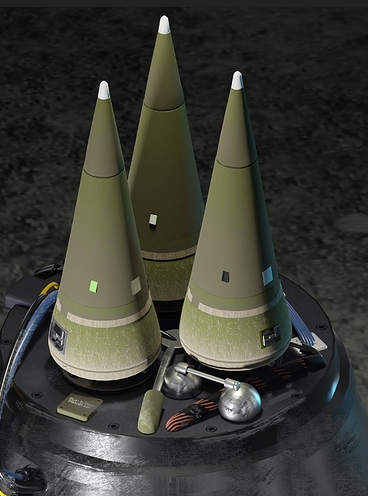
Some vocabulary from bad old days of the Cold War has come back to haunt us. Russia has announced that it has deployed its RS-28 Sarmat intercontinental ballistic missile (ICBM) in Belarus. The 112 ft long, 211 ton missile is said to carry 15 Multiple Independent Reentry Vehicles (MIRVs). As new and scary as this sounds, the US first conceived of the MIRV in the early 1960’s and deployed its first MIRV’d ICBM (Minuteman III) in 1970 and the first MIRV’d SLBM (Poseiden Sea Launched Ballistic Missile) in 1971. The USSR followed suit in 1975 and 1978, respectively.
In the early 1960’s it was believed in the US that it was behind the USSR in what was called the “Missile Gap”. It turns out this was incorrect and that, in fact, the US had a large advantage in the number of ICBM strategic delivery vehicles. For a long while we in NATO thought the Soviets were 10 feet tall and that turned out to be an exaggeration. From their performance in conventional battle, they have diminished in stature just a bit. However, their nuclear triad is to be respected.
The initial purpose of the MIRV concept was to compensate for inaccurate delivery. It has evolved to include decoys and multiple target delivery. There is a good deal of non-classified information on MIRV systems on the interwebs.
Putin’s threat of a new MIRV’d missile is just more nuclear bluster to frighten NATO citizens. For the present time his nuclear weapons are more valuable in storage as they have been all along with the Mutual Assured Destruction policy. That said, they have a policy of using nukes if the security of the state itself is under threat. I would guess that Putin sees himself as the state.
I wonder if it has dawned on the Russians that nobody in their right mind would actually make a preemptive attack on Russia or its former Soviet satellites. Who actually wants the place? What benefit is there in trying to subdue 140 million angry Russians and their huge frozen taiga? That’s nuts.
Reuters has reported that Russian ships have been observed in the area of North Sea energy resources of The Netherlands. MIVD head General Jan Swillens stated that “Russia is mapping how our wind parks in the North Sea function. They are very interested in how they could sabotage the energy infrastructure.”
The Reuters article went on to say “Dutch intelligence agencies MIVD and AIVD, in a joint report published on Monday, said critical offshore infrastructure such as internet cables, gas pipes and windmill farms had become the target of Russian sabotage activities.”
Norway is in a state of heightened alert because of recent appearances of unidentified drones buzzing over North Sea oil platforms, airfields and other sensitive sites. Norway has replaced Russia as a major supplier of natural gas. Norwegians believe that espionage, sabotage and false messaging are a means of intimidation. Though not a member of the EU, Norway mirrors the EU in many ways.
According to AP, seven Russian citizens have been arrested recently for flying drones or taking photographs of sensitive areas. In Norway it is illegal for Russian citizens or companies to takeoff, fly over or land on Norwegian Territory.
The clear intent of Russia Putin is to map out North Sea infrastructure for purposes of sabotage. Doing it in the open gives them the added benefit of intimidation. The UK and EU have considerable dependence on oil and gas from the North Sea. Plenty of communication cables lie there as well. Obviously, interruption of these resources will cause great economic and political disruption in affected countries. It is hard to believe, however, that Russia doesn’t already have data on the North Sea infrastructure.
Russia is sending a message that they consider North Sea Infrastructure a critical target for attack at some point. They know that winning a war is about removing your opponent’s will to fight. Collapsing your opponent’s economy and industrial base by shutting down the flow of energy is probably most likely very early in hostilities with the West. This should be nothing new to Western war planners. But to politicians and business leaders it might be a wakeup call.
Putin’s criminal invasion of Ukraine has given the West motivation to assess its defensive resources and move to beef them up. Putin has also given the West a picture of how the future world order could look. The West has ignored or underestimated the threat that Russia poses at its own peril. We’ve already begun Cold War II.
Putin’s Russia excels at brinksmanship and psychological operations. The Putin/Ukraine war is stalled for the Russian land forces at present, but he still has assets for conventional air and sea operations. Building on his lies that the “western Nazi’s” pose an existential threat to Russia, he can deflect attention elsewhere at least for internal consumption.
It is my sense that Putin and others like the NPRK would like nothing more than to be sure the continental US takes battle damage in the next big war. Just like our nuclear submarines, Russia’s large fleet of nuclear submarines can navigate around the world quietly in stealth. They can park off the US coasts and deliver whatever they want.
The West must absolutely stand firm on resisting Putin’s threats and holding back the conquest of his neighbors. I believe that Putin will remain a serious threat to the West as long as he is alive. His crimes are so extensive now that he can never safely retire from office and live in a dacha somewhere. It seems doubtful that his successor will be much different.
An open question is, why would Russia think that the West would preemptively attack them? Because we yearn for their vast stretches of taiga? Maybe they fear for their hydrocarbon reserves? Let ’em have their oil and gas. It is theirs. An attack on the Russian homeland would go nuclear early in a conflict. There is no future for anyone in nuclear war. Once that genie gets out of the bottle, there is no stuffing him back in like we did post-WWII. Like anyone else, the Russian people are nice folks. Except for their government. Rancid leadership is something their people will have to overcome.
I’m about to say some things that may seem (or are) hopelessly naive. But sometimes we should stop and reexamine our basic assumptions.
So, I have to ask the question. Why would anyone in their right mind contemplate an unprovoked attack on Russia? The present-day Russian and former Soviet leadership has always made a show of holding back what they call “western aggression”. They justify their military buildup by claiming that NATO is an immediate and existential threat to their security. But seriously, who the hell would want to control Russia? They fear the push back on their own behavior which is to threaten the west. It would be a total disaster for everyone.
Yes, NATO is a threat insofar as they hold the line against Russian expansionism. Should states succumb to Russian control just because the leadership of Russia says so? Obviously not. Russian control seems to come with the loss of freedoms, stultified economic progress and political oppression. Putin’s war was initially justified, at least by what is available in the western press, as a strike on incipient Nazism in Ukraine which Putin declared as a direct threat to the security of the Russian state.
Everyone outside of Russia realizes that this is a bald-faced lie cynically devised to justify Putin’s dream of empire.
For arguments sake let’s say NATO attacks Russia for whatever reason and let’s say NATO wins. What have they won? A giant collapsed country full of permafrost and mosquitos populated with angry citizens living in economic collapse. The US and coalition forces couldn’t even control Afghanistan with its population of neolithic religious maniacs and their opium poppy fields. And we left the poppy fields intact too!!What chance would there be for western forces controlling a defeated Russia? It would be like the dog who caught the car. What next?
The same question applies to Putin. If he conquers and occupies Ukraine and then the other former Warsaw Pact countries, what will he have gained? Apparently, Putin guessed that they would roll over and comply. That was the state of affairs during the days of the Soviet Union. The USSR had a powerful and penetrating police apparatus with a network of remote prison labor camps and little presumption of innocence.
Unfortunately for Putin, Ukraine didn’t just roll over and concede. They are fighting back against certain authoritarian control and loss of their Ukrainian heritage. In doing so, it is revealed to the world that Putin’s conventional military is a paper tiger. Military planners the world over are taking notes on the modern conduct of war. Resources that might have modernized the Russian military have been funneled elsewhere for a long time.
Russia’s nuclear forces, however, are something to worry about. However, Putin and his cronies know about Mutual Assured Destruction. This principle has prevented nuclear war since Russia got the bomb. Putin knows that if he releases nuclear war shots, the resulting nuclear exchange will not only devastate all participants, but will bounce the rubble a few times as well. Even if land-based missiles are destroyed, the respective submarine fleets can continue to unleash nuclear hellfire at leisure. The meaning of victory becomes very hazy here.
As always, the Russian model of conquest seems to impose brutal authoritarian control to suppress opposition. Not because there is something wrong with the Russian people. But Russian leadership has been so oppressive for so long that there is no institutional template for alternative leadership.
This is very simplistic, but does Russia know that nobody wants control of their country? Imagine the folly of it. Since the days of Stalin they have worked themselves into a lather about the west. The cold war was a game of weapon/countermeasure cycles that has quietly developed into Cold War II. It is all so unnecessary.
I think it is fair to say that everyone wants a peaceful Russia that can participate in world trade, tourism, science and cultural affairs. A reclusive and paranoid Russia that is angrily stamping its feet and issuing threats to its neighbors is a Russia that will remain unhappy and dangerous. Decent people and rich culture are abundant in Russia. Their leadership doesn’t let that shine through.
Yes, we understand that Russia was viciously invaded by the Nazis some years back but they prevailed. At some point everyone has to look to a prosperous future. Yes Russia, this includes you. There is no similar threat to Russia in the world today. Just because the west responds to Russian provocations doesn’t mean that there is an intent to attack. Just because the economic engines of the west outperform them at present doesn’t imply imminent attack either.
I would love to visit Russia as a tourist. Russian hospitality is first rate and the countryside is beautiful. Many people around the world would love to visit. But until the people can break free of oppressive leadership, it will remain a hermit kingdom in the manner of NPRK.
In following the savage Putin war against Ukraine I have become partial to watching short video’s on TVP’s Military Mind via YouTube. TVP is Polish public television. They have unique and up to date war footage and coverage every episode. The war footage they get is mostly drone or smart phone in origin and is pretty rough but it gives a sense of what it is like on the ground. If you are expecting politically balanced war reporting, this is not the place to get it. This Polish station is clearly wary of Russia, or Putin at least, and it’s geopolitical intentions.
Recently there was a particularly disturbing clip on TVP taken from a Russian television show called The Evening With Vladimir Solovyov. Solovyov is a state television mouthpiece for Putin. The format has guests standing at widely separated podiums and taking turns venting their sometimes murderous outrage. In it was a guest named Yevgeny Satanovsky who is President of the Institute of the Middle East who gave a very calm and matter-of-fact opinion on how to deal with their true enemies, the Americans. Russian TV has been startingly vocal about their perception of the “American threat” and what we deserve for standing up against them. From the Daily Beast article–
“First of all, our main enemy is certainly the United States. What does the U.S. react to? They react to two things: the threat of physical annihilation and the liquidation of a certain number of military personnel. What we know based on wars in Vietnam and Korea is that several tens of thousands of annihilated American servicemen will cause the public opinion in the U.S. to be severely strained. I will repeat: not several thousand, like in Afghanistan or Iraq, but a certain number of tens of thousands. Who will liquidate them, where they will be liquidated and in what way is completely irrelevant, but this is one of the objectives if we want to influence the American leadership. We have absolutely nothing to lose.”
Satanovsky concluded that based on how the Americans fought in Korea and Viet Nam, America could be counted on to limit it’s involvement up to a maximum of several “tens of thousands” of US casualties. They feign awareness of our dirty little secret of squeamishness about the body count in foreign engagements. Satanovsky said several times that Russia must “liquidate” several tens of thousands of Americans in order to stop America’s support of Ukraine. This is the key to American disengagement he says.
Resorting to grotesque threats in the same program, Andrey Kartapolov, head of the Russian State Duma Defense Committee, addressed the West with a line from an old Soviet movie: “Don’t worry, it won’t hurt when we cut your throat. We’ll slice just once and you’re in heaven… Our victory will take place wherever the Russian soldier will stop—and wherever he stops, from there he will never leave.”
Americanist Dmitry Drobnitsky commented: “In our country, we embraced one American we wouldn’t want to kill: that would be Tucker Carlson.” This is pathetic beyond words.
All of this is content generated by the host and his guests. But, their sentiments clearly are in line with the Kremlin’s interest in popular support for Putin’s war and antagonism towards the west. Much public sentiment seems to be tied up in national loss of face from the Russian military’s poor performance in the war but not so much in the actual need for the war. If you watch a few of these episodes you’ll see guests venting their white hot rage at America for it’s support of Ukraine peppered with references to WWIII and nuclear war with the west.
Propaganda, /ˌpräpəˈɡandə/, noun: information, especially of a biased or misleading nature, used to promote or publicize a particular political cause or point of view.
Americans should view some of this Russian television content to get an idea of the anti-American, anti-western bile being spewed continuously by the Russian propaganda apparatus. The Kremlin has been a master of propaganda for many years. They know the value of repeating big lies over and over. Unfortunately, certain Americans have been using this technique on our own population as well.
Hegemony, /həˈjemənē,ˈhejəˌmōnē/, noun: leadership or dominance, especially by one country or social group over others. “Germany was united under Prussian hegemony after 1871”
At present, Russia is publicly stamping their feet in outrage over western interference in their dirty little invasion, making every threat they can imagine. At the same time, actors for the state continue to conduct wave after wave of attacks on the west over the internet. Others are covertly interfering with our politics by trying to destabilize democracy. The overall goal the Russian’s share with China is to deflate American hegemony in the world and replace it with their own. You know, just your basic quest for world domination. It never ends.
The internet magazine Spiegel International, January 5, 2023, has an enlightening interview piece with the independent Russian opinion pollster and sociologist Lev Gudkov. His organization is the Levada Center which is described as the only independently operating opinion research institute in Russia.
Let’s cut to the chase. The tone of the interview is quite depressing in a near term if peaceful resolution of the Putin war is your hope. In case you were harboring the view that a groundswell of popular Russian sentiment against their country’s hostilities in Ukraine might lead to a change in policy in the Kremlin anytime soon, you will be disappointed because that is not what the polling suggests.
The polling also suggests that public sympathy for the plight of the Ukrainians is near zero. The idea of Ukraine as a sovereign state is not popular among the public.
When asked about public skepticism of the war effort-
DER SPIEGEL: What reasons do people give for their skepticism?
Gudkov: They say the operation is taking too long, that no progress has been made. People worry almost exclusively about their own country’s military defeat, the chaos in the army, the incompetence of the leadership. For years, they were told that the Russian army was the strongest and had miracle weapons, but that myth has evaporated.
DER SPIEGEL: The war itself isn’t being questioned.
Gudkov: No, the attacks on Ukraine and the massacres play no role. The Russians have little compassion for the Ukrainians. Almost no one here talks about the fact that people are being killed in Ukraine.
When asked about popular response to the war-
DER SPIEGEL: So they avoid it.
Gudkov: The war has exposed mechanisms in society that have existed since Soviet times. Out of habit, people identify with the state and adopt its rhetoric about their fatherland’s struggle against fascism and Nazism, just like they did in Soviet times, to justify the situation. It’s all been present in people’s minds for quite some time, and propaganda has activated these patterns. They block out any compassion and empathy for what is happening in Ukraine. Those feelings only apply their own dead and wounded soldiers, “our men.”
Other points made by Gudkov-
The potential for substantial public civil unrest was low in Soviet times and it remains so today.
Sanctions mostly affect the 20 % urban middle class.
Mobilization lead to decreased support for the war.
Mobilization was seen as a sign of defeat.
People are unwilling to protest because of the police and repression.
Fear of nuclear war has built up since the annexation of Crimea. “Soviet stereotypes were serviced, such as the complex of Russians supposedly living in a besieged fortress, being victims and not being liked by anyone.”
Gudkov says “In my opinion, the “Putinian” person is a continuation of the Soviet person, but the former is deeply cynical, confused and disoriented. The Soviet person knew that life was not rich, that there was a constant lack of something, be it goods or variety. But they believed that things would get better with time“
Russian trust in Ukraine collapsed with the loss of President Viktor Yanukovych who was loyal to the Kremlin.
Television broadcaster Margarita Simonyan famously said that if Russia loses “we will all end up in court in The Hague, from the janitor right up to the leaders.” It sounds laughable but who knows how much hyperbole people will absorb?
Russian state control of the media has been very successful in controlling the views of the population as has isolation from outside media. The challenge a belligerent Kremlin poses to the west and to democracy will be with us for a long time. Capitulating to Putin’s Kremlin would be a very regrettable mistake.
I believe that we in the US must understand that Russia has a history and perspectives that are very different from our own. We have very different languages, alphabets, traditions, folklore and lessons from history. Russia’s land was invaded in WWII by a very capable and violent enemy. Russians suffered and died in great numbers under the dictatorship of Joseph Stalin. Russian civilian and military losses during WWII have been estimated to be as high as 40 million dead. Russians continued to suffer in the suffocating grip of Soviet socialism until the collapse of the USSR. These dreadful experiences are layered over a long history that has never been exposed to the liberal democracy or free market capitalism that Americans have benefitted from immensely and take for granted.
It has been my habit to be circumspect about Russia. I studied a bit of Russian language in college, have a handful of Russian colleagues and have been to Russia on business. I enjoy 18th and 19th century Russian literature. I’m certainly no Russia scholar but I am sympathetic towards ordinary Russians who suffer under government repression and subsistence living, especially outside of Moscow or Saint Petersburg. Repression and poverty have been with Russia throughout history. Russia was an absolute monarchy up to the Bolshevik revolution in 1905-1917. It was a feudal society operating under a manorial system. Serfdom was common in Tsarist Russia from as early as the 12th century until 1861 when it was abolished. The Bolshevik revolution put an end to Tsarist rule with the abdication of Tsar Nicholas II in 1917 and murder of the Tsar and his family in 1918.
Today, President Vladimir Putin and his political machine have fabricated reasons to justify a violent military invasion in order to fulfill his dream of the unification of a greater Russian empire. Putin knows he won’t be stopped by a political uprising in his country. He seems quite confident that he can unleash brutal violence on the Ukrainian people without worry of a significant backlash at home. The people who fled Russia during the recent conscription are not present to protest against the war effort.
It is easy to believe that if anyone is the first to release a nuclear weapon, it is likely to be Putin or a successor. Release of a nuclear weapon will only be a difficult decision the first time. Once unleashed somewhere, reluctance for use will drop across the world.
The mountain of sanctions on Russia has had the side effect of bolstering Putin’s case that Russia is suffering from oppression from its western enemies. Putin’s response has only been to ratchet up the shelling of Ukraine. He will weaponize everything within his grasp and bring his hammer down as powerfully as he can.
My point today is that the EU, USA, and NATO must be extremely cautious with Russia in the present period of conflict yet maintain vigorous support for Ukraine and other border countries. Ukraine must be supplied with as much firepower as possible without direct conflict between NATO and Russia. Fortunately, that seems to be what is happening so far. While there are two opposing uniformed armies, Putin is using civilian collateral damage in Ukraine as a strategy to terrorize the population into submission.
My concern is the uncertainty of long-term political stability in US policy towards Russia, Ukraine and support for NATO. The US must maintain a firm opposition to Putin’s expansionism. Putin (and Xi for that matter) is clearly aiming to topple US hegemony in the world and would like nothing more than to see the US recede in influence. If you are not from the US, maybe this doesn’t sound so bad. But someone will aim for global hegemony and get it. Who is the least unfortunate choice?
Unfortunately, the disastrous presidency of Trump in the US gave the world in general, and Russia and China in particular, the impression that the US was in cultural decline due to moral corruption. We were perceived as a tired superpower rotting from within. A power vacuum will always be filled by some nation either abruptly or a centimeter at a time.
The political situation for Lukashenko in Belarus seems very precarious. It is hard to believe that he is a complete patsy for Putin. Knuckling under to Russia has to chafe at least a little bit. Russia has amassed firepower along the border joining Belarus and Ukraine and seems poised for action. Putin is also threatening Moldova over the safety of Russian troops in Transnistria. Any European state sharing a border with Russia has much cause for alarm. I’m guessing that Poland is worried about Russia capturing land to join the Kaliningrad Oblast to the rest of the country.
Putin will stop his aggression only when he is dead. Even then, a successor like Medvedev would likely continue the autocratic trend begun by Putin. Autocracies are notably difficult to take down. This war can play out in any number of ways.
Former US Secretary of State Henry Kissinger, aged 99, has released a new book recently titled “Leadership: Six Studies in World Strategy” and as a result has been on the interview circuit. A review of his life can be found on Wikipedia. An interesting interview was reported on Spiegel International recently. I was alive when Kissinger was doing shuttle diplomacy in Viet Nam and when he and Nixon went to China for the summit with Zhou Enlai and Mao Zedong in 1972. Nixon’s trip to China was a very big event then.
Right at the start of the interview, Spiegel asked Kissinger about a comment he is alleged to have said at the recent Davos conference. Kissinger was quick to correct the report.
DerSpiegel: “… Is this what you had in mind with your recent statement at the World Economic Forum in Davos, when you suggested that Ukraine accept a temporary division of the country, developing one part into a pro-Western, democratic and economically strong nation while waiting for history to reunite the country as a whole?”
Kissinger: “What I said is this: To end this war, the best dividing line would be the status quo ante, which means 93 percent of the country. That’s quite a different thing. If one identifies the status quo ante as the objective, that would mean that aggression has not succeeded. The issue, then, is a ceasefire along the February 24 line of contact. The territory still controlled by Russia, which makes up about 2.5 percent of Ukrainian territory in the Donbas as well as the Crimean Peninsula, would then be part of a general negotiation.”
Kissinger goes on the comment on China and Taiwan. He suggests that while the US is involved with Russian aggression indirectly, a Chinese attack on Taiwan would be full scale and put the US and China in direct conflict.
Kissinger believes in the support given to Ukraine by NATO to defeat Russian aggression. He goes on to emphasize that Europe needs to find a working relationship with Russia irrespective of the outcome of the Russian-Ukrainian war. He says-
“… the relationship of Russia to Europe needs to be addressed, namely the question as to whether it is a part of European history, or a permanent opponent based on other territories. That will become a main issue. And it is one that is independent of the conclusion of the war in Ukraine …”.
This kind of strategic thinking is in the realm of statesmanship.
An interesting question and answer piece has come out signed by Mykhailo Zahorodnii, Ukrainska Pravda. Zhyttia, titled (by Yahoo) “The atrocities committed by the Russians are their reaction to the fact they are nobody in their own country“. It is not a dispassionate bit of analysis by a senior historian, but rather by an experienced reporter from Ukraine. Yes, it is anti-Russian. It does not attempt to convey sympathy or fairness towards the Russian people. But, as one-sided as it is, I think that many valuable insights are made into the consequences of Russian history and also its politics over the last 30 years.
“And it [the Russian army] is doing the same thing to Ukraine as to Syria. That is, it is technically possible to turn every Ukrainian city into Aleppo. There are orders, there is no honour, there is no dignity, there are no human values.”
If Ukraine is to lose the war, then Russia should be made to pay dearly for it. However, Putin has stated Russian nuclear doctrine- they will only use nuclear weapons if the survival of the state is threatened. This is widely held to be true. The big question is, who decides what the existential threat to the state looks like? Putin decides, of course. This is why the US and Europe must avoid a ham-fisted foreign policy with Russia. The Russian president is a belligerent madman in charge of a nuclear state and whose fantasies about Russian manifest destiny are his guide. Tensions with Russia are here to stay for many years. Putin supported Trump for a reason. Trump “respected” Putin for unknown reasons. We need to keep American madman and rogue narcissist Trump and his ilk far away from foreign policy.

 Lamentations on Chemistry