
I would reproduce some memorable text from Carl Sagan’s book The Pale Blue Dot, but that would be a copyright violation. Instead, I’ll chime in and echo his intent. That would be for all of us to pause occasionally to reflect on our tiny spherical paradise amidst the barren expanses of the universe. Earth continues to harbor life because it can. The right distance from an average star for liquid water, the planetary magnetic field protecting the atmosphere from being stripped away, the right combination of chemical elements for the ignition and propagation of life, and the long-term climate that allowed life to survive.

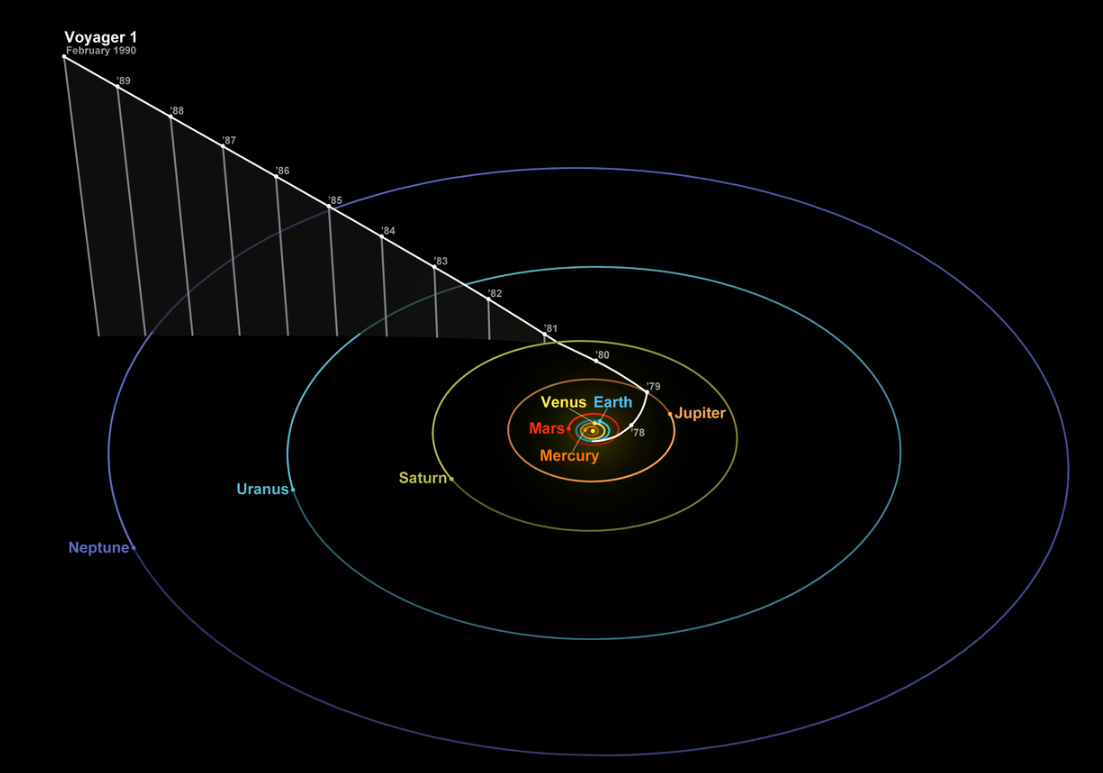
In 1989 Carl Sagan requested that an image of Earth be taken from a great distance even though the scientific value was nil. After some internal haggling, the administrator of NASA, Richard Truly, interceded and the imaging was approved. In 1990, the decision was made to allot time to image the Earth just before the camera Vidicon tube was scheduled to be switched off to conserve energy. Just 60 images were taken and stored on an onboard tape recorder until they were later relayed to Earth between March and May, 1990. The signal was received by the Deep Space Network after 5 1/2 hours of transit time.
Just looking at the image without any concern given to what is happening there at present, the Pale Blue Dot appears unremarkable. On the cosmic scale, it is just a tiny ball of wet rock. Yet with the right elements, compounds and plenty of time this bit of rock spawned sentient beings allowing the universe to become self-aware.
With all of the conflict and tension on Earth, someone has to stand up for the Earth’s biosphere. No matter what people do, nukes and all, planet Earth will remain in orbit spinning about its axis. It is civilization and the web of life -the carbon-based parts- that are serious risk. It is the birthright of each creature to share in the fruits of the earth. Politics and economics must adapt to a healthy and sustaining biosphere, not the other way around.
With the indecisive wars in Korea, Viet Nam, Iraq and Afghanistan, the US has been served many slices of humble pie. Yet, are we learning? Presently we are drawn deeper into the bottomless pit of the Israeli/Palestinian conflict. We have hitched our wagon to an Israel that pushed out the inhabitants of a piece of someone else’s land and colonized it. It is an undeniable historical fact. It should surprise no one that 2 million people now forcibly concentrated into a small patch of unproductive land and are militarily, politically and economically isolated are deeply resentful with their lot in life. As they have done many times in the past, the Palestinians have pushed back violently but this time with the help of others either directly or by proxy. The whole thing is further complicated by religious zeal on the part of both sides. Both claim to be doing God’s work, but to different ends. Magical thinking enforced by guns.
Elsewhere on the Pale Blue Dot, Putin’s savage invasion of Ukraine has thus far brought Russia only death and humiliation, though outwardly Putin postures himself as unworried. He is in tight control of a nation that has been under tight control for most of its history. Putin’s conventional military has surprised many by its brittle collapse in the invasion of Ukraine. As with the Soviet regime before him, much of his power rests only on the sandy pedestal of propaganda and the large bureaucracy to monitor or punish everyone. Putin’s real strength is his nuclear arsenal and his expressed willingness to use it.
The last time the Russian populace rose up to successfully overthrow tyranny was the Bolshevik revolution in 1917. Tsar Nicholas II was overthrown, murdered and replaced with a new type of totalitarian regime- The Union of Soviet Socialist Republics. Over time the USSR was able to modernize the state into a spacefaring, nuclear power but always retained and refined its authoritarian grip on its people.
Meanwhile in the west, a hornet’s nest of anger in the US has been awakened by a single charismatic and malignant narcissist who has attracted a dedicated following of the vocally disenfranchised. While his stunningly bad conduct should be obvious to anyone older than 12, no amount of pettiness, lies and over the top behavior seems to detract from his popularity. It has been said that he validates what his supporters believe. If that is true, then Trump is just the tip of a terrible iceberg.
Many 20th century dictatorships in history have been led by a charismatic idealist who understood the dark zeitgeist. Lenin, Mussolini and Hitler among others have risen to power and directed brutal attacks on whom they chose, sometimes driven by greed for power and other times by utopian fantasies. While Stalin didn’t author the Bolshevik revolution as Lenin did, he set the high-water mark for murder and cruelty in Russia. As bad as these actors were, all somehow avoided the assassin’s bullet during their heyday. One little piece of lead could have disrupted the timeline of terror each journeyed. Civilization does not have a provision that encourages this, though.
For crying out loud, people. Get a grip on how rare and special the Earth’s biosphere is. If there is another wonderous place like Earth, we are unaware of it and may never become aware. The earth is to be treasured.
 Lamentations on Chemistry