
Summary: This essay addresses the important role the federal government has played in promoting the American march of progress. The old saying that “Necessity is the Mother of Invention” has a large element of truth to it. It is not enough to identify a problem or challenge. For a person, group or organization to solve a technological problem or challenge, the goal must be understood completely, resources acquired, a plan must be constructed and approved by those who control the purse strings, and skilled people must be organized and set to work on the matter at hand.
The federal government can provide the Necessity needed for attention and resources put to play in achieving a goal. For instance, NASA will set a goal and is able to open a project up for bid. The gov’t can provide seed money to the contractor for prototype equipment to present with their bid. Government grants provide the necessity to stimulate invention, hopefully on a competitive basis.
……………………
I have been a lifelong aerospace enthusiast from Project Mercury forward to the present day. What I’m realizing, however, is that I’m increasingly skeptical of the value of further manned space flight by NASA. Whatever the 6 successful manned Apollo landing missions on the moon may have found tramping around the regolith up there, evidently not enough value was found to compel the USA to go back. Obviously, the Apollo program was partially a geopolitical stunt to rival the USSR for prestige and by many measures the USA won. But what did we win? Prestige and a great many valuable technological spin-offs.
In the early 1960’s the US government financed and organized JFK’s challenge of landing a man on the moon and returning him safely to Earth by the end of the decade. Our government allocated considerable national treasure to the moon landing project and put lives on the line. Arguably, of greater importance than a round trip to the moon was the powerful boost to aerospace, computer, and other technologies. The technology-push advances funded by the government would soon become important economic drivers for industry.
In fulfilling Kennedy’s challenge there was both popular excitement about the space program and more than a little skepticism. The USA was increasingly bogged down with the Viet Nam war. Into the early 1970s, the western geopolitical argument about the advances of communism, the Domino Theory, was still cited, but it was gradually weakened by lack of popular support for the war and the loss of American blood and treasure invested in keeping communist influences out of southeast Asia. By the mid 1970’s, the US had pulled out of Viet Nam leaving behind millions of casualties and little to show for the effort. Added to Southeast Asia was the self-destructive meddling with the Cuban communist state. Castro died of old age in his communist bed.
There is an old saying that went “He’d complain if they hung him with a brand-new rope”. The suggestion was that some folks would complain about simply anything. Beyond the geopolitical and apparent military threat of the USSR beating the US into space were the much-ballyhooed technological benefits of the program. One of the oft-cited spin-offs was a Teflon coating for frying pans. It was an example that most citizens would understand and appreciate. Many incorrectly believed that NASA invented Teflon. Actually, Teflon was discovered unexpectedly in 1938 by the DuPont chemist Roy Plunkett.
Libertarians have argued (to my face) that if we wanted non-stick Teflon frying pans, why not just invent it? The introduction of any new and revolutionary product by a corporation carries financial risk and possible loss of reputation. The vaunted contribution of NASA to perfluorocarbon (PTFE) polymers was to push forward projects that required PTFE specifications. Industry did the rest by finely developing technology for PTFE production to meet the demand. Once there was an inkling of demand, industry kicked into gear. It was market-pull by that time.
NASA is very much in the technology-push world whereas many businesses are more safely oriented to market-pull. Technology-push is about invention of leading-edge vehicles, equipment, substances, instrumentation or services. Technology-push requires early adopters willing to wager that the new tech will give them a competitive edge. Government provides a ready-made early adopter.
Market-pull is where a manufacturer produces known or existing products and services. They compete by offering better availability, price and quality than their competitors.
Technology-push is the world of the tech startup. A start-up founder has a product or service that is sure to be a hit if only their products could get manufactured and pushed into the market. Tech investors will examine the startup’s business and financial plans and take a closer look at the technology or service to be offered. Is there a prototype? Is valuable intellectual property protected under patent? How stable is the supply chain or is there one? Will the company be sustained on the tech product only or will consumables be produced as well.
Importantly, is the technology-push startup looking to produce just a single product or is the technology expandible across a spectrum of applications? What if the product performs below acceptable tolerances or simply fails in the field? A startup with everything invested in a single product model is a “One-Act Pony”. Wonderful though the One-Act Pony may be, it can get sick and die in the marketplace. It can grow old and obsolete, giving way to falling sales and the mad scramble to develop a replacement product. I’ve been a part of 2 startups hoping to produce one-act ponies. The ponies died and we hit the streets.
Investors can analyze market-pull business plans by looking at the economics of demand as well as distribution of existing or similar products. Annual sales can be estimated, EBITDAs calculated, and profit margins uncovered. If the profit picture fits the general business model and timeline of the investors, they can release funding rounds to the startup with benchmarks to be met.
Necessity as the mother of invention?
In normal circumstances, industry operated by ambitious people may be motivated to advance their technology skillset to realize entry into new and promising markets. However, that said, an industry that only acts to match technological advances set by competitors is not showing the mettle required to launch a new paradigm in the technology-push manifold. Merely matching the competition does not quite describe a technology-pusher.
A technology-pusher is likely to find that they must walk the manufacturing highwire without a net and perhaps for a long time. Unless you are quite wealthy, launching a startup will likely hold personal financial risk. Commonly, external funding means that some percentage of ownership or shares will be given to the investors. By the time the product or service hits the market, the founders may find themselves as minority stockholders. Their dreams of grand wealth and influence is tempered by reality.
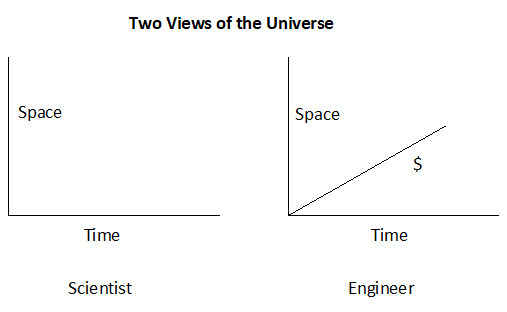
A technology-push company is often started by engineers or scientists with experience in a particular subfield. Scientists commonly receive little or no business education as a degree requirement. Their role is the science guru. Engineers, on the other hand, fully understand the cost imperatives of a project and are able to design to remain within tight cost constraints.
In science, scientists are the main honchos. In business, engineers are the princes of the kingdom. They design projects, lead them, and come in on budget on time. A CEO with an engineering background is not at all unusual. They understand money part.
 Lamentations on Chemistry