
At my undergraduate institution, lo these many years ago, our physics department had a neutron howitzer. The school was a medium sized state land grant institution mostly known for producing teachers and nurses. But it also had a decent chemistry department from which I spring-boarded my chemistry career. This device was an education and research tool from the post WWII atomic age. Recall that it was a period that promised nuclear electric energy too cheap to meter.
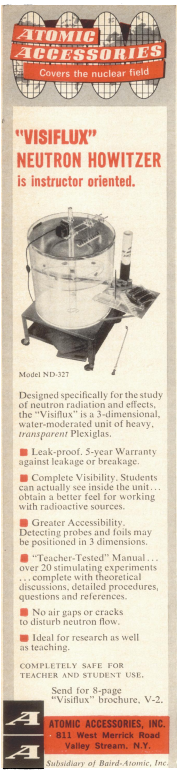
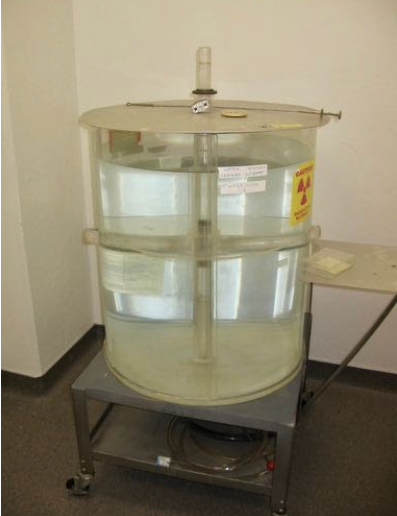
I would hazard a guess that the word “howitzer” was used because it’s application involves bombardment of atomic nuclei. In the center of a water tank, a source comprised of one of several highly active alpha emitters like Plutonium, Americium, Radium, or Polonium is exposed to beryllium which produces a neutron. The alpha source activity was typically 1 to 3 Curies in contact with beryllium and located within a small diameter tube penetrating the water tank, producing a “beam” of neutron flux passing through the tube. Materials to be activated are exposed to this flux for a set period of time.
Our neutron howitzer was used for a freshman chemistry lab to measure the half-life of an indium radioisotope. A piece of indium foil would be neutron activated by a timed exposure to a neutron flux and then placed in a radiation counter to collect counts over time from radioactive decay in the indium sample. Indium-115 in the sample would be activated by the absorption of a neutron to form a small amount of Indium-116m1 which emits gammas with a half-life of 54.2 minutes according to this source. This short half-life was ideal for a freshman lab period.
I’m quite sure that the school got rid of the neutron howitzer long ago. Nuclear radiation of any kind scares the beejeebers out of school administrators and assorted folks mucking about on campus. The principle of CYA is always at work in our institutions. CYA refers to Cover Your Actions, wink wink, nod nod.
The nuclear chemistry of neutron production and absorption-
Beryllium-9 + alpha particle ==> neutron + Carbon-12
A beryllium-9 nucleus absorbs an alpha particle (helium-4 nucleus) and then decays producing a neutron and Carbon-12 atom.
Indium-115 + 1 neutron ==> Indium-116m1 ==> Indium-116 + gamma radiation
The neutrons generated can impact an Indium-115 nucleus and be absorbed, producing a metastable Indium-116m1 nucleus. Nuclear reactions often produce nuclei in an excited energy state. An excited nucleus can “de-excite” by the release of a gamma photon through an isomeric transition (IT), not unlike atomic fluorescence.
It is interesting to note that the large capture cross section of indium-115 for thermal neutrons has been exploited for the survey of high-energy neutron fluxes. Indium foil is encased in paraffin and placed in a cadmium container. High-energy neutrons entering this composition are cooled to produce thermal neutrons which are then captured by the indium. The thermal neutron flux is proportional to the high-energy flux and the system can be used for the instantaneous detection and counting of neutrons.
In one lab for a class I took in grad school called “Radioisotope Techniques”, we had a cloud chamber up and running. The professor brought in a neutron source on the end of an 8 foot pole. He swung it over by the cloud chamber and there was a sudden burst of trails in the ethanol vapor. Neutrons were colliding with protons in the ethanol vapor creating ion pairs, leading to condensation vapor trails zipping around in the chamber. The neutron source had 1 Curie of plutonium in it. This was in the radiation biology department. The department had a 7,000 Curie cesium-137 gamma source we got to use as well. It turns out that if you expose tomato plants to intense Cs-137 gamma radiation even briefly, it stunts their ability to uptake phosphorus-32 phosphate. Yeah, imagine that.
 Lamentations on Chemistry