
I saw the words “thoriated tungsten” somewhere in the literature and became curious as to what brought these two metals together. Before I get to thoriated tungsten, I’ll give a little background on tungsten and filaments made from it. There is a surprising amount of art and science in tungsten filaments. Tungsten filaments split into two broad applications- illumination and thermionic emission.
I’ve been curious about the effect of surging LED lighting demand on the tungsten filament business and tungsten demand overall. Naively, I guessed that there might be a noticeable effect on tungsten demand. A Google search only turns up people who want to sell a market research document. One of these web sites claims that demand for tungsten is expected to nearly double from 2021 to 2029 from $4.41 Billion to $7.56 Billion. The major demand for this metal is from the mining and drilling industries in the form of tungsten carbide cutting tools. The major producers of tungsten are China, Russia, Portugal, Austria and Bolivia, with China producing the vast majority.
The important tungsten ores are-
- Wolframite, (Fe2+)WO4 to (Mn2+)WO4
- Ferberite, FeWO4
- Hübnerite, MnWO4
- Scheelite, Ca(WO4)
All have a +2 cation and the tungstate -2 oxyanion. The WO4-2 tungstate anion has tetrahedral geometry similar to sulfate and can also form polyoxotungstates with octahedral WO6 geometry. Polyoxotungstates can form clusters by the sharing of octahedral oxygens similar to silicates. A large number of interesting polyoxotungstates have been identified.
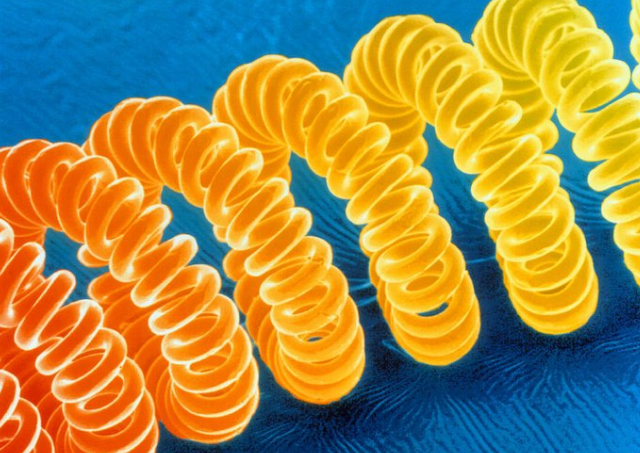
Tungsten turned out to be a perfect choice for light bulb filaments due to it high melting point and its mechanical integrity at high temperature. The coiled coil filament design proved to be much superior to a single coil or a straight filament. Below is a picture found at this website showing the illumination differences in the 3 configurations of the tungsten element. The difference in filament geometry is striking.
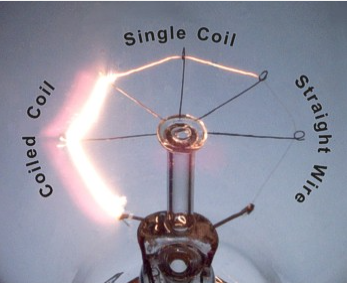
The photo above shows a 240 VAC 60 Watt bulb where a coiled coil has been uncoiled to produce a single coil section and a straight section. The whole coil is there. Light bulbs are filled with a mixture of inert nitrogen and argon at below atmospheric pressure. A coil allows a greater length of tungsten wire to be easily placed in the bulb and a coil of coils even more so. During operation the filament suffers heat losses by conduction and convection of the bulb gases. The primary coil and the coil of coils serve to reduce exposure of the filament to the cooling gas flow. The coil provides some self-heating due to the proximity of the coil to itself. It intercepts some of the radiant energy and heats further. In the coil of coils, this effect is much more pronounced as seen in the picture above. The Lamptech website containing this photo is well worth a visit.
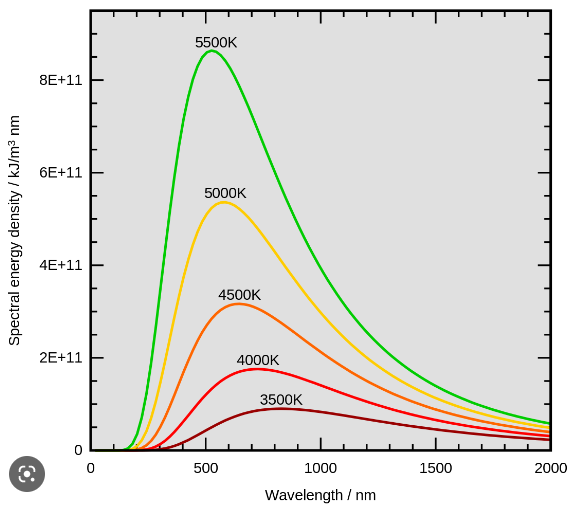
As mentioned above, one advantage of using tungsten as a filament is that it has an extremely high melting temperature of 3422 oC (3695 K). This allows the filament to be heated to very high temperature with the resulting blue shifted black body curve (above), This allows the spectrum to be brighter in the shorter wavelengths and consequently less reddish to the eye than a lower temperature filament. Wiens Law is the basis of color temperature.
When you shop for LED light bulbs, you might notice that LED bulbs are rated on the basis of color temperature. The lower the color temperature, the more yellow/red the light will be. The higher the color temperature, the more whitish the light will be.
However, with high operating temperatures a filament can evaporate, removing mass and robustness. Tungsten filaments, among others, are susceptible to this mode of failure. Another mode of failure occurs when a tungsten filament is hung vertically. Convection of the hot gasses in the bulb causes the top of the filament to get hotter and fail sooner. You’ll notice that lamp filaments tend to be strung horizontally.
Why tungsten halogen? Over time a tungsten filament will evaporate enough tungsten to blacken the bulb and become fragile. The presence of a halogen vapor in a light bulb causes a reaction between the tungsten and the halogen leading to redeposition of the tungsten back to the filament. However, this process requires higher bulb envelop temperatures, i.e., >250 oC. I have to assume that the small size of halogen lamps is to assure that the bulb temperature remains high for the tungsten-halogen recycle.
Thermionic Emission
Tungsten filaments in light bulbs is an application familiar to everyone. But there is another important use of tungsten filaments. The production of electron emission from filaments has been in use for a very long time. A hot filament or other hot surface under vacuum can be made to produce electron beams that can be accelerated or deflected and focused to do useful things. The electron beams can be made to carry modulated signals that can be put to use in detecting or radiating radio signals for radio, television or a myriad of other uses. The old vacuum picture tubes in early television used a filament to generate an electron beam that could be directed to scan across a phosphor coated surface to produce moving images.
What caught my attention when sorting through the tungsten literature was the mention of thoriated tungsten filaments. This topic goes back to the 1920’s with Irving Langmuir. In 1923 he published a paper in Physical Review Langmuir found that the rate of electron emission from 1 to 2 % thoriated tungsten to be “it was discovered that by suitable treatment the filaments, containing 1 to 2 per cent of thoria, could be activated so as to give an electron emission many thousand times that of a pure tungsten filament at the same temperature.” He found that the efficiency and life of a tungsten filament could be extended by spiking the tungsten with thorium oxide. He postulated that thorium is reduced and migrates to the surface of the tungsten filament forming at most an atomic monolayer. Thermionic emission occurs when a hot object like a filament evaporates electrons.
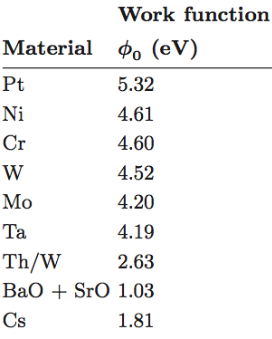
Every substance has work function energy in eV that is required to remove an electron from a surface. Additives to tungsten like lanthanum, cerium or thorium or their oxides have a lower energy work function than does tungsten and will produce a greater flux of electrons. This even applies to TIG welding where an electric discharge must jump across a workpiece and a sharpened tungsten rod.
A 1-2 % thoriated tungsten welding rod or filament will allow thorium to migrate to the surface via grain boundaries while in operation and deposit on the surface. The work function energy of thorium is lower than that of tungsten, so the thoriated surface can release more electrons at a given temperature.
 Lamentations on Chemistry