At a time when the Trump administration is making enemies in the EU with talk of a military adventure in Greenland, Putin has unleashed Oreshnik hypersonic intermediate range missiles at Ukrainian civilians. The targeting of civilians is nothing new for the Russians, but the Oreshnik missiles travel at up to Mach 10 (7610 mph) which makes shooting them down problematic. Russia has held back this missile system until now., though in 2024 it apparently had fired a test shot absent explosive warheads. According to Wikipedia the Oreshnik ballistic missile system is still in the experimental stage.
The Russians have gotten quite peevish lately, claiming that Ukraine targeted the sprawling home of Putin. Targeting civilians in Kyiv as well as Lviv in western Ukraine serves the dual purpose of reminding the NATO and the EU of the threat Russia poses to them. Golly. Imagine a warring state trying to decapitate the leader of its opponent. According to reports Russia has been trying to assassinate Zelinski, so a reciprocal decapitation effort should be expected.
While Russia burns through military resources and personnel, and while the Russian economy teeters on the edge of total collapse, the conventional military threat to Europe should weaken more by the day. They are taking roughly 1000 casualties per day while their recruitment effort is falling short of that number. However, the nuclear threat remains. It is an open question as to whether Putin refrains from releasing nuclear weapons as his tenure becomes endangered. The Oreshnik missile is capable of carrying multiple nuclear warheads- a fact that is lost on nobody.
It’s not in the nature of Putin or his Kremlin to admit even the slightest amount of damage or discomfort caused by Ukraine. One fine day the west will learn that Putin has disappeared and a successor has surfaced. What will Russia do then? A gesture of humanity, perhaps? That would be out of character. A Russian leader could never admit mistakes or defeat. Krushchev did it, but his tenure was cut short by the politburo with Brezhnev taking his place.
The history of Ukraine’s abuse from Russia is a sad tale of starvation (Holodomor), banishment to the gulags and ethnic cleansing (1947). Newsletters are available from The Kyiv Independent and try to connect the present Putin-Ukraine war with regional history. This is an email publication that originates in Ukraine and is written by Ukrainians. They try to explain “WTF is wrong with Russia.”
One eastern European scholar, Timothy Snyder, has written extensively about Russia and its influence on Ukraine. The Bloodlands is especially enlightening. After much civil conflict with Ukrainians after the Bolshevik revolution, Lenin relented and allowed Ukrainians to have their “own” state with the proviso that the new Ukraine must be part of the newly forming Union of Soviet Socialist Republics, USSR (or CCCP in Cyrillic alphabet).
Ukraine has a bad history with neighboring Russia dating back to near the beginning of the USSR. Putin’s goal is reclaiming the territory of the former USSR. including Ukraine, Because Ukraine has considerable productive farmland and minerals, and because it provides a land barrier to Moscow, Putin very much wants the land back.
Where are the Nazis that Putin claimed to be running Ukraine?
As of this date, Oct. 21, 2025, the Putin-Ukraine war is no longer dominated by Putin’s army on the Ukrainian battlefield. While Ukraine continues to gather sympathies from NATO countries and elsewhere, Putin has turned Russia into an international red-headed stepchild. Sanctioned into bankruptcy and pounded by the Ukrainian military, Putin continues to put on a brave face to the Russian people. The hybrid warfare conducted by Russia continues and is especially problematic for NATO states, USA included.
Even though Putin has won presidential elections in the past, the transfer of power remains very murky to those outside the Kremlin walls. Yes, a new Russian president could conceivably win an election but detaching Putin and the layers upon layers of nervous sycophants as well as his dark income streams will be a problem. It is a stretch to believe that Putin will leave office alive. Maybe they’ll find an apartment for him in Pyong Yang, North Korea?
Adding to the political complexity, there is considerable distrust between the Russian military and the security services, two of which in particular are the FSB and GRU. Some have claimed that the FSB would not allow a military coup owing to past animosity and distrust. Putin’s authoritarian state, while extensive, still is subject to the frigid winds of economics.
Note: Not residing in Russia, I cannot grasp the full extent of the events and mood unfolding there. All that remains is to perch on a power pole across the polar cap and try to discern fact from fiction.
>>> Let’s ask a very basic question about today’s Russia. Why can’t Russia Putin play nice? <<<
Like most, I have anxiously watched Putin’s invasion of Ukraine. The prevailing Russian narrative is trying to say that the sovereign nation known as Ukraine has historically been a part of Russia or some earlier Russian empire, a view promoted by Putin. Following the Bolshevik Revolution, Lenin directed the Bolsheviks to seize the territory now recognized as Ukraine. The goal was to claim territory for the Soviet Union, but also territory that was extremely fertile. Stalin ordered that Ukrainian industry and agriculture were to be collectivized. An independent Ukrainian government was briefly established but just as quickly collapsed. After several years of intense Ukrainian resistance and significant suffering, Lenin conceded and established Soviet Ukraine, enabling its incorporation into the Soviet Union as a constituent republic.
In the current action, with the support of an extensive security apparatus, Vladimir Putin has resolved that what is now Ukraine will be assimilated into a growing Russian empire. The process will methodically transform its Ukrainian identity through Russification, transforming it into southwestern Russia. Ukraine is expected to become an agricultural hub and potentially a strategic forward base for further military operations into Poland the Baltic states, and likely Moldova.
Why does Putin desire Ukraine when there is considerable open land to the east and north? Well, it’s the geography. The land beyond to the north and east of Moscow consists of vast stretches of challenging subarctic taiga and arctic permafrost, much of which is now thawing, making it unsuitable for roads, urban development, agriculture, and industry. In contrast, Ukraine boasts rich, productive farmland with significant annual grain exports. Additionally, along its southern coast, including Crimea, Ukraine possesses the only warm water ports available in the region, other than possibly the Neva River to the north which are vital for commerce and the military.
Historically, western European colonization was driven by the prospect of trade opportunity including raw materials, cheap labor as well as power projection. Like all countries, Russia would like room for its prosperity to grow. It is desirable that agricultural and industrial capacity also rise. However, Russia has learned the hard way the value of having a buffer zone between Moscow and Western Europe. The relative ease with which both Napolean and Hitler crossed the Eastern European territory enroute to Moscow, Leningrad and other cities through greater Russia did not go unnoticed by Stalin. By absorbing the Eastern European territories after WWII, Stalin built a picket fence protecting the Soviet state.
As the Nazi’s Operation Barbarossa was failing and Stalin’s Red Army began pushing the Germans into a westward retreat, the Soviets took advantage of the opportunity to install Soviet political structure in captured Nazi territory like the Baltic states, Eastern Europe and the eastern half of Germany. While Stalin did not share Hitler’s enthusiasm for exterminating Jews, he did act to eliminate preexisting local political structures which included substantial Jewish presence. This meant executions and large-scale banishment of politically unreliable people to the Russian gulag system. Poland was hit particularly hard by both Hitler and Stalin because it was directly between Russia and Germany and had a large Jewish population.
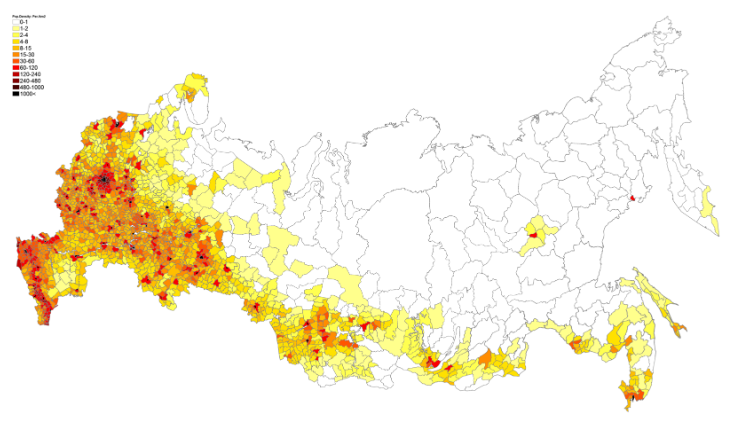
The above map shows the population density of Russia. A substantial fraction of Russians live in the southern and western regions of the country. If you assume that people are living there because it is at least somewhat livable, then the map shows the extent of land poorly suited for habitation.
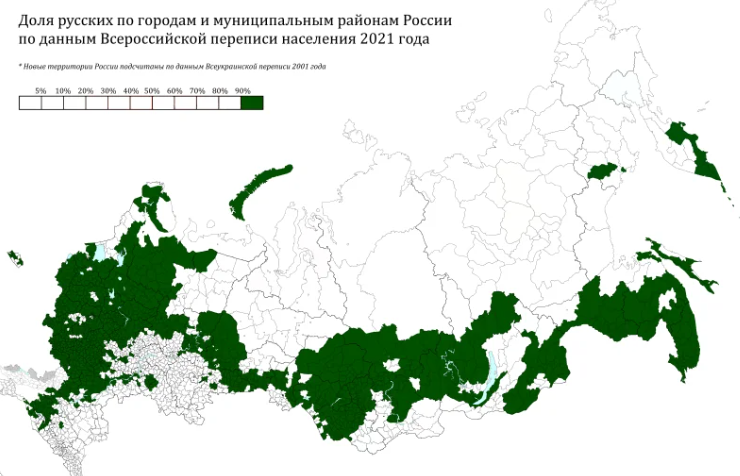
Map of Russia showing areas that are 90 % populated by ethnic Russians.
Russia has a great deal of acreage but the livable turf is much smaller.
Putin views the world partially from the old cold war perspective. It’s Russia against the aggressive, corrupt and immoral west, but without the fever dream of a Soviet-style socialist world. Putin’s state-controlled media endlessly repeats that the west wants what the Russians have and stokes the fires of fear. For the Soviets, “aggressive, corrupt and immoral” included resistance to Soviet influence.
In my many years of trying to be as informed as possible in many areas in a free and open society, not once have I heard anyone suggest “Gosh, I wish the USA could occupy Russia (or the USSR) as an American territory and take all of their stuff.” Imagine the scope of the folly in stupidity of such an attempt. It is mindbogglingly absurd to believe that one could or would want to do such a thing. Russia is for the Russians. Maybe one day they will hit upon a way to craft a free and open society.
The Soviets were ardent promoters of global socialism. Although not overtly socialist, Putin appears more focused on preserving Russian culture and dominance from across a substantial territorial buffer with the West. He asserts his aim to shield Russia from Western cultural influences and what he perceives as a “belligerent” military stance.
The “belligerent military stance” of the West amounts to NATO responding to Soviet adventurism and their habit of hybrid warfare. They would say the same thing from their perspective, but which side was the more authoritarian?
Historically, Russia has endured invasions by King Charles XII of Sweden, Napoleon, and later Hitler. The history of the Kievan Rus from 830 to 1241 is jammed with bloody feuds, wars and invasions. From the Principality of Moscow in 1281 to the end of the Tsardom in 1917, and even beyond into the era of the Soviet Union and into Putin’s time, near continuous conflict has plagued the Russian people. Fortunately, Russia’s northern geography and harsh winters have often played to its advantage, compelling invaders into prolonged conflicts and misery with eventual withdrawal. But not always.
Most nations would like to have global hegemony. Putin is fond of saying that Russia has suffered greatly from American and Western hegemony since WWII and hopes to put an end to it. He has reestablished a Soviet-like security state apparatus with strict media control when he assumed power after the 8 years of Yeltsin’s chaos following the collapse of the Soviet Union. He is trying to resume for present day Russia the former Soviet Union’s international status but largely without the manpower and resources of the former adjacent Soviet states.
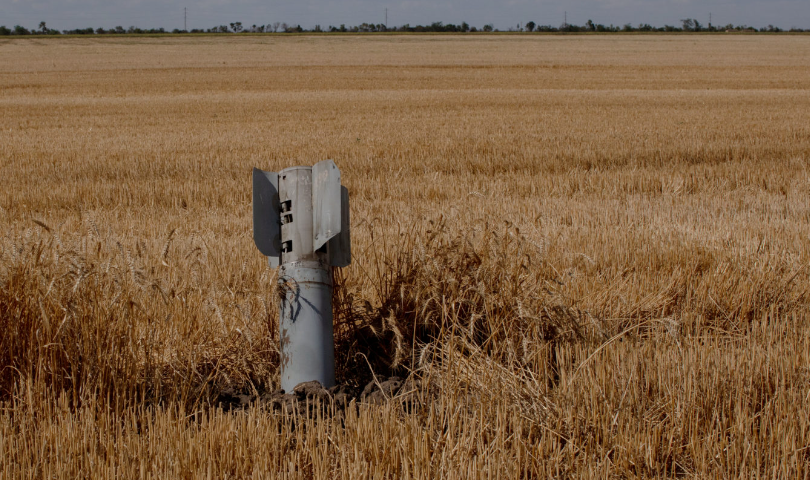
Source: The Fuller Project. Unexploded cluster bomb in Ukrainian wheatfield.
Like his Soviet predecessors, Putin both envies and worries about overreach of western hegemony and is moving to unseat the West. For that matter, so is China. This is only natural. I believe they resent western influence generally. The English language as the global lingua franca and the US dollar as the standard international currency are seen as an annoying affront to their own cultures, sovereignty and political significance. Again, this is only natural. And so is the temptation to use power projection or coercive propaganda to achieve their own hegemony. Casualties would be considered the West’s fault for being in the way.
Both Russia and China have long been critical of the West for internal propaganda purposes but to be fair there has been some valid criticism as well. In truth, the US has done some bone-headed things that we should not be proud of and that hardly serve to highlight our presumed “special” nature. But in fairness, most all cultures can look back at regrettable conduct in their history. Neither Chairman Mao’s China or Stalin’s USSR have sparkling clean histories either. Often the benefit of hindsight doesn’t come into focus until far down the timeline.
The Soviet Union in the person of Joseph Stalin, had brutalized Ukraine previously in an attempt to halt its independence. The Holodomor, meaning death by starvation, of 1932-33 is estimated by scholars to have killed 3.5 to 5 million people. This period of time is marked by forced collectivization of agriculture and industry in the USSR and Ukraine. Collectivization meant taking control of farmland owned by the peasants (especially the Kulaks), many times banishing them to the gulags never to be seen again. Already by 1931, Moscow had taken 42 % of the Ukrainian grain harvest, forcing some locations even to turn over seed for the following harvest. By early 1932 some districts in Ukraine were already experiencing famine. The governing committees in Ukraine in 1932 believed that the 6 million tons of grain demanded by Moscow was unachievable, yet they ratified the plan anyway.
The current brutal murder and devastation of Ukrainian citizens and their infrastructure and agriculture will take a generation or more to repair even if Russia prevails. Russia has done great damage to the Ukrainian environment in addition to the many casualties. Much of the country is cratered, littered with destroyed vehicles and war debris, denuded of vegetation, and rendered deadly by the landmines.
The great equalizer among the leading nations is Mutual Assured Destruction, or MAD, by virtue of the threat of the use of nuclear weapons for mutual annihilation. Sometimes just called “the bomb”, it was indeed invented by an international cast of scientists and engineers using American uranium and Plutonium and first used in successive releases by the US on Japan near the end of WWII in the Pacific theater. This will darken a stretch of American history indefinitely. Some continue to argue that the bombing was not necessary because Japan was soon to surrender, but it happened, and nothing can change that. However, to our credit, the US has never used it since and has actively sought with other nations to suppress the proliferation of nuclear weapons and remove the hair triggers for their use. That said, the US remains a no-first-use country but will participate in the principle of Mutual Assured Destruction as needed.
A Nuclear Sidebar
Very soon after the discovery of nuclear fission in December, 1938, in Nazi Germany by German-born chemists Hahn and Strassmann, and Austrian-born physicists Meitner and Frisch, the theoretical potential of using the vast energy output of nuclear fission for a bomb was quickly realized. On May 4, 1939, Frédéric Joliot-Curie, H. Von Halban and L. Kowarski in Paris filed for three patents using a fission chain reaction. Two involved power generation and the third was for an atomic bomb, patent No. 445686. Fission was experimentally discovered in Dec. 1938, theoretically explained in January 1939, and a patent for the atomic bomb was filed on May 4, 1939.
The point of this atomic interlude is to highlight the short time interval between the discovery of nuclear fission, conceiving the idea of the atomic bomb and filing for a patent by scientists. On August 2, 1939, a letter written by Leo Szilard and signed by Albert Einstein was sent to President Franklin D. Roosevelt warning that Germany may be developing an atomic bomb. This led to the Manhattan Project and America’s entry into nuclear weaponry.
During and after the Manhattan Project, Stalin’s spies detected and infiltrated the American bomb project and presumably used important stolen information for their own nuclear program. This was an important shortcut benefitting the Soviets greatly. The first Soviet atomic bomb burst so soon after the war shocked the world.
Humans have a gift for the invention and use of weapons. I’m sure it has always been that way for humans. The inclination for war and conquest is also an ancient instinct. It is hard to see how aggression will ever change. In view of this distressing thought, how are we to proceed?
Looking forward
In the short term we in the west must continue to discourage Putin’s expansionist push. A win for Ukraine will set a precedent that might even unseat Putin. It is up to the many good people in Russia to be rid of him. However, Russian citizens will have to struggle against the vast authoritarian political machine in place just like the Poles, East Germans and the other Soviet states had to do in the late 1980’s. The intimidation and resources of the Putin authoritarian state are a huge obstacle.
My guess is that in general, doing the “right thing” in a culture of normalized authoritarianism, bribery and corruption is more difficult to accomplish than doing the “right thing” in a free and open culture where doing the right thing is occasionally practiced and always admired.
To a westerner like me, Russian withdrawal from Ukraine seems like the optimal solution to Russia’s present economic and military race to the bottom. Even in winning, Russia will inherit a devastated region that will require vast resources and a decade to repair, as well as a population of angry and vengeful citizens looking to kill a Russian or two. Then there are all of the land mines to contend with. There is amputation or death by landmines in the future for many unsuspecting people regardless of who wins.
A cessation of hostilities led by Putin is likely to end his career. Thus far, Putin’s invasion has led to over 500,000 Russian casualties, of which there have been over 80,000 Russian fatalities. In a way, this pales in comparison to Stalin’s murderous handiwork, but the comparison is really more like “terrible versus really, really terrible.”
Whether or not Putin is a reanimated Soviet leader or “just” another Tsar isn’t a question to dwell on. He is a creature of his time who happens to be a former Soviet KGB officer but has rejected Marxist/Leninism and rules by a roughly mafia-style kleptocracy behind closed doors in the Moscow Kremlin. For Russian citizens, the rule of thumb is if you stay out of political business, the government will stay out of your business.
The reverberations of Trump’s South Carolina comments on NATO continue. Being a thuggish racketeer himself, he sees something like freeloading or racketeering in the motives of the NATO states. With his disparaging rants about NATO and proposing that the US stands back while Putin pushes west, he emboldens the Kremlin to maintain their aggression in the hope of the US standing down. There should be no mistaking Putin’s motives- he wants to recover the territory once controlled by the Soviet Union. Some suspect that Belarus will be annexed next.
Isolationism has been a Republican reflex since before the formation of NATO. It seems to be a part of the libertarian worldview of the isolated and rugged individualist. Either they do not care about the global balance of power or are ignorant of it. We are seeing a wave of Russian aggression disguised as self-defense or the defense of “ethnic Russians” living across borders. Hitler used this trick to grease the skids for his takeover of the Sudetenland in neighboring Czechoslovakia in 1938.
Putin’s invasion of Ukraine was partly justified with the lie that Ukraine is infested with Nazis who are threatening Mother Russia. In 2014 Putin had slyly marched into southern Ukraine annexing the Crimean Oblast. Shielded from critics by his extensive blackout of international media, Putin dispatched troops for the “Special Military Operation”.
On September 30, 2022, Putin gave a speech declaring annexation of Donetsk, Kherson, Luhansk and Zaporizhzhia. In an angry, ranting speech Putin said “They don’t want us to be free, they want us to be a colony; they don’t want equal partnership, they want to steal from us,”
In Ukraine, Russia has inadvertently revealed itself to the world as a paper tiger. However, they are still in possession of a large stockpile of tactical and strategic nuclear weapons with its own triad of delivery systems. Russia’s policy has always been to use nuclear weapons in the event of the possible downfall of the state. By that they mean the downfall of Putin by outside forces. Russia is not burdened by having a policy of “no first use” of nuclear weapons like the West.
So what about Putin’s comment that “They don’t want us to be free …”. This is the autocrat who has shut down all independent news reporting within Russia, disconnected internet access to much of the world, normalized defenestration and has criminalized even the smallest whiff of dissent. Like autocrats often do, he accuses others of what he does himself. His rationale is that harsh measures are necessary to resist outside threats. He also claims that the West wants to steal from Russia. When you are an isolated and naturally secretive country, accusations of thievery are a soft sell. Accusations like this are part of the feedback loop of paranoia, hardening resolve to resist by being more secretive and brutal.
Imagine the ridiculous folly of attempting to invade or colonize Russia or take resources from it for any reason. Really, who the hell wants to be in control of Russia other than some Russian? What would a foreign invader of Russia hope to accomplish by taking control of this giant, multiethnic country? Decades of bickering, insurgency and violence? The taiga? It is a stupid plan, yet Putin frightens the population with visions of American attack and along with its sexual perversion.
Putin’s lessons from history come from Soviet times when the KGB watched for spies behind every tree and surveillance of the citizenry was justified for “state security”, a catchall for close control of its citizens. Escape from the USSR was difficult and getting caught could mean long imprisonment in a gulag.
Putin’s protestations are little more than a trademark display of strongman fulminations meant to justify the slaughter of his own military in Ukraine. I’m surprised he doesn’t do it shirtless on horseback to display his lean and mean musculature.
The Russian people deserve much better than a long history and an extended future of oppression. The region has seen immense suffering over the decades from invasion by Hitler, deadly oppression from Stalin and privation and imprisonment by its own leadership. Today, the strong arm of the Kremlin regime reaches deep into their lives, preventing a popular uprising or just expressions of discontent. What Russia lacks is an army of martyrs willing to die for freedom because that is what it would take. Putin keeps them comfortable enough to stay out of politics.
Forward: This essay is directed to my fellow US citizens. The US and its allies are what stand between liberal democracy and rising global authoritarianism. Authoritarian states have proven to be quite resistant to rising democracy. We cannot let it get started without pushback. Just so we are on the same page, here is a description from Wikipedia-
“Liberal democracy or western democracy is the combination of a liberal political philosophy that operates under a representative democratic form of government. It is characterized by elections between multiple distinct political parties, a separation of powers into different branches of government, the rule of law in everyday life as part of an open society, a market economy with private property, universal suffrage, and the equal protection of human rights, civil rights, civil liberties and political freedoms for all people. To define the system in practice, liberal democracies often draw upon a constitution, either codified or uncodified, to delineate the powers of government and enshrine the social contract. “
The United States is on the cusp of making a fateful choice based on the results of the 2024 national election. While there are numerous issues simmering, I refer to the growing movement among conservatives to back off on military support for Ukraine. This group believes that we’ve spent far too much money on military aid for Ukraine’s defense and that these resources should be directed towards the homeland. The fact is that the US and other NATO countries have indeed sent a very large quantity of armaments and cash to Ukraine since the Russian invasion began.
What might the consequences be if the US and others simply backed away and let the two countries duke it out? In other words, we practice some old fashion isolationism. Here are some thoughts-
Putin is a murderous dictator with designs on (re)establishing a more widespread Russian empire. He wants to extinguish what is now Ukraine and meld it into a greater Russia. He believes that Russia is destined become a “great” power again. Suh a dream is not unexpected by a leader, but he began his expansion in 2014 with his quiet annexation of southern Ukraine.
Unfortunately, Ukraine is not where it stops. The eastern European and Baltic states are well aware of this threat and the history behind it.
The question of Putin’s mental state is of great interest to intelligence communities and to heads of state. Barbara S. Held, clinical psychologist and emeritus psychology professor at Bowdoin College, suggests that on the “sad/mad/bad” scale, Putin shows no signs of being sad or mad. What remains is the matter of bad. Coming away from the Held article, one is left with the sense that Putin’s “problem” isn’t legal insanity or a clinical disorder, but rather he is just a really bad person who makes what he thinks are rational choices and occasionally makes misjudgments.
“By all accounts, he [Putin] misjudged the ease of his mission, and shows no remorse about his massive killing in Ukraine. But poor judgment and moral callousness alone don’t constitute legal insanity or madness in the psychological sense.”
Crucially for Putin’s Kremlin, the state has such pervasive control that citizens are existentially afraid to defy the government. Putin is surrounded by many, many layers of loyalists. Putin’s Kremlin is a black box. Who knows what could happen in a power contest? It’s been said that in Russia, the rule of thumb is that if the people stay out of politics, the government will stay out of their lives.
Putin’s Kremlin believes that the mere existence of a successful liberal democracy like the US is an continuous threat to authoritarianism in general and to Putin’s Russia in particular. The Kremlin propaganda organs strenuously broadcast the weak and clumsy machinations in the US on a daily basis. This is very similar to the standard operating procedures of the former Soviet Union.
The Chinese Communist Party (CCP) believes very much the same thing. Liberal democracy in the world, with the US in particular, is an existential threat to Chinese leadership. The CCP can’t very well allow the public to seek greater freedom of speech lest citizens begin to question CCP authority.
An isolationist US is a country that has ceded its global influence to those who mean us harm. As US influence in the world diminishes, China and Russia will gradually move in to take up any slack.
A decision by the US to back-off its aid to Ukraine will create a power vacuum that will be instantly filled by the Putin regime. It will validate the assertions by the Russian and Chinese propaganda organs that the US is morally corrupt and weak and that its hegemony is finally over.
Why is Russia so aggressive? Look the long and complex history of the region and decide for yourself. A place to start might be with the Holodomor.
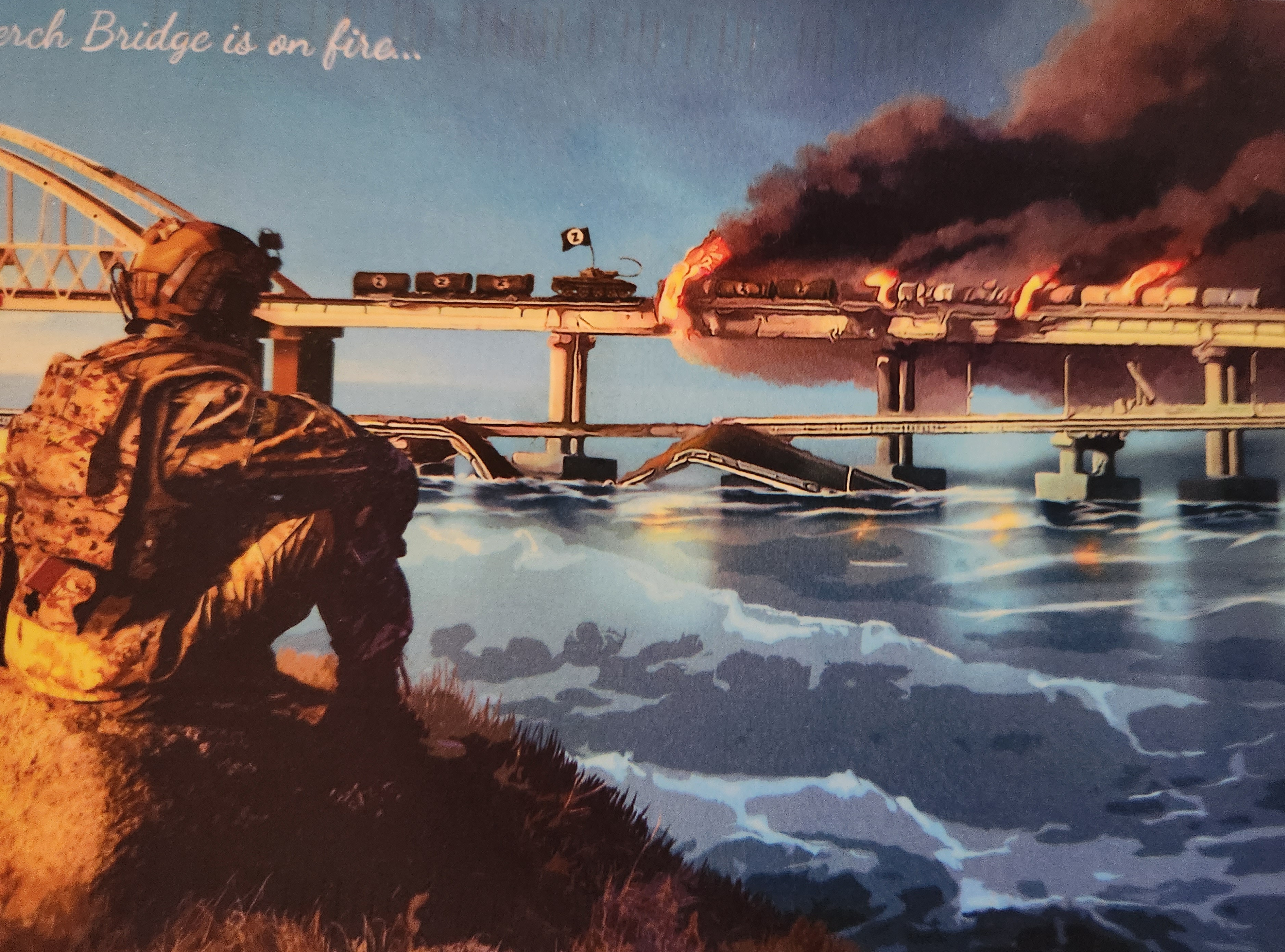
I received a post card from Ukraine the other day because of a donation I made. It shows an event they are very proud of- the first attack on the Kerch bridge. I’m sure some Ukrainians feel abandoned by NATO’s refusal to let them join, but there is good reason behind NATO’s answer. Russia’s long-standing morbidly paranoid obsession with NATO and the “morally corrupt” West would only be validated by such a move. It would be destabilizing today and would definitely bring us closer to nuclear conflict. To do so today would immediately step NATO into direct conflict with Russia. Ok. Enough from Captain Obvious.
Source: A post card from Ukraine.
After the Russian revolution of 1918, the Bolsheviks tried to capture and Russify the Ukrainian territory. After several attempts in 1918-1922 they relented and Lenin finally consented to give them independence as a state within the Soviet Union. This was not because Lenin was interested in building a Ukrainian state, but rather it was a desperate move to mollify the Ukrainians while allowing the Bolsheviks to keep control over the territory. Lenin did not set out to create Ukraine.
During the early 1930’s, Stalin’s government was busy collectivizing the agricultural lands of the USSR. Collectivizing Ukrainian farmland meant getting peasants, especially those with greater than 8 acres of land (Kulaks) to turn over their land to the collective. This proved to be so messy that eventually Stalin closed off Ukraine and required internal passports. Thus began a 2-year famine leading to mass starvation. Ukrainian crops and animals were systematically removed by the Soviets in what were sometimes called “red trains.” During this time several million Ukrainians were starved to death, executed or imprisoned in a distant labor camp. This period covering 1932 to 1933 is called the Holodomor, or The Great Famine. You can read all about it on the interwebs.
As directed by Putin, Russia is presently attempting to extinguish Ukrainian culture again. The kidnapping of children and shipping them to be raised in Russian homes as well as other forms of Russification in the occupied territories of Ukraine are underway. For the Ukrainians, the Russian invaders are like the Borg from Star Trek in their needy desire to absorb them into their domain- “Resistance is futile.”
It should be remembered that the Ukrainian experience with Russia has been very bad for a long time.
Authoritarianism isn’t just a problem in some eastern European states. Seeds of it are being spread here in the US by a new brand of neoliberal GOP leaders. Many times they have the words “liberty” or “freedom” in the organizations names. This is a disingenuous and underhanded rhetorical maneuver in the same way that countries that use “Democratic” or “People’s Republic” in their names. Using the words “liberty” or “freedom” implies the sacred and wholesome attributes of Patriotism, motherhood and apple pie. Their utopian vision necessarily leads to the demolition of our present liberal democratic society. Neoliberalism is the road to oligarchy.
“Neoliberalism advocates a deregulated, capitalist, globalist market economy, reifies individual greed, and markets a watered-down version of Austrian economics to left-liberals. This ideology manifests as a hybrid between right-and-left liberalism, where the social ideals of left-liberals (particularly, social equality) is attacked via economics and a worldview which views people as only making choices for themselves.”
“Liberal democracy is the combination of a liberal political philosophy that operates under a representative democratic form of government. It is characterized by elections between multiple distinct political parties, a separation of powers into different branches of government, the rule of law in everyday life as part of an open society, a market economy with private property, universal suffrage, and the equal protection of human rights, civil rights, civil liberties and political freedoms for all people.”
Obviously, there is overlap between the two definitions above. Both neoliberals and democratic liberals can be unquestionably patriotic. Where they differ is in their respective overall theories of civilization. As a baby boomer, I watched the funeral of JFK, the Viet Nam War, the Chicago riots, the killings at Kent State, the deceitful Nixon years, all of the moon landings, and everything else to the present day. During this time, semiconductors went from discrete devices to integrated circuits and medicine has advanced to applied biochemistry. All of the sciences have taken advantage of improving technology and have advanced at incredible speed and the unit cost of advanced technology continues to drop. Of course there were bad times, but there were a great many good times as well. The overall result was a good standard of living for most people and freedom from most of the dread diseases of the past. Life spans have increased, an explosion of consumer goods & services providing employment and items making our lives more convenient.
According to the Pew Research Center, 44 % of Republicans and Republican-leaning independents say that the US is giving too much aid to Ukraine. Not only that, but many Republicans are, if not outright admirers of Putin, view him more favorably than Biden, Harris, or Pelosi according to the Economist–YouGov poll of January, 2022. Liz Cheney refers to these people as the “Putin wing of the GOP.” In particular they admire his opposition to NATO, Western liberalism and LGBTQ+ rights. Is this because these Republicans have made a scholarly study of Putin against the backdrop of history and have concluded that he is worthy of their admiration over and above our democratic principles? Or are they parroting some sense of admiration drifting down from the GOP leadership? Decide for yourself.
Fascist, authoritarian leaders throughout history have always drawn the admiration of some fraction of a population. The 20th century alone had many standout examples and the trend continues to this very day. These leaders have convinced millions of people to ignore their own best interests and civil rights to support a cause that may have sounded exciting at a rally but led only to eventual oppression.
The Deep State
It appears that there really is a deep state in the US. It is the dark web of supporters, fund aggregators, lobbyists and fundraisers for the new ultra-conservative Republican party. These people wish to take us in the direction of more authoritarian and White Anglo Saxon Protestant (WASP) governance by gradually normalizing it. It’s like boiling the frog. This is not a Hollywood movie: the good guys could easily lose in the end. Once established, authoritarian regimes tend to last a long time, or at least, to the death of the tyrant. But sometimes the death of the tyrant only leads to continuation by another tyrant.
Trump and his ilk are succeeding in the normalization of regressive policy. Government-hating neoliberals and libertarians like Charles Koch and many others have been funding a movement for the demolition of most of the federal government in favor of a capitalist market-driven neoliberal Shangri-La. Remember when libertarian Grover Norquist said “I’m not in favor of abolishing the government. I just want to shrink it down to the size where we can drown it in the bathtub?” Libertarians and neoliberals aren’t anarchists, they just want the people with money and property to have the major input. Naturally, there is sympathy for this from many resource-heavy people.
Power has been defined as the ability to allocate resources. US national and global power is currently guided by taxpayer funded government. Both the private and public sectors add up to American hegemony. American business trends to increasing consolidation and is dominated by companies with the largest share of the resources. The natural end-state is monopoly. Business leaders piously repeat their appreciation of competition when, in reality, they are always trying to defeat the competition for market dominance. They will claim that market dominance is the ultimate result of achieving their fiduciary responsibilities- maximizing profit for the stockholders.
Boiling it down, libertarians and neoliberals want to abolish much of the state and federal government and focus on some kind of self-regulating market-based system. US economists always say that the market provides the most efficient use of capital. A market-based America will inevitably lead to a monopolistic corporate-based America. This is a system of economics, not governance. A plutocracy does not benefit the majority of us.
American corporations are not democratic in nature and make no pretense of it. They are autocracies ultimately answerable to the stockholders through a CEO and board of directors. State and federal government holds them answerable for adherence to the laws of the land. If there are a large number of burdensome regulations applying to the conduct of business, it is because sometime in the past, some individual or company has committed a harmful act leading to regulatory control. Regulations often stem from the dark side of past human behavior.
Back to Ukraine
Circling back, how does this talk of American politics relate to Ukraine? The Russian invasion of Ukraine and the Chinese threats over Taiwan and the Indo-Pacific region represent a period when major autocracies are pushing their boundaries. Russia is only held back because of NATO and other Western countries. China is held back because of its economic dependence on exports to Western nations who, surprisingly, will band together against them if threatened. I’m sure that they have also noticed that an otherwise simple military action of rolling tanks and troops into a “passive” territory like Ukraine can turn sideways rapidly. If anything, Putin has accomplished the opposite of his strategic goal of splitting up the members of NATO. It is critical now that US politics NOT cause us to abandon world affairs which is where Trump was leading us. The reelection of Trump would be an epic disaster for the free world and democracy.
A United States that tolerates the aggression of Russia or China is a country that cedes its global influence to them. Despite having lots of ugly history and a long list of regrettable decisions, the US remains a place that people want to immigrate to. You don’t hear about boatloads of immigrants attempting to get into Russia. If the US leaves a global leadership vacuum, guess who will jump in to take its place? Another liberal democracy? Seems unlikely.
Americans should remember that in the bathwater of US history there is a baby that needs to be cared for and not thoughtlessly discarded.
I’m about to say some things that may seem (or are) hopelessly naive. But sometimes we should stop and reexamine our basic assumptions.
So, I have to ask the question. Why would anyone in their right mind contemplate an unprovoked attack on Russia? The present-day Russian and former Soviet leadership has always made a show of holding back what they call “western aggression”. They justify their military buildup by claiming that NATO is an immediate and existential threat to their security. But seriously, who the hell would want to control Russia? They fear the push back on their own behavior which is to threaten the west. It would be a total disaster for everyone.
Yes, NATO is a threat insofar as they hold the line against Russian expansionism. Should states succumb to Russian control just because the leadership of Russia says so? Obviously not. Russian control seems to come with the loss of freedoms, stultified economic progress and political oppression. Putin’s war was initially justified, at least by what is available in the western press, as a strike on incipient Nazism in Ukraine which Putin declared as a direct threat to the security of the Russian state.
Everyone outside of Russia realizes that this is a bald-faced lie cynically devised to justify Putin’s dream of empire.
For arguments sake let’s say NATO attacks Russia for whatever reason and let’s say NATO wins. What have they won? A giant collapsed country full of permafrost and mosquitos populated with angry citizens living in economic collapse. The US and coalition forces couldn’t even control Afghanistan with its population of neolithic religious maniacs and their opium poppy fields. And we left the poppy fields intact too!!What chance would there be for western forces controlling a defeated Russia? It would be like the dog who caught the car. What next?
The same question applies to Putin. If he conquers and occupies Ukraine and then the other former Warsaw Pact countries, what will he have gained? Apparently, Putin guessed that they would roll over and comply. That was the state of affairs during the days of the Soviet Union. The USSR had a powerful and penetrating police apparatus with a network of remote prison labor camps and little presumption of innocence.
Unfortunately for Putin, Ukraine didn’t just roll over and concede. They are fighting back against certain authoritarian control and loss of their Ukrainian heritage. In doing so, it is revealed to the world that Putin’s conventional military is a paper tiger. Military planners the world over are taking notes on the modern conduct of war. Resources that might have modernized the Russian military have been funneled elsewhere for a long time.
Russia’s nuclear forces, however, are something to worry about. However, Putin and his cronies know about Mutual Assured Destruction. This principle has prevented nuclear war since Russia got the bomb. Putin knows that if he releases nuclear war shots, the resulting nuclear exchange will not only devastate all participants, but will bounce the rubble a few times as well. Even if land-based missiles are destroyed, the respective submarine fleets can continue to unleash nuclear hellfire at leisure. The meaning of victory becomes very hazy here.
As always, the Russian model of conquest seems to impose brutal authoritarian control to suppress opposition. Not because there is something wrong with the Russian people. But Russian leadership has been so oppressive for so long that there is no institutional template for alternative leadership.
This is very simplistic, but does Russia know that nobody wants control of their country? Imagine the folly of it. Since the days of Stalin they have worked themselves into a lather about the west. The cold war was a game of weapon/countermeasure cycles that has quietly developed into Cold War II. It is all so unnecessary.
I think it is fair to say that everyone wants a peaceful Russia that can participate in world trade, tourism, science and cultural affairs. A reclusive and paranoid Russia that is angrily stamping its feet and issuing threats to its neighbors is a Russia that will remain unhappy and dangerous. Decent people and rich culture are abundant in Russia. Their leadership doesn’t let that shine through.
Yes, we understand that Russia was viciously invaded by the Nazis some years back but they prevailed. At some point everyone has to look to a prosperous future. Yes Russia, this includes you. There is no similar threat to Russia in the world today. Just because the west responds to Russian provocations doesn’t mean that there is an intent to attack. Just because the economic engines of the west outperform them at present doesn’t imply imminent attack either.
I would love to visit Russia as a tourist. Russian hospitality is first rate and the countryside is beautiful. Many people around the world would love to visit. But until the people can break free of oppressive leadership, it will remain a hermit kingdom in the manner of NPRK.
The US needs many things, but now in particular we need a government that will strongly support Ukraine’s efforts to defeat Putin. Containment of Russia’s latest brutal dictator is a must for continued liberal democracy in the west. The US/NATO partnership is the necessary bulwark from the world’s two giant, grasping autocracies- China and Russia. Both will continue to be a challenge to the very existence of liberal democracies around the world for many decades to come.
Both China and Russia are weary of US hegemony in the world and seek to knock the US down and replace it with their own hegemony. The widespread use of English as the “lingua franca” of the world, US popular culture as well as the preeminence of the US dollar in world trade grates on their national pride. To coexist with US hegemony is to give consent. Both nations want to be masters of the realm. Simple human nature.
Perhaps Russia will emerge on the world stage one day as a guiding influence for decent civilization. But, that event will happen only after Russian citizens steer away from their long tolerance of autocratic and brutal leadership. It is up to the Russian citizenry to fix the Putin problem. Putin will not peacefully die in retirement. He’ll die in power like most of the former leaders of the Soviet Union from Lenin onwards did. Gorbachev had the grace to step down peaceably after he dissolved the Soviet Union. Somehow the pillars of support Putin has constructed over the years will have to crumble away. However, there is no guarantee that his successor will be much different.
The US had to be shaken from its isolationist trance to join in with WWI and WWII. Today, president #45 and others were showing a definite trend towards isolationism in the years prior to the onslaught of Putin’s savage war in Ukraine. #45’s tolerance and admiration of Putin was peculiar and very suspicious looking. Treating Putin like buddy is the wrong tack. George W. Bush said he peered into Putin’s eyes and saw his soul. Bush later said he regretted having said that.
It is not in the interest of the US or Europe to stand back as Putin goes on a land grab along the Russian frontier. So far Putin’s war has not devolved into a WWIII. The NATO countries have wisely avoided actions that would trigger a direct shooting war with Russia while at the same time sending resources to Ukraine. Yes, it is a proxy war. This support is expensive but it must continue.
With China showing interest in supporting Putin, we may find ourselves in a proxy war with them as well. However, China has much to lose in as much as the US is one of it’s biggest customers. Whatever the case, we’re on the way with Cold War II.
Henry Kissinger (HK) made waves at the Davos Conference in May of 2022 when he suggested that Ukraine and Russia return to the status quo ante. In a July 2, 2022 interview with HK in The Spectator, interviewer Andrew Roberts reports-
“If Russia stays where it is now, it will have conquered 20 per cent of Ukraine and most of the Donbas, the industrial and agricultural main area, and a strip of land along the Black Sea. If it stays there, it will be a victory, despite all the setbacks they suffered in the beginning. And the role of NATO will not have been as decisive as earlier thought.
The other outcome is an attempt made to drive Russia out of the territory it acquired before this war, including Crimea, and then the issue of a war with Russia itself will arise if the war continues.
The third outcome, which I sketched in Davos, and which, in my impression, Zelensky has now accepted, is if the Free People can keep Russia from achieving any military conquests and if the battleline returns to the position where the war started, then the current aggression will have been visibly defeated. Ukraine will be reconstituted in the shape it was when the war started: the post-2014 battleline. It will be rearmed and closely connected to NATO, if not part of it. The remaining issues could be left to a negotiation. It would be a situation which is frozen for a while. But as we’ve seen in the reunification of Europe, over a period of time, they can be achieved.”
HK supports the “equilibrium” of status of quo ante to the pre-February 24, 2022, borders rather than an attempt to defeat Russia. I think Ukraine would only agree to this if things were looking bad for them. As Putin has demonstrated, he lies all of the time. He is in no way dependable in a peace agreement.
Whatever it is that Putin responds to, we have to assume that overwhelming and superior firepower are high on the list. The US and NATO must present an iron fist in reply to Russian aggression. Putin has established himself as one of the major bad actors in modern times. The man’s ambition and swaggering macho is and will remain a threat to democratic states.
Modern Russian leadership has a pattern of oppression and intelligence gathering along with institutions to apply it everywhere they can. They are masters of propaganda and the psychology of intimidation. America is outclassed in the propaganda field.
American notions of social order were influenced by the British. The oppression of monarchy on the American colonies served as a negative example of how to govern. But, the British have the Magna Carta of 1215 in their history which was an agreement between a group of barons and King John of England providing protection of certain rights. The original charter was quickly annulled but was reissued in 1216. Over the years the charter became a part of political life in England.
The point of this history lesson is to suggest that Russian history has no similar example of democratic leanings. What did happen in 1861 in Russia was the Emancipation Proclamation by Emperor Alexander II abolishing serfdom. This edict was one of many liberal reforms during his reign (1855 to 1881) and gave 23 million serfs their liberty. While not democratic, it was a positive step change in Russian society. Another step change for Russia came with the Bolshevik revolution if 1917. Unfortunately, this gave rise to the Union of Soviet Socialist Republics (USSR) and all of the subsequent Stalinist and cold war turmoil that followed. Russia needs another step change to shake loose the dictatorship/kleptocracy model that Putin has put in place. Whatever it is that serves the needs of a peaceful Russia, it needs to arrive soon.
The internet magazine Spiegel International, January 5, 2023, has an enlightening interview piece with the independent Russian opinion pollster and sociologist Lev Gudkov. His organization is the Levada Center which is described as the only independently operating opinion research institute in Russia.
Let’s cut to the chase. The tone of the interview is quite depressing in a near term if peaceful resolution of the Putin war is your hope. In case you were harboring the view that a groundswell of popular Russian sentiment against their country’s hostilities in Ukraine might lead to a change in policy in the Kremlin anytime soon, you will be disappointed because that is not what the polling suggests.
The polling also suggests that public sympathy for the plight of the Ukrainians is near zero. The idea of Ukraine as a sovereign state is not popular among the public.
When asked about public skepticism of the war effort-
DER SPIEGEL: What reasons do people give for their skepticism?
Gudkov: They say the operation is taking too long, that no progress has been made. People worry almost exclusively about their own country’s military defeat, the chaos in the army, the incompetence of the leadership. For years, they were told that the Russian army was the strongest and had miracle weapons, but that myth has evaporated.
DER SPIEGEL: The war itself isn’t being questioned.
Gudkov: No, the attacks on Ukraine and the massacres play no role. The Russians have little compassion for the Ukrainians. Almost no one here talks about the fact that people are being killed in Ukraine.
When asked about popular response to the war-
DER SPIEGEL: So they avoid it.
Gudkov: The war has exposed mechanisms in society that have existed since Soviet times. Out of habit, people identify with the state and adopt its rhetoric about their fatherland’s struggle against fascism and Nazism, just like they did in Soviet times, to justify the situation. It’s all been present in people’s minds for quite some time, and propaganda has activated these patterns. They block out any compassion and empathy for what is happening in Ukraine. Those feelings only apply their own dead and wounded soldiers, “our men.”
Other points made by Gudkov-
The potential for substantial public civil unrest was low in Soviet times and it remains so today.
Sanctions mostly affect the 20 % urban middle class.
Mobilization lead to decreased support for the war.
Mobilization was seen as a sign of defeat.
People are unwilling to protest because of the police and repression.
Fear of nuclear war has built up since the annexation of Crimea. “Soviet stereotypes were serviced, such as the complex of Russians supposedly living in a besieged fortress, being victims and not being liked by anyone.”
Gudkov says “In my opinion, the “Putinian” person is a continuation of the Soviet person, but the former is deeply cynical, confused and disoriented. The Soviet person knew that life was not rich, that there was a constant lack of something, be it goods or variety. But they believed that things would get better with time“
Russian trust in Ukraine collapsed with the loss of President Viktor Yanukovych who was loyal to the Kremlin.
Television broadcaster Margarita Simonyan famously said that if Russia loses “we will all end up in court in The Hague, from the janitor right up to the leaders.” It sounds laughable but who knows how much hyperbole people will absorb?
Russian state control of the media has been very successful in controlling the views of the population as has isolation from outside media. The challenge a belligerent Kremlin poses to the west and to democracy will be with us for a long time. Capitulating to Putin’s Kremlin would be a very regrettable mistake.
Vlad Putin has been ominously reminding us that he will not rule out the use of nuclear weapons if the Russian state is under existential threat, whatever that means. Maybe now is a good time to review just a few basics of nuclear weapons and what they do.
There are a large number of internet sites that go into great detail about the dark art and history of nuclear weapons. No need to duplicate that here. I’ll just give my take on a few points.
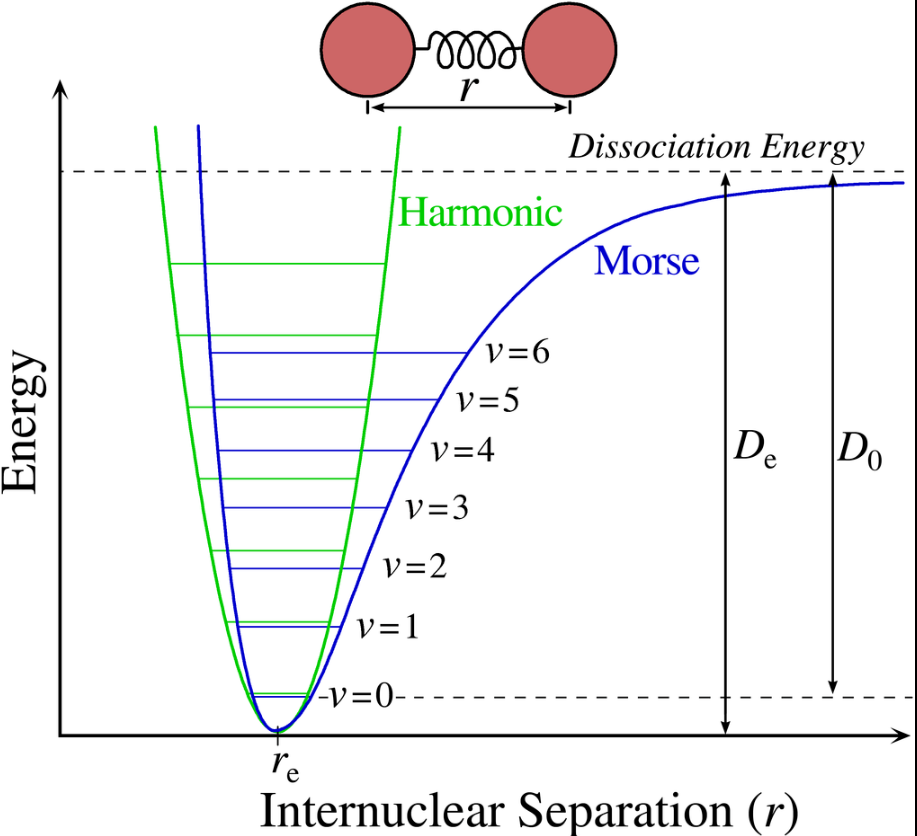
Remember the Morse curve from freshman chemistry? It describes the potential energy versus distance of two atoms at the scale of chemical bonds. The left side of the blue curve shows how steeply the repulsive energy potential rises (exponentially) with diminishing internuclear distance. By contrast, the attractive potential on the right of the blue curve flattens out with increasing interatomic distances. Keep this in mind.
When a fissile uranium-235 nucleus absorbs a neutron, the nucleus momentarily becomes unstable uranium-236. A stable nucleus has repulsive Coulomb forces between nucleons that are balanced at close proximity by the attractive strong nuclear force. The liquid drop model is useful for visualizing a nucleus as it fissions. On absorption of a neutron the uranium nucleus will distort to an elongated dumbbell shape leading to an imbalance of attractive and repulsive forces between nucleons. This can take the nucleus past the distance where the strong nuclear force attraction can hold it together. The strong nuclear force holding together nuclear particles (nucleons) falls off much faster with distance than does the Coulombic repulsion of protons. At the instant the nucleus separates into adjacent fragments, the two highly positively charged nuclei find themselves in very close proximity and are now only subject to net repulsive force. From the left side of the Morse Curve we can see that the repulsive force is exceedingly high in this moment. The highly repulsive potential energy is converted to kinetic energy at the moment the nucleus splits. The nuclear fragments fly apart at high velocity along with neutrons and dump thermal energy into the surrounding bulk material. But the kinetic energy of the fragments is not the only source of energy output.
Nuclear fission fragments are released in a highly excited state. Apart from their kinetic energy, nuclei have different energy levels with differing stabilities. A nucleus can undergo energy transitions from one state to another. These higher energy levels are called nuclear isomers and their stability can be expressed in terms of half-life. As fission fragments are formed they shed energy in the form of alpha, beta, gamma, and neutron emissions. Neutrinos are left out of this discussion for simplicity. As nuclei decay, they get closer to a stable ground state. Unstable nuclear fission products will decay in their characteristic ways, contributing to the overall energy release.
One challenge to weapons designers is to cause as many nuclei as possible to fission before the weapon undergoes “hydrodynamic disassembly” over the first 1 microsecond or less. After ignition the rapidly expanding plasma of the bomb core increases in volume and the probability of neutron collisions with nuclei diminishes rapidly. When a uranium or plutonium nucleus fissions, 2 or 3 neutrons are emitted which go on to strike other nuclei and induce fission in them. The cascading generations result in an avalanche of fissions. One of the ways to ensure that enough generations of fissions occur with enough neutrons flying about inside the supercritical assembly is to surround the core with neutron reflecting material. Ways of doing this can be found elsewhere.
One more thing about the strong nuclear force. This quote is from the Wikipedia entry for the strong interaction–
“The residual strong force is thus a minor residuum of the strong force that binds quarks together into protons and neutrons. This same force is much weaker between neutrons and protons, because it is mostly neutralized within them, in the same way that electromagnetic forces between neutral atoms (van der Waals forces) are much weaker than the electromagnetic forces that hold electrons in association with the nucleus, forming the atoms.“
A nuclear weapon produces a near instantaneous point source of energy release. These bombs can be detonated at or below ground or water level, or they can be set off in the atmosphere or space. The choice of where to do it depends on the intended effects. Subsurface bursts consume much of the explosive energy in moving soil or water which provides some radiation shielding to the surrounding area. Furthermore, bursts in contact with soil or water, especially when the fireball contacts the soil, tend to produce more fallout than air bursts. Air bursts deliver EMP, radiation and blast effects to a wider area, where “radiation” refers to neutrons, gamma and longer wavelengths of electromagnetic radiation. Thermal and blast effects produce considerable prompt destruction in the area surrounding the blast. As an approximate point source of energy, the intensity of the radiant energy falls off as some inverse square law. On an encouraging note, this means that radiation exposure falls off rapidly with distance. Distance is your friend.
There are numerous variations on the nuclear weapons theme. In the early cold war days, so called A-Bombs and H-Bombs were in the news. H-Bombs are also referred to as “hydrogen bombs or thermonuclear weapons.” An A-bomb, A for Atomic, was a basic implosion-type fission explosive and it was the typically the least powerful of the two. The H-Bomb was a nuclear fusion explosive that was triggered by a fission “primary.” That is, a fission trigger would be used to generate x-rays that would be “focused” onto fusion fuel, the “secondary,” which would initiate a runaway nuclear fusion explosion. The explosive yield of these bombs is much higher and can deliver a devastating blast to a larger area. Over time, the efficiency and compactness of these bombs has been greatly optimized.
The fusion explosive element was lithium-6 deuteride. The lithium atom would absorb a neutron, become unstable and decay into a helium-4 nucleus and a tritium (helium-3) nucleus. On a side note, in grad school I attended a seminar by Dieter Seebach from ETH, Zurich, who was talking about mechanistic work they’d done with lithium enolate complexes. He mentioned in passing that at that time, the mid-80’s, they had to be careful with stoichiometry because the commercial lithium that was available was often depleted of lithium-6 which was accumulated by the government for diversion to weapons. It was an unexpected brush with the cold war.
The main deleterious effect of radiation on human tissue lies in the formation of ions and radical pairs along the path of the penetrating radiation. The molecules of life are dissociated into ion pairs or radicals which may or may not collapse back to the original molecules. Given the amount of energy transferred into molecular dissociation along with random diffusion, the molecular destruction cannot be reversed. Heavy radiation particles like alpha particles produce a great many ions per centimeter of tissue penetrated. Penetrating, energetic photons like gamma rays produce relatively few.
There are 6 forms of hazardous radiation commonly considered- alpha, beta, gamma, x-ray, ultraviolet and neutrons. Of these 6, alpha, beta, gamma and neutrons are of nuclear origin. X-ray and ultraviolet are “electronic” in origin, that is they arise from electron transitions outside of the nucleus. The matter of the origin of x-rays is often confused in the literature with some authors implying that x-rays are from the nucleus. I prefer to define x-rays as resulting from electron transitions at the atomic level.
Of the 4 nuclear radiation types mentioned above, alpha, beta, and neutrons are particles. Gamma rays are photons. The atomic nucleus is comprised of so-called nucleons which are protons and neutrons. Nucleons are composite particles comprised of quarks and can bind by the strong nuclear force. Alpha particles are helium-4 nuclei and neutrons are neutral particles with approximately the same mass as a proton or about 1 atomic mass unit. Neutrons are not stable outside of the nucleus and have a half-life of about 15 minutes. Free neutrons will undergo radioactive decay into a proton, an electron, and an electron antineutrino.
Like gamma rays, neutrons are neutral in charge and have great penetrating ability. However, neutrons are effectively scattered by collisions with the hydrogen atoms of biomolecules and water. As a result neutrons can be very destructive to living tissue. As a side note, paraffin wax and water are effective shielding materials for neutrons due to the high concentration of hydrogen atoms. The collisions with hydrogen atoms in living tissues is a means of dumping neutron kinetic energy into the bulk matter, resulting in dissociation of biomolecules.
The so-called “neutron bomb” was an explosive that was designed to produce an abundance of neutrons at the expense of explosive yield. During the early Reagan years in the US there was much public handwringing about these bombs and their ability to kill people but leave buildings standing. People seemed indignant that somehow this reduced the value of human life below that of material things in the grand calculation of destruction.
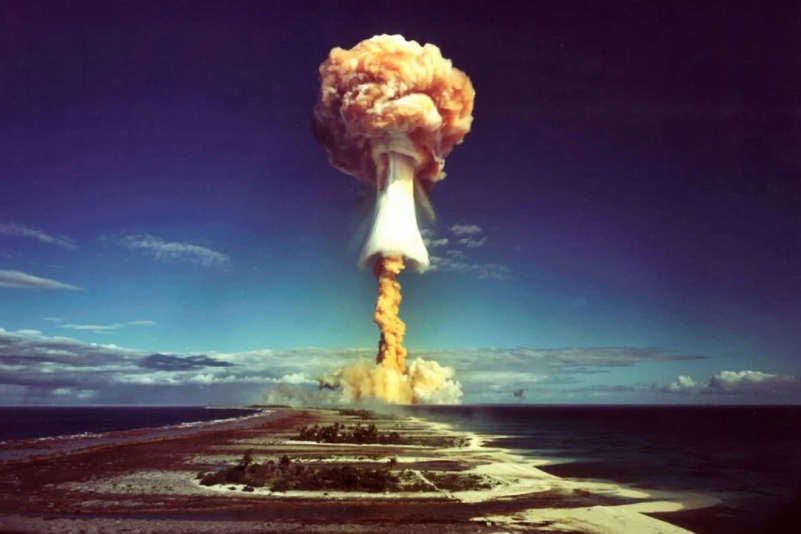
The characteristic mushroom shape rising to the sky after a nuclear air burst is just the result of a rapid release of energy and bomb debris in the air, but close enough to the ground to suck up soil. The “cap” of the mushroom results from the convectively rising point-source expansion of incandescent, debris-filled air from the point of energy release. The “stem” of the mushroom is a column of air that has rushed in to replace the rapidly rising fireball, picking up soil as it does so. There is nothing intrinsically nuclear about a mushroom cloud. Chemical explosives can do this as well.
Initially the fireball produces a strong pulse of thermal radiation. As this fireball develops, there is a momentary drop in radiant thermal energy due to the increasing opacity of the fireball. With further expansion the opacity of the fireball decreases and the thermal output increases. The shock wave and out-rush of air is obviously destructive, but the radiant thermal effects are not to be underestimated.
Another major effect of a nuclear blast is nuclear fallout. A nuclear blast unavoidably produces radioactive substances from the fission process and from neutron activation. A low altitude air burst is particularly troublesome because ground debris is sucked up into the air and contaminated with radionuclides. This material does what all suspended solids do, namely it is carried by the wind and falls back to earth gradually, contaminating a wide swath of ground. The finest particles remain suspended and are transported long distances, eventually falling out with rain or snow.
Finally, there are psychological effects associated with “the bomb.” It inevitably produces dread fear in people. This fear buttresses the idea of Mutually Assured Destruction or MAD.
Now that we are in a nuclear state of mind, let’s turn to what Putin intends to do with his nuclear arsenal. The Russians are not suicidal. Putin is neither crazy nor stupid. Russians have long understood where a nuclear confrontation with the West can go. They know escalation of nuclear war to full-scale would lead to mutual destruction of Russia and the West. The Russians know that the West has a policy of no first use with nuclear weapons and that we are extremely reluctant to use them. For the West, there is a firebreak between conventional and nuclear weapons. For the Russians, it is more of a continuum. They know that sabre rattling with their nuclear arsenal creates a good deal of anxiety in the rest of the world and Putin has been pushing this threat envelope to new levels and will keep doing so. Once a KGB guy, always a KGB guy. Putin obviously understands the pragmatics of coercion and the influential value of torture.
What nobody knows for sure is what happens when a Russian nuclear war shot is released. What does the West do? Respond in kind quickly or play the long game and see what happens next. How much planning has gone into nuclear conflict between two states outside of NATO? When would NATO step in? NATO is presently taking the side of Ukraine in terms of supplying money and arms but is studiously avoiding direct conflict with Russia. On the positive side, at least right now we aren’t bogged down with an endless middle east whack-a-mole exercise.
The best use of nuclear arms has always been and remains the threat of their use. Russia has been using this threat aggressively, even going so far as to blame Ukraine for planning a false flag operation with a “dirty bomb.”
Putin wants to see the alliance of the US and Europe disintegrate. He wants to see the American hegemony in place since WW II collapse. He wants to see the dominance of US culture, military reach, the influential dollar and prevalence of the default English language peel away. He wants to see Novorossiya rise from the ashes of the fallen USSR. But his vision requires the conquest of territory and cultural domination. The armed extinction project for Ukraine in process now will be followed by rebuilding the captured land with Russian infrastructure, political leaders and culture.
Russia, in its constant state of paranoia, wrings its hands about the “threat” of NATO at its border. The cruel irony is that it is hard to imagine that the West would find the conquest Russia possible or even desirable. The US-lead coalition was unable to get the medieval opium poppy kingdom of Afganistan under control with conventional weapons. How is it possible that we could even consider a preemptive invasion of Russia? Russia’s historical paranoia seems entirely self-serving for its authoritarian leaders.
One way to tear apart western alliances is to help them along with the demise of liberal democracy. Quietly support the internal cultural rot of individual nations by encouraging radical nationalism, white supremacy and political disharmony. It is happening all around us and especially here in the US. As badly as I’d love to entirely blame #45, I have to admit that he has only prodded a sleeping dragon. The MAGA and QAnon crowds were already out there. #45 has rallied them and validated their seething anger and indignation.
Today we have many people of great influence like Tucker Carlson, Alex Jones, Sean Hannity, nationalistic religious broadcasters, a stable of fringe political figures, and a mass of MAGA foot soldiers winning down-ticket elections moving their nationalistic and religious conservative agenda forward. Post-war baby boomers are being replaced with crowds and leaders who reject America’s present liberal democratic culture and leadership role in the world. There is growing open admiration for strongman authoritarian leadership. America’s experiment with fascism has already begun. Surprisingly, many Americans have expressed support for Putin.
Putin’s vicious attack on Ukraine, the rise of Trumpism with American fascism and a viral pandemic have overlapped within a narrow window of time- any one of which is a big problem by itself. It seems doubtful that MAGA right-wing crowds will have a change of heart in their vision for America. They will live out their lives within the same closed ideological space they are in presently. A political depolarization of America seems unlikely in the near term.
In this depressing global political climate it is more important than ever for the US to maintain its role as a thriving democratic culture and defender of those seeking democracy. Our leadership role in NATO must not waver against Russian aggression and expansionism. Russian expansionism will not end with Ukraine.
What will Putin do if he sees his internal political power structure collapsing? Will he ramp up the war to distract his opponents and rally the country? The present situation in Russia seems to suggest that rallying the population is more difficult than he anticipated.
It is hard to believe that Putin and his inner circle will change their ways in their lifetimes. They’ve painted themselves into a corner with their aggression and, like a trapped animal, will fight to the death. The cruel and murderous Joseph Stalin died in power. There is no reason to believe that Putin will be any different.

 Lamentations on Chemistry