
One of the interesting parts of having a blog is that you get to see the search terms that people use to find your site. We’ve been getting lots of hits lately from persons trying to squeeze polonium information out of the web. I went through some venerable reference books on my shelf and collated some general fun factoids on that fashionable metal – polonium.
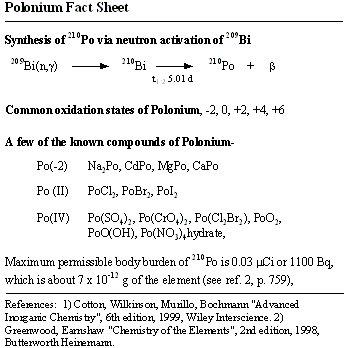
Polonium is actually a natural element found in thorium and uranium deposits. In the Radiation Health Handbook I count 33 isotope entries for polonium, 7 of which are metastable, or isomeric, states. The known isotopes are Po-193 through Po-218. Po-209 has the longest half-life at 103 years. Bismuth 209 is the heaviest stable nuclide. Nuclei heavier than bismuth often emit alpha particles, and do so exothermically or spontaneously. Polonium, one atomic number above Bi, has no stable isotope.
Loss of an alpha particle results in a drop of atomic weight of 4 and atomic number of 2. You can think of an alpha particle, or helium nucleus, as a good leaving group.
Polonium is very scarce. Its discovery, well known for being famous, was by Marie Curie and was accomplished by isolation from tons of ore. It was named after her home country of Poland. Today the the production of Po is effectively limited to Po-210 and is bred in nuclear reactiors via the transmutation of Bi-209 by neutron absorption to afford Bi-210. Neutron rich nuclides can drop their neutron count through the emission of beta particles (electrons) with a subsequent uptick of atomic number by one. So the Bi-210 nucleus transforms to Po-210 by beta emission. The polonium is isolated by fractional distillation from the remaining bismuth.
One gram of pure Po-210 is said to evolve 141 watts of heat. Consequently, one use of Po-210 has been for thermal electric power generation. It’s near exclusive emission of alpha’s minimizes shielding problems. Another important use of alpha emitters is for the generation of neutrons. This interesting process uses alpha particles to interact with beryllium nuclei to afford the extrusion of neutrons. In this way it is possible to have a compact neutron source. Place the source in a tank of water or paraffin, arrange for an opening, and presto! You have a cheap neutron beam source- sometimes called a neutron Howitzer. Plutonium-beryllium (PuBe) is more common than polonium because of the long half-life of available non-fissile plutonium sources. The neutron Howitzer is commonly used in neutron activation studies.
The chemistry of polonium is exotic by virtue of it rarity and the pragmatics relating to its high specific activity. It’s high specific activity causes it to radiolyze the solvent that the reaction or other manipulation is occuring in. This is especially problematic for organic solvents. The high activity will pose serious safety risks for the chemist in handling. Advances in organopolonium chemistry have been complicated by the pyrolysis of the organic fragments via radiolysis. This also complicates the preparation of crystals for x-ray crystallography. A properly equipped facility night have a remote manipulation setup for handling high activity materials. This is especially critical when the permissable body burdens are in the picogram range.
 Lamentations on Chemistry
So, if you wanted something you could use to spike a tea cup without changing the taste, what would be the Polonium compound of choice? A water soluble salt, perhaps?
Wikipedia says it can be methylated to form an organometallic, which might be more easily introduced into the victim.
I hate to ponder this kind of thing too much. I’d guess that the actual compound used was “off the shelf”, given the difficulties of doing transformations on something with such a high specific activity. I don’t know what kinds of Po compounds are commercially available. Usually Po is obtained and used based on its activity, not it’s chemical form. People who would be in a position of doing chemical transformations would be those folks who work in an existing rad lab with all of the critical infrastructure to support chemistry with Po.
More likely, the poison was an available radiohemical or source (eg., a needle tip) that may have been water soluble. Given the low maximum permissable body burden of Po (0.03 microCurie) a lethal dose amounts to a really small mass of Po. A rough estimate of a body burden mass of Po-
mass Po = (3.0E-8 Ci/Burden)/(4.5E3 Ci/g) = 6.7E-12 g Po per body burden.
Litvinenko experienced a fairly prompt death- within two weeks, say. My guess is that a dose of 100x to 1000x a body burden might be needed minimally to approach the “molecular death” effect. This is where biomolecules are irreversable fragmented by the ionizing radiation. One body burden of Po according to my reference (above) is 0.03 micro Ci, or 1100 Bq (disintegrations per second). So, 100x is 110,000 Bq and 1000x is 1,100,000 Bq. This represents a lot of ionizing energy that is basically 100 % absorbed by the body.
Given the low # of moles needed to afford one body burden, chemical toxicity seems negligible. In fact, any dispersed form would be a real problem for the victim. Po is a chalcogen and it’s chemical forms are in the list above. Given all of the potential “ligands” available to a solublized Po source in the digestive tract and bloodstream, it is hard to say if much actually concentrates in particular organs or bones.
Disclaimer: I’m a chemist of stable isotopes and not a health physics person. However, I can and do read. The analysis above is based on basic principles and may be subject to changes in detail.