
The Space Shuttle Program is scheduled for shutdown sometime in 2010. At that time the reusable, tiled spaceplane concept (STS) will be put to rest in favor of the capsule-on-a-rocket design. According to plans, there will be a 5 year interlude between the retirement of the shuttle and the implementation of a new man-certified lifter. Many have suggested that this idle period with no manned launch activity could lead to a brain drain in the ranks of skilled aerospace workers.
The successor to STS is the Ares Launch system consisting of a man lifter (Ares I) and a cargo lifter (Ares V). Ares I is a two-stage system that will take a crew of 4 to 6 into low earth orbit. This vehicle will carry 55,000 lbs of provisions and astronauts to the ISS. Additionally, it will be used to lift a lunar exploration team into orbit for docking with the lander module placed into orbit by the Ares V lifter.
Ares V is a heavy lifter and is expected to be able to place 414,000 lbs into low earth orbit or send 157,000 pounds of payload to the moon. Ares V uses two solid rocket boosters derived from STS and a central H2/O2 liquid fueled rocket using a cluster of 6 engines derived from the Delta IV system.
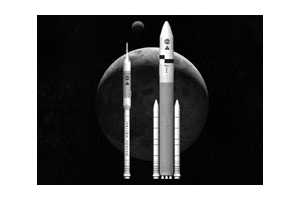 Ares I & V. Photo Credit- NASA
NASA has awarded contracts for this program and work is underway.
What has recently transpired is an alternative system proposed by a group of engineers. This system is called DIRECT, and involves the use of a single lifter called Jupiter. The Jupiter lifter is derived directly from the STS lifter which consists of two solid rocket motors and a central H2/O2 tank which feeds the shuttle engines. The DIRECT system would take advantage of existing technology, but with the addition of an O2 tank extension, a cargo section, and a cluster of engines to the existing liquid fuel tank. The proponents of this system claim that their system could get the next phase of manned space flight going sooner, simpler, and safer.
It is an interesting proposal. I hope it gets some serious consideration by the Congress.
 Lamentations on Chemistry
http://www.mazepath.com/uncleal/nasa3.htm
Modeling suggests the Aries I will reduce its human cargo to crimson sludge like a Wig-L-Bug emulsifies KBr pellet IR samples. NASA is studying SSB mounts based upon off-road shock absorbers. Werner von Braun used slide rules and Eastern European machinists not supercomputers and CAD/CAM. Only an idiot could not rebuild a proven solution. Only the King of Idiots could rebuild a proven solution deadly wrong.
(Use the Wig-L-Bug tool steel capsule with the tungsten carbide pestle. Polystyrene disposables will contaminate every sample.)
I recall seeing a special several years ago on the prospects for a jet which can take off and land without the need for boosters. I also remember a discussion on new supersonic aircraft. With today’s fuel prices it appears we should be grateful to get anywhere at any speed. Still, it would be interestng to know if practical suborbital commercial travel will ever be a reality. I’d been looking forward to a New York to Japan three hour flight. Now I’m reading stories about bringing back airships!
Regression!
Rumor has it the SR-71 could achieve out of atmosphere ballistic trajectories on paper. Nobody had a solution for (cooled) engine restart in the upper atmosphere. Unpowered it fell like a brick.
“Many have suggested that this idle period with no manned launch activity could lead to a brain drain in the ranks of skilled aerospace workers.”
NASA’s embarrassing failures are legendary. The inverted switch on the comet dust collector, the metric/English units collision with the Mars explorer,… These are system failures. How difficult is it do design a switch that can’t be put in incorrectly? (Hint: how many polarized electrical plugs are in your house?) How difficult is it to implement a deisgn review process so that this is done? Same with the unit mismatch. This is basic late 20th century engineering, no armchair quarterbacking.
If we really are concerned about “brain drain” from this low level, then we would be best off letting it happen so that everything fails. Then it can be shut down entirely despite the political difficulties of maintaining a jobs program for engineers.
I guess the magnitude of the “problem” depends on how much value the upcoming lunar program brings to our culture. The Venn diagram in my head puts the economics set inside the culture set.
In the popular conception, the space program has been a dynamic-mother-of-invention machine. But I’m not sure if the innovations generated by NASA filter much beyond the military and some highly specialized aerospace contractors.
Uncle Al- I think that the SR-71 was able to arc to an altitude where the control surfaces (elevons, rudders, etc.) were no longer effective. This could be regarded as a partial definition of “space”.
A retired military air traffic controller opines that the SR-71 Officially cruised at Mach 3.2 but its compressor inlet specs were compatible with Mach ~6. There are contingent severe wing leading edge heating problems.
Out of atmosphere loss of flight control could be addressed with reaction thrusters. Pratt & Whitney J58 engines fueled with Kelly’s Lighter Fluid were notoriously difficult to cold start (trimethyl boron as ignition fluid). In-flight “unstarts” garnered very sincere civilian ground complaints about reignition hiccups.
The Aries remake of Saturn V heavy lifters is monumentally FUBAR. The thing is CADed as a whole. Without compartmentalization and defined unit interfaces any component failure elicits global revision. Aries is the work of an ass (the same design philosophy that specified o-rings as dynamic seals in Space Scuttle SSBs).
You should visit the SAC museum west of Omaha. They have an SR-71 on display. http://www.strategicairandspace.com/
There used to be some boron fuels research north of Boulder (formerly Beech Aircraft). Somebody wrote a book on the development of boron fuels additives called The Green Flame: Surviving Government Secrecy, by Andrew Dequasie.
I am sold ! The Jupiter launch system is the way too go !Hands down.