
The United States Patent & Trademark Office collates and makes available online statistics relating to patent office activity. The data provided by the patent office could be thought of as a mine of information. A few companies make a business of collecting USPTO data and subjecting it to analysis.
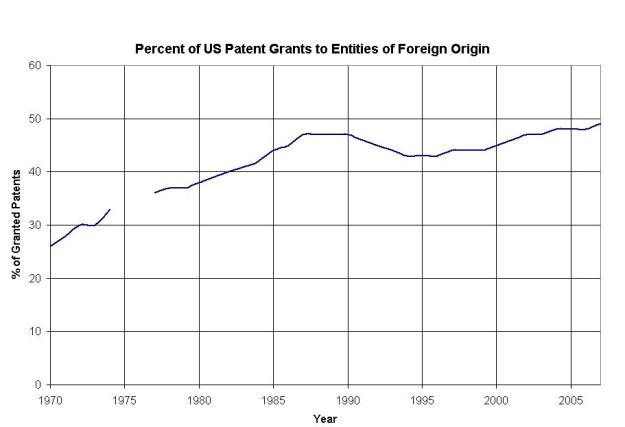
One of the more interesting things to be found is the % fraction of patents granted to foreign entities. As of 2007, the fraction of allowances to foreign entities is 49 %. The above graph shows the tend over time. The gap in the curve is due to the absence of data for 1975-1976 in the published data set.
The fraction of foreign patent allowances has remained approximately constant since ca 1985. There was a dip in the 1990’s that may correspond to some sort of pullback in R&D activity. This drop off in issued patents lags by several years due to pendency.
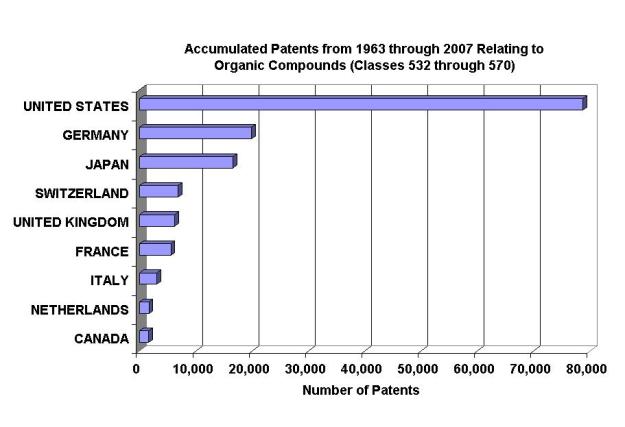
The above graph uses data published by the USPTO. Here we see the accumulated patent allowances to various nations over the period from 1963 through 2007. The data set is limited to Organic Compound classes 532 through 570 under the US classification system. For brevity, only the top 8 foreign applicants are shown in comparison to the US.
Very obviously Germany and Japan have the leading foreign awardees of US patents in this segment of R&D. I have not looked at how the reciprocal situation compares under PCT filings abroad by US applicants.
What is of greatest interest is seen in the top graph: 50 % of the patent real estate being staked out at the USPTO is going to foreign interests.
A unique feature of chemical patents is the Markush claim. Markush claims allow the claiming of a potentially large huge number of analogs defined by compact symbolism and covering vast swaths of the periodic table.
It is thus possible for a professor in Osaka to own the composition of matter of a Markush set of hundreds or thousands compounds that would then bar a company in New Jersey from making even an obscure member. Under the PCT, the same is true in the other direction.
The reach of property rights in the world of invention has become so extensive, and the data provided by the various patent agencies and abstracting services is so inadequate, that the act of performing a due diligence search is nearly comical. In truth, you look for low to middle hanging fruit and hope that an obscure sentence somewhere doesn’t blow a hole below your waterline one day.
Chemical patents are in dire need of reform in terms of the nature of the disclosure. Patent offices must find a way to facilitate the extraction of crucial information so the public has a fair chance of understanding what is off limits.
We need a more lucid recitation of claimed compositions and better use of language in the detailing of processes. Patents should be written with abstracting in mind. It should be made possible to extract processes and compositions into a form that can be accumulated in databases for rapid review. This has to begin in the drafting phase of the application.
[For some great feedback, check out the comments- Th’ Gaussling]
 Lamentations on Chemistry
“Patents should be written with abstracting in mind.” I would imagine that any attorney giving this advice to their client could be sued for malpractice.
The “inventor is their own lexicographer”, so that words mean what they want them to say. I’ve run across more than a few patents where the term “interpolymer” was used, a term that I had never heard of. Upon reading the patent, I saw that they were using that term instead of “copolymer”. The only reason I can figure for that was to make it easier for people to overlook it in a search.
“What is of greatest interest is seen in the top graph: 50 % of the patent real estate being staked out at the USPTO is going to foreign interests.”
As if all ideas were somehow the God given right of US citizens. If anything our society is corrupt and near fascist. We need less power, not more.
Anyway should you find even one member of a mega-Markush structures invalid, then ALL, yes ALL structures within the claim fall. Still you point out a true weakness, which is being addressed in the new legislation. You’ll likely get hit with a restriction in the first office action if the structures are unduly multiplied in the future. But remember an invention need not be literally reduced to practice, so in a way your anger at over-claiming may smother legitimate innovation in some areas (Markush structures can be used for machines, manufactures, processes as well as compositions of matter).
John is correct about the Lexicographer distraction. Hence I can say
the terminology ‘benzene’ implies all aromatic structures, substituted or unsubstituted, of a molecular weight less than 3000. I can then write my specification around this.
Patenting is not for the faint of heart.
One defense against Markush is to demonstrate one or more claimed structures exhibits no claimed activity, thus overturning the patent. Oh yeah… What does “no” mean on a log plot?
My concern about the substantial foreign ownership of a statutory monopoly has little to do with “who” owns the patent. I’m trying to understand what this data may be telling us about the health of our own innovation culture.
Instead of seeing foreign ownership as high, I see US ownership as low. I see US competitiveness as somehow proportional to the fraction of US patent ownership.
The quotation that John brought up – “The “inventor is their own lexicographer”, so that words mean what they want them to say.” -may be true in practice, but the use and intent of language in a patent should be understandable to PHOSITA. If we have given up on the ability of a PHOSITA to read a patent and come away with a reasonable grasp of what they have a right to practice, then the government has failed in its stewardship of this right.
Nick- “Anyway should you find even one member of a mega-Markush structures invalid, then ALL, yes ALL structures within the claim fall.”
I recall in learning and teaching organic chemistry that we use generalizations about functional group- or radical- behaviour as a means of making chemistry comprehensible. We make generalizations about alkyl groups, aryl groups, amines, halides, etc., that allow us to to go out and practice unfamiliar chemistry because similarities can be found and counted upon.
Lo and behold, the similarities between homologs apparently do not constitute a kind of obviousness in the patent world because the PTO allows substrate specific claims using transformations that are generic. For example, a new substrate may have a generic functional group on it, but since the skeleton is new, the transformations on its functionality may be considered novel.
So, you can use established reagents and conditions for what PHOSITA would recognise as a Friedel-Crafts reaction on a new substrate and be allowed a process claim. For me this is cognitive dissonance.
Oh yes, I’m really not very angry about it.
My field is somewhat unrelated to straight synthesis, but it’s been my impression that Japanese researchers seem to patent everything they touch. In my company, we’re somewhat on the other extreme, since we’ll only patent something that’s clearly defensible and a strong business interest. I wonder if the patent landscape has more to due with cultural practices than business interest in innovation. Nonetheless, I’m not necessarily disagreeing with your assertion that US competitiveness may be low.
I would like to offer an alternate viewpoint of the patent world that is not related to chemistry. I hold several patents for software where unlike the physically based world of chemistry, testing the validity of such claims is nearly impossible. The crap that the USPTO allows for software patents would simply amaze and astound you real scientists.
The trend you are seeing with these “foreign inventors” in Germany and Japan and elsewhere is a simple hedge bet that our broken patent system is going to one day allow them to exhort millions of dollars from the system. They’ve watched the machinations of our system as vaunted attorneys have fought the single combat warrior battle for Truth, Justice and the American Pay.
That’s not a typo… It’s all about the Benjamins. As Mr. Isocyanate put it, Japanese inventors patent everything they touch while we (collectively the U.S.) tend to patent only the clearly defensible stuff. Both strategies work but while the Japanese are using a shotgun, we prefer the dialed-in rifle.
That said the system we’ve instituted treats each and every pellet with the same attention as a bullet. It should be clear that although less effective individually, the shotgun system covers a larger spectrum than bullet and will ultimately will payoff far more.
Consider if you will the ridiculous 1991 Thomas Campana patent held by NTP that was used to torture Research in Motion (RIM – the CrackBerry folks) into submission in 2006. Ultimately this issue was settled for $612.5m on an 1990 investment of say $10,000. Even after paying off the attorneys (assume 40%) that’s still a 36,750 percent return.
You only need one pellet to hit and you’ve justified the entire portfolio of your claims.
If you peruse the NTP patent you will see that the overall intent of the patent is the “…use of radio frequencies to push email out to a mobile computer…”. Yes, those are my redacted words but part of the problem with the patent system is that we’ve allowed attorneys to take control of the lexicon as John so aptly points out.
Let me be clear. This is a ridiculous patent that should have never been awarded. Besides offering up only three weak references in the original patent, there is an enormous amount of prior art all around us to deny this patent.
Think about it. Western Union began delivering text-based messages over microwave telephone links in the late 1950s and continued that practice for three decades.
“The receiver was a mobile computer”, you say? Think back to the Apollo program. Text messages, albeit in the form of nibbles of information were being transferred between Earth-based stations and the Apollo Command and Lunar Modules (clearly mobile by anyone’s standard).
“Push Email” you say? It was common in the 1980s to set up a minicomputer’s modem system to await a call from a distant sender. Those calls contained the latest information including electronic messages purchase order and shipment records and a host of other things that we now do with email. Because the machine was listening for the call, this is clearly push technology.
You (or NTP’s attorneys) can argue until the Big Crunch that their system is somehow fundamentally new, novel, different and ultimately what you will uncover is that a combination of the fast paced drive of technology, corporate greed and attorney weasel-words just clearly overwhelmed the USPTO’s underpaid, overworked patent examiners like Stephen Chin (the guy that allowed the NTP patent).
Don’t get me wrong here. I do not believe that RIM is in anyway innocent in this high-stakes game. They’ve done their fair share of abusing the system for (IMHO) ill-gotten gain.
I had once lost hope that we could fix the problem but I recent regained it when I realized that we already have the perfect process to weed the charlatans from the fold (I think that’s a mixed metaphor).
It is called “peer review” and I would propose that all patent applications must spend 6-8 months in a formalized peer review, orchestrated by the patent office, before an application can be made. Because the patent office orchestrates the review, a timeline is established (legally) and when the patent is awarded it can be awarded to the appropriate people.
In the immortal words of Randall Monroe, “Science. It works bitches.”
Peace
Ps> I hope I got that last accreditation correct. If not, I’m sure that a peer review of this comment will fix it.
Pps> Is Mr. Isocyanate of Greek descent?
Ppps> This was not sent from BlackBerry.
Errata:
Paragraph Four should read:
That said the system we’ve instituted treats each and every pellet with the same attention as each and every bullet. It should be clear that although less effective individually, the pellets of the shotgun system cover a larger spectrum than any single bullet and ultimately will payoff far more.
The Ppps shoud read:
Ppps> This was not sent from my BlackBerry.
The USPTO has started a “peer review” pilot program in the computer and software area. I’m not sure if they are considering it sucessful or not. If it ever came to chemistry (specifically polymers), I don’t know that I’d have the time to put into it. Reading patent applications can take a lot of time given the verbosity of the writing attorney, the redundancies and the cursed crushed grammar (why must every claim be only one sentence?), but I certainly am not against the concept.
Hi Les, thanks for that comment. You don’t have any strong opinions on this, do you? \;-)
John – I was not aware of the peer review pilot. I’ll have to look into it.
Gaussling – Not as strong as my opinions on politics, beer or the inability of people to drive well 🙂
“Lo and behold, the similarities between homologs apparently do not constitute a kind of obviousness in the patent world because the PTO allows substrate specific claims using transformations that are generic. For example, a new substrate may have a generic functional group on it, but since the skeleton is new, the transformations on its functionality may be considered novel.”
Yes, this is technically true but I believe you over-state its impact. This goes back to In re Ochiai, In re Brouwer which made headlines a few years back. (see http://www.uspto.gov/go/og/con/files/cons104.htm)
In most cases you will be instantly hit with an obviousness rejection for let’s say using a Friedel Crafts with a new substrate and claiming that is not obvious. The burden will then be placed on your shoulders to prove that its not obvious. Where it gets dicey is when you suggest the new substrate using the conventional process uses a different mechanism or provides unusual results. What constitutes unusual results is of course interpretable only by our friend PHOSITA. This is all part of the patent office needing to interpret “the claims as a whole” rather than whether a conventional process exists in the prior art. If you look at 35 USC 103 (b) it was essentially created to overcome ‘Durden’ rejections, which was the governing law for many years prior to the courts acceptance of a broader interpretation.
So you’re correct, though you overstate the significance here.
As a PHOSITA I have found most Process Patents I have attempted to follow are suspect so as to if not intentionally written to hide the real procedure then they need a significant amount of additional effort to fix. Patents are primary legal documents and the science usually get obscured, often with inventive terms as suggested above. As per norm the lawyers typically are the ones who profit from them except in rare situations
“As per norm the lawyers typically are the ones who profit from them except in rare situations”
Why can’t chemists profit in a similar fashion? What the hell is wrong with chemists? Is it be possible that both chemical intuition and mercenary avarice can’t coexist in the human mind?
“Why can’t chemists profit in a similar fashion? What the hell is wrong with chemists?”
Here is the deal. It is the owner of the patent – the Assignee- who has the rights to the invention. Unless the chemist-inventor is also the assignee, they only get a silver dollar and another entry on their resume.
The assignee is typically the chemists employer and as a condition of employment, the employee has to sign over ownership rights. If the chemist is willing to start a company, then he/she can retain the ownership rights to the invention. It is a bit more complicated if government money is used in the process.
So, the question isn’t so much “Why can’t chemists profit in a similar fashion?” as “Why don’t more chemists start businesses?”
Because lots of chemists spend a whole bunch of time in school to get their degrees – four to BS, six to PhD, maybe 2 for a postdoc (the last two eras at 60-100 h/wk). With that kind of upfront cost, people are probably less likely to go into high-risk fields because their chance of recouping their upfront costs is lower. By the time they get through school, I am also assuming that at least some would like to have a family, which may or may not be consistent with the work necessary to start a business and the risk inherent in doing so.
It’s also possible that I’m mapping my risk aversion on to others, though.
Yeager although gausling and Hap are correct there is also the fact that Patent Lawyers typically have extremely high hourly rate ($500-1000/hr) in the authoring/submission/grant stage and if must defend or fight a Patent they get paid for that also.
My answer to “Why don’t more chemists start businesses?” is that most do not have the right connections to VC or other Money sources and even if they do try most Investors can not comprehend the technology (but one better have Patents, real or Potential because typically high value placed on IP).
I found an interesting document at the USPTO web site relating to (new) thinking on patentability-
Guidelines for the Examination of Claims Directed to Species of
Chemical Compositions Based Upon a Single Prior Art Reference
http://www.uspto.gov/web/offices/com/sol/notices/fr980826.htm
“Yeager although gausling and Hap are correct there is also the fact that Patent Lawyers typically have extremely high hourly rate ($500-1000/hr) in the authoring/submission/grant stage and if must defend or fight a Patent they get paid for that also.”
>$500 is for appeal/trial attorney. You should pay no more than $300 an hour for a decent patent attorney during the authoring/submission phase.
You’re being robbed.
I think your question of “Why don’t more chemists start businesses?” is worthy of a post on its own. That said, I do have a small comment. We always hear stories about business starting out of garages, and how some of the smaller chemical companies of today got started in that way as well. However, is it really possible for an entrepreneur to do chemistry in his garage? Would it be legal to set up a reactor of just even a mixer? Would a waste company make pickups? Would Aldrich deliver chemicals and would the distributors send samples or sell raw materials? I’m always under the impression that they would not, so someone starting a business would have the added expense of rent and waste disposal before they even acquired customers. And in a final comment, why do schools not teach chemists how to write an MSDS or the web of chemical safety, disposal, and transport laws? All of those are very important for the actual business of doing chemistry.