Monthly Archives: May 2009

Talibanistan

Holy smokes. Who’da thought that Pakistan’s western frontier would fold like a lawn chair to an invasion of jabbering, hairy, religious freaks? Someone has commented that while most countries have an army, Pakistan was really an army that had a country. It is difficult to understand the dynamics of this part of the world and how Pakistan could allow the Taliban warriers such a generous incursion.

North Korea is another army that has a country. As bad as the Pakistan situation is and no matter how belligerent the Iranians are, I suspect it will be North Korea who pops off the first nuclear warshot since Nagasaki. The question is, will it be against Japan, South Korea, or the US Navy? 

Then there is China which is apparently in possession of anti-ship ballistic missile technology (ASBM). This capability basically nullifies US superiority in force projection in the China Sea by our carrier fleet. US surface ships are helpless against attack by smart ballistic missiles raining in at Mach 10 or whatever the particular hypervelocity is.

Thermochemical Snipe Hunt

Spent the better part of the day hunting snipe in the chemical literature. I’ve been looking for some English language literature relating to the Yoshida explosive potential correlation between DSC heat of formation and DSC onset temperature. I have some sketchy relationships from Yoshida in Chemical Abstracts CAN 108:58900 –

Shock Sensitivity = log (QDSC) – 0.72*log(TDSC-25) – 0.98

Explosive Potential = log (QDSC) – 0.38*log(TDSC-25) – 1.67

QDSC is the magnitude of the exotherm as measured by DSC (presumably in J/g, not J/mol), and TDSC is the onset temp also determined by DSC. A separate reference suggests that compositions with EP>0 are potentially explosive.

I want some better grounding in the assumptions going into the correlation before I pony up my own results. This is potentially a very useful relationship in reactive hazards work and something I can do in the lab myself.

It’s a pity I do not speak Japanese since much of the cited work is in Kogyo Kayaku and in Japanese.

Scheiss!!

Ever pondered the merits of mixing up a batch of N5 salt? Polynitrogen chemistry. Yikes. Check out this link (rather large).

TurfFirst! Ecoterrorists Strike Campus

Guapo, Arizona. Ecoterrorists struck the campus of Pultroon College friday evening. Authorities allege that members of TurfFirst! spiked the quadrangle on the Pultroon campus. Groundskeepers, on what was by all appearances a “routine mowing mission”, encountered spikes in the turf they were trimming. Mowers unwittingly ran over metal spikes driven into the soil. The spikes damaged cutting blades on the mowers and in one case punctured a tire.

Head groundskeeper William “Herb” Cutter stated that his crew was shaken by the incident and that he was uncertain when they would return to the mowers. “This came from out of the blue,” Cutter said, “we had no idea that we were being targeted.” 

Special Agent John Blather of the Four Corners Terrorism Task Force stated that the incident at Pultroon College was only the latest spiking under investigation and that a post-doctoral fellow was designated as a person of interest. While the identity of the post-doc has not been released, Ortho Professor of Hedge and Turf Science Elaine Deere released a statement through the public relations office at the college.

Deere stated that a full internal investigation was underway regarding the possibility of members of the college community sympathetic to TurfFirst! The effect upon letters of recommendation was unclear at this time.

Deere did offer a possible motivation for the spiking. “This is Arizona, after all. I don’t know what we were thinking trying to grow Kentucky Blue Grass in the Arizona desert. Maybe that’s why they’re torqued at us?”

TurfFirst! is a murky and poorly known ecoterror group. They have shown a preference for striking at college campuses and turf farms. TurfFirst! is a group of radicalized botanists and soil fundamentalists who have claimed in a lengthy manifesto that the soil comprises a living, global organism that is being harmed by agribusiness and “chemical plows”.

It is a loosely affiliated and non-centralized group consisting of independent cells, or “berms” as they call themselves. Numerous symbolic targets have been hit by TurfFirst! operatives over the last 5 years, including both the baseball and football halls of fame.

The leader of TurfFirst! is not known with any real certainty. However, a shadowy figure who operates under the name of “Sedge” is thought to be a key player in the turf underground movement.

Opening Night

The opening night production of Beets went quite well. The house was packed and the cast & crew rose to the occasion.  The audience was quite responsive to the script and as a result we found out where the real laugh lines were. The trick to acting is to lift a 1 dimensional string of characters from a page and give them depth and color.

The only production snag was with the house lights. For some reason the software wasn’t able to call for the house lights to dim. The lighting guy opened the door of an obscure closet in the vaudeville-era backstage to reveal a glowing, LED festooned, 6 ft tower of computerized widgetry. Working feverishly and with green pinpoints of light reflecting off his smudged bifocals (a la Dave Bowman), he finally toggled the right button and got the house lights to darken. Otherwise the software-driven lights and sound worked well.

I wasn’t nervous until 15 minutes before showtime. Standing in the wings I tried to recite my lines in my head, but just couldn’t summon them from the turbid depths. I don’t mind sayin’, this was a distressing development. But after I walked on stage the lines came on cue and we got the thing done.

From the comments at the reception after the show it was apparent that the audience understood the story and were emotionally drawn into it. For two hours we suspended reality and had a shared experience. This is the goal of the writer, director, cast, and crew. When it works it is an amazing thing.

Hot Stage at 7 PM

Hard to believe- our show starts in just a few hours. I’ve given my 2 comp tickets to family. Folks are forkin’ over real money to sit and watch us do this thing. Ticket sales have been strong, so everyone is jazzed. If anything, the cast is a bit over rehearsed. We’re happy just to get the thing going. The sound and lighting cues are set.

Th’ Gaussling plays a sugar beet farmer, which ain’t much of a stretch, havin’ growed up on an Iowa hog and corn farm. Turns out that my step-mother grew up on a beet farm in this area and is aware of the Greeley WWII POW camp’s location. There were supposedly ~155 POW camps in the US by the end of the war.

Beets Poster

It is a decent story and certainly makes for a good dramatic situation. My part is a minor role, though I am in 5 scenes. In terms of the storytelling, my character is a device contrived by the writer to make sure that certain information gets on the table so the audience can get the facts and circumstances in context. This is part of the playwriters craft that I had failed to appreciate previously.

It is a good play and I am lucky to have been a part of it. Quiet backstage!

May Linkfest

A friend sent me the link to Wolfram|Alpha  just a while ago. So far it seems to be a bit lean in textbook-style content in the chemistry area. For instance, when you enter “aromatic solvents” into the dialog box, it returns with

Wolfram|Alpha isn’t sure what to do with your input.

But if you type in “toluene”, suddenly it is the CRC and is flush with data. The stated goals of the Wolfram|Alpha developers are-

Wolfram|Alpha’s long-term goal is to make all systematic knowledge immediately computable and accessible to everyone. We aim to collect and curate all objective data; implement every known model, method, and algorithm; and make it possible to compute whatever can be computed about anything. Our goal is to build on the achievements of science and other systematizations of knowledge to provide a single source that can be relied on by everyone for definitive answers to factual queries.

I do not yet know enough about this resource, but it seems to be a data engine rather than a prose engine.

Landscheidt Cycles Research is a site devoted to the Planetary Influence Theory. This theory pertains to the possible gravitational influence of the planets on solar cycles. it is worth a look.

Watts Up With That? is a blog concerned with global climate issues. The blogger and many of the commentors seem to have their facts straight about global climate change. The site is very data intensive.

If you are a scientist or manage scientists, it is worth considering the file drawer effect.

An online NMR predictor can be found at nmrdb. In my experience the splitting and chemical shifts seem to be in the “not too awful” range.

Biohackers

A recent article in the WSJ solemnly described several amateur biologists who were doing simple molecular biology experiments in their homes. Naturally, this has not escaped the attention of certain authorities and certain deeply conservative establishment news corporations.

What is distressing is the reflexive conclusion that their activity is automatically dangerous and likely to be symptomatic of malevolent intent.  It is common for those in power to look over their ramparts and view the world as a spectrum of threats. And so it is in this case that distrust has arisen and reporters are using the words “weapons of mass destruction” or “ebola virus”. 

Could it not be that some people outside of the heavily in-bred fields of science have a genuine and scholarly interest in molecular biology but no interest in grad school?

The entrance to scientific activity is highly formalized with layers of degree requirements, preferred pedigree, institutional infrastructure, regulatory complications, and a mafia-like oligarchy that disperses the resources and opportunity that is so necessary for buoyancy in science.

How does a creative amateur scientist get to take a jouney of discovery in a field that is institutionally inaccessible to them? And how does an interested individual who is clever enough to conduct experiments deal with a government whose reflex is to see WMD and terrorists behind every lilac bush? There are serious civil liberties problems here that pit the brain stem against the frontal cortex.

It is in the nature of some people to be distrustful and find threats behind every shrub. It has been my observation that people who default into a distrustful posture are very often not trustworthy themselves. The distrustful often invoke slippery slope arguments as rhetorical devices to block their opponents move into new conceptual turf. What the distrustful and paranoid fail to see is that we live every minute of every day on multiple slippery slopes, yet we somehow survive and thrive.

The Venue

This morning we moved our set into the theatre that we will be performing in for the next two weekends. This is my first acting performance in a decent theatre. It has clean dressing rooms below the stage and reasonably up-to-date lighting and sound capability. The theatre seats 400 and has been well refurbished over the last few years.

We have a tech crew running the lights and sound, a props & costume crew for scene changes, a makeup person, a set builder, and a few other gofers who handle the 10,000 details. All we have to do is remember our lines and avoid falling into the orchestra pit. The lead character has been sick for the last 10 days, so the producers have been nervous. He is a quantum computing physicist who happens to dig acting. The physicist gets the girl. The chemist gets to shout at people and whittle.

Last friday’s local paper featured a full page closeup of me, Th’ Gaussling, hamming it up on stage. Mother of pearl! Today’s thrill of standing on the set and looking into the auditorium was soon replaced by waves of nausea at the realization that this thing is really going to happen. Holy smokes. What have I done?

Cresson Gold Mine, Part 3.

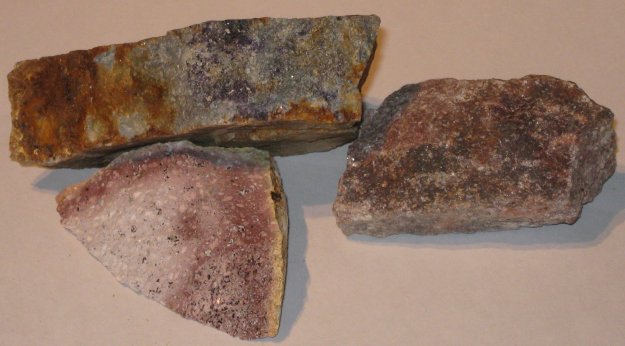
The Cresson Mine in Cripple Creek contains a good deal of fluorite. I was able to casually collect a few samples just lying in the road bed. In the photo below, the rock on the top has the most pronounced blue/purple color indicating CaF2 (fluorite). These specimens are not collectors pieces and are entirely unremarkable other than as indications of fluorite.

Cripple Creek Fluorite Indications (Cresson Mine). Copyright 2009 Gaussling.

Cripple Creek Fluorite Indications (Cresson Mine). Copyright 2009 Gaussling.

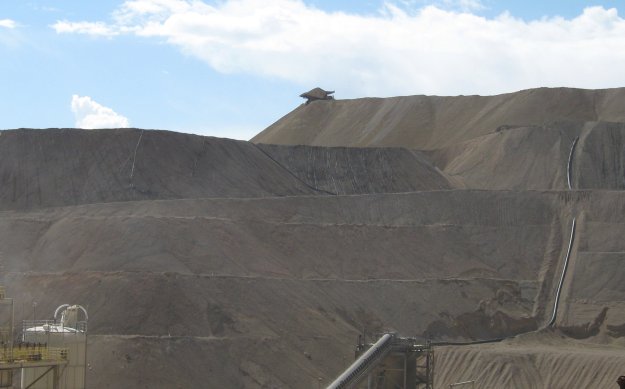
The mine business model requires heap leaching as a means of extracting the gold value out of the ore. Given that the ore is peculiar in that it contains gold in the form of gold telluride which cannot be leached out by cyanide, approximately 40 % of the gold remains in the host rock. The cost per toz of gold produced must be kept as low as possible and the way you do that is economy of scale.

The heap sits atop multiple layers of clay barriers and the 14,500 gal per minute of extract that flows out of the heap 24/7 is passed through coconut husk charcoal to trap the gold cyanide and the raffinate is recharged to the desired 100 ppm titer of aq NaCN and pumped back onto the pile. pH adjustment is a constant chore. The crushed rock is mixed with calcuim oxide prior to being dumped on the heap to maintain a high pH.

Building the Heap. Cripple Creek Cresson Mine. Copyright 2009 Gaussling.

Building the Heap. Cripple Creek Cresson Mine. Copyright 2009 Gaussling.

Cresson Gold Mine, Part 2.

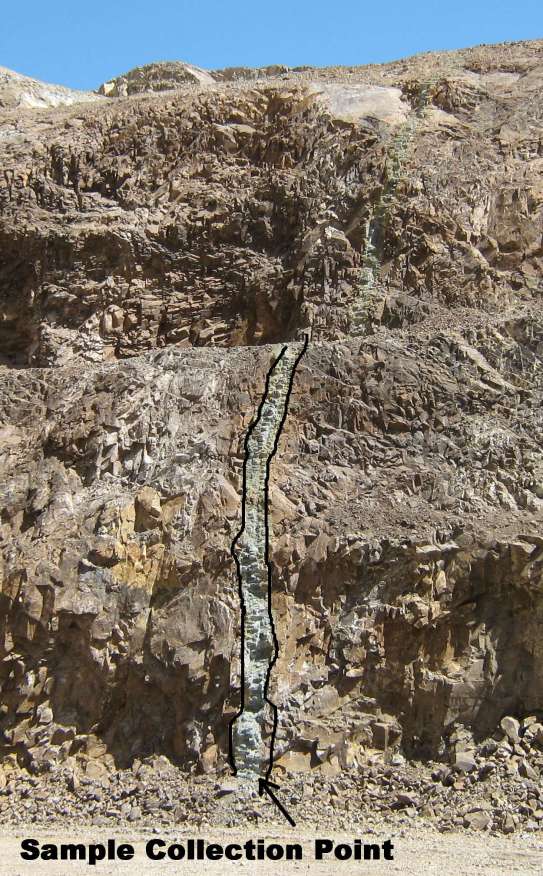
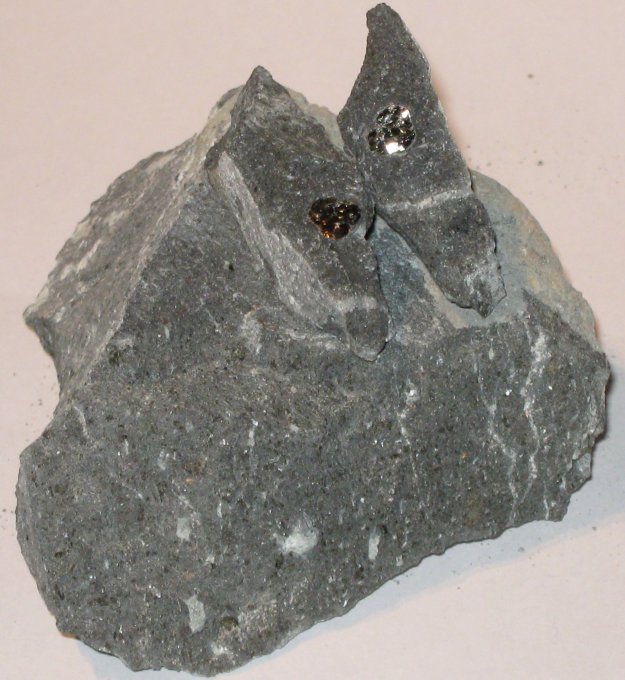
We collected samples of the lamprophyre in the bottom of the pit. The formation appeared whitish green in on the weathered surface owing to oxidation. However, if a fresh surface was exposed, the rock was composed of sugary dark xtals with the occasional biotite phenocryst.

Outlined Lamprophyre at bottom of Cresson open pit mine

Outlined Lamprophyre at bottom of Cresson open pit mine. Copyright 2009 Gaussling.

Cresson Mine Lamprophyre Close-up

Cresson Mine Lamprophyre Close-up. Copyright 2009 Gaussling.

Mafic or ultramafic rocks are low in silicates and enriched in Fe and Mg oxides. The lamprophyre above is mafic in composition with a sugary xtal matrix with biotite and other phenocrysts.

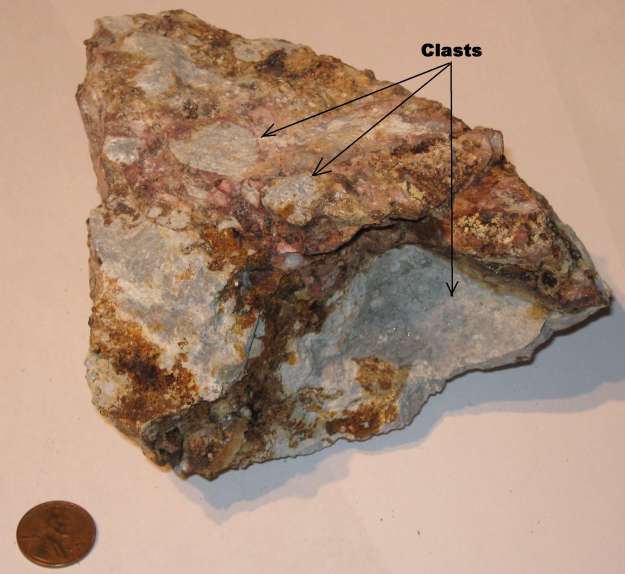
Breccia from Cripple Creek Diatreme

Breccia from Cripple Creek Diatreme. Copyright 2009 Gaussling.

The breccia above is characteristic of the Cripple Creek diatreme. Relatively rounded clasts populate the mass of the aggregate, indicating that the clasts were rounded by some process prior to deposition.

The gold is generally too dispersed to see, however, you can see pyrite with a hand lense in many of the samples. Pyrite often accompanies gold.