
Monthly Archives: May 2009

Cresson Gold Mine, Part 1.

Early saturday morning 50 intrepid geotouristas packed into vans and drove to the CC&V mine in the Cripple Creek district of Colorado. Most of the group were professional geologists- professors, teachers, and geological survey folks. There were only a few interlopers like myself who were interested but untrained in geology. Not surprisingly, a background in chemistry is nearly useless when the discussion turns to stratigraphy and rock morphology.

The Cripple Creek gold district consists of an extinct volcanic structure called a diatreme. A diatreme is characterized by the presence of a volcanic pipe structure filled with brecciated rock. It is thought that the combination of shallow hot rock and ground water lead to violent explosions that resulted in fractured rock. Cripple Creek breccia has rounded clasts, indicating the rock fragments were exposed to rough, erosive treatment leading to attrition and rounding of the clasts prior to consolidation of the breccia.

In the past, gold mining at Cripple Creek was a underground activity. The district contains an extensive network of remnant subsurface works of drifts and shafts. Today, CC&V’s mining activity is limited to high throughput open pit excavation supplying pulverized rock to a cyanide heap leach field. A constant flow of ca 100 ppm aqueous sodium cyanide solution is leached from the top down through as much as 800 vertical ft of gold bearing rubble.
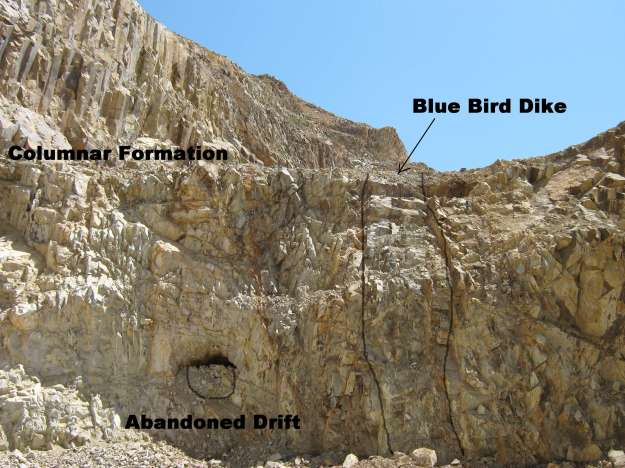
Abandoned Drift and Blue Bird Dike
Abandoned Drift and Blue Bird Dike

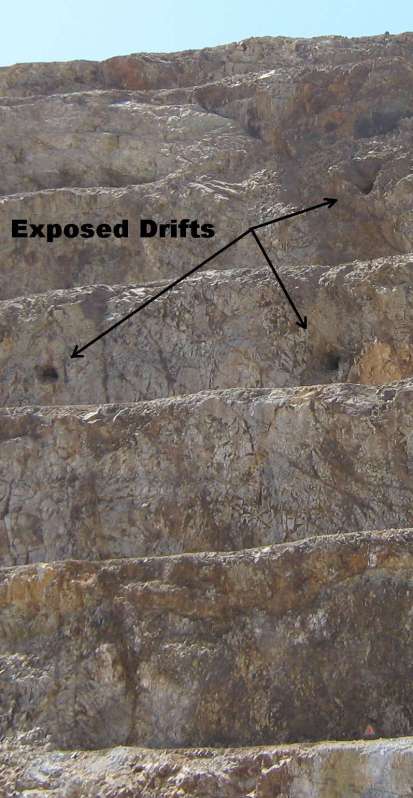
Columnar formations can be seen in certain locations of the mine (See photo: some features are enhanced with lines to show the margins). As the pit expands, drifts and shafts are exposed as seen in the photo above. The Blue Bird dike is an igneous intrusion into the surrounding formation. It is no coincidence that the drift in the photo is near the dike. It is common to see disturbed zones along the intrusion where gold can be found in higher abundance. The goal of the drift miner was to follow the enriched rock for more efficient reclamation of value.
Exposed Drifts During Pit Operations

Exposed Drifts During Pit Operations

A feature seen in the pit is a Lamprophyre, or igneous dike comprised of ultramafic, silica-poor, magnesium-rich rock. Biotite phenocrysts can be seen in samples. This is regarded as an unusual feature.
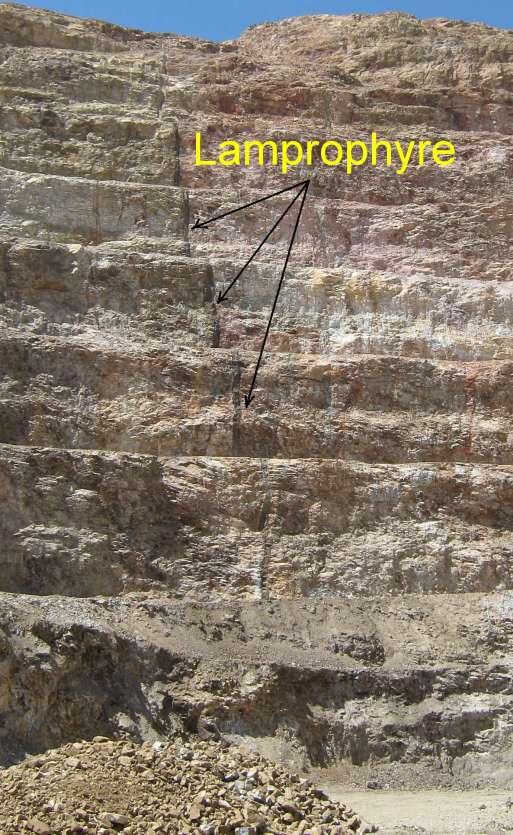
Lamprophyre formation in Cresson Mine

Lamprophyre formation in Cresson Mine

 The big haul trucks carry 300 tons of rock from the mine to the crusher. The crusher is actually a series of crushers that reduce the ore to pieces roughly 3/4 inch in diameter.
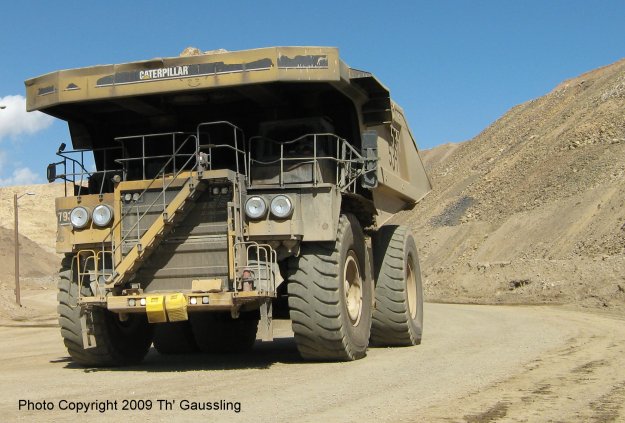
Haul Truck Carrying Rock from Blasting Site to Crusher

Haul truck carrying rock from blasting site to crusher The crushed rock is blended with lime and then driven to the leach pile for extraction. Another load for the leach heap.
 

A Massive Au/AuTe Deposit

Th’ Gaussling attended a geology seminar thursday evening at the Colorado School of Mines. It was given by the chief geologist at the Cripple Creek & Victor gold mine (now AngloGold Ashanti) and was concerned with 3-D modeling of the volcanic formation that forms the center of the deposit.

What is unusual about the CC&V mine is the extent to which tellurium is present. There are a dozen or more tellurium minerals and many of them are present in the ore body. The CC&V load was discovered relatively late- about 1891. Due to the extensive fraction of AuTe and AuAgTe minerals, the presence of the ore body was not detected by placer prospecting. 

Prospectors panning for gold in local streams had no way of knowing that extensive gold was present because AuTe(Ag) minerals do not have a gold-like appearance.  Legend has it that it was discovered by a drunken cowboy who noticed some native gold in an outcropping in the area and took a sample down for assay. As I have mentioned before, the Cripple Creek district has produced about half of all the g0ld to come out of Colorado.

What is key to the formation is the fact that it has zones of extensively altered volcanic rock disturbed both mechanically in the form of fractures and faulting, and chemically in the form of its potassic-alkali nature. The formation has strongly brecciated zones and is desribed as “vuggy”, meaning that there are extensive voids. Native gold and gold telluride mineralization can be found on the surfaces of the vugs. The mineralization was deposited by hydrothermal streams extracting Au and Te from unknown source rock.

Presently the operation is surface mining which feeds to a cyanide leach field for gold extraction. The surface pit mine is working downward, digging through the extensive network of mineshafts. In the early days at Cripple Creek the mining was limited to underground activity. Miners would follow the extensive subsurface network of gold-rich veins in whatever direction they might go. The result is a very complex and extensive matrix of tunnels and shafts that extend downward to as low as 3000 ft. In the early days, the economics of subsurface vein mining were attractive enough to sustain the operation. Today, the economy of scale dominates and pit mining with heap leaching of the lower grade ore is what sustains the operation.

The gold is recovered by a cyanide leach field that is 800 ft thick in places. This method produces ca 300,000 toz/yr. The process does not recover Au from AuTe. It is left untouched in the leach heap and constitutes ca 1/3 of the total gold present.

Curiously, during the many eruption cycles in the distant past (~32 ma), debris from the surface has washed back deep into the formation. Bits of woody debris have been recovered within cementitious rock hundreds of feet below the surface. The CC&V geologist showed a core sample with a wood fragment imbedded within it. For a time reference, the current episode of Rocky Mountains (the Laramide Orogeny) began ~65 ma.

Chemist Gaussling will blend in with a group of geologists tomorrow morning and take an extensive geology tour of the mine site. Hopefully, there will be pictures to share. We’ll be going up to ~10,000 ft, so it will be chilly.

LC Dreamin’

When I get to work this morning I’ll be greeted with a brand spankin’ new Agilent 1200 HPLC sitting on the bench in my lab. It has a diode array detector (no flippin’ MS this time). Pretty sweet.  Gosh, early 1990’s LC capability- already!

It is interesting how the installer assumed I’d be doing reverse phase work. Must be what most of the weenies in pharma are using. Carbon-heteroatom-carbon-heteroatom-carbon-heteroatom-carbon=heteroatom-carbon-heteroatom- … maleate.

Organic Symposium at CU

The 41st National Organic Symposium starts 7 June, 2009, in Boulder at the CU campus. I’m trying to decide if I want to go bad enough to pay the admission price.  The registration is rather pricey- $400-425, depending on your membership status. The symposium features a lineup of some of organic chemistry’s top rock stars and illuminati.

The whole fandango begins with a homily by Bobby Grubbs on what else? Metathesis. Good lord. I don’t think I can bear to see it again. I wonder if he’ll disclose the patented art during his talk? (These guys never point out that the cool and useful stuff is tied up in claims!)

I popped into a few web sites of the various rock stars who will be presenting. I noticed that Dale Boger is selling his lecture notes on-line for US$120 for a CD.  Fancy that.

Apparently, he is still working on Vinca alkaloids. Buried in the Boger website is a graphic showing the various and complex compounds that his groups have prepared. It is pretty amazing, really. But it is as much an indication of what generous funding and hordes of rabid post-docs and grad students can provide as anything else. Boger is listed as an inventor on 25 US patents (with Scripps as assignee) by my count. Scripps owns a bunch of Boger technology. I wonder if any of it is commercialized? I don’t know the guy, so I don’t want to be too obnoxious here.

If an advisor is patenting the work that a student is doing for her/his dissertation, how do they manage the notebooks (i.e., disclosures) and the meetings with the students committee? If the student is helping to develop IP for someone else, are they decently paid for it? Does the student have multiple notebooks for confidential and “public domain” work? What kinds of liability does a student have in terms of proprietary information after they graduate? Lots of sticky issues for a fresh graduate.

NCC 1701

“To boldly go …”.  The worlds most famous split infinitive lives on. Better yet, tatted Romulan skinheads bring doomsday to a theater near you.  To the delight of Trekkies everywhere, the latest incarnation of the Star Trek franchise was just released. Clearly, it was designed  for the Yuppy Trekkie crowd of viewers who were assimilated decades ago into the original Star Trek setting.

Rather than introducing a new crew of characters with a new set of quirks and dynamics, this movie sets the stage for the original cast and crew. The time setting of this episode puts it between Star Trek: Enterprise and the original TV series. The movie is well cast with strong character conformance with the original crew.

The stark difference between this production of Star Trek and the original made-for-TV series is the highly engineered style of film making. The cinematography and editing are best described as frenetic and delerious. Decades of television production are recorded via standard sound stage cinematographic sensibilities where the cameras are firmly planted to dollies castering around on a flat surface. Perfect focus and reference frame squareness and stability were as consistent as the print on a dollar bill.

In this production of Star Trek the camera is an extension of the viewers senses rather than just a means of recording scenes. It’s use is meant to amplify and focus the confusion and danger of the scene. Closely framed scenes of objects in wreckless motion, off-focus shots, and obtuse tilt angles bring the action past your retina and into your brainstem. It is quite effective.

And yes, Kirk suffers from chronic lackanookyitis. He does get a bit of technicolor action, but it is only slightly more racey than the classic shot of him pulling on his boots after a romantic encounter. If you see the movie with your mother, sunday school teacher, or kids it is unlikely that anyone will be too embarrassed.

I attended with a quantum physicist friend and we agreed that some of the physics was deeply flawed. Scotty’s cabbage creature friend was odd and the ending was less than satisfying. Nonetheless, I would rate this movie a strong thumbs up and most preferably viewed in a decent theater with a big screen.

California- Our Problem State

It would be easier and would consume less bandwidth if the days in California without a wildfire were reported, since they seem to be fewer in number.

What will the Feds do if California legalizes and taxes pot? Will they declare it a Narco-state and allow Lou Dobbs to supervise the construction of a morality fence along the borders? What affect will it have on the SWAT apparel and black helicopter industries?

This could give a whole new range of possibilities for our next Disneyland vacation. To hell with Florida!

No Business Like Show Business

Th’ Gaussling has a minor part in a play produced by a local community theatre group. Opening night is May 22, so the pucker factor is presently in überdrive. I’m in 5 scenes, one of which involves some shouting and pushing. Lots of opportunities to goof up. I play a farmer, so I get to do my Fess Parker accent and country mannerisms.

Rehearsals are getting pretty intense. This is the first time this play has been performed, a fact that is both good and bad. We have the blocking in place and most everyone knows their lines. Now it is just a matter of refining the performance.  A mark of an experienced actor is the ability to recover seamlessly from mangled lines. I’m not as far from that ideal as I used to be.

This is Th’ Gaussling’s 2nd production. My acting isn’t terrible, exactly. Folks are polite with me, at least to my face. I can perform certain kinds of parts acceptably. I’m more like a Slim Pickens than a George Clooney.

Putting on a good show is much more difficult that it might seem. I do it for personal growth and the satisfaction of pulling off a good performance. It is wildly outside my normal activity and is a good outlet for nervous energy.

“Don’t Even Taste Like Sewage”

I spent 4 1/2 hours saturday touring our town’s water system from both ends. It was quite a detailed tour and, since it involved chemicals, how could I not tag along?

We began with the sewer reclamation plant first. Lots of interesting details here. Turns out that one of the big problems to running a waste treatment plant has to do with keeping large debris out of the pumps- rags, underwear, shoes, plastic parts, etc.  Once you get past the shock of learning what your fellow citizens can and do flush down the toilet, it is plain to see that a bit of money spent on screening out the the big chunks is returned in the form of reduced down time and pump repair costs.

Our little hamlet of 6,000 souls sends 450,000 gallons of waste water to the reclamation plant on an average day. The flow peaks at about 8 am every day in the form of a sudden 5-6 x increase in flowrate. It takes about 90 minutes for an average volume (i.e., a flush) of wastewater to get to the plant. A lot of groggy citizens hop into the shower at around 6:30 am.

After the incoming stream passes through a grit removing station at the entrance, it is lifted to the first treatment operation for aeration and fermentation. This is the physical high point in the process, meaning that the stream is subsequently transferred by gravity for the remaining process steps.

I won’t go into further process details other than to say that the final step prior to discharge into the stream is a sanitizing step where the effluent is exposed to a large jolt of UV radiation. At this point in our tour, the plant manager dipped a sampler into the flow and withdrew one liter of clear, colorless liquid with a few strings of algae floaters. Only too eager demonstrate his faith that the water was sanitary, he dipped a finger into the effluent, put it into his mouth and exclaimed with a grin as wide as his mullet

“It don’t even taste like sewage!” 

As he passed the sample around so others could share in the experience, I wandered over to the control panel and feigned interest in the LCD display. The UV just renders the wee beasties non-viable. Their little microbial carcasses are still there. Pathogen free it may well be, I didn’t have the stomach to taste it. Yes, I know that microbes are everywhere and that our notions of what constitutes “clean” are merely a fantasy. But I just couldn’t do it.

A hot little number

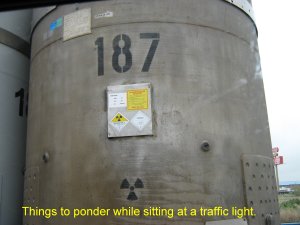
hot-load-on-the-interstate1

I see these shipping casks on the highway at least once a month.  This time I had a Canon with me (Powershot A470, you know, a camera). While sitting at the off-ramp stop light next to this container I began to wonder how much activity shines through the shielding. I began to daydream … if I could see in the gamma spectrum, would this thing be bright or dim?

Then, in the blink of an eye the spell was broken. The light turned green and I parted company with this hot little number.