
We collected samples of the lamprophyre in the bottom of the pit. The formation appeared whitish green in on the weathered surface owing to oxidation. However, if a fresh surface was exposed, the rock was composed of sugary dark xtals with the occasional biotite phenocryst.
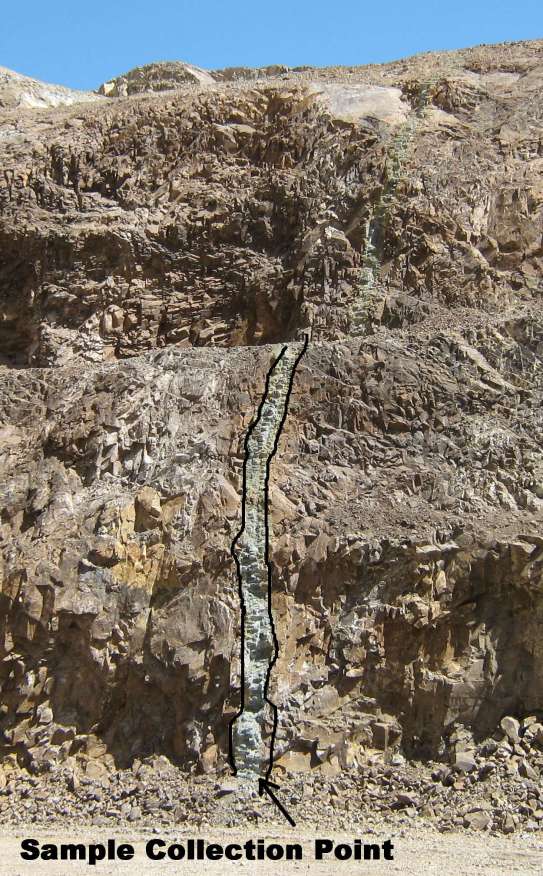
Outlined Lamprophyre at bottom of Cresson open pit mine. Copyright 2009 Gaussling.
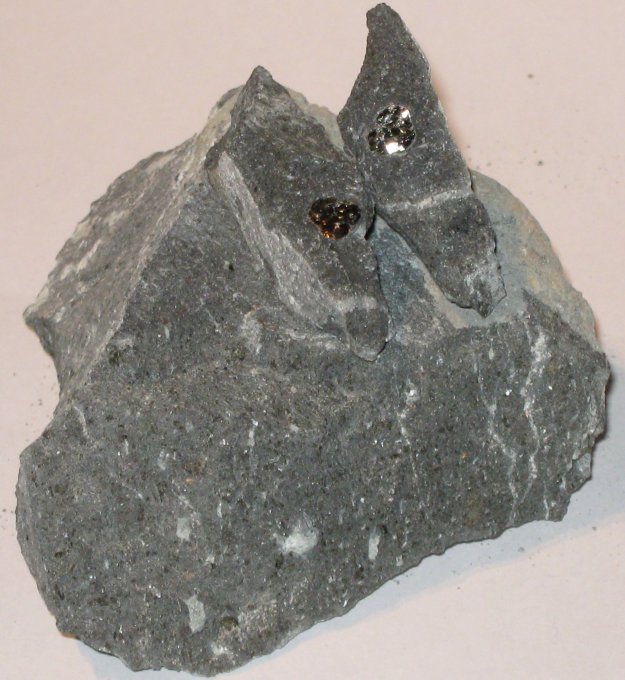
Cresson Mine Lamprophyre Close-up. Copyright 2009 Gaussling.
Mafic or ultramafic rocks are low in silicates and enriched in Fe and Mg oxides. The lamprophyre above is mafic in composition with a sugary xtal matrix with biotite and other phenocrysts.
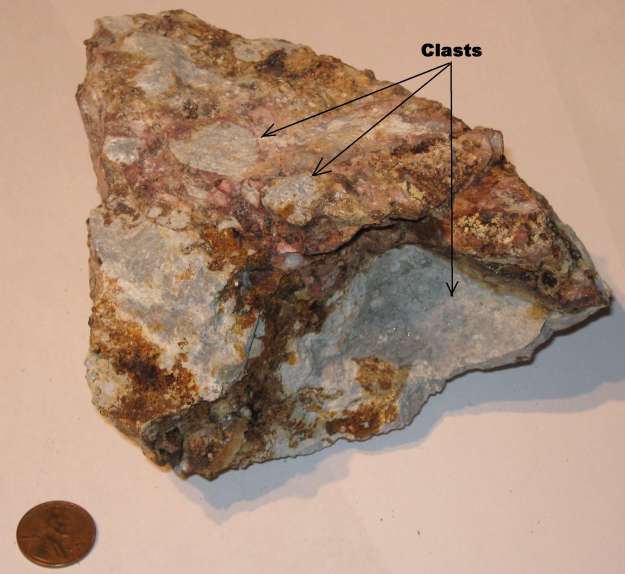
Breccia from Cripple Creek Diatreme. Copyright 2009 Gaussling.
The breccia above is characteristic of the Cripple Creek diatreme. Relatively rounded clasts populate the mass of the aggregate, indicating that the clasts were rounded by some process prior to deposition.
The gold is generally too dispersed to see, however, you can see pyrite with a hand lense in many of the samples. Pyrite often accompanies gold.
 Lamentations on Chemistry
Those are very nice rock samples!
I study geology and I’m currently preparing a presentation about pyroclastic rocks and their respective sedimentation processes. I would like to ask for your permission to use your image of the cripple creek diatreme breccia. Naturally I would give you credit for the image.
(And yes, I basically created my account only to ask you this XD)
Please feel free to use the images. Best of luck to you!
The lamprophyre sample was fractured with a hammer and a crystal was exposed and sent next to where it was fractured from- thus the “‘two” crystal inclusions.
Th’ Gaussling
Thanks a lot! 🙂