
According to news sources, BP is allegedly using a dispersant called Corexit EC9527A. According to the EPA this formulation contains water, propylene glycol, and 2-butoxyethanol, as well as an unspecified confidential additive.
I guess the question is, what purpose does this treatment serve? By dispersing the petroleum, I assume that the effect is to spread a given mass of petroleum into a larger volume of sea water by virtue of producing dispersed globules of oil-phase material. Does the increased surface area result in off-gassing of volatiles and subsequent submergence of the now denser oil phase? Or, will the dispersed petroleum simply drift into larger patches of oily water? If it enables an increased dispersion so that the currents can chaotically distribute the petroleum to a greater range of shorelines, is this treatment of any real benefit? Perhaps it is better in the long run to have a heavier coating on fewer beaches? Less acreage to scrape.
EPA is making noise about BP’s choice of Corexit. Seems to me that butyl cellosolve has been in the market for quite some time. There should be some information on its fate in the watershed. Judging from the map, the oil spill is near the dead zone around the mouth of the Mississippi River. So, until somebody gets some survey data, it’ll be hard to estimate the magnitude of the environmental insult of this event to the open ocean.
I do not understand what government officials were trying to do by saying that they might take over control of this spill. What is the government going to do to a petroleum discharge a mile below the surface? Call the Navy? Or Boots & Coots? As good as these guys may be, they’re land lubbers.
Let the folks at BP finish the job.
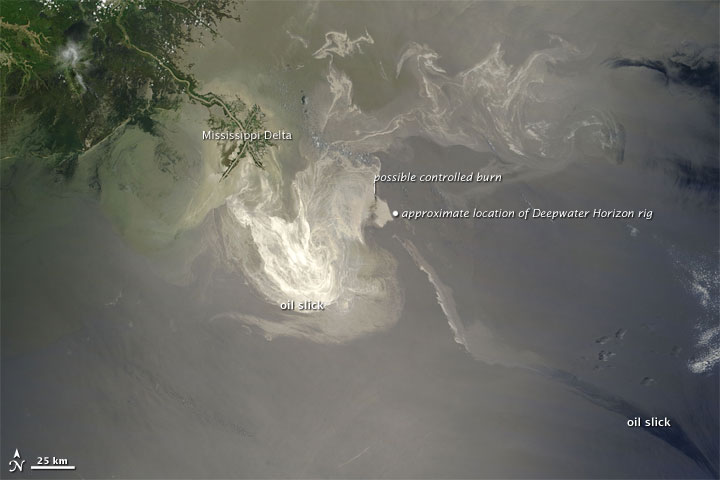
NASA Earth Observatory Photo, May 24, 2010.
 Lamentations on Chemistry
http://blogs.nature.com/news/thegreatbeyond/2010/05/deepwater_horizon_plug_the_dam.html
The South votes Republican. Chicago pol in the White House ain’t gonna do nothin’ but keep talkin’ jive, makin’ promises, ridin’ in a fine long limousine. The Exxon Valdez was 10.8 million gallons, degassed. Even conservative estimates are a Gulf of Mexico Valdez/week plus methane.
Casebooks say dispersion reduces negative publicity from surface presence. 0.1-5 mm globules in the water column will be ingested by the entire food web. Whatever is not killed will be rendered inedible. Petroleum degradation is aerobic. Thousands of cubic miles of ocean will be rendered anoxic. Benzene is frankly leukemogenic, n-hexane kills livers. Nobody is talking about the gassy well’s planet-scale methane emissions. Wasn’t methane a potent greenhouse gas before this happened?
Consider the Indonesian Sidoarjo mud flow, hydrofracturing, and erosion of industrial piping by high velocity dirty streams. It is well nigh time for unanticipated “bad luck” to visit the Gulf of Mexico. Call it surface subsidence then multiple formation ruptures uncontrollably spewing oil over an acreage of vents. I bet you they drilled it like crap, too, under direct BP managerial supervision telling the engineers to go faster.
An oil surface layer will drastically slow evaporation kinetics and reduce wave chop. Hurricanes will have little to feed their heat engines. Reduced albedo and evaporative cooling do suggest a pressure cooker seeking catastrophic failure if the lid cracks.
Is BP delivering real time video feed of the gusher, er, leak – or is it splicing and looping or having technical difficulties? That simple diagnostic screams the real truth.
Pingback: BP oil spill. What are the merits of using dispersants? « Lamentations on Chemistry