
My morning commute through the countryside takes me past more than a few fields of sunflowers. By late July the flowers are out and without exception, all nodding toward the east where a star appears every day. Many of the local farmers have taken to raising sunflowers rather than the usual corn and sugar beets. I haven’t a clue as to what kind of machinery is used to harvest these things.
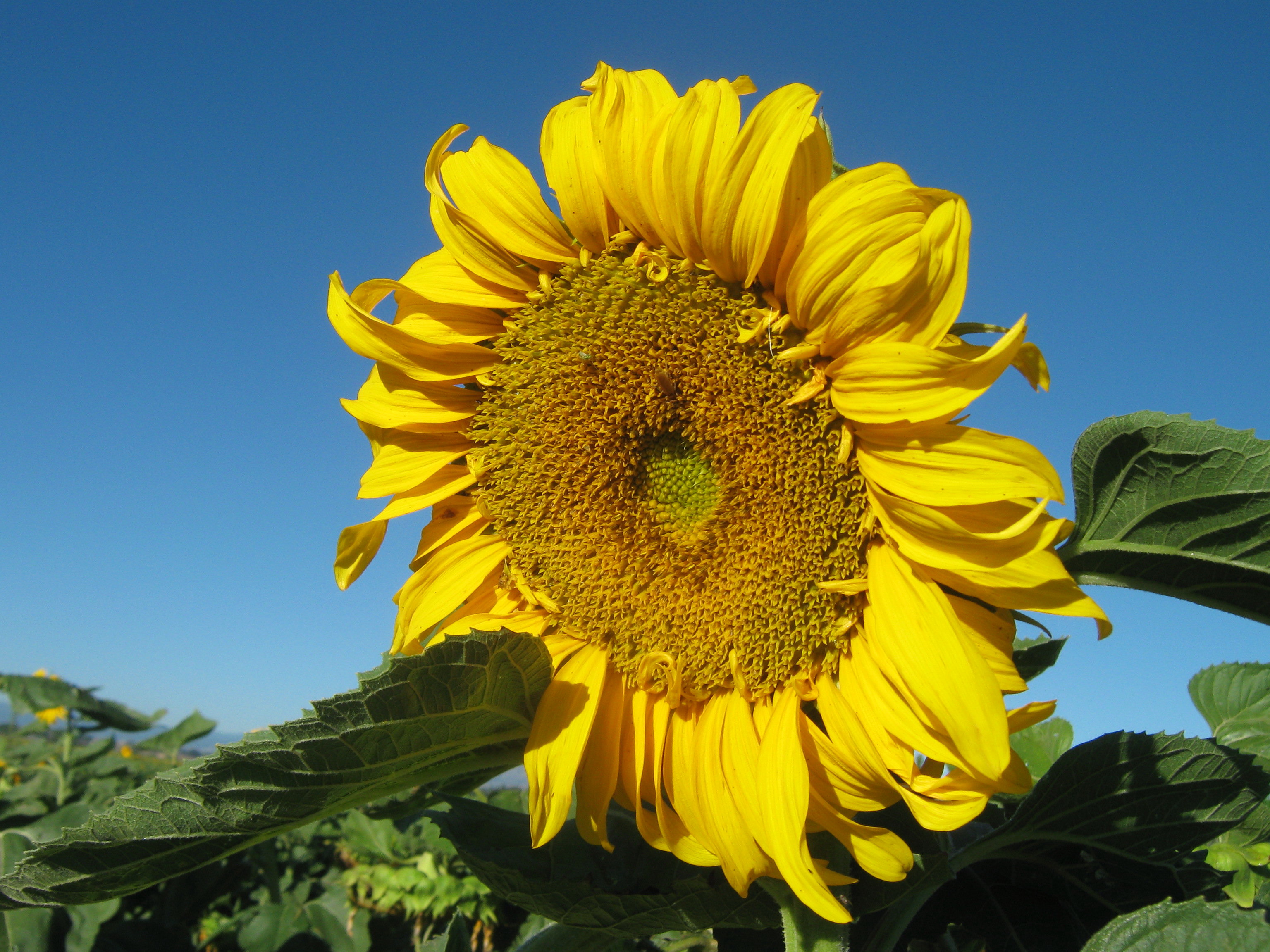
One of the local heliotropes
It is uncanny that the entire crop will lock the flowering body orientation in the direction of the sun. Somehow the direction of the sun at other times of day does not randomize the orientations. If you stand and look at a field of sunflowers, you’ll see outliers in height, but not direction of flower orientation. Or so my experience has been. There has to be some frequency of orientation outliers.
I wonder if there isn’t some growth step in the stem than occurs over a short time span X days into its growth, removing what stem mobility that might exist and locking the flower in place?
Such things make me wonder if our concepts of consciousness, with human consciousness as the benchmark, aren’t a bit too self serving.
 Lamentations on Chemistry
I know I’ve read about the mechanism, but can’t recall where. The side getting the sunlight shrinks thereby promoting the turn.
I take the Penn and Teller approach to magic – knowing the secret makes it no less fascinating to watch.
I totally agree with you and Penn and Teller.
Sunflowers are rare among commercial crops for being allelopathic (walnuts are champs here). Their leaves and roots (the rhizosphere!) excrete sesquiterpene lactones annuionones and leptocarpin; sesquiterpene heliannuols A, C, D, F, G, H, I, and L, a diversifolide stereoisomer (4,15-dinor-3-hydroxy-1(5)-xanthene-12,8-olide), and helibisabonols that, technically speaking, knock the crap out of competitive weeds.
http://pubs.acs.org/doi/abs/10.1021/ol7028178
One quivers in anticipation of outraged Enviro-whiners determined to save the Earth from sunflower toxification screaming with Christian Fundie preachers outraged at Muslim sunflowers.
You’ll be interested to know that in order to get the photo, I had to wade through a patch of thistles. Thisles are the ultimate weed, well, except for kudzu.
Thistle, crab grass, blackberry, ragweed, poison ivy… each has its invasive and defensive sparkles. Giant Hogweed sustains its revenge. The thing wil leasily top eight feet tall and its white composite flower heads can be two feet or more in diameter. Every bit of the plant is dripping with psoralins. Brush against it then hit sunlight. Contaminated skin blisters as you watch, then ulcerates. The holes finally heal to pigmented scars.
British Columbia’s sparsified forests and clearings are particularly hospitable hosts. Enviro-law prohibits going after Giant Hogweed in a useful manner in “protected” environments. BC thus invests considerable time, money, and blistered scarred volunteers to achieve nothing. It is a wonderfully sustaining program – a Federal weed. Recursion: see “Recursion.”
I saw the lovely sunflowers before I got to the ridiculous roundabout. 🙂
They’re the ones! And I love that roundabout. We need more of them. To hell with stop signs.
I once planted a row of giant Russian sunflowers between two out buildings on my property and thought the effect from the roadway would be fantastic. It would make a spectacular show…or so I thought. Of course you have to know which buildings I’m talking about as they themselves are quite picturesque. Having never grown sunflowers before, the tall Russian type or any others for that matter, and not knowing about this orientation phenomenon, I just assumed the flowers would face west toward the road with their bright, sunny and happy faces in cooperation with my brilliant aesthetic plan. I was saddened by the mutinous show that year and have not planted another thing in that spot since.
Thanks for sharing. That is a good story. I tell ya, if ya can’t get plants to cooperate, what hope is there?