
On a recent vacation trip to the Puget Sound area I managed to take a public tour of the Boeing manufacturing facility in Everett, WA. They don’t give away the tour- it costs $25 for adults and lasts about 90 minutes. For cash you get a movie highlighting the history of Boeing and a trip to a few mezzanines overlooking the 787 Dreamliner and 747 manufacturing areas. And just like Disney, you exit the attraction tour through the gift shop.
The first thing you notice is that security is very stringent. No phones, bags or purses, etc., once the tour begins. They are an important military contractor after all. As technically savvy as they may be though, the communication level of the tour guide was roughly 6-7th grade. The reason might be the wide range of visitor ages and nationalities. One Asian visitor on our bus wore a blue track suit bearing the name “Mongolia”.
It is easy to forget just how brilliant the US is and has long been in the broader aerospace world. Of course, other countries have developed advanced aerospace platforms, and produced their share of talent too, notably France, England, Germany and Russia. But one must admit that considerable advancement has happened here for some reason. A broad industrial base with access to raw materials and capital is certainly a big part of it. Perhaps our remote location between two great oceans and historical absence of the distraction of carpet bombing by foreign adversaries has a little to do with it as well.
Balloon on a hazy day.
For many of us, aerospace brings out excitement and optimism by its very nature. It embodies much of the best in people. The pillars of aerospace are many and rely strongly on ingenuity and engineering disciplines. By discipline I mean rigorous design-then-test cycles. A human-rated flying machine is a difficult and expensive build if the goal is for people and equipment to return intact. Unlike SpaceX who has launched much cargo, and among other things, a cheese wheel and a car, NASA has been launching people for a long time. Not to diminish the fine work of SpaceX or the other commercial efforts, it’s just that NASA takes a lot of heat for their deliberate pace.
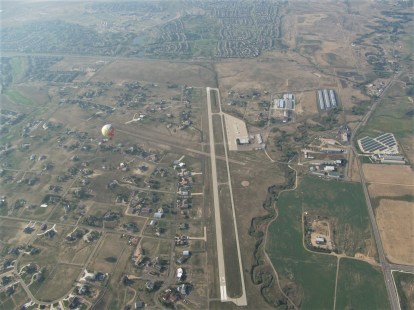
Erie Airport, Colorado, from a hot air balloon at ca 2000′.
The last week has been a period of many modes of transportation. It’s been planes, trains, automobiles, ferry boats, and a hot air balloon. The nightmare of Seattle traffic is best forgotten. If you can avoid driving in Seattle during rush hours, do so.
If you can swing a hot air balloon ride, do it. Dig up some of that cash you have buried in the back yard and spend it. I found the ride to be absent any nerve wracking moments and to be quite a serene experience. There is no wind aloft and it is dead silent when the burners aren’t going. Do bring a hat, however. The burners are bloody hot.
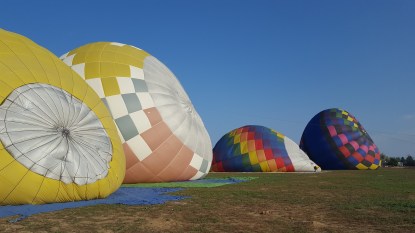
Getting ready for a 4-balloon launch.
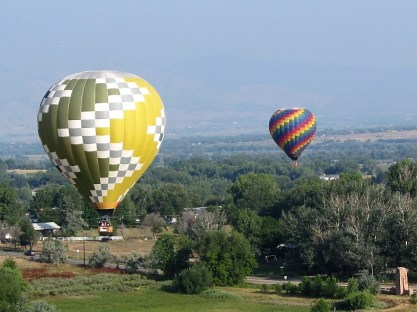
Like all pilots, balloonists enjoy low level flight.
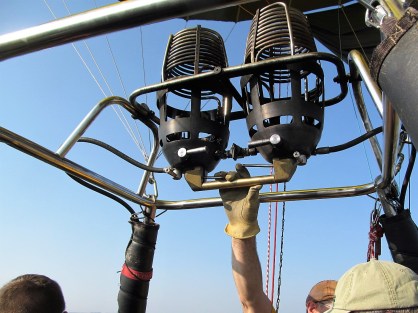
The burners emit tremendous radiant heat. A wise passenger wears a hat for this reason.
 Lamentations on Chemistry
Greetings, wise Gaussling! It is good to see you in such good spirits. I hail from New Mexico originally. I grew up in Las Cruces, but in the north, in Albuquerque, the annual hot air balloon races every October were spectacular. The season will be upon us soon. I have never been, alas, although here in the northern most parts of Phoenix, I see hot air balloon races now and then.
I enjoyed reading your post, especially this part, as it has been on my mind lately,
I was just chatting last night with a friend from Wichita who is an EMT (Emergency Medical Tech, i.e. paramedic) but understands these things. We agreed that an unusual confluence of circumstances are necessary in order to achieve the sort of things that Boeing accomplished for aerospace, as well as other large industrial/scientific projects such as NASA’s moon landings, safe and productive shipyards for commercial and military purposes in Norfok, VA and Galveston, TX, structural engineering feats such as Hoover Dam, offshore oil platform design and so forth. Being blessed with natural resources is not enough. Well-maintained infrastructure, a motivated, capable workforce, and social and political stability are necessary too.
I enjoyed your comments about SpaceX! Very prescient of you, especially in light of the hullabaloo this past week about Elon Musk (who received gobs of government funding for his Tesla Motors vehicles rather than powering through on venture capital alone as some wish to believe)!
Hi Ellie,
I quite like your comment in regard to the importance of infrastructure. I view it as a mark of civilization. What disturbs me especially are the corrosive effects of the present political regime on the pillars of our civilization. Not just bricks and mortar, but also the administrative elements like environmental protection, social welfare, and health. The big job of government is to protect ourselves from each other. The neoliberal politicos of today seem hell bent not just exposing citizens to the raw forces of society for the sake of efficient use of capital, but also to actively align citizens into more orderly groups to facilitate corporate exploitation (i.e., student loans). All of this through the agency of government. It is a perversion of democracy.