
As interest in lithium batteries continues to ramp upwards, interest in other metals like cobalt used in lithium batteries advances with it. Cobalt has been identified as a particularly problematic metal as the largest single source is in the troubled mineral rich Democratic Republic of Congo. Rightly or not, some are comparing cobalt from Congo to blood diamonds.
The Idaho Cobalt Belt (ICB) lies on the eastern edge of Idaho along the Montana border running to the northwest for about 60 km. Cobalt was identified in the area in 1900. An abstract in the USGS Publications Warehouse gives a brief technical description of the Idaho Cobalt Belt. The full paper can be downloaded from a publisher’s paywall site. (Why a government agency makes us pay for it’s information work product is beyond my comprehension.)
Another source describes the belt as “originally exhalative, stratiform mineralization within the Proterozoic Yellow-Jacket formation”. The Yellow-Jacket formation is connected with the Yellowjacket mine.
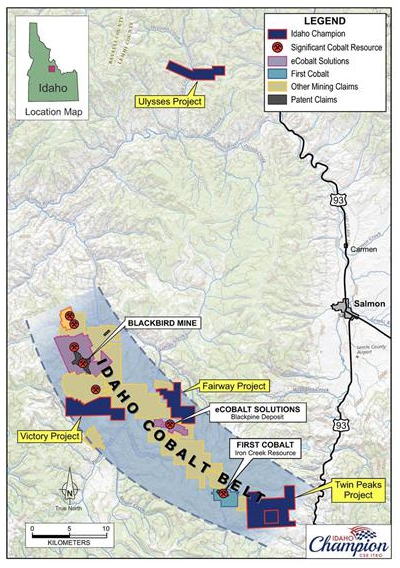
According to EastIdahoNews.com, the Australian firm Jervois Global has suspended the opening of cobalt mining operation in the ICB for an unspecified time. Jervois CEO Bryce Crocker said the move is “due to continuing low cobalt prices and U.S. inflationary impacts on construction costs.” Over the last 12 months the price of cobalt has dropped from $81,923/T to $34,930/T as of 3/30/23.
The number of cobalt-bearing minerals is too numerous to list here, but a thorough list can be found at minedat.org. Cobalt is rarely found alone, but instead is combined with other metals as a variety of minerals. Important ores of cobalt are Cobaltite, CoAsS, Glaucodot, (Co0.50Fe0.50)AsS, Skuttarudite, CoAs3, and Erythrite, Co3(AsO4)2 . 8H2O. Arsenic is found in 93 cobalt minerals. Other notably abundant elements found with cobalt are sulfur (72 Co minerals), nickel, iron and copper. Other elements associated with cobalt are listed in the minedat.org reference.
The Idaho Cobalt Belt is described as a “strata-bound copper-cobalt district hosted by the Yellowjacket Proterozoic Formation” (1).
According to the Cobalt Institute, there are 5 types of economic geological concentrations of cobalt: Sediment hosted, Hydrothermal and Volcanogenic, Magmatic Sulfides, Laterites and Manganese Nodules, and Cobalt-Rich Crusts.
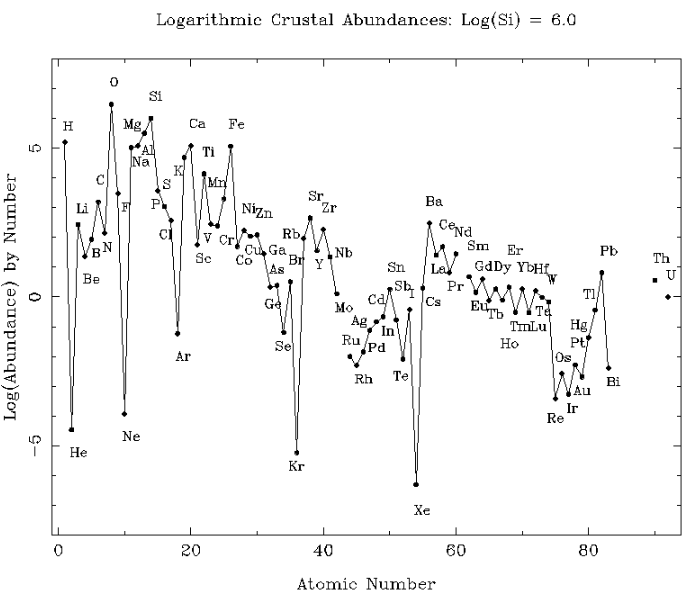
The crustal abundance of cobalt can be seen in the graph below. From the graph it appears that cobalt, nickel, copper, chromium, zinc, vanadium and manganese have similar crustal abundances.
Cobalt is rarely the sole economic mineral at a mine, at least outside of the Congo. Pyrometallurgy, hydrometallurgy, extraction and electrolytic processing may be used in combination to produce streams of copper, nickel and cobalt. The beneficiation and recovery process of purified cobalt metal or cobalt salt will depend a great deal on the concentration and chemical nature of the elements present.
According to Mindat.com, the three cobalt-bearing minerals found at the Blackbird Mining District are: Siderite, Ludlamite and Vivianite. All three varieties of host rock are iron (II) minerals.
Cobalt has 2 common oxidation states, 2+ and 3+. According to a USGS reference, the atomic radii of Co2+ and Co3+ are similar to Mg2+, Mn4+, Fe2+ and Fe3+, and Ni2+, meaning that cobalt can substitute for any of these elements in many minerals. The practical consequence of the ability of cations to substitute is a large number of mineral variations. While chemically interesting, this poses complications for ore processing.
Like all metals mining, cobalt must be separated from the ore. Cobalt is not found as the native metal but rather as an ionic complex along with copper and nickel cations. The negative counter-ions are typically silicates and sulfides. Cationic metals ultimately must be reduced to the native metal, but first the desired metal cation must be selectively removed from a dog’s lunch of ionic and covalent species. The desired metal may be removed early in the separation process or after a long series of processing steps to remove other components.
All of the elements and their respective ionic forms have different physical and chemical properties. These differences are exploited in order to separate the elements.
(1) Nold, J.L., Mineralium Deposita, July 1990, Vol 25, Issue 3, p. 163-168. DOI 10.1007/BF00190377
 Lamentations on Chemistry
As a sample of what goes on up there near the Idaho/Canadian border, check this out:
This is stunning. Over the years, the company kept dumping waste into the river by “accident”. At some point this long trail of accidents became part of their business model. The article didn’t indicate what consequences the company faced over this massive pollution.