
Recently I had the occasion to take a ride in a vintage Fort Tri-Motor aircraft operated by the Experimental Aircraft Association, EAA. Among many other things they take it upon themselves to maintain and circulate certain aircraft around the country for display and to offer rides. The whole enterprise is about promoting civilian aviation and encouraging youth to pursue a career in aviation. The best way to generate enthusiasm is to give rides. This visit was sponsored by the local chapter of the EAA.
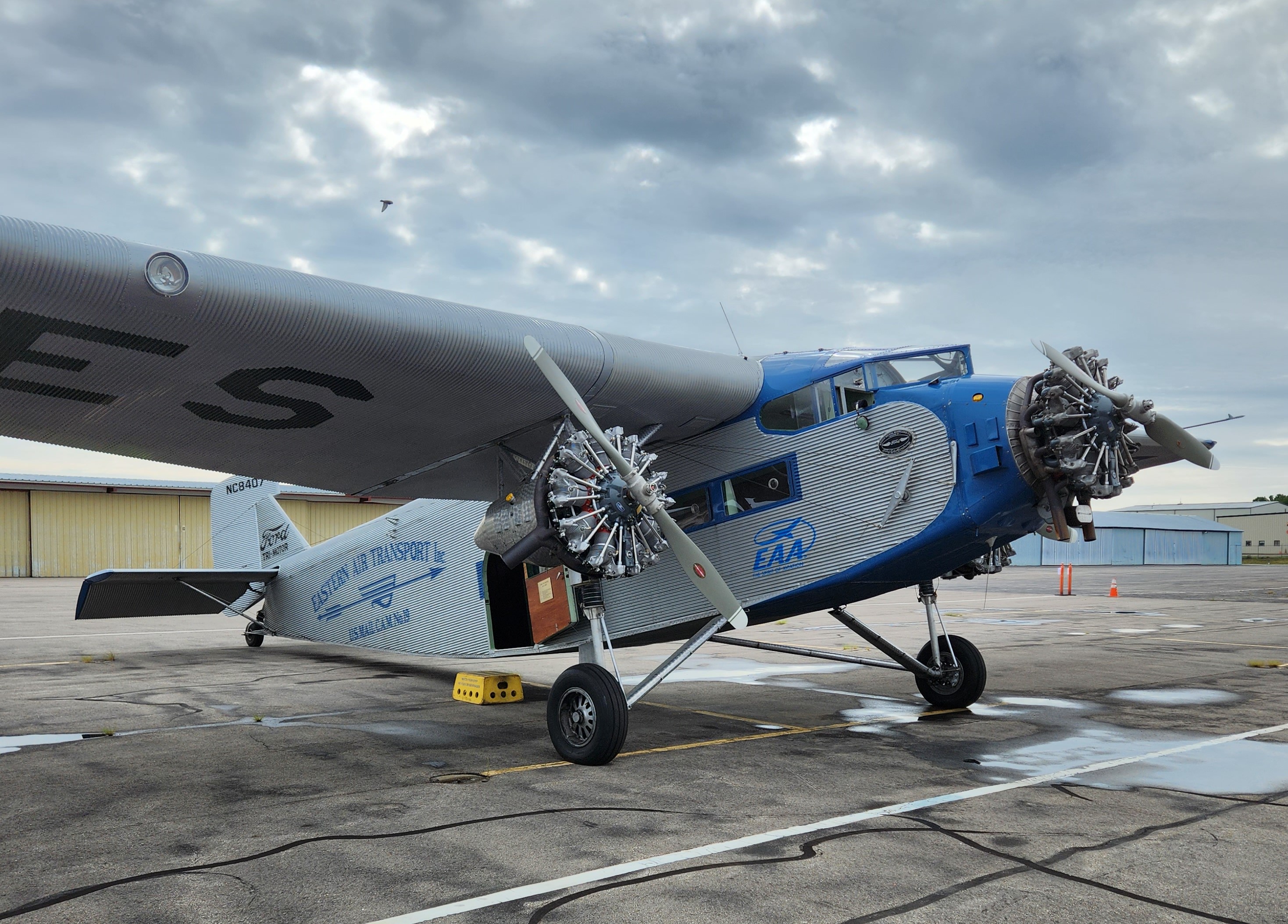
This transport aircraft is a 3-engine, high wing tail dragger. The skin is made of a corrugated aluminum alloy covering an all-metal frame. The Tri-Motor has all metal control surfaces which was unusual for the time. The corrugation serves as a stiffener but does increase the drag a bit. From 1925 to mid-1933, the Ford Company produced 199 copies. Ford stopped production in favor of more profitable opportunities. The EAA Tri-Motor is a 1929 Ford 4-AT-E with serial number 69. According to Wikipedia, there are currently 8 Tri-Motors with Airworthiness Certificates. and another 5 under restoration.
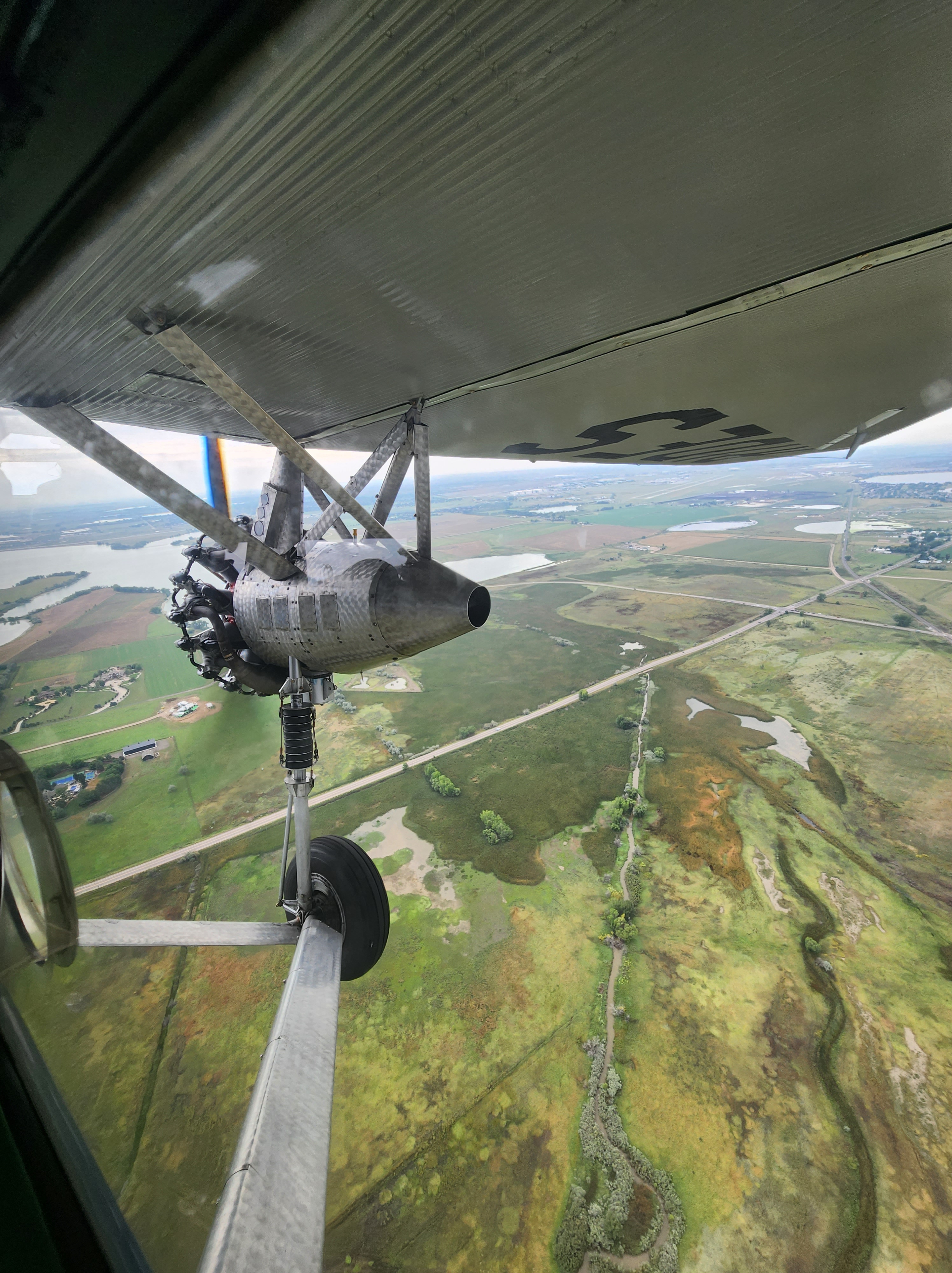
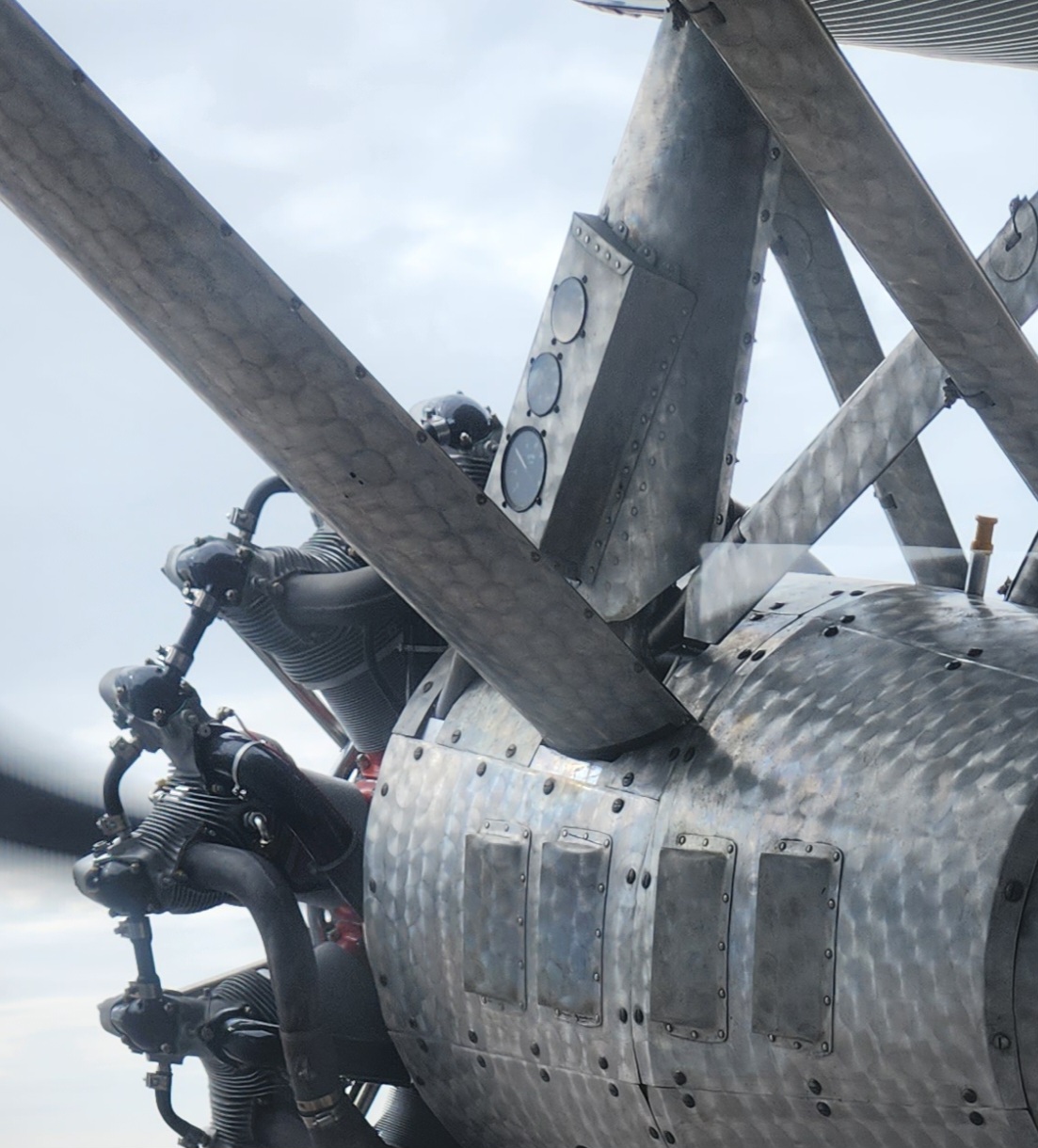
The two outboard radial engines each had engine instruments located just above the cowling for “easy” viewing. Evidently this was a concession to practicality and avoided the problem of routing cables and tubes to the cockpit. In those days, avionics were just a twinkle in the designer’s eyes and were largely mechanical in nature with cables and tubes with fluid.
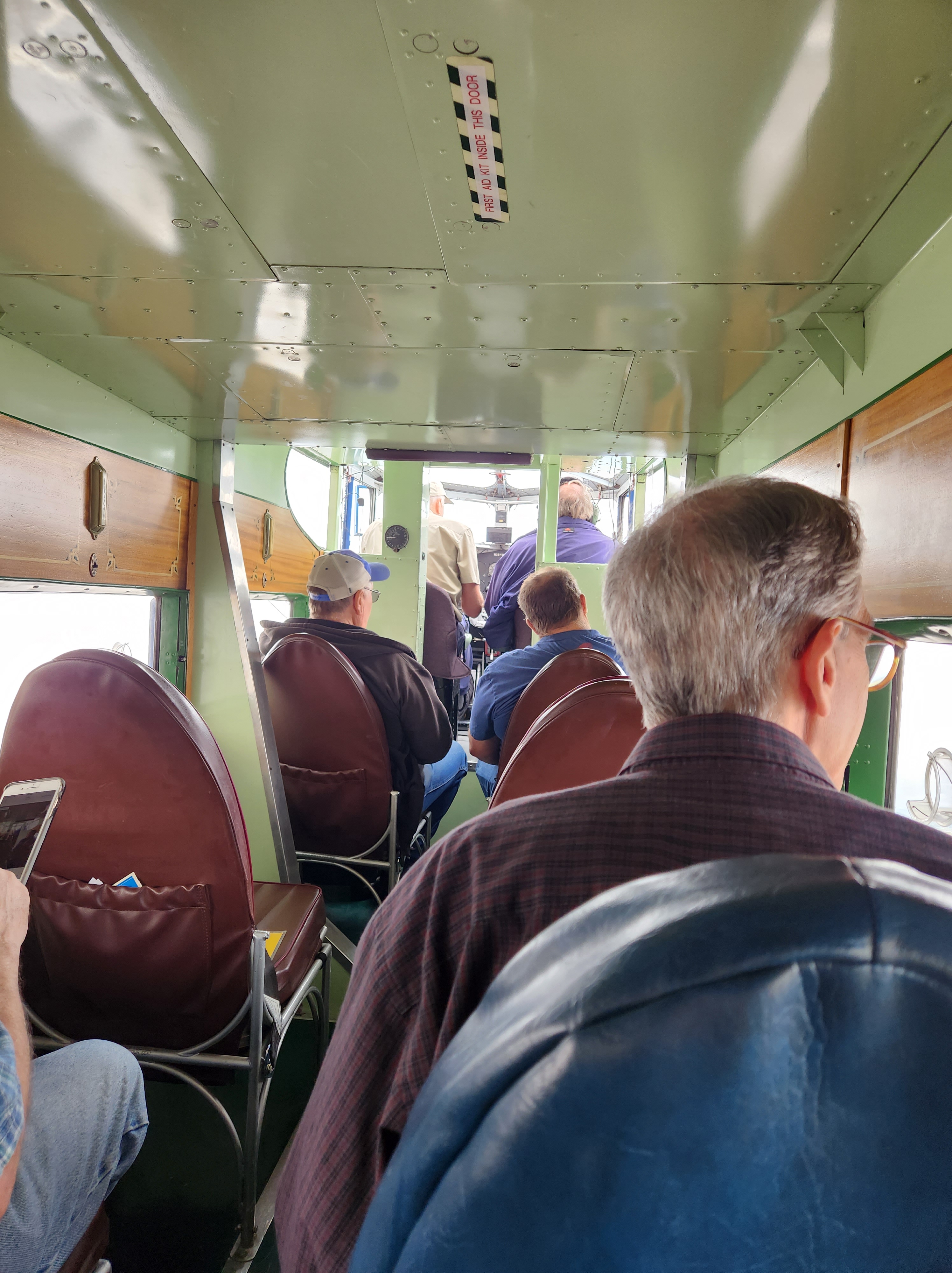
The Tri-Motor gives the visual first impression of being sort of a brick sh** house with fins- sturdy, stable and slow. But, looks hardly matter and we had a great ride from start to finish. It was a calm morning with no convection activity and stable air. Winds were calm and the temperature was ~70 oF. A searing, hot summer day at 5000 ft ground elevation is not the best thing for slow, lumbering aircraft. The density altitude can climb to the equivalent of 9000 feet affording a low rate of climb. There were a few dark scud clouds loitering below the 2000 ft ceiling.
We circled the nearby city and came back on a long final approach. The view from the airplane is quite nice, much like flying in a fish tank. The pilot greased a two-point landing. It’s not a high-performance bird by today’s standards with it’s 93 knot cruise but it could carry 11 paying passengers beginning in the mid 1920’s.
The Tri-Motor was designed to be a reliable transport for passengers and cargo but falls short in the “need for speed” department. One barrier to higher performance in the 20’s and 30’s was a reliance on low compression ratio engines. I say “reliance” because the fuels available then were prone to knocking or pre-detonation if the compression ratio got too high. Knocking or detonation before a piston finishes its compression travel up the cylinder (pre-detonation) could harm an engine and certainly robbed it of power. Aircraft engines are run at constant high rpm compared to automobiles because they have no transmission. As a car accelerates to cruising speed, the gearing is adjusted to maintain optimum rpms on the power band. This allows lower rpm as cruise speed is approached. Aircraft are notable for their lack of a gearshift handle.
The 1920’s were a period of transition in which higher octane fuels were being developed so high engine compression ratios and higher power could be achieved. Tetraethyllead was commercialized in 1924, but was found to be quite toxic to workers in its manufacture.
Early on the development timeline of gasoline engine, it was found that gasoline engines had limitations in power output. One path to higher power output was to increase the compression ratio in the cylinders. Greater piston travel meant more power produced per cycle. Unfortunately, this eventually led to undesired knocking. Incidentally, ignition by compression is how a diesel engine works.
>>> Here is how I wedge chemistry into a post about an airplane. <<<
An interesting article on the history of antiknock additives can be found here and a much better one here. The production of bulk 100 octane aviation fuel was a key factor in the British establishing air superiority over the Luftwaffe in WWII. Across the Atlantic it was none other than Jimmy Doolittle who convinced the US military to convert to higher octane avgas (Incidentally, Doolittle had a Masters and PhD in aeronautics from MIT). In the mid-1920’s Doolittle was pushing seaplanes for the Navy to their limit in speed. He achieved numerous speed records and won many prizes for this. Doolittle would later win acclaim for leading a successful April 18, 1942 bombing raid of Tokyo from an aircraft carrier. Doolittle had a remarkable career and his contributions to many aspects of American aerospace were invaluable.
There were two aspects to manufacturing higher octane fuel at a profit- blending and the manufacture of tetraethyllead. Blending was just a normal refinery operation. Production of tetraethyllead was chemical synthesis to produce an organometallic substance that had to be optimized and scaled up.
Tetraethyllead is synthesized by reacting a sodium-lead alloy with chloroethane- a mixture pretty close to Earth, Air, Fire and Water. The reaction produces tetraethyllead, sodium chloride and unreacted metallic lead. Isolation of product from the reaction mixture is achieved by steam distillation. That tetraethyllead (i.e., something with metal-carbon bonds) is stable in the presence of steam is, in my mind, remarkable. Tetraethyllead is a neutral, hydrophobic substance that is soluble in the hydrocarbon fuel.
Numerous organometallic antiknock additives were found such as the piano-stool complex Methylcyclopentadienyl manganese tricarbonyl (MMT), Ferrocene (the first metallocene), Tetraethyllead, and Iron Pentacarbonyl (Yikes!).
Side note: A serious MMT manufacturing explosion happened in Jacksonville, Florida in Dec. 2007. The blast killed 4 people and injured 14. It was estimated to have been equivalent to 640 kg TNT. Loss of cooling led to a runaway of the batch reaction.
>>> Back to regular programming <<<
Performance specifications straight from Wikipedia.
Original Specifications
- Crew: 3 (pilot, co-pilot, flight attendant)
- Capacity: 11 passengers
- Length: 49 ft 10 in (15.19 m)
- Wingspan: 74 ft 0 in (22.56 m)
- Height: 11 ft 9 in (3.58 m)
- Cabin length: 16 ft 3 in (5 m)
- Cabin width (average): 4 ft 6 in (1 m)
- Cabin height (average): 6 ft 0 in (2 m)
- Cabin volume: 461 cu ft (13 m3)
- Empty weight: 6,500 lb (2,948 kg)
- Gross weight: 10,130 lb (4,595 kg)
- Fuel capacity: 231 US gal (192 imp gal; 874 L)
- Oil capacity: 24 US gal (20 imp gal; 91 L)
- Powerplant: 3 × Wright J-6-9 Whirlwind 9-cylinder air-cooled radial piston engines, 300 hp (220 kW) each for take-off
- Propellers: 2-bladed fixed-pitch propellers
Performance
- Maximum speed: 132 mph (212 km/h, 115 kn)
- Cruise speed: 107 mph (172 km/h, 93 kn) at 1,700 rpm
- Stall speed: 57 mph (92 km/h, 50 kn)
- Range: 570 mi (920 km, 500 nmi)
- Service ceiling: 16,500 ft (5,000 m)
- Absolute ceiling: 18,600 ft (5,669 m)
- Absolute ceiling on 1 engine: 7,100 ft (2,164 m)
- Rate of climb: 920 ft/min (4.7 m/s)
- Time to altitude: 7,200 ft (2,195 m) in 10 minutes
 Lamentations on Chemistry
Fascinating.
Thanks for sharing this story. I have passed it along to friends and family who have aviation interests.
Phil Sent from my iPhone
>
The editing was poor in that post. I’ve updated with chemistry information.