Monthly Archives: May 2024

Vatican Cracking Down on Alleged Apparitions

When a tiny slit between the grubby natural world and the rarefied ether of the supernatural tears and the two realms have a chance to see one another, people will naturally want to tell others. As luck would have it, when Catholics experience an apparition, it always seems to be from the Catholic playbook. You know, the Blessed Virgin, Jesus on toast or Saint so-and-so. It’s never Martin Luther or Desmond Tutu.

I write about this only as an amused outsider. I don’t care what they think they saw. Let ’em have it. It’s a great story to share. What is engaging for me is that the Church is uneasy with the doctrinal implications of what many of the apparitions or miracles have brought to the mix. The quote below by Cardinal Víctor Manuel Fernández is insightful.

Effective May 19, 2024, the Vatican has issued a document titled “Norms for Proceeding in the Discernment of Alleged Supernatural Phenomena.” Whereas previously, a local bishop had much discretion in what he decides before he announces a determination on an event of alleged supernatural origin. The new guideline states that the Vatican’s Dicastery for the Doctrine of the Faith (DDF) “must always be consulted and give final approval to what the bishop decides …”. The new norms say that “only the pope can judge that an alleged apparition or other phenomenon is of “supernatural origin.” 

What is going on with the supernatural phenomena issue? Has there been an outbreak? The whole religion rests on a pillar of the supernatural so is it really that bad? The real change is very small- the main difference with the new guideline is that consultation between the diocesan bishop and the dicastery is now in the open rather than going unmentioned and the Pope has the final word according to the Catholic News Agency. They don’t want the doctrine to get too wacky.

Why? It seems that the accounts of personal revelation and Marian apparitions were getting a bit out of hand. Many bishops have been inclined to rule in a positive way in favor of the alleged apparition. This became a problem writ large in the minds of some and it had to be addressed.

As I have previously mentioned, I did time in Texas. I did a postdoc in the blazing hot, heavily Catholic city of San Antonio, TX. One evening on the local news there was a TV camera crew trying to capture an apparition of the Blessed Virgin Mary. It happened in an alley in a tree back lit by a streetlight and it drew a crowd of anxious, jabbering onlookers. The apparition itself was actually a shadow from a tree under the streetlight. But with the car headlights and TV camera lights it had completely vanished. Yet people lingered, hoping for a glimpse of the miraculous sighting. Eventually, the camera crew signed off and left. It was yet another Marian Apparition witnessed only by a lucky few.

Chomsky’s Opinion Piece in the NYT on AI

The New York Times published an opinion piece on March 8, 2024, by Noam Chomsky, Ian Roberts and Jeffrey Watumull called “The False Promise of ChatGPT”. Dr. Chomsky and Dr. Roberts are Professors of Linguistics and Dr. Watumull is a director of AI at a technology company.

Both Chomsky and Roberts are professors of linguistics at prestigious universities. As linguists, their approach to AI begins with citing elements of human intelligence and drawing comparisons of what AI systems actually do. The human brain is not just a computational engine marching bits around inside silicon chips but made of fatty neurons. Our brains are able to ” … balance creativity with constraint”. I think this is called “considered judgement”.

Naturally the piece has spurred numerous rebuttals including one by ChatGPT. Having used ChatGPT, I can confirm that it left me in a state a wonderment. It is easy to be impressed by its speed and seemingly cogent response. AI and machine learning are part of a current and expanding technology bubble being inflated up by computer code squads in both academics and business. It is both a fascinating basket of problems to be solved and a lucrative startup space for an emerging industry.

Some text from the article-

If you look back on the history of science and technology, many patterns arise. The discovery or invention of the wheel and the lever, iron and copper smelting, the steam engine, the Voltaic pile, electromagnetism, coal tar distillates, the first sulfa antibiotic Prontosil, the discovery of nuclear fission, and many, many more discoveries and developments of core technologies. What these events have in common is that each sit at the beginning of a long and fruitful chain of succeeding developments along with business opportunities and great wealth. The wealth came from having something new and useful to sell. Most of these development chains involved the reduction of labor hours in production to produce a unit of product. With competition came the impetus to reduce costs to maintain sales.

An earlier technology bubble was the personal computer (PC). The PC’s very existence led to software development leading to an avalanche of improvement in every aspect of the PC. This led to the use of spreadsheets, word processors, email and databases which phased-out the need for a large secretarial pool. These improvements gave way to do-it-yourself correspondence and spreadsheet data analysis, as well as a multitude of data entry and typesetting chores for everyone. This had the effect of keeping the headcount down at the organization and perhaps raising margins.

The question now is, what kind of havoc in the labor market will be wreaked by AI? Will AI be exploited to traffic in political influence? It already has. AI amounts to a foam of adjacent expanding bubbles trying to push into every aspect of our lives, each bubble a cure looking for a disease. But virtually every new technology seeks the same. The difference with AI is that it in itself is a smooth-talking devil capable of offering either great good or an entry into the dark arts.

Risk and Regulations: An Epistle to the Bohemians, Redux.

Attached is an updated reprint of an essay I posted 10/28/07. Since then I have shifted into EPA regulatory compliance within the chemical industry. My views have changed a little, it turns out.

==========

“We live in an age of miracle and wonder” is the refrain from Paul Simon’s album Graceland. All around us and through us are engineered materials devised for their specific physical and chemical properties. Time-released magic bullet drugs that inhibit specific enzymes. Flavors & fragrances, colorants, rheology modifiers, UV absorbers, emollients, preservatives, food irradiation and manufactured food additives are engineered and marketed to satisfy our lizard brain’s willingness to shell out cash-for-fun and stimulate our limbic system’s emotive triggers. 

It is hard to avoid contact with manufactured goods that aren’t affected by chemistry. A century and a half of tinkering with substances at the molecular scale has given us the ability to optimize the composition and performance of products that make our lives easier and safer.  Microprocessors and Lycra, Hastelloy and Lipitor- the chemical industry has evolved to produce the raw materials and finished goods needed for the performance we have come to expect.

Industry has a Spotty Record of Safety

Along with the considerable list of positive contributions, history provides a detailed record of the problems associated with the exuberant but uncritical acceptance of the flood of manufactured goods.  From radium poisoning of watch dial painters to chromium VI to asbestos, there is a long list of accidents, ignorance, negligence and environmental insult. The trail blazing of our chemical industry leaves behind it a chronicle of tragedy as well as benefits.

The result of the checkered past of industry is a growing (some would say “metastasizing”) and intertwined web of state, federal, and international regulatory oversight and requirements. And with it- arguably as a result of it- has come greater institutional risk aversion

Risk Aversion

In a general way, risk aversion is a type of survival trait and is likely hardwired into our ape brains. It is hard to blame people for being wary or fearful of risks, especially those they do not understand. Over time risk aversion is useful survival trait. But on the other hand, risk aversion is also a type of inertia. Or, it can be a fulcrum from which policy and imaginary justifications are leveraged.  The fear of risk may be firmly grounded on experience or it might be imagined or a mixture of the two. The hard part of risk management is identifying real hazards and the probability and magnitude of a bad outcome for managing safety day-to-day. Basically, the hard part is the whole part.

Corporate officers have a fiduciary responsibility to the stockholders. They’re purpose is to maximize profits without undue risk to the organization. Most respond to the regulatory environment by perhaps heaving a sigh and relenting to the requirements. Regulatory compliance can have costs associated with it like animal testing of chemical products and intermediates, or engineering upgrades and these costs need to be built into annual budgetary calculations.

How Granular Does Safety Have to Be?

Can safety practices be excessive? I would say that if some specific activity is based on imaginary risks, risks identified by the untrained or massively overestimated risks, the cold eyes of an industry consultant may be needed. Who knows, you may have actually underestimated a risk.

Safety has a large psychological component to it. How do you compel people to behave consistently in a way that keeps everyone safe? Not just immediately, but in the twentieth or five hundredth time they perform a task with associated hazards? Complacency is a normal human weakness where a misstep can lead to casualties.

The amount and type of safety measures in chemical processing required greatly depends on the chemical substance. Some company’s batch records give very detailed instructions to maintain constant safety. Others are less so on the assumption that the operations staff know what they are doing. Too much detail can lead to operator impatience and freelancing.

It is possible for organizations to be dominated by confident voices that are quite risk averse but not very knowledgeable about the technology. Leaders will state that “safety-first is our policy”.  A paper storm of SOPs will issue, dragging out the most elementary actions into numerous steps and check boxes. There is great merit to SOPs, but enlightened and proactive interpersonal management of hazardous operations is just as important. Management by walking around works.

Organizations can find themselves spiraling into micromanagement of even the smallest details for fear that the regulatory and liability hammer could fall at any moment. Indeed, if one studies many regulations in detail, it is easy to fall into habit of overreacting. Risk aversion isn’t just a personality issue, it is statutory under numerous regulatory umbrellas.

Being a baby boomer, the chemical safety practices I have been exposed to and have practiced is rather out of date. My education occurred during a time when running chemical reactions on an unventilated bench top was normal. We used Tirrill burners to flame dry our glassware on the sophomore organic lab benchtop and set the hot glass on a Transite square, an asbestos product from Johns Manville. I still would have no problem using Transite. In fact, I have done many things since summer of 1980 that would be frowned upon today. My grad school and post doc time went way into the weeds on using hazardous materials with minimal oversight.

Today I am a senior chemist involved in chemical safety in industry. Until recently, I was involved in finding the thermal safety boundaries of chemical reactions through calorimetry. But with the past experience that I have, I know a bit more about the boundary conditions of handling chemicals than the younger chemists may get to acquire. In order to know how to work with hazardous chemicals you must have worked previously with hazardous chemicals and perhaps seen for yourself what can happen with sloppy technique.

This is nothing reckless like poking alligators with a stick in Florida or free climbing El Capitan. I mean things like seeing what actually happens when you pour concentrated H2SO4 into water fast enough right up to the boiling point taking care not to have a splash. Maybe you can see the heat of dilution boiling the water at the H2SO4/water interface.

The Regulatory Environment

Statutory risk aversion is the domain of the state. The name “Nanny State” is a sarcastic descriptor referring to a perceived excess of regulated requirements and conditions in our lives as well as the set of penalties.  Though perhaps well intended, the Nanny State seeks to zero out risk. Even if a situation arises for which there is no explicit regulation, OSHA has the General Duty Clause where employers are required to provide:

This provision exists to address any gaps in OSHA regulations that may not account for unforeseen circumstances. The plethora of regulations is partly due to the vast array of situations in which industrial employees might be injured or killed. Additionally, lawyers have identified and exploited loopholes in the regulations, which are subsequently closed by regulatory agencies. Ambiguities are often resolved through statutory amendments or the application of established case law.

EPA TSCA has the job of generating and enforcing regulations regarding the manufacture and use of a range of industrial chemicals in a limited sector of manufacturing. The central doctrine is from:

TSCA does not include Food, Drugs, Petroleum, Pesticides and a few other areas.

The key words above are unreasonable risk. With every New Chemical Substance filing sent to the TSCA folks at EPA, an assessment must be made by various subgroups for unreasonable risk by the human health group, the engineering group and the environmental group. Thresholds for “unreasonable” have been quantified in order to exclude subjectivity. EPA has many computer models of exposure thresholds, migration in the soil and toxicity to many creatures including humans.

The regulatory environment can make the production of a new chemical substance more expensive or even unfeasible. Nobody advocates the idea that we should be free to pollute and risk the lives of workers and communities.  But even for the most skillful and well-intended, there are many regulatory landmines to dodge: air, water, and waste permits; local zoning; OSHA; EPA (TSCA); fire codes; insurance inspections; MSDS’s in multiple languages; ITAR; and DEA. All have reporting requirements, statutes, and paper trails to maintain.

Pragmatics

There are two kinds of disaster that can bring down a chemical plant. One is obviously a fire or explosion in the plant made even worse by casualties. The other is an administrative or legal disaster. This could be a tax problem or worse like having been determined to be out of EPA regulatory compliance for a chemical release into the environment or worker exposure over time. EPA fines are levied per day per violation.

In my view, the USA began ossifying many years ago in regulatory paralysis in much the same way the EU or Japan has.  The combination of business risk aversion along with the popular sport of outsourcing our means of production only serves to accelerate the de-industrialization of the USA and the EU. At present there is some effort by the semiconductor manufacturers and others to repatriate manufacturing back to the US out of fear of foreign governments using strategic trade regulation as a competitive cudgel.

What can one reasonably do? Consider even if regulations could be softened, this could take a long time. Until such time as there is a change in regulation, it is best to knuckle under willingly. First on the list is to just be compliant with regulations. Even an excellent argument against an “unjust” regulation enforced by an agency will get you nowhere because regulators are legally required to enforce the regulations and fine violators. If you are facing a regulatory judgement, it is well worth having a lawyer who specializes in that area of the law.

Accepting a harsh judgement on your record can possibly hurt you in the future by having a history of serious earlier infractions. A lawyer can search the case law and possibly find a lesser judgement or better interpretation of the regulations. Avoid at all costs the possibility of being found a repeat violator in some future court action. There could be extenuating circumstances that should be taken into account, but this is the lawyer’s domain and is no place for amateurs.

Fiat Lux

In the chemical industry we have regulatory specialists and EH&S departments who keep on top of the regulations and are responsible for maintaining timely compliance. They help keep the doors open and should be appreciated. That said, executives lurking in the C-Suite should be at least conversant in labor and environmental regulation to the point where they know to get advice before issuing directions relating to this.

Learning Chemistry and Struggle

A few thoughts on struggle in learning. I’ll confess to having taught undergraduates in the classroom and the research lab environment. My classroom teaching bona fides are limited to 6 years of college level chemistry lecture/lab and quite a bit of one-on-one chemistry tutoring.

Many students approach college chemistry courses with caution. For some, a year of freshman general chemistry is mandatory for their major. Majors such as pre-med, physical therapy, and veterinary medicine require organic chemistry in addition to general chemistry. As my specialty lies in organic chemistry, I have experience teaching both general and organic chemistry students..

From my perspective, general chemistry is as much a mathematics course as it is a science course for many first-year students. A significant portion of general chemistry involves establishing and solving problems that necessitate fundamental algebraic manipulations and calculations. Skills such as balancing equations, maintaining units throughout calculations, and understanding significant figures are essential to master. Additionally, there is the challenge of learning the new vocabulary.

Students who managed to avoid chemistry in high school sometimes found themselves treading water in college chemistry and were afraid of taking two 5 credit hour hits to their GPAs. Most pushed on and got through it. General chemistry is a foundation course and is critical for further pursuits in fields related to the use of chemicals. Unfortunately, a year of gen chem doesn’t really make a person able to function as an independent chemist. It is helpful, though, for technicians in a lab doing routine chemical tests.

A common problem I encountered while teaching chemistry was the desire of some students to give up hope of ever “getting it”. They would hold off attending office hours to discuss their difficulties until it was too far down the semester timeline. This was usually after a few botched regular exams or a low midterm grade. Frequently the struggling student was having trouble with or neglecting the assigned homework from the text.

Now and then you’d run into a prof who had performance expectations that even they might not have met as an undergrad. They’ll strut around acting as though they were singlehandedly maintaining “proper” academic ideals. Who knows, maybe they had a point. You can try to enthuse everyone using words and pictures, but inevitably there are those who are utterly disinterested, inept or just anxious to put chemistry behind them.

In retrospect, I should have been more direct in calling in more students to office hours who were in grade trouble early in the term. Unfortunately, like many other profs I sometimes subscribed to the sink or swim approach to college education where unsuitable students are culled from the herd. It is a sort of Darwinistic mindset that is easy to fall into. In the end, we have to give all students a fair chance or even a second chance to earn the credentials that the institution confers.

Colleges are organizations that award credentials to verify achievement in meeting or exceeding educational standards set by in-house professors. It tells people that you completed what you started: you navigated a complex maze of intellectual achievements and came out the other side a success.

For any given subject there are always those who struggle with it to some extent. It could be from simple boredom, distractions from real life or the comprehending of difficult material. It may be that the subject just isn’t for them. For myself, I struggled with a foreign language and eventually gave up. I needed full immersion and that wasn’t going to happen. I still regret giving up.

One problem that can often be addressed, however, is the matter of struggle. It seems that many students are not accustomed to struggling with learning. All of us have learned particular subjects successfully because it “just fit” our cognitive abilities, interest or perhaps it was brilliantly presented to us. Or it was a special time in our lives when we were uniquely receptive. It could very well be that previous exposure to the subject was a bit shallow with grade inflation, leading to overestimation of their abilities.

Unfortunately for some, the very necessity of struggle convinces them that the subject is beyond their abilities. They come to believe that if the subject does not immediately stick or appear obvious, then they might as well give up because they will never “get it” along with a collapse of self-esteem.

Giving up on a subject early-on could allow them to switch directions in their education with less time lost and perhaps they would be relieved by that. In this case, giving up is just making a better choice based on experience. Regardless, students should be unburdened early on of the idea that struggle is a predictor of failure. In reality, most learning involves struggle at least to some extent.

Remedies for Struggle

Reading the assigned chapters several times is helpful. First pass, scan the content for a general idea of where the topic is going. A careful reading next with a focus on the example problems is very helpful. Try to understand the example problems and the reasoning presented. Next work on the problem set. If there is time, a third reading can help to cement in the concepts in the chapter. Before going on, work on the assigned problems. Open the solutions manual only if stuck. Struggle with the problem a bit. Success with solving assigned problems can be extremely helpful for a student.

If laboring alone isn’t helping, some schools have tutoring resources available. If not, there are often tutors who will charge on an hourly basis. A few hours of tutoring may be all it takes to get back on track. Sometimes there may be study partners from your class who can study with you. Then again, office hours with your prof or TA can help you over some rough spots. The point is- Struggle!

When I was writing exams, I would look at the example problems in the text as well as the assigned problems. I chose the problems to assign because I felt that they got to the heart of the concepts I held as important to the subject at the level of the content. I would use the assigned problems or those from lecture to write problems using different substances where a reaction would lead to an unambiguous answer. It’s ok to write some questions that require bit of logic to solve, but you can’t turn the exam into an intelligence test.

I once taught a course in chemistry for non-majors. These were students who had tried to get into Geology for Poets or Astronomy but couldn’t get in. They were trapped into taking chemistry for their science requirement for graduation! Early on, a few “representatives” of the class cornered me after a lecture and informed me that “everyone” expected true/false questions on the exams. Pausing, I said I would give them true/false questions, but they would get 1 point for a correct answer, 0 points for no answer, and -1 point for an incorrect answer. The lesson was that if you don’t know something it might be better to just be quiet. After a single exam they never mentioned true/false questions again.

Students eventually realize that chemistry is a highly vertical subject. The more advanced and interesting concepts are built upon or knitted together from those learned earlier. Later coursework will assume that the student has a grasp of content from earlier prerequisite courses. Thirty-one years later the 95 course evaluations from that Catholic women’s college still sit in an unopened envelope in my office.

Find a way to deal with anxiety. Exercise or find a councilor, psychologist, or psychiatrist for help. Anxiety is “druggable”, that is there are meds for it that are very effective. I’m sure there are exceptions, but a family practice doc can’t go very far down the road in treating anxiety. A psychiatrist can fine tune and mix the individual meds to best suit you. It really works.

Most importantly, the student should not EVER get behind in the coursework. It might even be better to drop the class than try to make up for much lost time. The normal rate of chemistry content flow to be absorbed is already high. To have to make up for time lost while also keeping up with the current content flow is often impossible.

Finally, consider that struggle just means that you have to put forth effort to learn. True learning means that your neurons are making new connections in your brain, not just images of something new. To have learned means that your brain has found a way to take diverse inputs and assemble them into part of your consciousness. Sometimes it isn’t easy, but persistence is the key.

Uselase Activator trans,trans-Frogadiene

Poltroon University, Guapo, Arizona. Poltroon University is proud to announce the discovery of a formerly vexing biochemical signal pathway leading to personality excursions in certain individuals. Assistant Professor of Molecular Biology Dr. Frederick “One Eye” McMurray, Ph.D., of the Department of Molecular and Tubular Biology led the research. McMurray has pinpointed the signaling pathway leading to uncontrolled blathering about certain kinds of trivia. Previously thought to be a variety of Tourette’s Syndrome, uncontrolled and prolonged outbursts of sports trivia- baseball and bowling trivia is common in the US and The Bahamas.

Poltroon University Clearly Distinguished Professor of Obscure Natural Product Chemistry, Dr. B.L. Bowelson, has discovered a new variety of psychoactive substances while surveying the jungles of central New Worcestershire, Africa. Interested in studying a frog whose skin is known for treating the dreaded jungle halitosis, Bowelson brought samples back to Poltroon and began to extract skin samples. After years of tedium a significant quantity of the previously unknown substance Frogadiene was obtained.

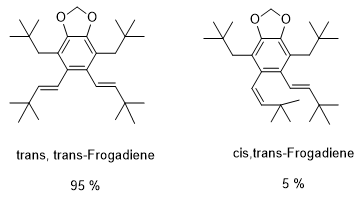
Isomeric forms of Frogadiene. Source: Poltroon University office of public relations.

The major isomer, trans,trans-Frogadiene, was found to be the most efficacious form in badger halitosis studies. The substance works by inhibiting the stinky and hazardous hydrogen sulfide produced by sulfur reducing bacteria. Another intriguing effect of the Frogadiene in the forest inhabitants is the enhanced ability to participate in convivial discussions. For a day or two, village victims of jungle halitosis were able to sit with family and friends without the foul breath. After imbibing a tea made from frog scraps, for a time the once blabbering halitosis victims were able to converse without the usual stream of useless information.

Noting the increased, though temporary, ability to avoid outbursts of trivia, McMurray set out to understand the molecular pharmacology of Frogadiene. The first target was the membrane enzyme uselase. This protein was already connected with stimulating the trivia peduncle of the human brain. By maceration in pH 6.9438 buffer of 30 freshly deceased brain donors, a small quantity of uselase was isolated.

The uselase isolate was treated with synthetic trans,trans-Frogadiene and crystals were produced of the complex. X-ray crystallography clearly showed the Frogadiene bound to the enzyme. Later it was found to be an activator of the protease enzyme uselase. In the presence of Frogadiene the enzyme is phosphorylated and passes into the intracellular medium. Once inside, the activated enzyme cleaves DNA which eventually leads to the production of the neurotransmitter monotonine. This neurotransmitter suppresses the urge to issue torrents of trivia.

The pharmaceutical company Azidoberg is in negotiations with Poltroon in an effort to buy the patent.