Author Archives: gaussling

About gaussling

Gaussling is a senior scientist in the chemical business. He occasionally breaks glassware, spreads confusion and has been known to generate new forms of hazardous waste. Gaussling also digs aerospace, geology, and community theatre.

Technological Triumphalism

“Technological triumphalism” is a term that surfaces infrequently, encapsulating the belief in our capacity to resolve almost any issue through the innovative use of technology. While technological progress has led to countless pivotal breakthroughs, such as antibiotics and the transistor, it has also given rise to means that magnify age-old human tendencies towards negative behaviors. As our tools and methods evolve with technological advancements, so too do our desires and avarice, often intensified by the fresh opportunities new technologies present.

As an example of technology bursting on the scene producing both good and bad consequences, consider the Haber-Bosch process for the industrial manufacture of ammonia. An industrial feedstock like ammonia can split into several streams. On the plus side, cheap and available liquid or gaseous ammonia for fertilizing crops was a boon for mankind in terms of increased food production. Also, the combination of ammonia and nitric acid leads to the production of the solid fertilizer ammonium nitrate.

Another and wholly different product stream involving the oxidation of ammonia (Ostwald Process) is nitric acid production, HNO3. It is required for the manufacture of industrial intermediates, high explosive nitroaromatics like TNT, picric acid, nitroesters like nitroglycerine and even more powerful explosives. Explosives are neither inherently good or bad, their merits depend on how they are used. When used for construction or mining, explosives are a positive force in civilization. However, they cast a long dark shadow when used to destroy and kill.

Fritz Haber

A good example of unanticipated consequences of a technology uptick is found in the story of the German chemist Fritz Haber. Haber won the 1918 Nobel Prize for Chemistry for the invention of the Haber-Bosch synthesis of ammonia. It is estimated the 1/3 of present global food production relies on the use of ammonia from the Haber-Bosch or similar processes. Haber has been widely praised for his part in the invention of catalytic ammonia production using atmospheric nitrogen. These are important developments, but … [Wikipedia]

As a German nationalist, Haber was also known for his considerable contributions to German chemical warfare through WWII. Haber was responsible for the production of Zyklon A and Zyklon B.

It is claimed that neither Fritz Haber nor Carl Bosch were fans of National Socialism in Germany in the 1930’s. Haber claims to have done his WWI gas warfare work for Kaiser Wilhelm as a German patriot. Intimidated by German laws aimed at Jews and Jewish colleagues, Haber (a Jew converted to Catholicism) left Germany in late 1933 for a position as director of what is now the Weizman Institute in what was at that time Mandatory Palestine. He died while enroute in the city of Basel, Switzerland, at age 65.

Chemical warfare in WWI began with an idea from volunteer driver and physical chemist Walther Nernst who suggested in 1914 the release of tear gas at the front. This was observed by Haber who later suggested chlorine gas be used instead because of its density. Haber personally supervised Germany’s first release of chlorine gas at the Second Battle of Ypres in WWI. Supervising the installation of the 5730 tanks of chlorine were chemist Fritz Haber, chemist Otto Hahn, physicist James Franck and physicist Gustav Herz. Of the 5 scientists mentioned above, Nernst included, all would receive a Nobel Prize in their lifetimes.

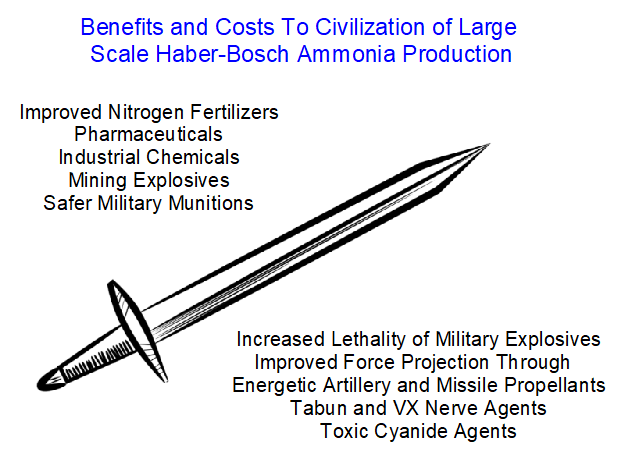
The double-edged sword of ammonia. The military benefits apply to both offensive and defensive use. Graphics by Arnold Ziffel.

The Future

Ask yourself this- will your descendants in the year 2124 share in the creature comforts coming from the extravagant use of resources as we have? Doesn’t the word “sustainability” include the needs of 4-5 generations down the line?

There are wants and there are needs. For many of us in the 21st century, most our needs in the US are more than satisfied along with surplus income to satisfy many of our wants. Will our descendants a century from now even have enough resources to meet their needs after our continuing wanton and extravagant consumption of resources of the last 150 years?

What will descendants in 100 or 200 years require to fend off the harshness of nature and our fellow man? Pharmaceuticals? Medical science? Fuels for heat and transportation? Will citizens in the 22nd century have enough helium for the operation of magnetic resonance imagers or quantum computers? Will there be enough economic raw materials for batteries? Will there be operable infrastructure for electric power generation and distribution? Lots of questions that are easy to ask but hard to answer.

Come to think about it, does anyone worry this far in advance? The tiny piece of the future called “next year” is as much as most of us can handle. Is the world a much smaller place than it used to be or is the scale just better understood?

A plug for climate change

Even the sky is smaller than we think. At 18,000 feet the atmospheric pressure drops to half that at sea level. This means that half of the molecules in the atmosphere are at or below 18,000 feet. This altitude, the 500 millibar line, isn’t so far away from the surface. From the 58 Fourteeners in Colorado, it is only 4000 ft up. Not that far. The breathable, inhabitable atmosphere is actually quite thin. The Earth’s atmosphere tapers off into the vacuum of space over say 100 km, the Kármán line. While this is more of an arbitrary designation than a physical boundary between the atmosphere and space, the bulk of the atmosphere is well below this altitude. With this in mind, perhaps it seems more plausible that humans could adversely affect the atmosphere.

The lowest distinct layer of the atmosphere is the troposphere beginning as the planetary boundary layer. This is where most weather happens. In the troposphere, the atmospheric temperature begins to drop by 9.8 Â°C per kilometer or 5.8 oF per 1000 ft of altitude. This is called the dry adiabatic lapse rate.

With increasing altitude, the atmospheric temperature gradient decreases to about 2 oC per kilometer at ~30,000 ft in the mid-latitudes where the tropopause is found. The tropopause is where the lapse rate reaches a minimum then the temperature remains relatively constant with altitude. This is the stratosphere.

Over the last 200 years in the West at least, advances in medicine, electrical devices, motor vehicles, aerospace, nuclear energy, agriculture and warfare have contributed to what we both enjoy and despise in contemporary civilization. The evolving mastery of energy, chemistry and machines has replaced a great deal of sudden death, suffering and drudgery that was “normal” with a longer, healthier life free of many of the harmful and selective pressures of nature. Let’s be clear though, relieving people of drudgery can also mean that they may be involuntarily removed from their livelihoods. It is quintessentially American to sing high praises to capitalism. It is even regarded as an essential element of patriotism by some. On the interwebs capitalism is defined as below-

Capitalism is an economic system based on the private ownership of the means of production and their operation for profit.

As I began this post I was going to cynically suggest that capitalism is like a penis- it has no brain. It only knows that it wants more. Well, wanting and acquiring more are brain functions, after all. Many questions stand out, but I’m asking this one today. How fully should essential resources be subject to raw capital markets? It has been said half in jest that capitalism is the worst economic system around, except for all of the others.

I begin with the assumption that it is wise that certain resources should be conserved. Should it necessarily be that a laissez faire approach be the highest and only path available? Must it necessarily be that, for the greater good, access to essential resources be controlled by those with the greatest wealth? And, who says that “the greater good” is everybody’s problem? People are naturally acquisitive, some much more than others. People naturally seek control of what they perceive as valuable. These attributes are part of what makes up greed.

Obvious stuff, right?

The narrow point I’d like to suggest is that laissez faire may not be fundamentally equipped to plan for the conservation and wise allocation of certain resources, at least as it is currently practiced in the US. Businesses can conserve scarce resources if they want by choosing and staying with high prices, thereby reducing consumption. However, this is not in the DNA of business leaders. The long-held metrics of good business leadership rest on the pillar of growth in market share and margins. Profitable growth is an important indicator of successful management and a key performance indicator for management.

Firstly, a broader adoption of resource conservation ideals is necessary. Previous generations have indeed practiced it, with the U.S. national park system serving as a notable example. However, the scarcity of elements like Helium, Neodymium, Dysprosium, and Indium, which are vital to industry and modern life, raises concerns. The reliance of Magnetic Resonance Imaging (MRI) operators on liquid helium for their superconducting magnets poses the question of whether such critical resources should be subject to the whims of unregulated laissez-faire capitalism. While some MRI operators utilize helium recovery systems, not all do, leading to further debate on whether the use of helium for party balloons should be permitted to continue, given its wasteful nature.

Ever since the European settlement of North America began, people have been staking off claims for all sorts of natural resources. Crop farmland, minerals, land for grazing, rights to water, oil and gas, patents, etc. Farmers in America as a rule care about conserving the viability of their topsoil and have in the past acted as a group to maintain it in good condition. But, agribusiness keeps making products available to maximize crop yields, forcing farmers to walk a narrower line with soil conservation. Soil amendments can be precisely engineered with micronutrients, nitrogen and phosphate fertilizers to reconstitute the soil to compensate for higher yields. Herbicides and pesticides are designed to control a wide variety of weeds, insect and nematode pests. Equipment manufacturers have pitched in with efficient, though expensive, machinery to help extract the last possible dollars’ worth of yield. Still other improvements are in the form of genetically modified organism (GMO) crops that have desirable traits allowing them to withstand herbicides (e.g., Roundup), drought or a variety of insect, bacterial, or fungal blights. The wrench in the gears here is that the merits of GMO have not been universally accepted.

Livestock production is an advanced technology using detailed knowledge of animal biology. It includes animal husbandry, nutrition, medicines, meat production, wool, dairy, gelatin, fats and oils, and pet food production. There has been no small amount of pushback on GMO-based foods in these areas, though. I don’t watch this in detail so I won’t comment on GMO.

The point of the above paragraphs is to highlight a particular trait of modern humans- we are demons for maximizing profits. It comes to us as naturally as falling down. And maximizing profits usually means that we maximize throughput and sales with ever greater economies of scale. Industry not only scales to meet current demand, but scales to meet greater future demand.

Essentially everyone will likely have descendants living 100 years from now. Won’t they want the rich spread of comforts and consumer goods that we enjoy today? Today we are producing consumer goods that are not made for efficient economic resource recovery. Batteries of all sorts are complex in their construction and composition. Spent batteries may have residual charge left in them and have chemically hazardous components like lithium metal. New sources of lithium are opening up in various places in the world, but it is still a nonrenewable and scarce resource. This applies to cobalt as well.

Helium is another nonrenewable and scarce resource that in the US comes from a select few enriched natural gas wells. At present we have an ever-increasing volume of liquid helium consumption in superconducting magnets across the country that need to remain topped off. This helium is used in all of the many superconducting magnetic resonance imagers (MRI) and nuclear magnetic resonance (NMR) spectrometers in operation worldwide. Quantum computing will also consume considerable liquid helium as it scales up since temperatures below the helium boiling point of 4.22 Kelvin are required.

As suggested above, today’s MR imagers can be equipped with helium boil off prevention recovery devices that recondense helium venting out of the cryostat and direct it back into a reservoir. One company claims that their cold head condensers are so efficient that users do not even have to top off with helium for 7-10 years. That is a good thing. Hopefully it is affordable for most consumers of MRI liquid helium.

In the history of mining in the US and elsewhere, it has been the practice of mine owners to maximize the “recovery” of ore when prices are high. Recovery always proceeds to the exhaustion of the economical ore or the exhaustion of financial backing of the mining company. Uneconomical ore will remain in the ground, possibly for recovery when prices are more favorable. It is much the same for oil and gas. As with everything, investors want to get in and get out quickly with the maximum return and minimum risk. They don’t want their investment dollars to sit in the ground waiting for the distant future in order to satisfy some pointy headed futurist and their concern for future generations.

What is needed in today’s world is the ability to conserve resources for our descendants. It requires caring for the future along with a good deal of self-control. Conservation means recycling and reduced consumption of goods. But it also means tempering expectations of wealth generation, especially for those who aim for large scale production. While large scale production yields the economies of scale, it nevertheless means large scale consumption as well, In reality, this is contrary to the way most capitalism is currently practiced around the world.

Sustainability

The libertarian ideal of applying market control to everything is alleged to be sustainable because in appealing to everyone’s self-interest, future economic security is in everyone’s interest. If high consumption of scarce resources is not in our self-interest, then will the market find a way to temper it? As prices rise in response to scarcity, consumption will drop. ECON-101 right? Well, what isn’t mentioned is that it’s today’s self-interest. What about the availability of scarce resources for future generations? Will the market provide for that? What does “sustainability” really mean? Does it mean that today’s high consumption is sustained, or does it mean resource conservation?

Is the goal of energy sustainability to maintain the present cost of consumption but through alternative means? Reduced consumption will occur when prices get high enough. As the cost of necessities rises, the cash available for the discretionary articles will dry up. How much of the economy is built on non-essential, discretionary goods and services? The question is, does diminished consumption have to be an economic hard landing or can it be softened a bit?

Some chemical elements

Here is where we transition into some chemistry. Our transition into a more electric world requires the use of certain chemical elements that may be unfamiliar to many. Certain elements are critical such as copper, aluminum, steel, silicon, germanium, gallium, neodymium, lithium, indium, boron and some others. And each element requires industrial plants and mining to produce them. Mining and refining generally use large quantities of electric power and water. Most all of the equipment in the mines and industry rely on steel machinery which itself requires a cascade of resources to produce.

As of the date of this writing, we are already down the timeline by many decades as far as the R&D into alternative electrification. What we are faced with is the need for a rapid and very large scaling-up of renewable electric power generation, transmission and storage for the anticipated growth in power consumption for electric vehicles.

Price elasticity is where an increase in price fails to result in a drop in demand. Necessary or highly desirable goods and services may not drop in demand if the price increases at least to some level. As with the price of gasoline, people will grumble endlessly about gas prices as they stand there filling their tanks with expensive gasoline or diesel. Conservation of resources has to overcome the phenomenon of price elasticity in order to make a dent without shortages.

A meaningful and greater conservation of resources will require that people be satisfied with lesser quantities of many things. In history, people have faced a greatly diminished supply of many things, but not by choice. Economic depression, war and famine have imposed reduced consumption on whole populations and often for many years. When the cause is released, people naturally return to consumption as high as they can afford.

The technological triumphalism reflex of civilization has allowed us to paint ourselves into a resource scarcity corner. We are reliant on new technology that itself is reliant on more mature technology.

Added 10/30/24.

The habit of relying on future technological breakthroughs to solve current problems is universally seen as a positive expression except for those culturally disconnected from modernism such as the Amish, etc. The problem arises when we blunder forward, oblivious to consequences of the technology. Unforeseen consequences are notably difficult to visualize early in development and may be interpreted by some as negativism.

In chemical manufacturing we are accustomed to a performing PHA- Process Hazard Analysis -when starting up a new process. In a PHA meeting we list all of the potential points of failure in the process equipment and then brainstorm every possible failure mode and possible links to other equipment. It usually takes most of a shift and it is essential that engineers and plant operators are present to lend their expertise. As potential failures are identified they are rated according to their likelihood and seriousness. Each entry that calls for a dated action item by persons responsible for solving the problem.

What the PHA also does is to alert those involved in designing processes of problems that may be general in nature and worth remembering for the next process.

Social Media- An invention gone bad?

Did the persons who introduced the various social media platforms in the early days consider the possible malevolent use and consequences of their online products? Was anything other than the rapid development of their platform and getting online as fast as possible even considered? Was there a devil’s advocate in the building at the time? Once money is invested in a business plan or invention, the desire to go to market becomes insurmountable.

If the question is “could trolls and other online troublemakers have been avoided from the beginning?”, then perhaps the early social media developers should have some accountability to those who download the app. If not, what should be the developer’s role in solving the problem of online trolling or fraud?

As with so many useful things in the marketplace that have a dark side, weapons for instance, doesn’t the user have some responsibility for proper use? Well, yes and no. Someone who knows about guns should have the responsibility for its use, that’s yes. Going very dark, what about leaving a loaded and chambered pistol on a playground. Is it reasonable to expose children to the danger from mishandling? Should they be expected to know what the loaded pistol could do? Clearly not.

The core of the issue seems to be the matter of when a seemingly innocuous invention is released for global use and is unexpectedly misused by some users. Is the developer responsible for damages resulting from the misuse? Can the developer be forced to harden their product to attenuate the abuse?

Could it be that clamping down on trolls on a given app will involve a reduction of clicks or eyeballs? Would advertisers overlook this or negotiate a lower price?

It is doubtful that anyone in 1975 was begging for a Facebook to come on the market. Dot matrix printers were a marvel then. Eventually, when available, Facebook would take the world by storm. Demand appeared when people became aware of it. Is it a triumphal bit of technology? Both were built to exploit existing telecommunications technology and data collection systems. Facebook is a system that converts views and clicks into money over the internet. Facebook is a product that delivers our eyeballs and data to advertisers. Similar to a newspaper or television. Fb is triumphal to advertisers and Meta.

Conclusion-

Is there really such a thing as general Technological Triumphalism? I’m beginning to think that it might exist only as squinted at from 50,000 feet. In the very early 20th century, physicians longed for a magic bullet to cure infections apart from the toxic mercurials then in use. They needed a Technological Triumph, and it arrived in pieces through experiments over time. Along came sulfa drugs, then penicillin and both of these were explored for more potent analogs. As medicinal chemistry advanced, entirely new classes of antibiotics were discovered. The lesson of penicillin coming from mold led to the exploration of microbial and fungal sources from all over the world, producing antibiotics affecting a variety of systems in gram (+) and gram (-) bacteria. Once an active candidate is discovered, it’s structure and stereochemistry are determined. Once the composition is known, modifications can be prepared to explore the efficacy of analogs and sort out the mechanism of its antibiotic properties.

Technological Triumphalism can be a philosophy that in its hazardous form can lead people to believe that if a technology goes surprisingly bad, certainly something can be invented to make it better. Fix one technology with another. The discovery of antibiotics was the result of answering a question that begged for a solution.

An example is the problem of CO2 in global climate change. Should we compensate for rising CO2 emissions by scrubbing the atmosphere or should we find a way to reduce emissions by driving fewer miles? The first is a technological solution and the other is more of a lifestyle change.
Whiners Going on About Increasing Oil Production

[Note: Let’s get something straight here. I’m an industrial chemist and not a pencil-necked economist. I’m going to talk about some O&G economics from my industrial perspective. MAGA people are whining about increasing oil production to ease gas prices. My view is that these buggers are idiots, but I won’t say it like that. I’ll just discuss some pragmatics of oil refining.]

In an article published 10/1/24 in The Center Square the writer reports that a survey of voters in the key swing states of Arizona, Georgia, Michigan, Nevada, North Carolina, Pennsylvania, and Wisconsin that between 80% and 86 % of voters say that the price of daily necessities has gotten painful. Between 88 % and 94 % say they are concerned about inflation. This survey was obtained by Morning Consult/American Petroleum Institute poll obtained exclusively by The Center Square. “The poll surveyed nearly 4,000 registered voters Sept. 20-22 with a margin of error of 4%.”

From the article-

Some refining basics

I think there is some misunderstanding generally about how the oil & gas (O&G) business works. First off, it is a global market and is subject to supply and demand pressures from all over the world. Second, there is O&G supply and there is refinery capacity. One might suppose that increasing O&G production domestically would automatically lead to lower fuel prices at the retail level. However, refinery throughput is limited to its particular capacity and storage. And, why would O&G producers increase output to an excess just to lower prices at the retail level? Leaving money at the table is against the instincts of every businessperson and is contrary to the fiduciary responsibilities of executives to stockholders.

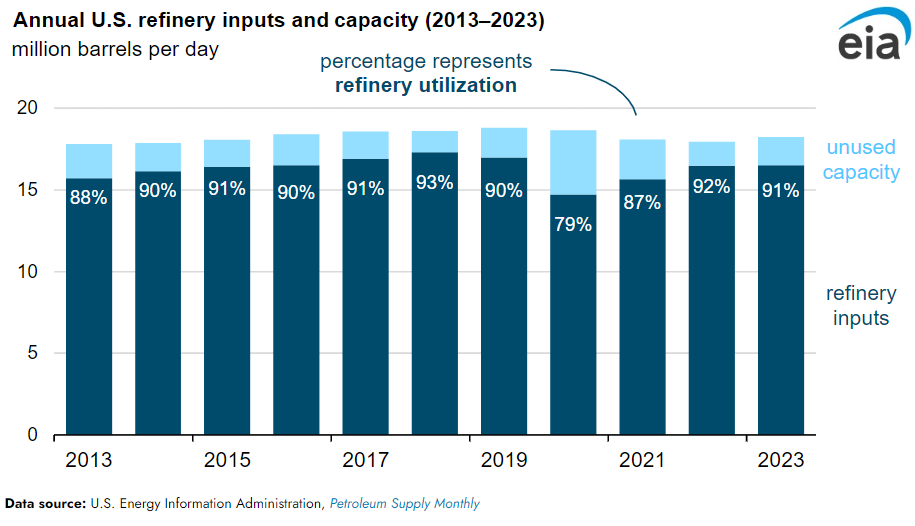
Refineries are usually operated at about 90 % capacity. Lest one think that refiners only need to tweak the throughput up a bit, it must be understood that it is unwise to operate a refinery or any other manufacturing plant at a constant 100 % capacity. Like any other factory, a refinery is subject to sudden or planned maintenance requirements, equipment failures, process upsets, variability in oil feedstock composition, hurricanes, variable demand in product spread or even infrequent operational error. A sudden unexpected shutdown can lead to a variety of complications as well as unleashing hazards at the large scale. Once a refining process line goes down, repair and restart can take one or more weeks to months to bring the process back to stable production.

A petroleum refinery is operated on a continuous throughput basis with series and parallel processing occurring simultaneously. Operating a refinery profitably is a complex job requiring a specialized skillset. As a PhD organic chemist, I am barely qualified to even set foot in a refinery, much less be of any kind of use there. Chemists may be found on site, but most likely in the quality control lab. These are the rarefied heights of the petroleum engineer.

A petroleum refinery is designed to take crude oil and gas inputs and shape them into an optimal spread of profitable products. The focus will be on maximizing the output of the most profitable products, especially motor fuels in the form of the various grades of gasoline and diesel. Your local gas station buys fuel from a wholesaler/distributor at a quoted price then sets a retail price depending on not just the wholesale price, but more importantly the local market prices and expected sales volume.

Operating a refinery is a continuous flow exercise and is a bit delicate. A refinery is a web of continuous unit operations each with an input stream from one unit operation and an output stream to another operation. Each unit operation has a specific task to perform safely and efficiently. These unit operations subject the input hydrocarbon stream to heating, fractionation by distillation, and each of the many distillate streams are then subjected to their own unique processing. Other operations include alkylation, hydrotreating, sulfur scrubbing, catalytic cracking, isomerization, catalytic reforming, heat exchange, more distillation, blending and finally transfer to storage. Each operation is designed to process throughput at high flow rates to afford the best production rate of finished goods.

Waste process heat is directed to certain operations and used for greater efficiency. Oil refining inevitably produces light hydrocarbons whose recovery produces diminishing returns for recapture or comes from pressure venting where the vented gases are not suitable for recycle. In this case these gases are sent to a flare tower and burned. The flare tower plays an important safety role as it burns away flammable hydrocarbon gases that might otherwise accumulate and spread near the ground, posing a serious fire and explosion hazard.

Naturally, this requires considerable coordination to manage the rate of output of one operation to the input rate of the next. In fact the whole plant requires coordination of rates of throughput, pressure and temperature. A refinery is constantly monitoring and adjusting individual parameters with automation and human oversight to remain in “tune”.

During the recent COVID-19 pandemic and the reduction in demand, a number of refineries were shut down for maintenance or upgrades and a few were shut down permanently. This created a bottleneck in refining capacity nationwide and there was a shortfall in overall refinery output, leading to higher retail pricing of fuels as demand eventually rose.

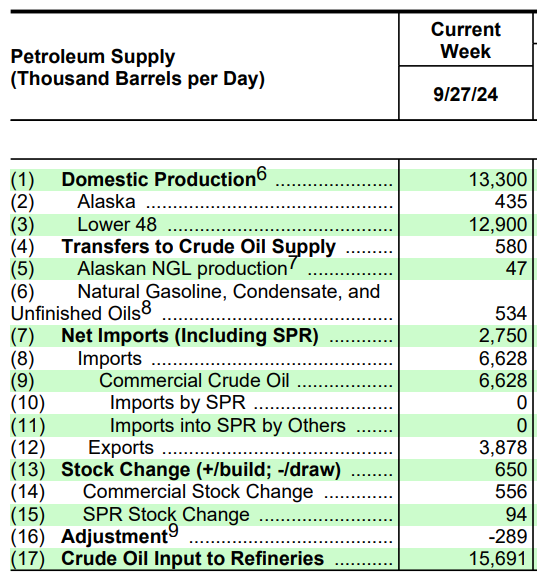
Today the USA both imports petroleum and exports it. The supply of crude oil and gas depends on contractual obligations and who is willing to pay the highest prices.

Source: US Petroleum Balance Sheet, week ending 27 Sept 2024, Energy Information Administration (EIA)

The United States in a net O&G exporter. Between imports and domestic output, the US is currently processing enough O&G for our needs with surplus to export. And what will an increase in domestic fracking really do for the US, again pricewise? It can increase the production yields at individual O&G wellheads bringing greater volume for the O&G producer over time. Done properly, fracking makes sense. However, if fracking provides a conduit for natural gas, oil or produced water into ground water, then it can be irredeemably harmful for those so affected.

Even if domestic O&G production is increased and released into the market, the near-term problem will be limited refinery capacity. The lead time for building a large oil refinery can be 4-5 years from design phase to commissioning. Permits, financing and societal pushback can add considerable time. Putting a complex refinery in the ground can cost $5-$15 billion. Startup and adjustment of a refinery is time consuming, complex and can be a bit hazardous. Accidents during startup and shutdown are not uncommon.

The politically popular opinion that what the US needs is an increase in oil production to drive down retail gas and diesel pricing rests on specious assumptions. The government provides regulatory oversight in many aspects of O&G production and refining. In my view, government oversight in regard to environmental protection and worker safety is of critical importance. Global free market control of O&G production and distribution, while often heavy handed and seemingly heartless, is the best model we have at present for production and distribution of hydrocarbon-based goods to consumers. For a historical example of government control of supply and distribution, we can look at the Soviet Union and its authoritarian centralized control of nearly everything. The Soviet model of governance and production of goods and services failed spectacularly by 1991. The leadership of the USSR dissolved the Soviet system themselves after concluding that it was no longer workable. For all of its many flaws, the overall western model of capitalism continued to thrive.

In short, it only makes sense to increase O&G production to keep retail fuel prices low if the refineries demand more crude to meet their distributor’s demand. Refined fuels could be imported for distribution here, but an uptick in storage capacity will likely be required. Refineries are fundamentally limited by their processing capacity. Refineries, like most manufacturing operations, are designed to provide an optimum output with the installed equipment. Greater throughput requires larger equipment or additional process streams

Anecdote: Every day I pass through the intersection of an east/west state highway and a north/south interstate highway. On the west side of this busy intersection there are four gas station/convenience stores competing for our gasoline and diesel business. Just a block to the west is a stoplight and at the four corners of this are three of the gas stations with direct access to the light. The fourth is not at the light so entry or exit to this station is not controlled by the light. During the early morning commute time, the four electronic signs indicate morning prices that invariably are $0.20 to $0.60 lower than mid-day prices. The tall electronic signs allow for convenient rapid response to competing prices. One station is beyond the single stoplight intersection, so both exiting eastbound vehicles and entering eastbound vehicles who need to turn left across uncontrolled heavy traffic have to wait for a break in the congested traffic. This is a competitive disadvantage for them. The other three stations have direct access to the stop light. Co-incidentally, the traffic-disadvantaged station nearly always has the lowest prices first. This tends to set the stage for a daily price war. This morning the 85-octane gasoline price was $2.719 at all four stations.

There are some plusses for the disadvantaged station mentioned above. Unlike the other three stations there is room for 18-wheelers to fill their tanks with diesel and park overnight next to a cheap motel and a Waffle House (Hey! Waffle House hash browns are the greatest). The left turn across traffic disadvantage to 4-wheelers is only a minor obstacle to the 18-wheelers using the station since they are apparently fearless in pulling into heavy traffic to execute a turn.

Econ 101 Conclusions

Like everything else, scarcity applies pressure on hydrocarbon prices up and down the supply chain- from wellhead to fuel tank. National politics can play a role in hydrocarbon pricing if it threatens to alter scarcity in some way. In chemical kinetics we are interested in finding the rate limiting step in a multistep chemical reaction. This step is the bottleneck that controls the overall reaction rate. In much the same way, a bottleneck in a supply chain will control the rate of output of a given product. The rate of delivery through the bottleneck controls the rate of wealth creation for those in the supply chain. To increase the rate of wealth creation, one must multiply the number of these bottlenecks in parallel or design a new bottle with a larger neck. Importantly, the rate of wealth creation can be a winning positive or a losing negative number. Excess capacity anywhere in the chain results from excessive money spent on unneeded production scale.

Note: There is much more to the macroeconomics of O&G production than what I have addressed. The economics of O&G production and distribution in the US depends on policy and regulatory factors as well as considerable anticipation and speculation (gambling) in the marketplace. Despite this, it is possible to make certain very broad statements in the context of general supply and demand principles. The finer, high resolution, details can be found elsewhere.

A Career Phase Change is Coming

After 26 2/3 years on the job, I’m being let go. Actually, my position and director title are being eliminated as of December 24, 2024, and nothing else is there for me. My company is 4 years into the new ownership, a venture capital company, and it’s likely that thoughts of the big payoff are in the air. In preparation for this the CEO, just back from a board meeting, is cutting costs and polishing up the balance sheet for an impending sale. Or so some believe. The mighty and all-knowing overlords of Oz are looking to cash in their chips.

Anecdote

Early after the buyout I had the occasion to speak with one of the board members before their first on-site meeting. This fellow was the retired founder of a chemical company and owned a personal business jet which he flew to the meeting himself. It was an Embraer Phenom 100 which can be flown by a single pilot and under instrument conditions. Both he and his wife were instrument rated and signed off to fly the twin engine jet as a single pilot. As we got to the meeting room, he was greeted by the board chairman whereupon they began to compare notes on their business jets- a Phenom and a Gulfstream. I left since I had no jet of my own to discuss. I was not dejected but merely amused at the different existence these kings of the world occupy.

Back to the story

Having joined the company in 1998 when it was a family operation and coming from a small liberal arts college teaching background, I adapted well to the isolated, almost tribal, company life. Outside influence was scarce. We were inbred and operating on a remote desert island. I got to wear many interesting hats in the organization, and it made for an interesting job despite the lack of structure. Many years later though and with new ownership, the problem became one of wearing too many hats. My job description got overloaded with diverse activities and defied any orthodox job description. My career had become the kitchen junk drawer. I was warned by a friend and boss not to do this. His counsel was to leave and find a more orthodox corporation, but it was just too interesting. In the end he was right. I should have left about 2004.

These days job descriptions are built to exacting standards. None of the cross-disciplinary general chemist stuff that I was used to. I think this is part of what did me in. Early on I had traveled much of the northern hemisphere on sales and sourcing trips. I managed the sales and marketing department for 6 years, did patent analysis and IP due diligence, wrote and submitted a patent application, did some R&D, led accident investigations, conducted R&D on the pyro- and hydrometallurgy of several rare earth minerals, started a process safety department, conducted reaction calorimetry experiments for over 12 years, and finally jumped into TSCA regulatory compliance when we were short staffed. After 3 years I’m still in regulatory compliance.

I have no interest in retirement and halting all chemistry-related activity and doddering into my retirement years because I really dig chemistry. Sitting on the porch whittling a stick and telling stories is not what I want. But a chemist without an organization is hard pressed to continue being involved with actual chemistry. It is true that for everything there is a season. The transition to the next season has begun.

Limitations of Quantum Computing

Note: First, let me make clear that I am not a computer scientist and while I’ve learned FORTRAN, BASIC and PASCAL in the early 1980’s followed by coursework in quantum chemistry in grad school- and somehow passed– the question of how quantum computation actually computes with qubits remains a mystery to me. Honestly, I’m weary of hearing about it. That said, I do continue to worry about the ever-increasing pressure on the liquid helium tit which quantum computing will definitely lock on to.

An interesting article came out in the current issue of Quantum Magazine giving some straight talk about how quantum computers might actually be used. All of us have been bombarded by breathless predictions of a wondrous future where we can find prime factors of stupidly large numbers and crack very secure cryptography.

Quantum chemistry is about orbiting electrons confined to particular regions of oddly shaped space around a positively charged nucleus, depending on their energy. That is a lifetime of study right there for me. I think I’ll stick to atoms and molecules.

Oh yes, in the early 80’s we used an IBM 360 and submitted our batch jobs as a stack of punch cards. Eventually we were allowed to use the DEC writer for BASIC programming. One sunshiny day an Apple 2 appeared in the chemistry department office. It had 16 K of memory, a green monitor and an external floppy disk drive. There were whispers that 32 and maybe even 64 K were on the horizon. Heady stuff.

The IT guys were surly then too.

Lawfare

There is an interesting substack post by historian and NYU prof. Ruth Ben-Ghiat discussing the latest filing by Special Counsel Jack Smith that was just unsealed and released by Judge Tanya Chutkan. The full 165 page document can be found here. Boiled down, the filing makes the case Trump is not immune from prosecution.

Ben-Ghiat summarizes-

The article goes on to say that Trump uses a ‘personalist’ model of governance where his personal, legal, political and financial needs take precedence over the party and the nation. And his needs are endless. The GOP is his personal storehouse of resources. His close followers are individuals who are strongly loyal to him and his mystique. He can convince others to conduct unsavory or even criminal acts, and when they fail, he’ll find someone else. This is not without precedent in the history of authoritarians.

The word ‘Lawfare‘ seems appropriate to Trump’s method courtroom delays and litigating to the hilt to sow confusion, expense and delay. it works, but is hugely expensive. Trump has been a wellspring of billable hours for the legal profession.

Imbeciles All

I just read that conservative influencers and even former president Trump have been referring to VP candidate Walz as ‘Tampon Tim’ over the state law mandating free menstrual supplies be available in grades 4-12 in Minnesota schools. The issue for some is that these supplies be made available to all needing access to the products, including transgender students, in whatever restrooms commonly used by students.

Editorial

I grew up in an America where such juvenile and scurrilous name calling would at least be kept out of the public discourse. It fell under the heading of “Mature and Common Decency” that most adults adhered to. That the insulting appellation “Tampon Tim” is being bandied about by a former US president in a presidential campaign watched by the world and being eagerly repeated by news outlets as infotainment. Even worse is the large population of MAGA citizens who accept and even encourage Trump’s troubling behavior. Trump is riding a wave that was already there waiting for someone like him.

The Minnesota law behind the controversy

HF 2497

Article 1

The response by the Trump horde has been vigorous and execrable. Even #45 himself is calling Walz ‘Tampon Tim’ in the open.

Oh, right. Karoline said that the threat was from ‘the leaderswho support …’. So, what kind of harm could women suffer from a leader who makes free feminine hygiene products available in the public schools? Her statement obviously signals ‘danger’ from tolerance for transgenderism. The matter of gender dysphoria is listed in DSM-5-TR as a recognized condition, but not a mental illness. The Journal Psychiatry has a short and readable paper on diagnosing gender dysphoria. From the article, Gender dysphoria is ‘a marked incongruence between one’s experienced/expressed gender and primary and/or secondary sex characteristics.’

Conservative protestant evangelical leaders and many GOP politicians who rage about the illegitimacy of gender transition have taken the path of idiocy and are happy to be there. Gender dysphoria is a medically recognized condition based on a minimum set of criteria. Those so afflicted often lead lives of misery that frequently ends in suicide.

This sounds like little more than a regression to the Victorian age taboo about discussing the female body and its physical processes. Or the entire subject of sexuality.

In this case I tend to think that being a female making ridiculous claims about an exclusively female topic does not afford refuge from criticism, but only boils down to a person being a dipshit trying to influence others by stoking brainstem-level fear. This is the usual Republican means of grabbing power.

New Words from British TV

Vocabulary gained while watching British crime shows. I will only show the meaning from the context in which they were heard.

  • Putrescible, noun or adjective: liable to decay; subject to putrefaction, “putrescible domestic waste”
  • Summat, pronoun: a British dialect form of the word ‘something.’
  • Egg sucking, phrase: used as an expression of anger or scorn, ‘go suck an egg if you don’t like it’
  • Scarpered, intransitive verb, to flee or run away.
  • Minging, adjective: very bad or unpleasant.
  • Parkour, noun: the activity or sport of moving rapidly through an area.
  • Bloke, noun: a man, guy or dude.
  • Knackered, adjective: Worn out or tired.
  • Bollocks, : nonsense or rubbish.
  • To leg it, phrase: To run away.
  • Gob, noun: Mouth.
  • Cuppa, noun: Shorted version of ‘cup of tea.’

Editorial

Let me say a few things about British television in general. We subscribe to both BritBox and Acorn TV found on Prime streaming service. First, in American TV entertainment, most of the actors tend to be very pretty and young- even the men. It’s a bit too saccharine. British TV has young and pretty people too, but with a large dose of people who ordinarily wouldn’t fit that description. Perhaps the talent pool there is small. My point is that the Brits use older folks to a larger extent than in the US. Another noticeable difference is the use of gun play in the cop shows. British TV uses far less shooting or even just the pointing of guns in their screen plays. There is some, granted, but far less than in the US. I like that. The Brits have a tradition of parlor murder mysteries where the killer is identified by deduction. On Brit TV, conflicts or apprehensions of suspects is frequently handled without excessive violence.

Another refreshing aspect of BritBox and Acorn TV is the availability of continental European programming. I’ve never been bothered by reading subtitles, so the authenticity of language and the drama is unfettered. Truthfully, the use of subtitles for English, Scottish and Irish programming is necessary when accents are too thick to understand, which is not infrequent.

One thing I have noticed is the adoption of American English vocabulary abroad. It is a bit sobering to see the extent of influence abroad by the US movie and television industry.

Helium and the “Howling Gasser”

Global demand for helium is expected to double by 2035. Helium is a critical, non-renewable resource used across the world. It is found in natural gas deposits in limited number of gas wells. Helium is the second most abundant element in the universe behind hydrogen. But this is averaged across the universe. Any helium the earth’s early atmosphere may have had has long ago diffused into space. At present, helium from terrestrial sources is derived from radioactive decay of uranium, thorium and daughter products within the Earth over eons of time. Underground structures suitable for the accumulation of natural gas may also accumulate helium.

Helium is useful in science and industry for many reasons, but mostly for its extreme chemical inertness and ultra-low boiling point. A gas with a very low boiling point, and if you manage to condense it, finds use as a low temperature coolant. Helium serves as an inert atmosphere in many applications including nuclear power, semiconductor manufacturing, welding and for pressurizing rocket propellant tanks. In liquid form, it boils at the low absolute temperature of 4.2 Kelvin (-261.1°C) and is indispensable as a cryogen for many applications from medical Magnetic Resonance Imaging (MRI) and quantum computing to other superconductor applications. Those of us who make great use of nuclear magnetic resonance spectroscopy (NMR) are highly dependent on it as an analytical tool. NMR has made identification and quality control possible in many kinds of chemical manufacture.

According to one source a single MRI unit can contain up to 2000 Liters of liquid helium and consume 10,000 Liters over its 12.8-year lifespan. If you condensed the helium gas into liquid from the balloons at the Macy’s Thanksgiving Day Parade, there would be enough liquid helium to keep two MRIs running for their lifetimes. The US presently has approximately 12,000 MRI units across the country. The good news is that helium recycling equipment can be fitted on to an MRI machine to greatly extend the life of a helium charge. Usually, a liquid helium dewar is immersed in a liquid nitrogen filled dewar which is inside a vacuum insulated container. The liquid nitrogen bath helps with the helium boil-off somewhat, even though the bp of nitrogen is considerably higher than that of helium, yet much lower than room temperature.

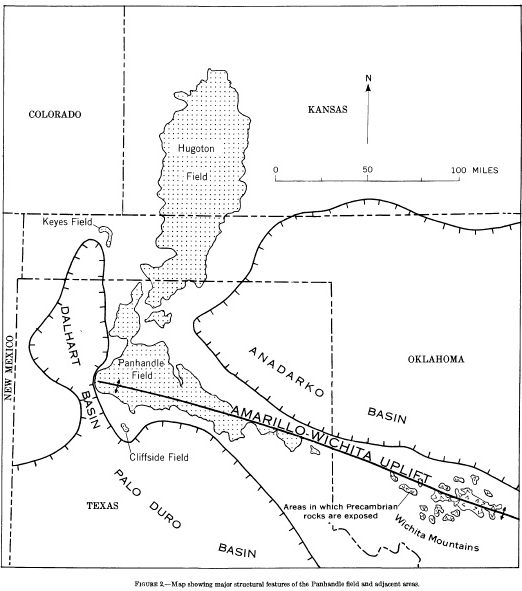
Source: Wikipedia. The Hugoton and Panhandle gas fields rich in helium. There are many other helium-rich gas fields in the US, but none as large as the Hugoton and Panhandle gas fields.
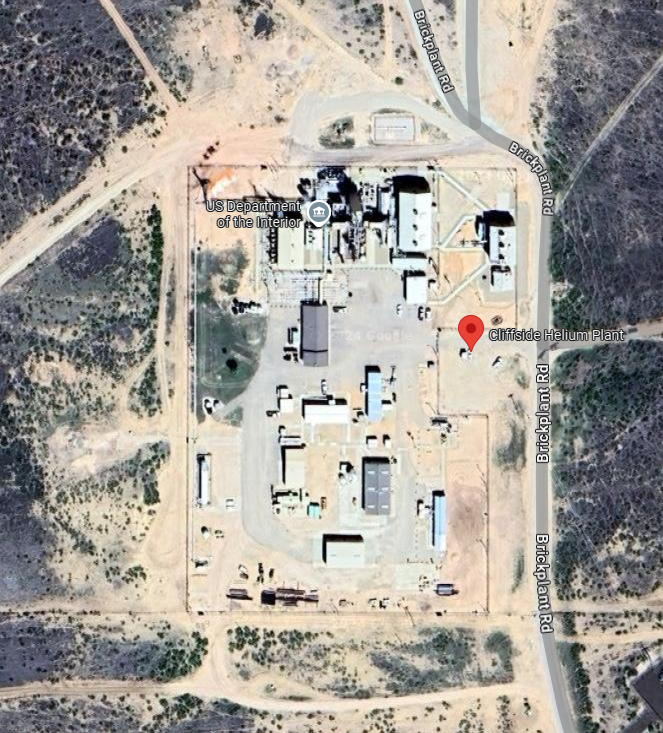
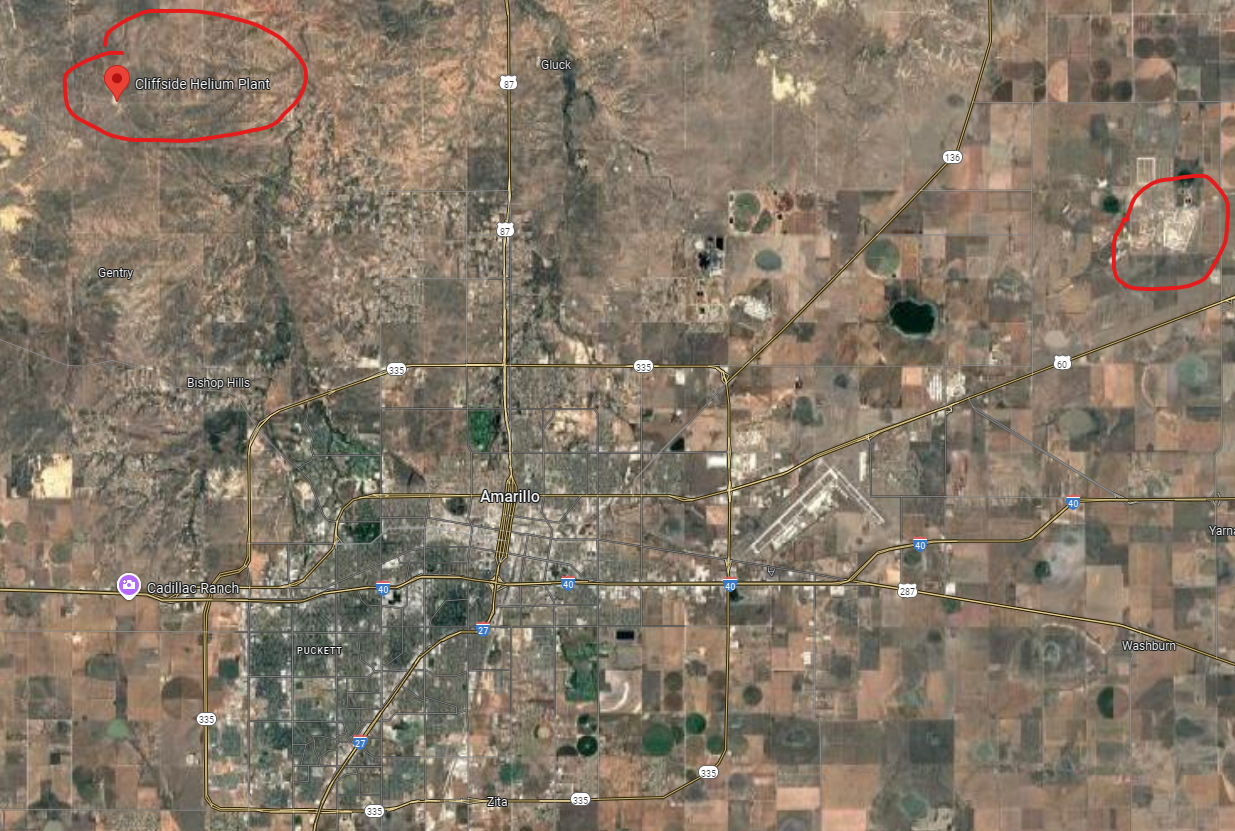
Source: Google Maps. Aerial view of the Cliffside Helium Plant. If there are actual cliffs near Cliffside then the panhandle folks are calibrated differently from me as to what constitutes a cliff.
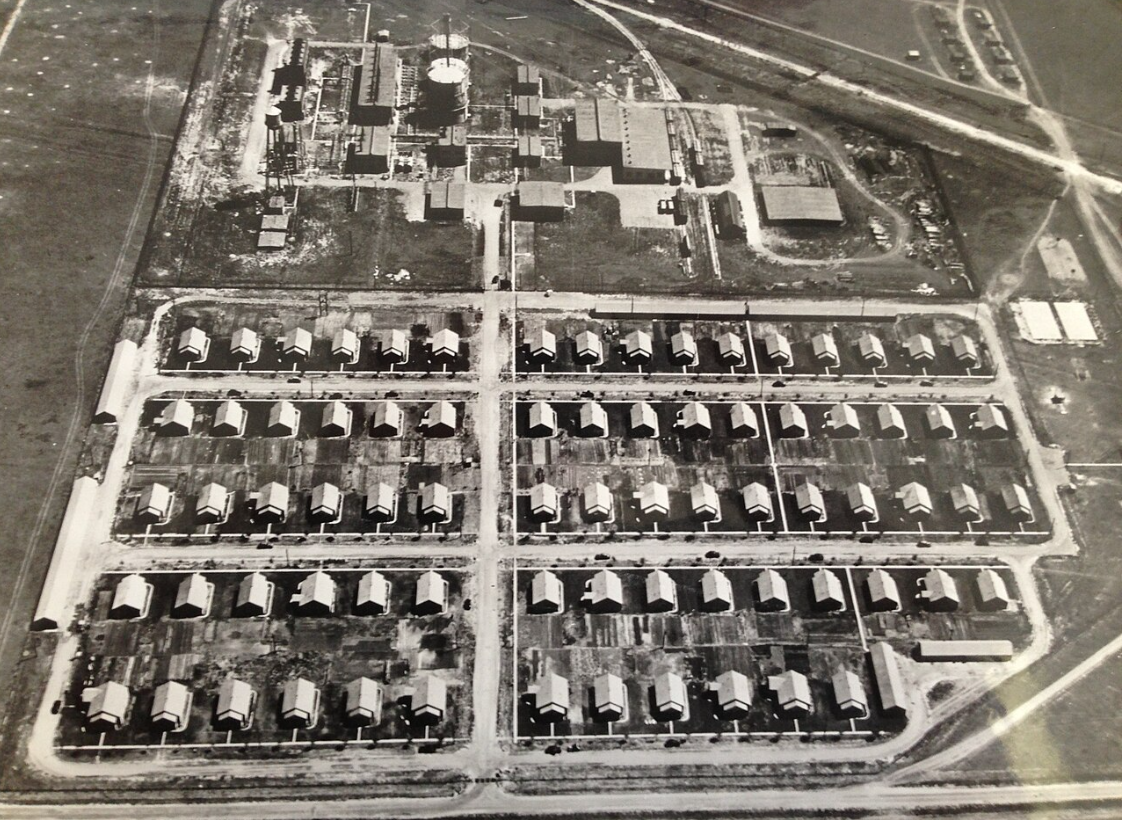
Source: Wikipedia. The Excell helium plant, ca 1945. Note the company housing.

Helium is isolated from natural gas. According to the American Chemical Society, the US, Algeria and Qatar have the major the helium reserves while the US, Russia and Algeria are the top suppliers of helium. The majority of US reserves are in the Texas & Oklahoma panhandles and Kansas. The Cliffside helium plant is located a 15 miles NNW of Amarillo, TX, over the Cliffside dome. It is in the red circle on the upper left in the photo.

The Amarillo Helium Plant got its start in 1929 when the federal government bought 50,000 acres NNW of Amarillo for a helium extraction plant. The motivation was to accumulate helium for lighter than air aircraft like balloons and blimps.

Source: Google Maps. Cliffside Helium Plant, Amarillo, and Pantex.

It is interesting to note that the Pantex nuclear weapons plant is about the same distance but to the NE of Amarillo, TX. It is circled in red in the upper right. It is the primary site in the US where nuclear weapons are assembled, disassembled or modified. Uranium, plutonium and tritium bearing components are stockpiled there. Weapons that use tritium in their booster gas have a shelf-life constraint due to tritium’s very short half-life, so the gas must be periodically upgraded.

The facility opened in 1942 for the manufacture of conventional bombs and was shut down shortly after the Japanese surrendered in 1945. The site was purchased in 1949 by what is now Texas Tech and used for research in cattle-feeding operations. In 1951 it was surrendered to the Atomic Energy Commission (now the National Nuclear Security Administration) under a recapture clause.

So, we might ask the question: Why was anyone looking for helium in natural gas at the time? The easy answer is that nobody was looking for it. In May of 1903 in Dexter, Kansas, a crowd had gathered at a natural gas well to celebrate this exciting economic find. A celebration had been planned and the towns folk were there to see it ignited. It was called “a howling gasser” and there was much anticipation of a spectacular fire. After much ballyhoo and speeches, a burning bale of hay was pushed up to it in anticipation of ignition of the gas jet, but the burning bale was extinguished. This was repeated several times, but no fire. The disappointed crowd wandered off. Later Erasmus Haworth, the State Geologist and geology faculty member at the University of Kansas, got word of this curious event and managed to get a steel cylinder of gas sent to the university.

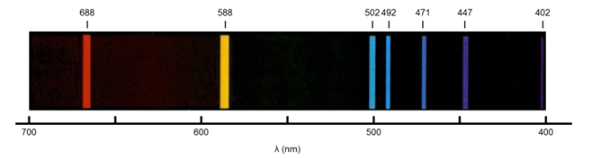
At the University Haworth and chemistry professor David F. McFarland determined that the composition of the Dexter gas was 72 % nitrogen, 15 % methane and 12 % of an “inert residue.” Soon, McFarland and chemistry department colleague Hamilton P. Cady began “removing the nitrogen from the gas sample by applying a spark discharge with oxygen over an alkaline solution.” This tedious procedure was soon replaced by using a glass bulb of coconut charcoal immersed in liquid air. This method had been shown to adsorb all atmospheric gases except helium, hydrogen, and neon at the temperature of boiling liquid air” (-310° F). The unabsorbed gas was collected in a glass tube and examined by emission spectroscopy. The spectrum showed all of the optical lines of helium. This discovery by McFarland and Cady showed that sizeable quantities of helium did exist on the Earth. The total amount of helium in the Dexter gas was 1.84 %.

Graphic: Atomic emission lines of helium. Source: chem.libretexts.org

The nagging question I have is how did the nitrogen content in the Dexter sample come to be? The thinking is that N2 gas found in natural gas derives from chemical alteration of organic ammonium compounds deep in the natural gas forming strata. To a chemist “ammonium” has a specific meaning. To a geologist it may just mean “amine”: hard to tell. N2 molecules are in a deep thermodynamic well, meaning that once formed, the nitrogen is very stable and not readily altered without large energy inputs. So, the formation equilibrium of N2 could favor its formation rather than returning to a precursor.

The removal of nitrogen, called nitrogen rejection, is a normal part of natural gas processing. The incentive for its removal is that it lowers the BTU content and thus the value of the gas. According to one source, the Midland gas field in the Permian formation of Texas is unusually high in nitrogen, from 1 % to 5 %. Given that the usual specification for nitrogen content is 3 %, excessive nitrogen must either be reduced by dilution or removed.

The problem of nitrogen becomes especially acute for gas that is condensed to LNG (Liquified Natural Gas). Natural gas that has too much nitrogen in it has a higher partial pressure of nitrogen and as a result it occupies space in a pipeline or LNG carrier that could be occupied by a gas that pays- natural gas. Non-combustible gas in the liquefaction train at the LNG terminal wastes its processing capacity. The specification mentioned above becomes more problematic when it is realized that the N2 content of natural gas may vary considerably from one wellhead to the next, adding to the overhead cost of quality control of the output gas.

Back to the Howling Gasser, the fact that the natural gas screaming out of the wellhead wouldn’t ignite was an extreme example of the effect of nitrogen in the formation. What saved the day was the high enrichment in helium. But, you would have to know to look for it. That a curious geologist and two chemists were able to isolate the helium and perform emission spectroscopy on it without a clue as to what it was stands as an excellent example of what curious, knowledgeable folks can do when given the resources. The state of Kansas is to be congratulated as well for providing the research facilities at the University of Kansas in Lawrence, KS.

Amassing Cannon Fodder is an Old Soviet Tactic

After reading a biography of the Russian Marshal of the Soviet Union, Georgy Zhukov, it becomes apparent that there are parallels between Soviet tactics in WWII and those used in the Putin-Ukraine conflict. Beyond the deployment of similarly vintaged tanks and weaponry, General Zhukov was notorious for committing his forces to battle with little regard for casualties. Similarly, Putin’s military has been characterized by the use of inadequately trained and equipped conscripts. Additionally, it has been reported that Putin’s forces have positioned troops behind the front lines to prevent or even target any deserting or retreating frontline soldiers. Zhukov’s approach often involved rapidly advancing battalions and armor to the front with minimal planning, depending on the attrition of Nazi forces. This tactic was typically executed under Stalin’s direct orders, though sometimes initiated by Zhukov independently.

The conflict between Putin and Ukraine has evolved into a war of attrition. Initially, Putin thought he could swiftly deploy tanks and troops as he did in southern Ukraine in 2014, seizing territory through sheer intimidation. However, he miscalculated the armaments, determination and tenacity of the Ukrainian forces. Since 2014, tens of thousands of Ukrainian soldiers have received training from Western nations. By February 2022, they were significantly better prepared and less intimidated by Putin’s military. In conventional warfare, the Russian military turned out to be a paper tiger, at least with its conventional non-nuclear forces, that is. The Putin-Ukraine war is still unfolding but Russia will come out of it severely stunted win or lose and possibly with new leadership. Whatever the outcome, the winner will have a great deal of de-mining to do. The conflict continues to unfold, but regardless of the outcome, Russia is likely to emerge greatly weakened, potentially with a change in leadership.

Putin is a smart guy. Certainly he knows the consequences of releasing as much as a single low yield tactical nuclear weapon, even if it’s limited to a demonstration. Pandora’s box would swing wide open and out would slink an ever-expanding series of repeats of above ground nuclear blasts until a city would be hit. Then all out nuclear war could happen in the old eye-for-an-eye fashion. Dark days would follow indeed.

Putin surely realizes the dangerous situation his county is in with mounting military losses, the brain-drain of skilled workers leaving the country and a crumbling oil and minerals-based economy. Yet he wears the neutral expression of the Sphinx in public because he must. He has painted himself and his nation into a corner. He even resorted to making nice with the plump North Korean dictator which must have been a nauseating demotion for him.

A bit of history

The Magna Carta was an agreement signed in England on June 10th, 1215, at Runnymede along the River Thames. This agreement had the unique provision of the enforcement of limitations on the sovereign. Rather than a simple recitation of grievances by the barons, the Magna Carta contained ‘security clause 61’ which provided for the barons the authority to seize the castles and lands of King John and hold them until such time as he held to his responsibilities as agreed upon in the signed document.

The Magna Carta was not just a contract between wealthy barons and King John, rather it was a step change towards political reform that provided for enforcement on the King. From Wikipedia

Unfortunately, the distrust between the barons and the Crown, compounded by the annulment from Pope Innocent III, led to its swift failure. Just a few months after the agreement fell apart, the First Baron’s War erupted. However, this was not the final chapter. The document was reissued in successive versions, with the more radical language removed, in 1217, 1225, and finally in 1297, when its remaining elements were incorporated into England’s statute law. It was not unique in its attempt to limit the power of the Crown; similar efforts were seen elsewhere. Over time, the Parliament of England enacted laws that overshadowed the original document, diminishing its significance.

Back to Russia

The point of highlighting the Magna Carta, despite its failure, is that nothing of this type of significance happened in the history of Russia, at least until the Bolshevik Revolution. Perhaps this comparison is too facile, causing real historians to choke on their Starbuck’s latte. But allow me to finish. The Magna Carta was not entirely unique for its era. However, it was notable for including a provision that enforced the good faith by the King. It represented a collective bargaining effort by the 25 barons with King John to alleviate some of the monarchy’s oppression and, in doing so, progress the political atmosphere for a short time with fits and starts. As kings often do, King John protested to the Pope, who then exerted his authority in a manner only a Pope could. The Pope excommunicated the Barons and nullified the agreement, having been persuaded by King John that it undermined the Church’s authority.

Russia seems not to have a tradition of producing successful popular uprisings to the power of the Tsar. of course, the Bolshevik revolution is the shining counterexample. Not in the sense of overthrow so much, but as an enforceable agreement to relieve a measure of oppression by the monarchy at all levels. In contradiction to this sweeping generalization is the case of Tsars Alexander I and II. Alexander I introduced minor social reforms but he was a strict Russian nationalist and Slavophile. Many of the reforms he instituted early in his career were retracted later.

Tsar Alexander II , however, instituted many liberal reforms but is possibly most revered for his Emancipation of the Serfs in 1861. In the US, he is remembered as the Tsar who sold us Alaska. He was a supporter of the Union in the American Civil War and even sent ships to New York Harbor and San Francisco Bay to deter Confederate warships. Eventually he was assassinated in Saint Petersburg on March 13, 1881. The first assassin’s bomb thrown under his armored carriage left him dazed but uninjured. The second assassin’s bomb thrown shortly thereafter delivered the fatal injuries as he stepped out to investigate. The third assassin’s bomb was unused.

Zooming forward to the present, what actions can the Russian populace take regarding Tsar Putin? After centuries of political oppression aided by new thinking, modern technology, and nuclear weapons the current Tsar has built a deep and wide moat around himself and his allies within the Kremlin establishment. Beyond this moat stands a population conditioned to obedience by fear, a legacy of decades of Soviet rule. I believe that national pride will deter them from emulating Western forms of civil society and governance. And why can’t they develop an authentically Russian something-something ‘democracy’, or whatever? Russia has deep foundation of cultural, artistic and scientific achievements to take pride in, despite its history of authoritarian governance. Whatever Russia eventually does, it will be heavily Slavic and Eastern Orthodox.

Russians are just as pleasant and smart as everyone else in the world, obviously. Russian hospitality is first rate as I have personally experienced. They just have the heavy blanket of oppressive leadership over them that continues to drag through the generations. Even if Putin falls out of power, there is a line of replacements cut from the same cloth. Perhaps a leader of a reform movement could rebuild Russia? It could happen but just as likely it could revert into a system that is better at prosecuting a war of aggression and suppression of the population. The replacement of Putin could be good for the world, or it could go sour. The world has to wait it out and see. In the meantime, it is critical to keep Putin out of Ukraine, Poland and the Baltic states.

The Putin government is like a toxic gas- it will expand into all of the space available. After the decades-long stand down in tension since the collapse of the Soviet Union, the problem of an aggressive Russia arises again. The West must remain the sturdy counter example to the authoritarian culture of Putin’s Russia. We in the USA, especially, need to do a better job as the shining city on the hill. Lately the shine is wearing off.

Aromaticity, Asphaltenes, Maltenes, Asphalt and Asphalt Concrete

9/11/24. At present numerous oil production platforms in the Gulf of Mexico have been evacuated because of Hurricane Francine. One of them is the “Who Dat” O&G field. The Who Dat field produces O&G with low wax content and no asphaltene flocculation. The origin of the phrase “Who Dat” comes from the Acadiana region of Louisiana. There are numerous claims to the origin of the phrase and there have been legal spats as to the trademark ownership of the phrase. The NFL in particular has thrown its ponderous weight around in the matter. The reader is encouraged dive into ‘controversy’ for themselves.

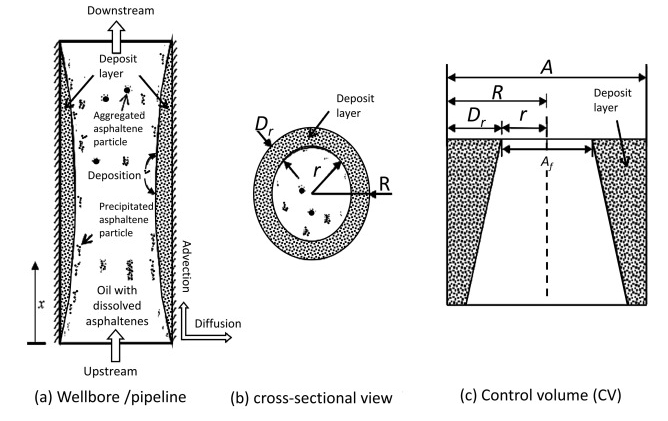
The low asphaltene-flocculation of the Who Dat field is fortuitous since asphaltenes can accumulate and choke the well bore or downstream piping, interfering with recovery. The graphic below is borrowed from a book chapter by Abdullah Hussein, Essentials of Flow Assurance Solids in Oil and Gas Operation, published by ScienceDirect in 2023. Fouling by asphaltenes can be removed by dissolution in aromatic hydrocarbons or detergents.

Source: Chapter 2 – Flow Assurance, Editor(s): Abdullah Hussein, Essentials of Flow Assurance Solids in Oil and Gas Operations, Gulf Professional Publishing, 2023, Pages 53-103, ISBN 9780323991186, https://doi.org/10.1016/B978-0-323-99118-6.00015-0 (https://www.sciencedirect.com/science/article/pii/B9780323991186000150). Reproduction of the graphic above is done under the Fair Use Doctrine.

As asphaltene-bearing oil rises in the wellbore, it will begin to depressurize and cool causing the asphaltenes to precipitate out of solution and aggregate, resulting in flocculation and fouling of the wellbore, downstream equipment and pipelines.

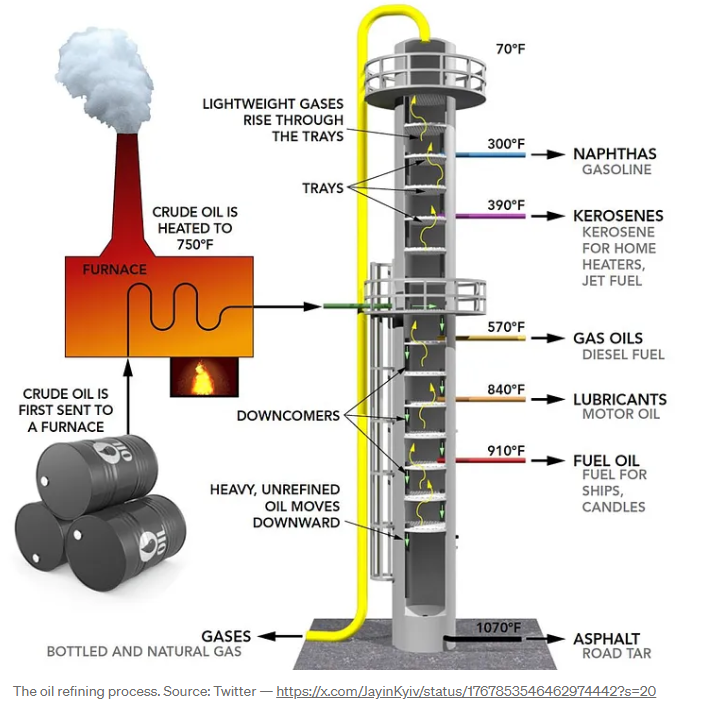
Graphic: Note that the higher the boiling point (heavies), the lower on the column a fraction is drawn from. In particular the asphalt fraction must remain quite hot to assure that it can flow away. The low boiling point fractions (lights) are vented off and sent elsewhere for processing. The graphic is sourced from here under the Fair Use Doctrine.

The simplified cartoon of a distillation column above shows that used in petroleum refining to isolate hydrocarbon components (fractions) in broad groupings by boiling point. These columns are quite tall and can be spotted easily as you drive by a refinery. Crude oil has suspended solids that are removed by water extraction which is then vaporized in a separate furnace under pressure. This hot, crude vapor is then pumped into the bottom of the distillation tower. For the non-industrial chemists out there who are accustomed to heating a reaction or distillation vessel directly nested in a heating mantle, this offset heat exchange approach is quite common. The fuel for the furnace can be several in-house sources.

Crude oil is a highly complex mixture of hydrocarbons and NSOs (nitrogen, sulfur, oxygen and heavy metals) with a broad range of structures and boiling points. These petroleum hydrocarbons contain a bit of nitrogen, sulfur and oxygen, produced water, natural gas, and inorganics. The hydrocarbons are further divided into linear, branched, aromatic/nonaromatic and cyclic carbon skeletons in which each can be subdivided again into differing molecular formulas and degrees of unsaturation. At this point the reader may need to take a cool refreshing dip into the pool of chemical bonding and the covalent bond in particular because this has a direct bearing on degrees of unsaturation.

A swerve into the weeds of chemical bonding

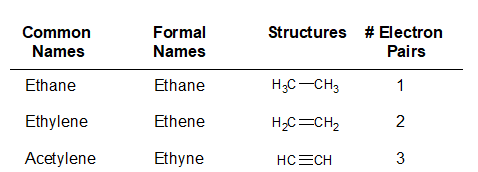
Here is the long and short of how the different types of chemical bonds affect the formula and structure of a molecule. Carbon atoms make up the skeleton of a molecule and are connected through the sharing of electron pairs. The shared electrons in a bond spend some fraction of their time in orbit between the two carbon nuclei and as such continue to screen out some of the mutual repulsion of the two nuclei. But that is not all. It turns out that this is where quantum mechanics rises from the murky depths of reality. The two bonding electrons are each able to occupy more space than what is available in the individual atoms and so drop in overall energy just a bit. This energy drop is manifested as heat which diffuses into the local environment. The amount of energy lost consists of a discrete quantity of electron orbital energy and occurs in a stepwise manner. This discrete step change is a “quantum jump”. [Note: a ‘quantum jump’ is often portrayed in the popular media as some type of Disneyesque dramatic and abrupt big shift in something or other. In reality it refers to a discrete step change in energy at the sub-nanometer scale.]

Graphics by Fred Ziffel. Each line between the Carbon atoms represents one pair of bonding electrons.

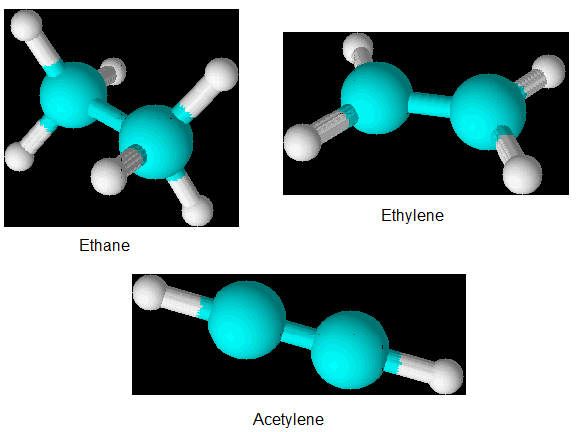
The number of bonds between the carbon atoms has consequences in the 3D shape of the molecule. In the 3 ball and stick representations below, only skeletal single bonds are shown (for reasons known only to ChemSketch).

Graphics by Arnold Ziffel. Bonds number 2 and 3 are omitted in Ethylene and Acetylene to emphasize the shapes. Note the flat planar shape of Ethylene compared to Ethane.

But what do you mean by ‘aromatic’?

The aromatic feature of a molecule is very special. It has a unique type of pi-bonding involving ‘special’ numbers of bonding electrons arranged in a ring and limited by the formula (4n + 2), where n is a counting integer. For n = 0, 1 2, etc., the numbers of electrons involved will be 2, 6 and 10 bonding electrons alternating in a ring. The most frequent ‘special’ number of electrons is 6, as in 3 alternating pairs of 2 electrons. Here, aromatic does not refer to fragrance, although many aromatic compounds like vanillin do have a fragrance. A cyclic group of 3 alternating bonding pairs of electrons will spontaneously ‘delocalize’ and occupy a lower energy level- a much-favored situation. That is, they will circulate around in a continuous ring and occupy a space above and below the ring atoms in a ‘sandwich’ fashion. Okay, we’re drifting a little too far into the weeds.

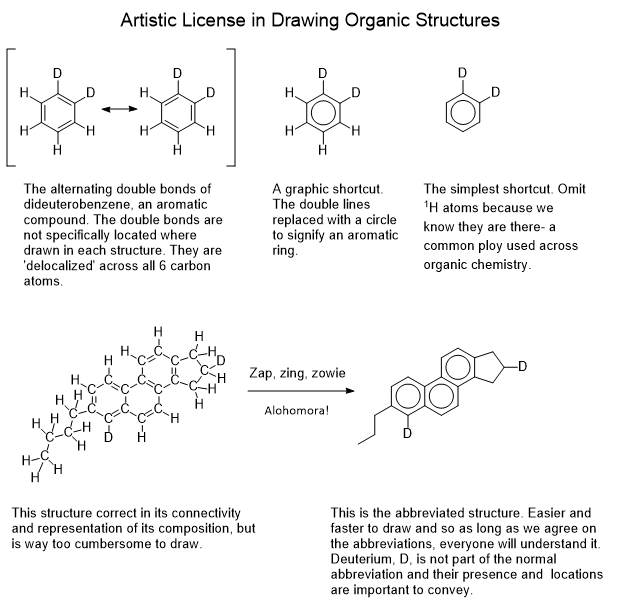
Graphics by Arnold Ziffel. Organic chemists draw a lot of chemical structures and, frankly, it can become tedious. To make life easier, certain graphical norms have arisen to stem the tedium.

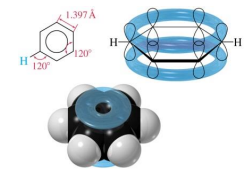
Knowing full well that I am presenting a highly truncated explanation of aromaticity, I have borrowed 3 representations below of the aromatic compound benzene. Given that single C-C bonds are longer than double C=C bonds, one might expect to find that with both C-C and C=C bonds present, 3 bonds would be longer than the other 3. But this isn’t what’s observed. Measurements show that all 6 CC bonds are of the same length, 1.397 Angstroms. And the CC bond angles are all 120 degrees, again different from C-C bond angles. These observations tell us that all 6 CC bonds are equivalent yet different from isolated CC bonds. Note in the upper right structure the 2 blue rings situated above and below the carbon skeleton. These rings represent delocalized electrons that are off-axis to the C-C bonds. They sandwich the carbon skeleton of C-C bonds. The blue rings show the space where the 6 C=C bonding electrons may be found. The bottom structure is a space filling model showing approximately the space occupied by the electron cloud. Think of it as the location of where another molecule will collide with it.

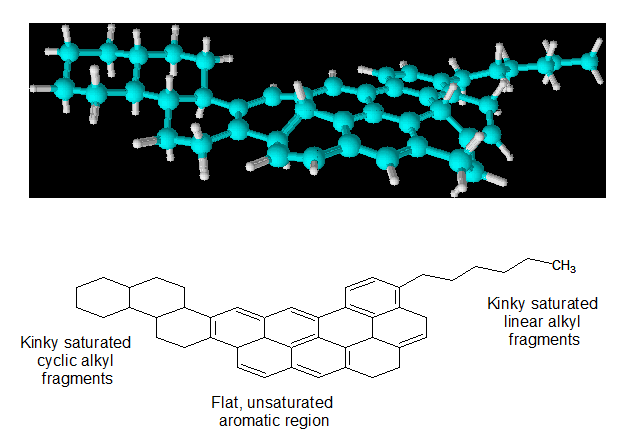
The imaginary large molecule shown below consists of a central region that is flat and two domains that are kinked and bristling with hydrogen atoms. The structure is shown stationary but in reality, it is vibrating vigorously, tumbling in solution, being battered by adjacent molecules and mashing its way through any liquid that may be around it. You know, the usual liquid scenario. The cyclic alkyl groups on the left are locked in space allowing only limited wagging motion, but the alkyl group on the right is free to rotate about all of the C-C bonds allowing the chain to writhe and snake around in its immediate 3D space.

Graphics by Sam Hill. 3D and 2D structures of an imaginary asphaltene. The aromatic section of the molecule is flat while the alkyl parts are kinked and bristly.

Above I referred to “… the sharing of a pair of electrons.” This is only just 1 part in a story of several kinds of chemical bonding. One carbon atom can bond to another carbon atom with 1, 2 or 3 pairs of electrons, producing 1, 2 or 3 chemical bonds. Carbon can also bond by sharing electrons (covalent bonding) with other atoms like nitrogen, oxygen and sulfur to form single or multiple covalent bonds. Atoms like hydrogen, boron, fluorine, chlorine, silicon, phosphorus, bromine and iodine bond well with carbon but with only a single bond. In general, as we move to the left and down on the periodic table the sharing of electron pairs becomes more and more one sided favoring the atom nearest to the upper right of the table. [Note to the purists: we are going to ignore carbanions, carbocations and carbenes in this post.]

Back to our regularly scheduled program

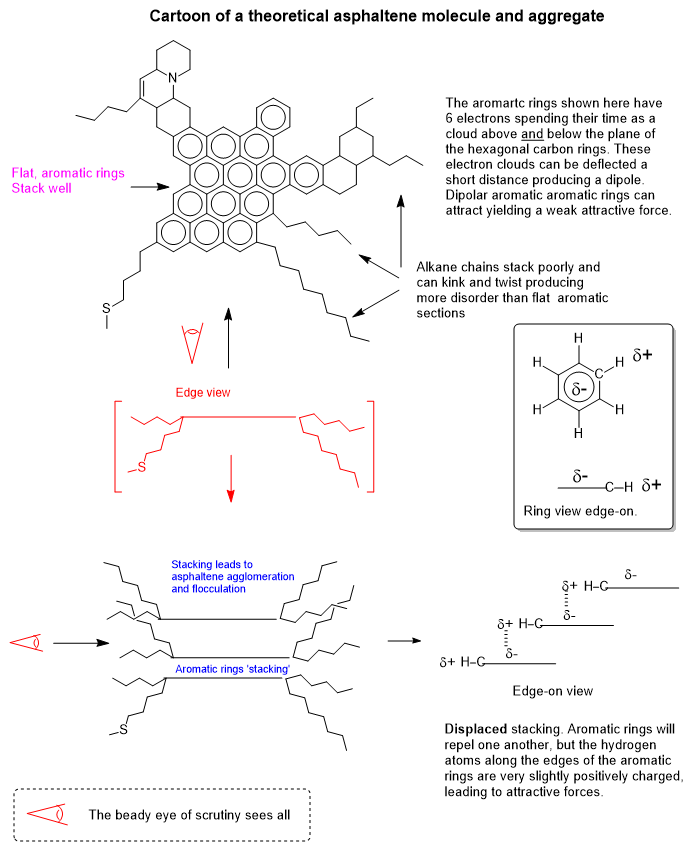
So what does all this bonding jazz have to do with asphaltenes? The type of chemical bond that makes aromatic rings flat, the pi-bond, is very abundant in asphaltenes. An aromatic ring of 6 carbon atoms has 3 alternating pi-bonds. Such compounds are commonly referred to ‘unsaturated’ meaning they have multiple bonds between carbon atoms rather than bonds with hydrogen- they are unsaturated with hydrogen atoms. These molecules consisting of hexagonal arrays, sharing edges like a thin honeycomb and are able to stack on one another- sometimes called pi-stacking.

Graphics by Arnold Ziffel. Agglomeration is when stacks of asphaltene begin to form. Flocculation is when groups of agglomerated asphaltenes mass together.

The asphaltene component of asphaltene (!?!) has been defined as that fraction which is soluble in aromatic solvents like benzene, toluene and xylene, etc., but not in alkane solvents. From this link, “Asphaltenes are referred to [as] the poly-dispersed distribution of the heaviest and most polarizable fraction of the crude oil.” This property derives from the large fraction of aromatic structures in the asphaltene.

Asphaltenes are a complex mixture of hydrocarbons containing variable amounts of nitrogen and sulfur atoms built into the structures. As a category, asphaltenes are substantially aromatic in nature with rather high molecular weights but may have cyclic and acyclic saturated hydrocarbon, or alkyl, fragments attached. These alkyl fragments lend solubility of individual asphaltene components in saturated hydrocarbon solvents (alkanes) and thus offer a means of semi-selective isolation. Maltenes are asphaltene components that are viscous liquids soluble in n-alkane solvents. Maltenes provide the adhesive qualities in asphalt. Asphaltene is divided into 2 fractions: Asphaltene and Maltene.

The words asphalt and bitumen are sometimes used interchangeably, both referring to the same material. Asphalt is the American English version. To help avoid confusion, the terms “liquid asphalt”, “asphalt binder” or “asphalt cement” are used in the U.S. to distinguish it from asphalt concrete. We recall that concrete is comprised of aggregate held together by cement.

Colloquially, various forms of bitumen are sometimes incorrectly referred to as “tar“. Asphalt or bitumen occurs naturally or can be manufactured. The roadbeds we drive on are “asphalt concrete” where stone aggregate is mixed with hot liquid asphalt as a binder that upon cooling forms a hard, durable surface. In common usage “asphalt concrete” is shortened to asphalt while the British call it tarmac.

Thus far, we have been talking about crude oil-based asphalt. Roughly similar materials like tar or coal tars are derived from sources other than petroleum. Generally, the words tar and pitch are used interchangeably but each can be considered specific to separate starting materials. Tar is a dark brown or black viscous liquid and is the result of the destructive distillation of a wide range of organic materials like wood, peat, coal. or petroleum. Pitch derives just from plant material.

In the early 1960’s, Dr. Fritz Rostler and coworkers of the Golden Bear Oil Company, now Tricor Refining LLC, discovered the cause of asphalt deterioration. He found that during the heat treatment used in asphalt processing and/or under prolonged exposure to sunlight in the presence of oxygen, the maltenes are degraded and their adhesive attribute is diminished, allowing the asphalt/aggregate components to crumble.