Gaussling is a senior scientist in the chemical business. He occasionally breaks glassware, spreads confusion and has been known to generate new forms of hazardous waste. Gaussling also digs aerospace, geology, and community theatre.
Congratulations are in order to India’s space agency, the Indian Space Research Organization (ISRO), on their successful moon landing with Chandrayaan-3. This is a great achievement for any organization and India well deserves their feeling of pride in the accomplishment.
A soft touchdown on the moon is a challenging task every time it is done and requires that a great many systems in a lengthy sequence of events perform perfectly. Presently, the rover has deployed properly and is in motion.
The Chandrayaan-3 spacecraft is comprised of a propulsion module, a lander and a rover. Each is equipped with scientific instrumentation.
Lander
Chandra’s Surface Thermophysical Experiment (ChaSTE) will measure the thermal conductivity and temperature of the lunar surface.
Instrument for Lunar Seismic Activity (ILSA) will measure the seismicity around the landing site.
Langmuir Probe (LP) will estimate the near-surface plasma density over time.
Rover
Alpha Particle X-Ray Spectrometer (APXS) will derive the chemical composition and infer the mineralogical composition of the lunar surface.
Laser-Induced Breakdown Spectroscope (LIBS) will determine the elemental composition (Mg, Al, Si, K, Ca, Ti, Fe) of lunar soil and rocks around the lunar landing site.
Propulsion module
Spectro-polarimetry of Habitable Planet Earth (SHAPE) will study spectral and polarimetric measurements of Earth from the lunar orbit in the near-infrared (NIR) wavelength range (1–1.7 μm [3.9×10⁻⁵–6.7×10⁻⁵ in]).
Russia’s Roscosmos Space Agency suffered a setback in its moon landing ambitions with the loss of its Luna-25 lander. Launched August 10 from the Vostochny Cosmodrome in southeastern Russia, contact with the craft was lost after a command was sent for it to lower its orbit around the moon. By August 20 Roscosmos had to conclude that the vehicle had impacted the moon. This was the first Russian attempt to land a probe on the moon since Luna-24 in 1976. The goal was to land at the 100-kilometre-wide Boguslawsky crater.
I’m in the middle of sorting through government regulations and I thought I’d pass along some definitions to help grasp just What. The. Hell. Is. The. Difference between the United States Code, U.S.C., and the Code of Federal Regulations (CFR). The EPA has a website that describes the regulatory process.
First in the sequence, bills are written, debated, and voted upon. The legislative branches write a law and the President signs it or does not. If signed the law is sent for inclusion into the U.S.C.
Next the new law needs to be “codified” into the United States Code. This is the official compilation of US Federal law and is published every 6 years. In between publications, annual cumulative supplements are published.
Once codified in the U.S.C., the government agency tasked with putting the law into effect (promulgation) may (or may not) rewrite the code into a comprehensible form that can be understood by the public. The relevant agency is also responsible for enforcement.
Regulations Can Expandor Evolve
If the agency becomes aware of issues in need of regulation, it may generate new regulation and place a “Notice of Proposed Rule Making” in the Federal Register for public study and comment.
After the comment period, the agency may or may not update the proposed regulation(s) and issue a Final Rule. The Final Rule is then published in the Federal Register.
Regulations are codified in the official Code of Federal Regulations (CFR). The CFR is split into 50 subject matter categories called “Titles.” An electronic copy of the CFR called eCFR and is kept online at this link.
(This is a 2012 post that I’ve dredged up to run through the mill again.)
Poltroon University, Guapo, Arizona. A scandal has rocked the Institute of Quantum Cogitation at Poltroon University. A graduate student and supervising faculty member stand accused of academic fraud. The office of University Chancellor Clodagh A. Gatwick released a statement indicating the matter was under internal investigation.
Associate professor Corey Irwin was placed on administrative leave while the graduate student, Ragnar Ostrom, faces possible suspension.
Irwin and Ostrom were initially accused of falsifying results from a series of thought experiments published in Physics Expecta Acta, 2007, Section B, 256-278. However, it was later determined that the falsified thought experiment results were in fact plagiarized from a future thought experiment to be published by Faroe Island physicists Spotsandottir and Dotsson. The two physicists were surprised to learn that their work was being usurped by other workers.
The Society of Thought Experimentation was contacted for comment but issued a press release stating the Society was still imagining what it’s position would be.
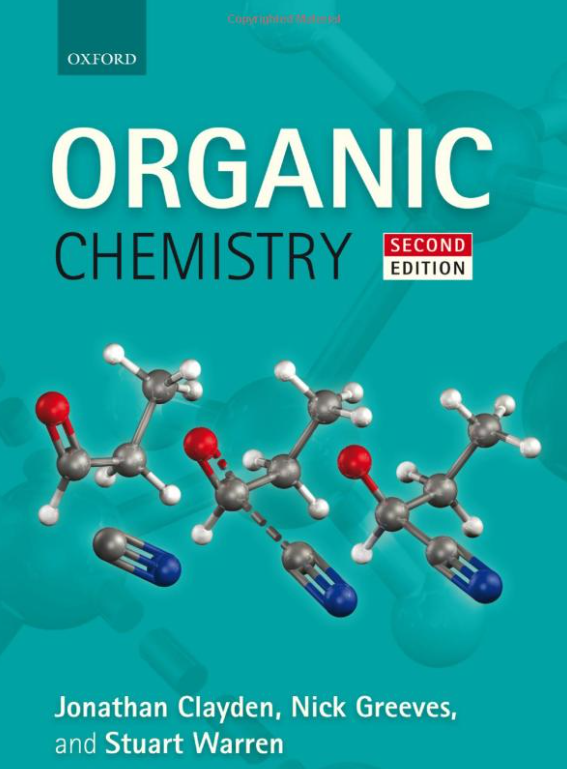
On occasion I step off the industrial hamster wheel for a few minutes to have a look around. In Linkedin this morning I saw a post for the 2nd edition of Organic Chemistry by Jonathan Clayden (Author), Nick Greeves (Author), Stuart Warren (Author), Oxford University Press, ISBN-13 : 978-0199270293. From inside the hole along the creek where I spend my free time, I was never aware that Warren had an O-chem textbook.
Amazon allows you to examine a bit of content on-line. If you teach O-chem, this text is worth a look in my estimation.
Many of us are familiar with Warren from his bookOrganic Synthesis: The Disconnection Approach, 1st edition 1982. A second edition was released in 2008. Retrosynthesis was spreading around to the far-flung corners of the chemistry polygon then. Warren’s book was quite useful in demonstrating that technique for devising an organic synthesis.
An interesting interview of Warren can be found at The Skeptical Chymist from 2009. Warren died in 2021 at age 81.
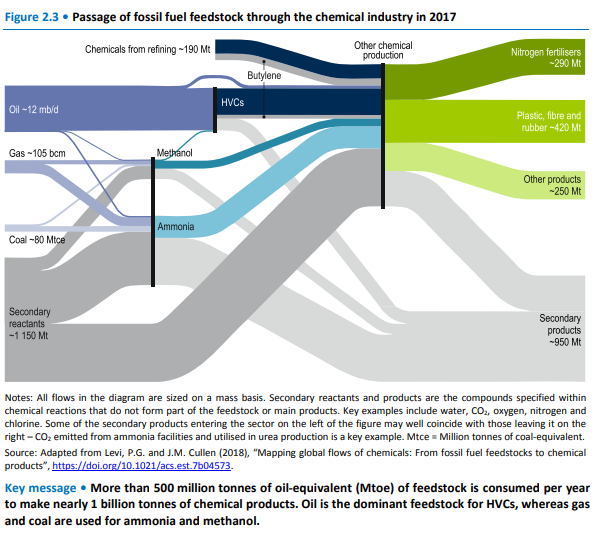
I am asking this question because the transition away from fossil fuels will have a serious knock-on effect on a very large sector of the global economy. Of the total liquid hydrocarbon production, 14 % goes to the petrochemical markets. Of natural gas production, 8 % goes to petrochemicals.
There is a serious complication connected with the idea of shutting down the combustion of hydrocarbon fuels. The elimination of oil and gas combustion activity means that crude oil production drops precipitously and therefore so would refining. Oil refineries are designed to maximize the volume of their most profitable products while minimizing their cost to manufacture. I refer to gasoline, diesel and aviation fuel. Petrochemicals come from oil and gas. Their economics ride on the coattails of fuel production to some extent in terms of scale. Refineries are physically large operations so as to operate with the maximum economy of scale. Maximum economy of manufacturing scale drives consumer prices downward.
Refineries produce much more than fuels. They produce asphalt, lubricating oil, polymer raw materials, petrochemicals for pharmaceuticals and other raw materials for thousands of products we take for granted. There are countless uses for petrochemicals beyond throw-away plastic bottles and bags. Just look around where you are sitting this very moment. Unless you are in Tierra del Fuego or Antarctica, you can’t help but see examples of hydrocarbon applications.
“Our economies are heavily dependent on petrochemicals, but the sector receives far less attention than it deserves. Petrochemicals are one of the key blind spots in the global energy debate, especially given the influence they will exert on future energy trends.” Dr Fatih Birol, Executive Director, IEA
Could refineries adapt to the loss of a large fraction of their fuels production and still produce petrochemicals? Engineering-wise, I’d say yes. But as far as economics go, that is a harder question to answer. Company officers have a fiduciary responsibility to the stockholders. This is a baked-in feature of corporate business. The promise of ever-increasing margins and volumes is part of that. Switching gears towards sustaining the petrochemical sector in the face of declining fuel sales is natural in one sense, but if it involves declining EBITDA over time, it could be disastrous for the stock market. Petrochemical prices might have to climb drastically to sustain earnings. Players in the global oil & gas market are extremely twitchy. The mere suggestion of a potential problem is enough to send prices soaring or diving. Luckily, a wind-down of fuel production will take some time during which the players might be able to compensate.
Look around you. How many consumer goods come in plastic containers or plastic film-coated paper? All of our electronic devices are built into casings of some sort, most of which have plastic or fiberglass (resin impregnated glass fiber) components. The list is endless. For many or most of these things to stay on the market, a substitute material will be needed to replace the hydrocarbon-based materials. Wooden casings for computer monitors and iPhones? What about paint? Paint is loaded with hydrocarbon components.
A vast number of products we take for granted use hydrocarbon materials in some way. Perhaps renewable plastics will scale to meet certain demands. Recycling applies only to those plastics that can be melted- the thermoplastics. Thermoset plastics like melamine cannot be melted and so cannot be recycled. Recycling only works if consumers close the recycling loop. Plastics must be carefully sorted in the recycle process. When a mixture of plastics is melted, the blend can separate like oil and water producing inferior product. National Geographic has a good web page describing recycling.
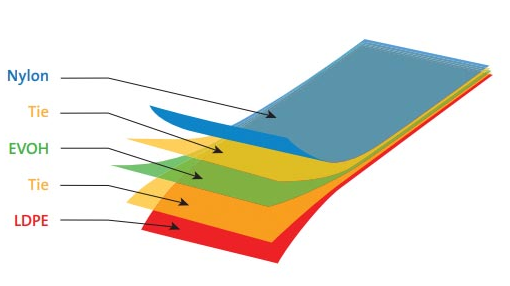
Some plastics such as clear, colorless polyethylene films are usually pure polymer. Most synthetic polymers are colorless. In general, any synthetic polymer that is colored has pigments in it. Black plastic is loaded with soot for instance. Many polymer films for packaging are multilayered with different types of polymer layered together.
Waste thermoplastic with food residues is very problematic, especially those with oil residues. Waste plastic for recycle must be clean. Multilayer plastic films are not suitable for recycling either.
Source: Technical Bulletin, Saint Gobain. Multilayer film structure with 3 different films and two tie layers between them. The Nylon layer provides toughness and tear resistance. The polyethylenevinyl alcohol (ethylene-vinyl chloride copolymer) layer (EVOH) blocks the transmission of oxygen and carbon dioxide. Low density polyethylene (LDPE) layer provides broad chemical compatibility along with biocompatibility for safe handling of biopharmaceuticals. Not all polymers are compatible with melt bonding. The tie-layer is a melt-bondable adhesive polymer film that hold the layers of polymer into a single film. The tie layer polymer is often a polyethylene film that has a surface layer of organic acid or anhydride groups that can bind to other polymers by melt bonding.
Other additives such as plasticizers are present in flexible plastics like polyvinyl chloride (PVC) or other compositions where suppleness is important. Pure PVC is rigid. Additives are an industry unto its own. The varieties and grades in the plastics business is mind boggling. The variety of plastic compositions is too diverse to allow recycling of all plastics.
The point of this plastics background is to suggest that there are so many types and blends of plastic on the market- which is made even more complex by labels and additives -that the scope of polymer recycling must be narrowed to a few of the larger volume plastics. This is what is done today. LDPE, PP and PETE are the major polymers that are recycled in the US. Apparently, Japan is good at recycling. We in the US do poorly.
Polymer manufacturing is likely to continue indefinitely. There is simply too much money at stake for the big oil & gas and petrochemical players to deconstruct themselves to a large extent. They will, however, follow the consumer, but how far?
So, the question is this- for the sake of keeping a viable petrochemical stream in place while hydrocarbon fuel consumption declines, how much hydrocarbon fuel can we burn per year without exceeding the capacity of the earth to absorb the CO2 produced? We want to lower the slope of the atmospheric CO2 curve enough to achieve a reasonable steady state. The global economy depends very much on the production and use of petrochemicals. People will generally avoid economic suicide.
Where is the balance point for a sustainable production of necessary petrochemicals and the decommissioning of hydrocarbon fuel production? I certainly don’t know.
Note: Below is a quick safety brain-dump from a career in academic chemistry labs and chemical manufacturing facilities. It is not meant to be an unabridged guide to lab safety. Look elsewhere for that. it is easy to overlook Safety Data Sheets that come with chemical purchases.
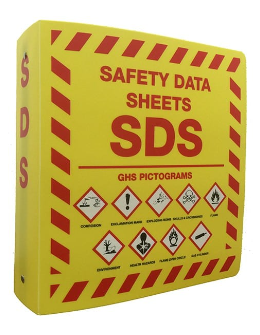
At some time in their chemistry education the student should have had a good look at the chemical Safety Data Sheet or SDS for the chemicals and solvents they are using. While not necessarily very informative in terms of reaction chemistry, these documents are taken very seriously by many groups who can/will have an impact on your chemistry career and safety. Regardless of your walking-around-knowledge about a chemical substance, you should understand that the people who respond to emergency calls for a chemical incident will place a high reliance on what is disclosed on an SDS. A student who is connected with an incident won’t be the first point of contact when the fire department or ambulance arrives and wants information. In fact, it is highly unlikely that a student will ever have direct contact with a responder unless it is with an EMT.
Know where the SDS folder is. It may be in print or online.
When emergency responders arrive at the scene of your chemical incident, they will have protocols built into a strict chain of command. All information will pass through the responder’s single point of contact. The fire fighter with the fire hose is not the person you should try to communicate with. Information regarding the incident must be communicated up the chain of command from your site incident commander. The person responsible for the lab should know who that is. The staff at the incident site (your college) will also have protocols built onto a chain of command. Again, “ideally” the incident commander at the incident site will ask for information from others on the site regarding details on the event including the headcount (!) and communicate it to the incident commander of the responders. This is done to avoid confusing the responders with contradictory or useless information. Do not flood the responders with extraneous information. Don’t speak in jargon. If there are important points like “it’s a potassium fire”, pass it along. If there are special hazards like compressed hydrogen cylinders present, they’d like to know that too. Answer their questions then step back and let them do their job.
When responders arrive at the scene of a chemical incident, the first question they will ask is if everyone is accounted for. If everyone is accounted for, they will not risk their lives in the emergency response. However, if there are people unaccounted for or known to be trapped in a dangerous place or incapacitated, the responders will take greater chances with their own safety to rescue the victims. They will act to minimize property damage only if it can be done without risk to life and limb. Nobody wants to die saving property.
College chemistry departments that I have been involved with have had a flat policy of evacuating everyone from the building and congregating them at a defined location in response to an alarm. That way there is at least some reasonable chance that an accurate head count can be made. If technical advice is needed, faculty connected with the incident site should be consulted. The college will have an Environmental Health and Safety (EH&S) group or person who presumably will take charge of the incident on the incident side. The leader of EH&S should be informed of any hazards unique to the substance of concern if there is no SDS. Let them communicate with the responders. Generally, we chemists help most when we keep out of the way.
College chemistry departments are famous for housing one-of-a-kind chemical substances in poorly labeled bottles in faculty labs. These substances almost never have any kind of safety information other than perhaps cautionary advice like “don’t get it in your eye.” Luckily, university research typically uses small quantities of most substances except perhaps for solvents. Solvents can easily be present at multiples of 20 liters. These large cans are properly kept in a flammables cabinet. While research quantities may not represent a large fire hazard initially, there could easily be enough to poison someone. When you get to the hospital, the ER folks will have to figure out what to do with your sorry ass lying there poisoned by your own one-of-a-kind hazardous material.
In principle, the professor in charge of a chemistry research lab should be responsible for keeping an inventory of all chemicals including research substances sitting on the shelf. Purchased chemicals always have an SDS shipped with them. These documents should be filed in a well-known location and available to EH&S and responders.
The chemistry stockroom is a special location. Chemicals are commonly present at what an academic might call “bulk” scale, namely 100 to 1000 grams for solids and numerous 20 L solvent cans. The number of kg of combustibles and flammables per square meter of floor space is higher here. The stockroom manager should have a collection of SDS documents on file available to responders.
Right or wrong, people positively correlate the degree of hazard to the nastiness of an odor. Emergency responders are no different. This is another reason why it is critical for them to have an SDS. People need to adjust their risk exposure to the hazard present as defined by an SDS. We all know that some substances that are bad actors actually have an odor that is not unpleasant for a short time, like phosgene. Regardless of this imperfect correlation, if you can smell it, you are getting it in you and this is to be avoided. Inhalation is an important route of exposure.
In grad school we had an incident where a grad student dropped a bottle in a stairwell (!) with a few grams of a transition group metal complex having a cyclooctadiene (COD) ligand on it. Enough COD was released into the stairwell to badly stink it up. They didn’t know if it was an actual chemical hazard or not, so they pulled the fire alarm handle. The Hazardous Material wagon showed up right next to 50-60 chemistry professors, postdocs, and grad students. The responders were told what happened and with what, so they dutifully tried to find information on the hazards in their many manuals. They did not find anything.
They had 50-60 chemists within spitting distance but didn’t ask us any questions. This is because they are trained to respond as they did. This was a one-off research sample of a few grams but it had an obnoxious smell with unknown hazards. Finally they sent in some guys in SCBA gear and swept up the several grams of substance and set up a fan for ventilation. Don’t be surprised if the responders don’t have special tricks up their sleeves for your chemical event. They can’t anticipate every kind of chemical incident.
Long story short, both the responders and the chemists didn’t have any special techniques tailor made for this substance. There was not evident pyrophoricity or gas generation. It was a dry sample so no flammable liquids to contend with. The responders used maximum PPE and practiced good chemical hygiene in the small clean up. Case closed.
An SDS is required for shippers as well. It shows them how to placard their vehicles according to the hazards. Emergency responders need to see the SDS in order to safely respond to an overturned 18-wheeler in the road or to a spill on a loading dock. It could also be that the captain of container ship wants to know precisely what kind of hazardous materials are visiting his/her ship.
Finally, an SDS should be written by a professional trained to do it properly. By properly I mean by someone who understands enough about regulatory toxicology, emergency response, relevant physicochemical properties, hazard and precautionary statements and shipping regulations to provide responders with enough information to respond to an incident. Here, incident means an unexpected release with possible exposure to people, a release into the environment or a fire or possible explosion.
In my world, the word “accident” isn’t used so much anymore. With the advent process hazard analysis (PHA) required by OSHA under Process Safety Management prior to the startup of a process, potential hazards and dangers are anticipated by a group of experienced experts and adjusted for. So, it is getting harder to have an unexpected event. “Accident” is being replaced with the word “incident.”
Toxicology is a specialty concerned with poisons. Regulatory toxicology refers to the field where measurements and models are used to define where a substances belongs in the many layers of applicable regulations. Toxicity is manifested in many ways with many consequences and each way is categorized into levels of severity. There is acute toxicity and there is chronic toxicity. Know the difference. That said, dose and exposure are two different things. Exposure relates to the presence of external toxicants, i.e., ppm in water or micrograms per cubic meter of air. Dose relates to the amount of toxicant entering the body based on the exposure time in the presence of a toxicant and the route of entry.
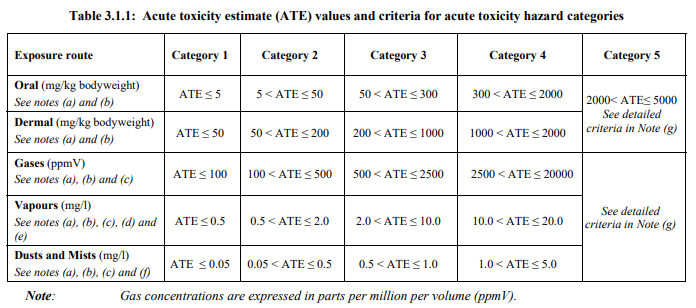
An SDS uses signal words like “Caution”, Warning”, or “Danger”. A particular standard test is needed to narrow down the type and magnitude of the toxicity. The figure below from the GHS shows the thresholds for categorization of Acute Toxicity.
Hazard and precautionary statements are important for an SDS. Rather than having everybody dreaming up their own hazard descriptions and precautions, this has been standardized into agreed upon language. Among other sources, Sigma-Aldrich has a handy list of Hazard Statements and Precautionary Statements available online.
Regulatory toxicology is very much a quantitative science enmeshed with a web of regulations. The EPA for instance does modeling of human health and environmental risks based on quantitative exposure or release inputs. Without toxicological and industrial hygiene testing data, they may fall back on model substances and default, worst case inputs to their models. In reality the certain hazard warnings you see on an SDS may or may not be based on actual measurement. The EPA can require that certain hazard statements be put on a given SDS based on their assessment of risk using models or actual data.
To be clear, hazard information reported on an SDS are considered gospel to emergency responders. Chemists of all stripes should be conversant with Safety Data Sheets and have a look at them the next time a chemical arrives. Your lab or facility should have a central location for SDS documents, paper or electronic.
In the handling and storage of chemicals, some thought should be given as to how a non-chemist would deal with a chemical spill. Is the container labeled with a CAS number or a proper name rather than just a structure? A proper name or CAS # could lead someone to an SDS. Is there an HMIS or other hazard warning label? There are many tens of thousands of substances that are either a clear, colorless or amber liquid or a colorless solid. If not for the sake of emergency responders then for the poor sods in EH&S who will likely have to dispose of the stuff when you are long gone. Storing chemicals, liquids especially, with some kind of secondary containment is always a plus. Keep the number of kilograms of combustibles and flammables in the lab to a minimum. A localized fire is better than a fire that quickly spreads to the clutter on the benchtop or the floor.
I’ve been struggling to find the words to accurately and succinctly describe MAGA followers in the US with their silly contrarianism and shallow theories of patriotism. I do this because there is something truly peculiar about the shape of conservatism today. I’ve been avoiding the word “stupid” because I didn’t want to hurl the accusation towards people with genuine cognitive disabilities. After all, intelligence is a multilegged attribute that encompasses too many diverse abilities with a single word. But of late I’ve decided that the word is fine to use if you don’t associate it with cognitively disabled people. Online you can find a definition defining it as “behavior or actions that show a lack of good sense or good judgement.” If it isn’t a clean detachment from the cognitively disabled, then at least it is only a superficial scratch.
Ex-president #45 took a sharp swerve from the “norms” of American politics and examples are too numerous to list here. His angry movement didn’t fall out of thin air. In the 2016 election he attracted followers by his audacity and with the propaganda engines of Twitter, conservative radio and television news. They were already out there primed by the nascent Tea Party, but along comes #45 giving them a charismatic and bellicose populist leader with a knack for getting on the news. His rhetorical skills are unmatched and he knows instinctively how to attract and excite a crowd. Importantly, he is a master of social media muckraking. He is not in the least inhibited by social norms for civil discourse.
The big hammer that American conservatism wields is the view of the “good us vs the bad them.” Somehow, the “bad them” always involves liberalism. “Them” can be the flavor of the day- immigrants, abortion, Muslims, NATO etc. This is guaranteed to frighten a certain fraction of the electorate. Throw in the eschatology of conservative Christians claiming that American politics will lead to or accelerate the end times and you have potent brew of dread fear.
Just to be clear, in US history there have never been long stretches of time when citizens frolicked innocently in green pastures of civility and peace was upon the land. There has always been turmoil and hardship somewhere for someone. We’ve always had murderers and thieves preying on the innocent and unwary. Yet the US experiment with democracy and capitalism overall has thrived, dipped and recovered over time. Somehow, Americans have avoided fascism. Until now.
There have always been exceptional people in the world who were able to rally groups for an epic cause, whether it was for military, political or religious purposes. It is the story of history. Today is no different, although the means and speed of persuasive communication has advanced considerably. After the invention of the printing press, there was opposition by religious leaders claiming that easy and rapid availability of information or propaganda would destabilize their personal view of how the social order should be. Since then, ideas of all sorts have found their way into the minds of the masses at increasing speed to this very day. Today, populist rhetoric and opinion can travel internationally at speeds limited only by the clock speed of computers and the speed of light.
There has always been a fraction of any population that gets agitated or frightens easily. Fright can come from direct experience or persuasion. Anything that threatens perceived safety, stability or income will unnerve people to some extent and some much more than others. It is called economic disenfranchisement and it is widespread in the US. Money equals power and lacking it means that one is not invited to the party.
The feeling of being cheated also agitates people. And this is where #45 excels. Unfortunately, in the US there is a large group of people that have not been able to fully enjoy the fruits of our civilization. For many reasons they have been passed over in terms of opportunities to advance or just keep up with the times.
One effect of technological advance is the obsolescence of labor-intensive jobs. Labor costs are always a target for innovators and businesspeople in the eternal march towards greater efficiency. This has been happening since the invention of the wheel. Any given task can be the target of cost reduction by lowering of the headcount. It may seem coldhearted but, in society, it is as ever-present as gravity.
People who lack valuable skill sets or those made obsolete by technology or corporate maneuvering are at a serious disadvantage in American society. People who chose life paths that did not include educational enrichment such a trade school or college have long been at a disadvantage. A comfortable retirement after a lifetime of low wages is difficult or impossible. Some people manage to excel but most don’t. Some start businesses that take off. Most don’t because they don’t know how or lack startup capital. The market can only sustain so many nail salons or restaurants in a given location.
Indicted ex-president #45 discovered his knack for anger politics at some point and jumped on it at a time when conservative electronic media was blossoming. He couldn’t help himself. His authoritarian impulse found a venue in politics and wide acceptance.
The acceptance of authoritarian leadership is particularly stupid for a citizen in a democracy. Our democracy is extremely unusual in human history. Many of us fail to appreciate that.
All of us exhibit stupidity now and then. We all commit “behavior or actions that show a lack of good sense or good judgement.” I do, that much is certain. We live in a time when a great many fellow citizens assent to a movement that, in the end, is not to their best interests. Not all stupid behaviors are equal in magnitude or in the kind of harm produced. It seems to me that gladly accepting authoritarian leadership in anger is especially stupid. Democracy once forfeited is not easily retrieved.
Trading away many of the benefits of democracy for some perceived guarantee of social order is a prelude to dictatorial government. Democracy is inherently chaotic to some extent. This is at the core of the American experiment. In exchange a notch of social order we trade some measure of freedom and liberty. Voting for authoritarian governance is the final act of a democracy.
When I look around I marvel at how quickly some things can happen. How is it that so many people prostrate themselves in front of a madman like Trump since 2015? So many people are able to ignore the lies, aspersions and exaggerations that he casts about, and they even increase their support for the man as the felony indictments accumulate. Who would have guessed that America would fall into this tar pit of absurdity?
I’ve always suspected that the American experiment would collapse at some point, like all empires do. But to do so at the hands of a cartoonish, thuggish wannabe dictator-real-estate-developer-TV-star is just too much to bear. It’s so incredibly disappointing.
The Trump lovers seem unlikely to respond to reason in their lifetimes. They will go to their graves having given themselves to a confidence man who spoiled the American experiment.
Reuters has reported that the crack spread enjoyed by oil refiners is currently sitting around $37.50. The crack spread is the difference between the price of crude oil and the petroleum products coming from it. This number is an indicator of the profitability of refinery output.
Cracking is a major operation at oil refineries where heavy, long chain hydrocarbons are broken into shorter chain hydrocarbons. Crude oil naturally contains a limited amount of components suitable for modern engines. An important attribute is branching. The goal is to produce the most valuable products from otherwise longer chain, lower value hydrocarbons.
A Scratch in the Surface of Gas Chromatography
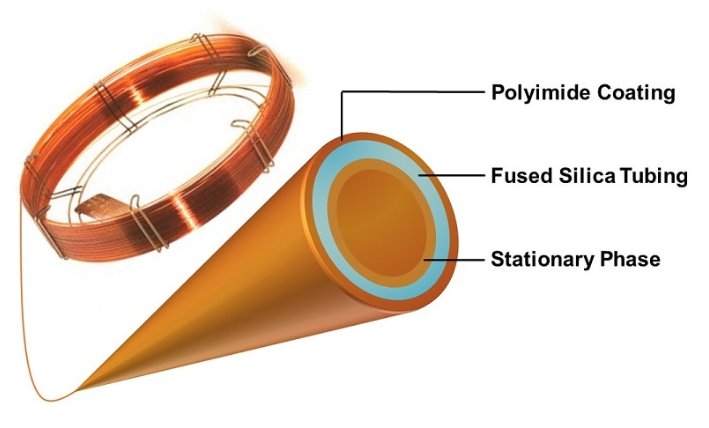
The analytical workhorse of the petroleum refinery is the gas chromatograph, or GC. The GC consists of a precisely controlled oven and within it is a coiled, small diameter hollow fiber many meters in length. It is called a capillary GC column. At one end of the column is an injection chamber with a silicone septum that samples are injected through via syringe. This chamber is hot enough to flash evaporate the sample but not so high that it decomposes. For instance, I have usually used a 250 oC injector temperature. A common volume of liquid to be injected is 1 microliter. The sample can be neat or a solution and must be scrupulously free of particles.
Inside the injector is the carrier gas input- helium is often used. A large amount of the vaporized sample is flushed out of the injector leaving only a small quantity of sample to be injected. Connected to the injector is the entrance of the capillary column. The goal is to inject a very narrow plug of sample into the capillary column all at once. After the injection, the detector is activated and the data collection begins. Progress can be followed in real time or not. Once the sample is on the column the GC run must be taken to completion. There is no reset for the column.
The inside surface of the long capillary column can be just fused silica or it can have a coating. In any case, the components of the sample each have a different affinity for the inner wall of the capillary. As the carrier gas pushes the vaporized sample components along, the components with the least affinity for the inner column surface advance through the column fastest and arrive at the detector earlier. Generally, the higher the molecular weight, the lower the volatility and the longer it takes to exit the column.
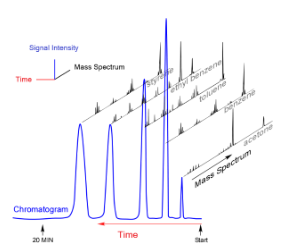
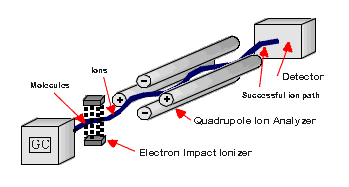
At the terminus of the capillary column is the detector. There are a variety of methods used to detect sample and send a signal to the plotter or computer. A particularly useful type of GC system uses a mass spectrometer as a detector. The flow of components enters an ionization chamber and positive ions are generated by electron impact and sent through the mass analyzer and on to the detector. This is occurring continuously as the sample components exit the column. As the components are detected, a regular chromatogram is collected and displayed. The difference with the mass spec detector is that along the timeline, mass spectra are also collected. It is possible to select any given peak in the chromatogram and display the mass spectrum.
A mass spectrum for every peak. Source: God I hope they don’t mind my using this graphic. American Chemical Society. I don’t need ACS goons banging on my door again!
Graphic from NASA showing schematic of the GC Mass Spec aboard the Huygens probe to Titan.
A mass spectrum detector offers the possibility of identifying the individual peaks from the molecular ion mass and the fragmentation pattern. That said, not all mass spectra are easily interpreted. Only cation fragments are visible. Neutral fragments must be inferred.
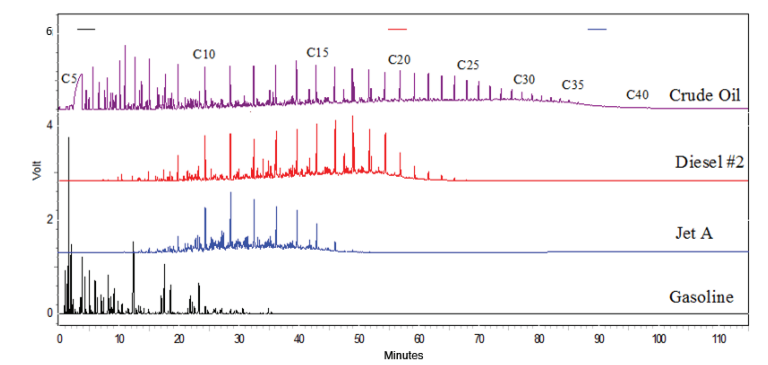
A stack of gas chromatograms showing the components of crude oil and several derived products below it. Each peak indicates a single component with the intensity along the y-axis and time in minutes along the x-axis. The area under each peak is proportional to the % composition in the sample. On the left side of the chromatogram are the components that are more volatile and exit the GC column earliest. The right side shows the components that exited the column after longer intervals. They are the longer chain molecules. Source: IRTC.
Back to the Crack
The most valuable refinery products are gasoline, fuel oil (including diesel), and aviation fuel. Within these three areas are subcategories that split into different product lines. These fuel product categories are defined by the number of carbon atoms in the blend of hydrocarbon molecules, saturation, and branching.
Refineries produce blended fuels affording certain properties according to their use. These properties include boiling point and vapor pressure specifications, octane or cetane numbers, viscosity, and pour point specifications. Between distillation, cracking, aromatization and reforming a wide variety of hydrocarbon substances are available from refining for formulation. A refinery is engineered to produce the largest volume of the most valuable hydrocarbons from continuous flow processes at the greatest profit.
Oh, I was just joking about the ACS goons. They don’t bang on your door.
I received a post card from Ukraine the other day because of a donation I made. It shows an event they are very proud of- the first attack on the Kerch bridge. I’m sure some Ukrainians feel abandoned by NATO’s refusal to let them join, but there is good reason behind NATO’s answer. Russia’s long-standing morbidly paranoid obsession with NATO and the “morally corrupt” West would only be validated by such a move. It would be destabilizing today and would definitely bring us closer to nuclear conflict. To do so today would immediately step NATO into direct conflict with Russia. Ok. Enough from Captain Obvious.
Source: A post card from Ukraine.
After the Russian revolution of 1918, the Bolsheviks tried to capture and Russify the Ukrainian territory. After several attempts in 1918-1922 they relented and Lenin finally consented to give them independence as a state within the Soviet Union. This was not because Lenin was interested in building a Ukrainian state, but rather it was a desperate move to mollify the Ukrainians while allowing the Bolsheviks to keep control over the territory. Lenin did not set out to create Ukraine.
During the early 1930’s, Stalin’s government was busy collectivizing the agricultural lands of the USSR. Collectivizing Ukrainian farmland meant getting peasants, especially those with greater than 8 acres of land (Kulaks) to turn over their land to the collective. This proved to be so messy that eventually Stalin closed off Ukraine and required internal passports. Thus began a 2-year famine leading to mass starvation. Ukrainian crops and animals were systematically removed by the Soviets in what were sometimes called “red trains.” During this time several million Ukrainians were starved to death, executed or imprisoned in a distant labor camp. This period covering 1932 to 1933 is called the Holodomor, or The Great Famine. You can read all about it on the interwebs.
As directed by Putin, Russia is presently attempting to extinguish Ukrainian culture again. The kidnapping of children and shipping them to be raised in Russian homes as well as other forms of Russification in the occupied territories of Ukraine are underway. For the Ukrainians, the Russian invaders are like the Borg from Star Trek in their needy desire to absorb them into their domain- “Resistance is futile.”
It should be remembered that the Ukrainian experience with Russia has been very bad for a long time.
Authoritarianism isn’t just a problem in some eastern European states. Seeds of it are being spread here in the US by a new brand of neoliberal GOP leaders. Many times they have the words “liberty” or “freedom” in the organizations names. This is a disingenuous and underhanded rhetorical maneuver in the same way that countries that use “Democratic” or “People’s Republic” in their names. Using the words “liberty” or “freedom” implies the sacred and wholesome attributes of Patriotism, motherhood and apple pie. Their utopian vision necessarily leads to the demolition of our present liberal democratic society. Neoliberalism is the road to oligarchy.
“Neoliberalism advocates a deregulated, capitalist, globalist market economy, reifies individual greed, and markets a watered-down version of Austrian economics to left-liberals. This ideology manifests as a hybrid between right-and-left liberalism, where the social ideals of left-liberals (particularly, social equality) is attacked via economics and a worldview which views people as only making choices for themselves.”
“Liberal democracy is the combination of a liberal political philosophy that operates under a representative democratic form of government. It is characterized by elections between multiple distinct political parties, a separation of powers into different branches of government, the rule of law in everyday life as part of an open society, a market economy with private property, universal suffrage, and the equal protection of human rights, civil rights, civil liberties and political freedoms for all people.”
Obviously, there is overlap between the two definitions above. Both neoliberals and democratic liberals can be unquestionably patriotic. Where they differ is in their respective overall theories of civilization. As a baby boomer, I watched the funeral of JFK, the Viet Nam War, the Chicago riots, the killings at Kent State, the deceitful Nixon years, all of the moon landings, and everything else to the present day. During this time, semiconductors went from discrete devices to integrated circuits and medicine has advanced to applied biochemistry. All of the sciences have taken advantage of improving technology and have advanced at incredible speed and the unit cost of advanced technology continues to drop. Of course there were bad times, but there were a great many good times as well. The overall result was a good standard of living for most people and freedom from most of the dread diseases of the past. Life spans have increased, an explosion of consumer goods & services providing employment and items making our lives more convenient.
According to the Pew Research Center, 44 % of Republicans and Republican-leaning independents say that the US is giving too much aid to Ukraine. Not only that, but many Republicans are, if not outright admirers of Putin, view him more favorably than Biden, Harris, or Pelosi according to the Economist–YouGov poll of January, 2022. Liz Cheney refers to these people as the “Putin wing of the GOP.” In particular they admire his opposition to NATO, Western liberalism and LGBTQ+ rights. Is this because these Republicans have made a scholarly study of Putin against the backdrop of history and have concluded that he is worthy of their admiration over and above our democratic principles? Or are they parroting some sense of admiration drifting down from the GOP leadership? Decide for yourself.
Fascist, authoritarian leaders throughout history have always drawn the admiration of some fraction of a population. The 20th century alone had many standout examples and the trend continues to this very day. These leaders have convinced millions of people to ignore their own best interests and civil rights to support a cause that may have sounded exciting at a rally but led only to eventual oppression.
The Deep State
It appears that there really is a deep state in the US. It is the dark web of supporters, fund aggregators, lobbyists and fundraisers for the new ultra-conservative Republican party. These people wish to take us in the direction of more authoritarian and White Anglo Saxon Protestant (WASP) governance by gradually normalizing it. It’s like boiling the frog. This is not a Hollywood movie: the good guys could easily lose in the end. Once established, authoritarian regimes tend to last a long time, or at least, to the death of the tyrant. But sometimes the death of the tyrant only leads to continuation by another tyrant.
Trump and his ilk are succeeding in the normalization of regressive policy. Government-hating neoliberals and libertarians like Charles Koch and many others have been funding a movement for the demolition of most of the federal government in favor of a capitalist market-driven neoliberal Shangri-La. Remember when libertarian Grover Norquist said “I’m not in favor of abolishing the government. I just want to shrink it down to the size where we can drown it in the bathtub?” Libertarians and neoliberals aren’t anarchists, they just want the people with money and property to have the major input. Naturally, there is sympathy for this from many resource-heavy people.
Power has been defined as the ability to allocate resources. US national and global power is currently guided by taxpayer funded government. Both the private and public sectors add up to American hegemony. American business trends to increasing consolidation and is dominated by companies with the largest share of the resources. The natural end-state is monopoly. Business leaders piously repeat their appreciation of competition when, in reality, they are always trying to defeat the competition for market dominance. They will claim that market dominance is the ultimate result of achieving their fiduciary responsibilities- maximizing profit for the stockholders.
Boiling it down, libertarians and neoliberals want to abolish much of the state and federal government and focus on some kind of self-regulating market-based system. US economists always say that the market provides the most efficient use of capital. A market-based America will inevitably lead to a monopolistic corporate-based America. This is a system of economics, not governance. A plutocracy does not benefit the majority of us.
American corporations are not democratic in nature and make no pretense of it. They are autocracies ultimately answerable to the stockholders through a CEO and board of directors. State and federal government holds them answerable for adherence to the laws of the land. If there are a large number of burdensome regulations applying to the conduct of business, it is because sometime in the past, some individual or company has committed a harmful act leading to regulatory control. Regulations often stem from the dark side of past human behavior.
Back to Ukraine
Circling back, how does this talk of American politics relate to Ukraine? The Russian invasion of Ukraine and the Chinese threats over Taiwan and the Indo-Pacific region represent a period when major autocracies are pushing their boundaries. Russia is only held back because of NATO and other Western countries. China is held back because of its economic dependence on exports to Western nations who, surprisingly, will band together against them if threatened. I’m sure that they have also noticed that an otherwise simple military action of rolling tanks and troops into a “passive” territory like Ukraine can turn sideways rapidly. If anything, Putin has accomplished the opposite of his strategic goal of splitting up the members of NATO. It is critical now that US politics NOT cause us to abandon world affairs which is where Trump was leading us. The reelection of Trump would be an epic disaster for the free world and democracy.
A United States that tolerates the aggression of Russia or China is a country that cedes its global influence to them. Despite having lots of ugly history and a long list of regrettable decisions, the US remains a place that people want to immigrate to. You don’t hear about boatloads of immigrants attempting to get into Russia. If the US leaves a global leadership vacuum, guess who will jump in to take its place? Another liberal democracy? Seems unlikely.
Americans should remember that in the bathwater of US history there is a baby that needs to be cared for and not thoughtlessly discarded.





 Lamentations on Chemistry