Gaussling is a senior scientist in the chemical business. He occasionally breaks glassware, spreads confusion and has been known to generate new forms of hazardous waste. Gaussling also digs aerospace, geology, and community theatre.
It turns out that I have no aptitude at all for ball sports or dancing. My long suffering spouse has been forced to dance without me. My natural athletic abilities are concentrated on my uncanny ability to jump out of the way or just standing back. This proclivity is rich in survival benefits. For instance, I’ve never torn a ligament sliding into first base or cracked my head on the dance floor. Nor have I ever taken an elbow to the eye in basketball. No abrasions or grass stains from flag football either.
I do rather like to watch rugby though. I admire the pre-game Māori Haka demonstration for its drama and its sincere invitation to rumble. Hockey is another one I can watch at the game. The puck is always in motion. Unlike baseball, with hockey or rugby something is always happening. Even if a rugby player is injured, they continue to play around the body. I admire that.
Baseball games are just too damned long, even with the new rules. Ninety minutes should do it. They just stretch it out for concession sales. Some folks like to guzzle $9 utility beers and gnaw on $14 slices of pizza to the sound of old timey organ music. I can go maybe once a season, but more? Nope.
Watching golf is a colossal snooze fest. I do enjoy watching chess matches though- even that is more exciting than golf. And the muted voices of the announcers as if they have to keep their voices low. Gimme a break. Golf is for idlers. It is a meaningless difficult task. I understand that golf is hard. I just don’t care. My conception of hell involves watching golf in church.
Basketball? If you can dunk the ball, the hoop is just too low. For crying out loud. Enough said.
NFL football? Good gravy. I just watch the last 5 minutes. The manufactured gladiator drama pitting millionaires against each other is just nauseating. And the guys delivering the play-by-play color in the background yammering on about failed strategy as if randomness had no part in it. With all of the rules, it is nearly a technology, not a game.
Soccer? Good grief. Need I say it?
Ok, time to come clean. It isn’t the sports so much as it is the immense crowds at these live events. I truly despise being in a crowd. In fairness, the crowd probably despises me back.
Atomic hydrogen (the major isotope protium) is the simplest, lightest and most abundant neutral atom in the universe. Molecular hydrogen, H2, is the simplest neutral molecule in the universe. Seems very simple. Well, hold on. Turns out that molecular hydrogen has two distinct forms and it relates to the business of nuclear spin.
Quantum mechanics (QM) is a basket of wavy weirdness. It is a model of the universe at the atomic and nuclear levels that is wildly different from the larger scale Newtonian universe of colliding billiard balls we humans casually observe. The QM model of the microscopic universe dates back to the early 1900’s and has been endlessly supported by experimental data, and it continues to surprise to this day. One of the fundamental QM quantities is ‘spin.’
Fundamental particles like electrons and protons have something referred to as spin angular momentum. In the larger scale Newtonian universe spinning is something that we equate with an object that is rotating about an axis. Protons have a measurable diameter- it is a finite sized object with mass, charge and spin. Electrons have mass, charge and spin also. However, electrons do not have a measurable size. They appear to be a point charge. So, how does an electron with no measurable size actually spin? What is it that spins? A point of clarification: Quantum spin has nothing to do with a rotating internal mass. It is a quantized wave property expressed in units the same as classical angular momentum (N·m·s, J·s, or kg·m2·s−1). So, what the hell is quantum spin?
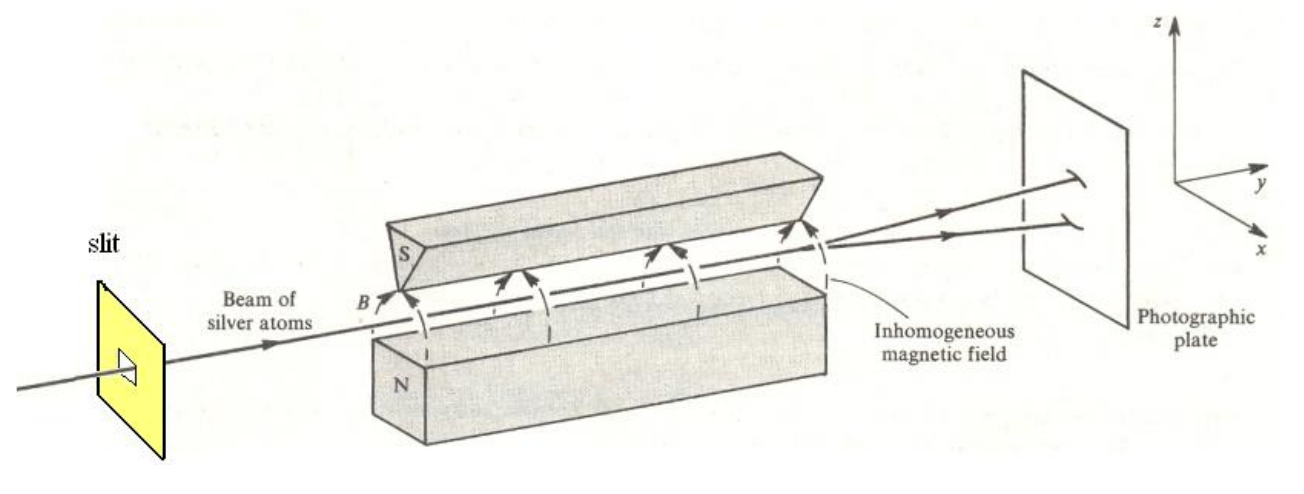
Spin angular momentum was inferred experimentally by the Stern-Gerlach experiment, which was first conducted in 1922. In this experiment, silver atoms were passed through a magnetic field gradient towards a photographic plate. Particles with no magnetic moment** would pass straight through unaffected. Particles with non-zero magnetic moment would be deflected by the magnetic field. In the experiment, the photographic plate revealed two distinct beams rather than a continuous distribution. The results indicate that the magnetic moment was quantized into two states. The magnetic moment at the time was thought to be due to the literal spinning of an electrically charged particle. They deduced that there were two spin configurations- i.e., they were quantized.
If you want to go deeper down the QM rabbit hole, be my guest. We’ll go forward with the notion of spin up and spin down. You’ll see how it works.
Atomic Hydrogen- Things Get Sciency
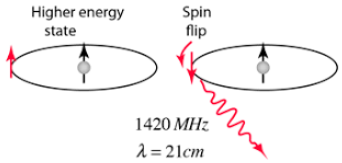
First, let’s look at a neutral hydrogen atom made of a proton and an orbiting electron. Both particles have spin and each can be in one of two states relative to the other- parallel and antiparallel or simply spin up and spin down for the sake of illustration. The spin combinations are up-up and down-up as shown in the figure below. Think of the arrows as bar magnets, so up-up would be two magnets with the north poles in parallel and the down-up would be bar magnets with magnetic poles facing opposite directions, or antiparallel. The arrangement where the magnets are aligned with identical poles in the same direction is less energetically favorable than when they are antiparallel. Since it is energetically down-hill, the up-up will want to flip to down-up or antiparallel lower energy state. The energy difference is lost as radio frequency radiation in the microwave band.
A spin flip to lower energy level results in the emission of a 1420 MHz (21 cm wavelength) radio frequency emission. This can be detected by a radio telescope though with some difficulty due to poor signal to background noise. Credit: http://hyperphysics.phy-astr.gsu.edu/hbase/quantum/h21.html
The spin transition energy is 9.411708152678(13)×10−25 Joules. Regions of space with more intense 21 cm radiation are thought to be regions of greater hydrogen atom abundance. These regions can be examined for redshifting to give clues about relative motion in space. The spiral structure of the Milky Way galaxy was discovered with 21 cm radio observations.
Molecular Hydrogen, H2
Molecular hydrogen consists of two hydrogen atoms that share a pair of electrons which provide the bonding force. The two electrons spend a finite amount of time between the protons canceling the repulsive force between them. It’s called a sigma bond. So far, so good. The bond is springy so the molecule can/does vibrate.
An unfortunate reality of chemistry– Like most topics, the more background you have on a chemistry principle, the more unifying and elegant it becomes. This means that sharing the beauty of the molecular world is a little more difficult that many would like. I regret this most sincerely. Most freshman chemistry involves balancing equations and PV=nRT math. Necessary but not always captivating. Freshman chemistry is much like the Hobbit in the Lord of the Rings trilogy. It’s a necessary prelude.
First, a Dive Down the QM Rabbit Hole
Ok. I couldn’t ignore the QM rabbit hole. The two electrons of an H-H bond must have opposite spins in order to form a covalent bond. An orbital represents a specific occupancy space for one or two electrons around an atom or molecule. They are places, not physical objects. The atomic orbital model is a mathematical construct based on spherical harmonics to define the shapes of space that electrons will occupy around the nucleus, depending on their energy and quantum numbers. The likelihood of finding an electron is wavelike within a region of space.
Two electrons can occupy one orbital if they have opposite spins. It’s referred to as spin pairing. (Note: I posted on the orbital stuff a few posts back.) This hard and fast rule of antiparallel spins occupying the same orbital is formalized by the Pauli Exclusion Principle. The Pauli Principle says specifically that “no two fermions with half-integral spins can occupy the same quantum state within the same quantum system“. Electrons are fermions and the upshot is that only 2 electrons of antiparallel spin can occupy a single orbital. If two or more orbitals of equal energy level are available, the electrons will occupy separate orbitals with the same spin. The manner of the filling of orbitals with electrons is covered by Hund’s Rule.
Finally, QM gives a number to an electron’s spin- the spin quantum number. According to the Pauli Exclusion Principle, two electrons in a single orbital must have different half-integral quantum spin numbers: +/- 1/2, or antiparallel- to occupy the same orbital space.
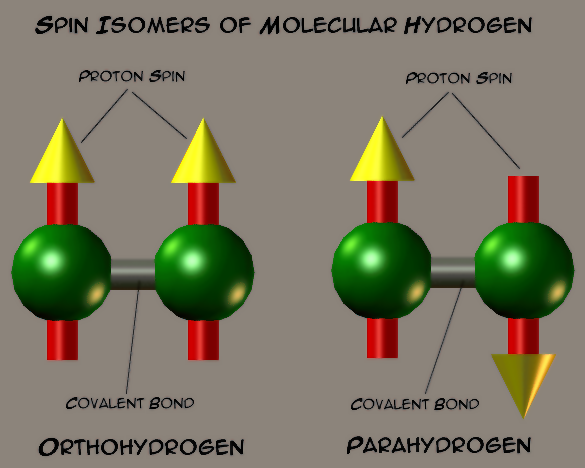
Because the two H-H electrons are spin paired, there is no net spin from them. However, the protons are a different matter. Their spins can be parallel (up-up or down-down) or anti-parallel (up-down). The anti-parallel spins cancel to give no net proton spin to the H-H. But, in the case of spin parallel, the H-H molecule definitely has net spin.
The spin parallel H-H molecules are called orthohydrogen and spin antiparallel H-H molecules are called parahydrogen. They are referred to as spin isomers or allotropes and are each distinct substances. There can be interconversion from orthohydrogen to parahydrogen molecules. The transition does not emit radiation, but it is exothermic. The parahydrogen is more stable by 1.455 kiloJoules (kJ/mol) per mole. Heating hydrogen will bring the composition to a maximum of 25 % ortho to 75 % para. When hydrogen is liquified, there is a slow conversion of ortho to para. It is worth noting that the enthalpy of evaporation of normal hydrogen (1:3 ortho to para) is 0.904 kJ/mol which is smaller than the 1.091 kJ/mole for 1:3 ortho to para conversion enthalpy for “normal” hydrogen. The conversion of orthohydrogen to parahydrogen in liquid form is exothermic and can result in hydrogen boil-off, leading to hydrogen loss and possibly causing a hazardous pressure rise. Those who regularly handle liquid hydrogen must be aware of this phenomenon. Orthohydrogen can also be catalytically converted to parahydrogen by contact with certain substances like ferric oxide, chromic oxide as well as several materials.
** Magnetic moment (from Wikipedia): magnetic moment is the magnetic strength and orientation of a magnet or other object that produces a magnetic field.
The International Energy Agency (IEA) is predicting that growth in annual demand for crude oil will shrink from 2.8 million barrels per day to 0.4 million barrels per day by 2028. This is interpreted to be the result of the global shift to cleaner energy alternatives as well as high prices and security of supply issues. By 2028 IEA says that peak oil demand may be in sight.
IEA also predicts that the use of oil for transport fuels will go into decline by 2026. Many more insights into the global oil market are to be found in the link.
Note that this report is about oil, not natural gas.
Latest news from the Baptists. At the 2023 Southern Baptist Convention (SBC) in New Orleans a move is underway to expel almost 2000 women from pastoral functions in its churches. A general vote will take place this week.
Apparently, the right wing of the SBC wants to crack down on what it sees as a liberal shift in its membership. Ultraconservatives believe that women pastors are just the beginning of future acceptance of homosexuality and sexual immorality. The ultraconservative fraction of American evangelism has been melding with Republican politics for decades since President Reagan and Jerry Falwell.
Pastor Mike Law from Arlington Baptist Church in Arlington, Virginia, wrote a letter suggesting an amendment to the SBC constitution stating that a church could only be regarded as Southern Baptist if it “does not affirm, appoint or employ a woman as a pastor of any kind.” The 111 page letter co-signed by 2000 male pastors and professors. Law cites 1 Tim. 3:1–7; Titus 1:5–9 in the Bible as backing up his assertion of the role of women in the church.
The language of these verses do not explicitly declare women as ineligible as an “overseer”, but they state that the overseer must be a “husband of only one wife“. The rest of the language goes on to list a number of personal qualities that an overseer must have.
I’m obviously not a Biblical scholar nor a believer in magic. Furthermore, this is a private matter among Baptists. Actually, it amuses me to watch them agonizing over how to polish the big brass knob on the doorway to their hoped for afterlife.
What I do care about is that this is a major setback for women in the 13 million member SBC organization. It imposes an inherent subordination on females based on the assertions of males who have appointed themselves in charge based on their literalist interpretations.
The text that they cite was written in a time when women were mere chattel who were deemed lesser than men. People get so wrapped up trying to do biblical things in biblical ways that they forget the core humane purpose of the church.
Worse than the unreasonable restraints on SBC women is how it will validate the woefully misguided instincts of the ultraorthodox Baptists as they spread into the greater population through politics. They want a theocratic state where people like themselves will rule under “biblical law”. They’re going to be disappointed.
A report from Reuters reveals that due to heavy rains in the Ivory Coast, cocoa production is under threat of flooding, insect damage and disease from heavy rain this rainy season. Ivory Coast is the world’s largest producer of cocoa.
The Ivory Coast cashew industry is on the verge of collapse following the COVID-19 pandemic, resulting in farm overproduction and slumping demand. Industrial buyers of cashews have stalled in their purchasing of cashews from farmers due to low demand globally. Farmers are stuck with unsold produce from the last 2 seasons due to the lack of industrial demand.
Ivory Coast is the leading producer of cashew nuts in the world with 792,678 metric tons of output in 2019. This is closely followed by India with 743,000 metric tons of output the same year. These two countries have a solid lead over the next largest producers in Burundi, Viet Nam and Philippines with 2019 productions of 283,328, 283,328, and 242,329 metric tons respectively.
The quote below gives the most interesting explanation I’ve seen of gun culture in the US.
“Guns are at the center of a worldview in which the ability to launch an armed rebellion must always be held in reserve. And so in the wake of mass shootings, when the public is most likely to clamor for gun regulations, Republicans regularly shore up gun access instead.”
No matter your position on firearms, there is no point in scolding the opposite side since few if any people are ever convinced to join your side. It is a waste of time and energy. The grownups of America need to find a way to de-normalize violence in general. Guns happen allow a person to commit violence from a safe distance, plainly a reason for their popularity. Obviously, self-defense is a delicate spot, but if committing violence is not nearly viewed as normal by the broader population, the need to for lethal self-defense just might diminish a bit.
American gun culture as I see it is comprised of a spectrum of individuals ranging from violent criminals to paranoid militiamen to peaceful hunters and sport shooting enthusiasts. Criticism of gun culture should not bunch them together under one umbrella. Carefully chosen vocabulary should be used so as not to antagonize the more peaceful side of the spectrum.
When the European frontier was settled by stone age people 40 or 50 thousand years ago, there were no firearms. There were weapons that could only be energized by their personal strength. Fighting was more intimate in the sense that clubbing and jabbing had to be done up close to your adversary. Stoning could be done from a few steps back. Killing wounds led to exsanguination and a rapid death while others led to sepsis and a longer, agonizing death.
The invention and spread of gunpowder starting in 9th century China led to the development of guns, cannons and, eventually, exploding projectiles. It was lost on no one that firearms enabled the projection of lethal force from a safer distance. The first really big war, World War I, in Europe was when advances like the Maxim recoil-operated machine gun and high explosives like picric acid were first put to large scale use. When the Maxim machine gun came out, many predicted that the mere appearance of the weapon would frighten the enemy into submission. Of course, it didn’t work and over the years the result was more and more efficient and mutual slaughter of opposing forces.
Male humans in particular have always been drawn to weapons and the martial arts. There are exceptions obviously, but men seem to take a shine to guns early in their lives. When asked why they like guns, they usually mention something about protection from intruders or perhaps just being a good guy with a gun in general. Often heard is the argument-terminating reminder of the 2nd Amendment and the vow that their guns could be confiscated only from their cold, dead hands.
Some Americans do live their lives in dangerous places. With some training, having a handgun in the nightstand may indeed be necessary for protection. Speaking for myself, I have never lived anywhere that was so burdened with crime that I felt it was necessary to pack a handgun. So, I can’t criticize those who are threatened by crime.
What I can criticize, though, is the broader culture that idolizes the Hollywood image of a good guy (or gal) who resolves conflict with a firearm. We have the screenwriters to thank for this. They dream up the story arc in the screenplay to include some fancy gun play. Death is always immediate and without the off-putting cries of pain and writhing that comes with a serious wound.
Gunplay in European TV programming is much less common. I’ve watched TV police drama series from the UK, Denmark, Norway, Iceland, Sweden, The Netherlands, Belgium, France, Italy and Germany. The only significant shooting I’ve seen is in a show from Germany called Luna & Sophie. Surprise, surprise. It turns out that a compelling police drama screenplay can be written without a lot of shooting and gratuitous violence. Or even with none at all. Perhaps it is because guns are not very abundant in the general population in Europe.
An effect of repeated and detailed depictions of gun violence on TV is that it suggests that shooting people is, well, normal. It normalizes the notion that the shooter can be the judge, jury and executioner. Killing someone with a gun also bypasses all of that due process stuff that wastes so much time. We all know that this is a dramatic depiction and that shooting people in real life will have very serious consequences. In my idea of civilization, people would be safe without a firearm. But, this is a fantasy I never expect to see unless I move to Iceland.
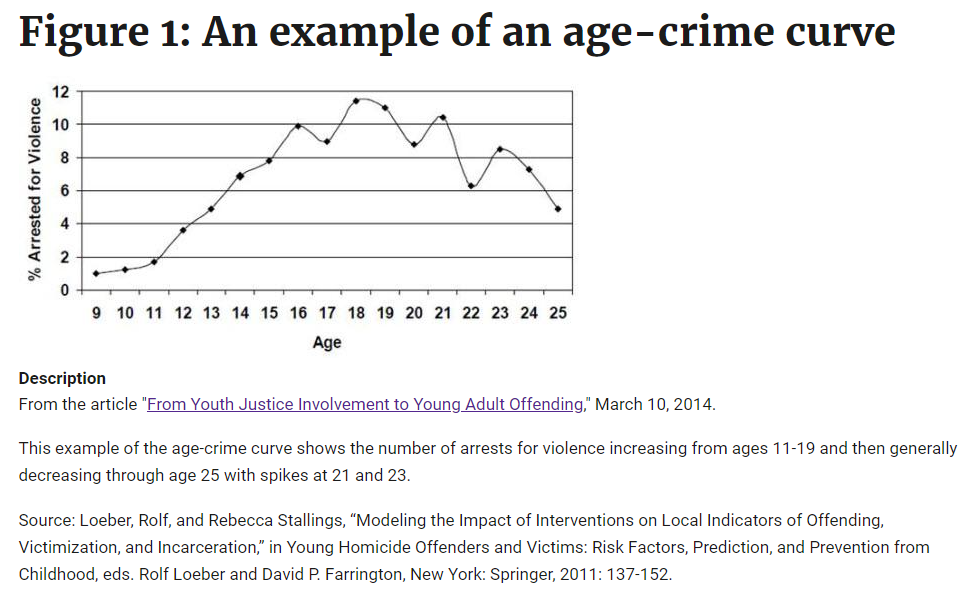
Maybe you could say that gunplay on US television mostly depicts good guys with guns defeating bad guys with guns. I’ll agree, that is a positive spin. The problem lies with population distribution within a large group. It often happens that a classroom or a large population will distribute itself unevenly when certain measurable attributes like personality or other performance metrics are considered. It is referred to as the bell curve. In the ideal mathematical sense, there is the standard distribution. Below is an example of a bell-shaped curve of % of members of a population versus age.
What is interesting to note is that as the population increases in size and barring any other influences, you would expect the population of each of the individual age groups to grow in number, though not necessarily in percentage. The point is that as the population grows, so does the subgroup of younger criminals.
So, as the general population increases we can expect the population of criminals to grow as well.
Reality
Clearly, America is in a pickle. Mass shootings have been increasing in number, unlike with most other comparable nations. But with every mass shooting the cries for gun control go unanswered no matter the number of bloody dead children strewn about the floors of American schools. What can be done?
Removing guns from citizens or blocking their ownership will not happen. This is completely unworkable and serious people know it. It will only lead to civil war.
More laws and tougher sentences for gun-related crimes. This has been done and hasn’t solved the problem.
Training teachers to shoot attackers. If you know many teachers, you know this is unworkable.
The congress will accomplish absolutely nothing but handwringing.
A president can do nothing without the support of the congress. Nothing will happen here.
The gun lobby and the National Rifle Association will continue to spew their cold dead hands rhetoric, shouting down voices in favor of even the faintest of gun control remedies, regardless of the bloody mayhem happening.
Citizens dedicated to maintaining the status quo with 2nd Amendment hysterics will continue to shout, wave their flags and demand freedom.
Republicans will continue to whip up hysteria by lying that gun rights are on the cusp of disappearing.
Militiamen will continue to gather in the woods hoping for civil war.
The US has planted itself into a sort of cul-de-sac of violence and extremism in regard to the possession of needlessly powerful weapons and there seems to be no way out. There is no viable political action on the horizon. Instead, let’s forget the damned guns and look elsewhere.
A simple suggestion
In the US we are bathed in violence as entertainment. There were 45,222 firearm-related deaths in the United States in 2020 according to the Centers for Disease Control. That is an average of 124 Americans dying per day from firearm-related injury. These aren’t misfires from gun cleaning.
While multiple factors lead to violent actions, a growing body of literature shows a strong association between the perpetration of violence and exposure to violence in media, digital media, and entertainment.
I’m not sure that viewers are actually asking for all of the entertainment violence that we see- it’s just that if it’s there we’ll eagerly watch it. It resembles click-bait. It is easy to write screenplays with of violence in it. Violence is genuinely exciting to most viewers. Violent content in programming helps to sell projects to those who finance and buy it. It definitely draws eyeballs which sells tickets, subscriptions and advertising. This is a reliable money machine.
What applies to movies also applies to video gaming. Many games are chock-full of violent content where the gamer does the simulated killing personally. I’ve played it myself. It triggers something that compels you to keep killing. But, does that condition you to committing actual violence? Maybe it is an effective release.
Producers and writers of violent content know full well what it takes to kick up the excitement factor. It is formulaic. While they operate under some sort of content guidelines, they are motivated to push it to the edge. The question is, do shoot ’em ups have to be every 4th scene? Are writers unloading their responsibility for compelling content to the stunt coordinators of gun fights and other violence?
What is needed is for screenwriters, producers and directors to back off on the violence a bit. All of the violence on TV comes from the imagination of the writers and producers. Surely it is within their power to throttle back a bit on the shooting, blood and guts. Desecration of human beings as entertainment should have tighter limits.
The goal is a safer and less violent civilization. The people who portray violence in vivid detail and orgasmic revenge produce a commercial product idealizes violence. They should be expected to self-govern better.
A Plea to Filmmakers
Your advertisers know that a certain fraction of viewers are persuaded to buy their products because of advertising within your TV programming. If they are persuaded to buy widgets they probably don’t need, don’t you think that your portrayals of violence might also be effective in negatively influencing impressionable young people? Will half the violence really reduce your profits by half? Does reducing violent content really infringe on your creative freedom? How limited are your creative abilities that you must accurately portray the destruction of human life?
The Telegraph published an interesting opinion piece on unanticipated problems with increasing dependence on renewable energy sources in the UK. The author was Dr Capell Aris PhD, a former Fellow of the Institute of Engineering and Technology of the UK. The thrust of the article has to do with grid inertia. It turns out that rotating generators have energy stored in heavy rotating turbines that can compensate for short interruptions in the power grid. Wind and solar power generating stations do not have inertia like a steam or gas turbine does at a conventional power plant.
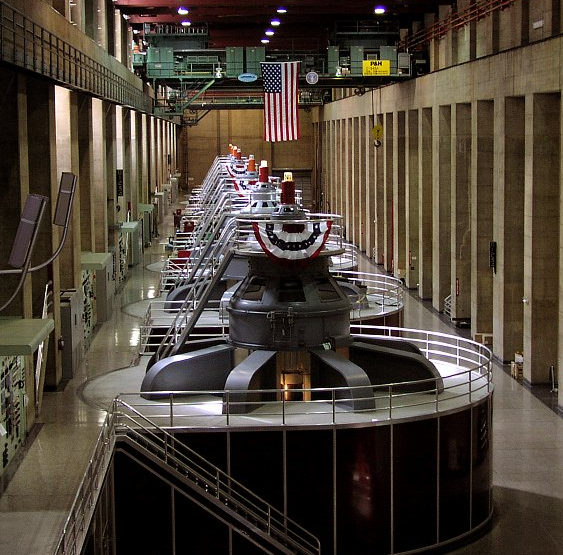
Power generators at Hoover Dam.
A critical parameter that power generating stations must watch is the line frequency. The entire US power grid must be producing 60 Hz power all of the time for stability. The load on a system must be in line with the supply. If the load exceeds what the grid inertia can supply, then overloaded generators will begin to slow with reducing line frequency and voltage. This forces the plant to disconnect neighborhoods on the power grid to bring the frequency and voltage back into line. This is called load shedding. If the plant generator frequency drops outside of specifications, the plant must disconnect. Allowing the generator frequency to stray too far from 60 Hz +/- 1 % can lead to physical damage of power transmission equipment.
Power sources that lack this inertia remove stability from the grid. Solar and wind cannot participate in this stabilizing feature. It’s just physics.
The power outage in Texas on Feb 21, 2021, relates to this in some ways. There is a very informative article by Houston Public Media here which I won’t repeat in detail. The upshot is, due to a winter storm a number of power plants in Texas went off-line, leaving too few plants remaining to service the load on the grid. Oh, yes, somehow Texas has constructed a power grid that is isolated from the rest of the US. It is managed by ERCOT, Electric Reliability Corporation of Texas. So, as power plants dropped out, there were fewer and fewer remaining stations providing inertia to the Texas grid. Plants remaining in operation faced higher loads than they could service and saw reducing line frequency, causing them to gradually blackout certain areas. Operators made a last call for blackouts when the line frequency dipped to 59.3 Hz. More blackouts did the trick. Only after widespread blackouts were they able to achieve a steady state and avoid a total collapse.
Warning: A large dose of sarcasm is being dispensed.
American media mogul, founder of Regent University and Southern Baptist Preacher-man Pat Robertson has fallen over dead. He was constantly yammering on television and leveraging his Christian nationalist views on conservative US politics to the point where disasters like 9/11 were blamed on spiritual revenge. Yes, big guy upstairs, you know, the one who set the galaxies spinning and knows our every impure thought, is upset with many of us because of our woke political views. The GOP loves the hellfire and brimstone stuff. It naturally attracts a certain caste of voters (MAGA people) who eagerly line up to see God-fearin’ preachers and Republican officials openin’ up a can of whoop-ass on the libs. These are the voters who Republican candidates lust after. Robertson’s apocalyptic theology depended on this.
Are such people retrievable from their trip down the rabbit hole of petty magical mystical thinking? It doesn’t appear so.
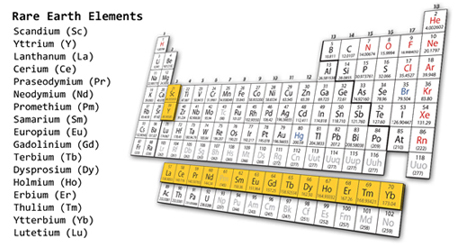
One shining example of a scarce resource in need of conservation is the Rare Earth Elements (REE) series generally, and Neodymium, Nd, and Dysprosium, Dy, in particular. Nd is described as hard and not very malleable or ductile and Dy is very malleable. Both have a silvery metallic luster and similar chemistries forming +3 cation as the most stable cation. The REEs are often divided in a funny way. There are the Lanthanides which can be further subdivided into two subgroups – the light REEs from Lanthanum to Europium and the heavy REEs from Gadolinium to Lutetium. Of the lanthanides, heavy REE deposits are more scarce, but of the heavy group Dy is the most abundant.
Promethium is highly radioactive Lanthanide with a half-life of 17.7 years for the longest lived isotope, 145Pm. Interestingly, the mode of decay for this isotope is electron capture, sometimes called K-capture. Promethium has only a transitory existence due to its short half-life. The entire group of REEs share the ability to form +3 cations. This increases the difficulty of isolating pure elements from an ore since most ores contain multiple REEs. Worse, the +3 Lanthanides also have similar ionic radii allowing for them to substitute with each other in minerals. Similar ionic radii makes it a bit harder to isolate them.
The other subgroup comprises Scandium and Yttrium- sometimes called the Scandium group. In the periodic table all of the REEs are transition metals in Group 3.
For clarity, the periodic table below shows a yellow vertical column of two elements, Scandium and Yttrium. They are members of the REE group. The yellow row of elements below are the Lanthanide elements. All together they make up the REEs. The Lanthanide elements differ from the other two REEs in that they have f-orbitals with valence electrons.
Chemistry is about what valence electrons do. These are the electrons that interact with the world around the atom or molecule. All electrons in an atom or molecule spend their time in special regions of space called orbitals. Electrons in the outer valence level can be taken away or shared. If there is an empty space in the valence level, electrons can be dropped in. Valence electrons form chemical bonds. These electrons are chemically reactive because they are furthest from the nucleus and feel the least nuclear attraction. But their reactivity mostly disappears if the valence orbitals are full. Inert gases are inert because their valence orbitals are full. It is possible for empty low-lying orbitals to accept electron pairs from other neutral species like H2O, phosphorus compounds, carbon monoxide and the like. Metals can have both negatively charged and neutral species docked in place around a metal cation.
Removing a valence electron from an atom is called oxidation and dropping an electron into the valence level is called reduction.
Electrons spend their time in specially shaped regions of space around atoms and molecules called orbitals. We do not need to know where an electron is exactly at any given moment. The orbital shapes define where electrons spend 95 % of their time. Orbitals do not have sharp edges. They taper off into space. The image below is a more realistic representation of where electrons can be found. Orbitals represent regions where there is the largest probability of finding electrons of a certain energy. If you consider a spherical space surrounding an atom, you could say that the probability of finding an electron within is p=1. But due to the peculiar shape of the spaces where electrons spend their time, an electron is more likely to be in the space defined by spherical harmonics. Therefore, any given space within the sphere could be assigned a probability per cubic picometer of containing an electron, depending on its location. Probability per unit of volume can be referred to as probability density. It is the probability density represented by orbitals that is wavelike in quantum mechanics.
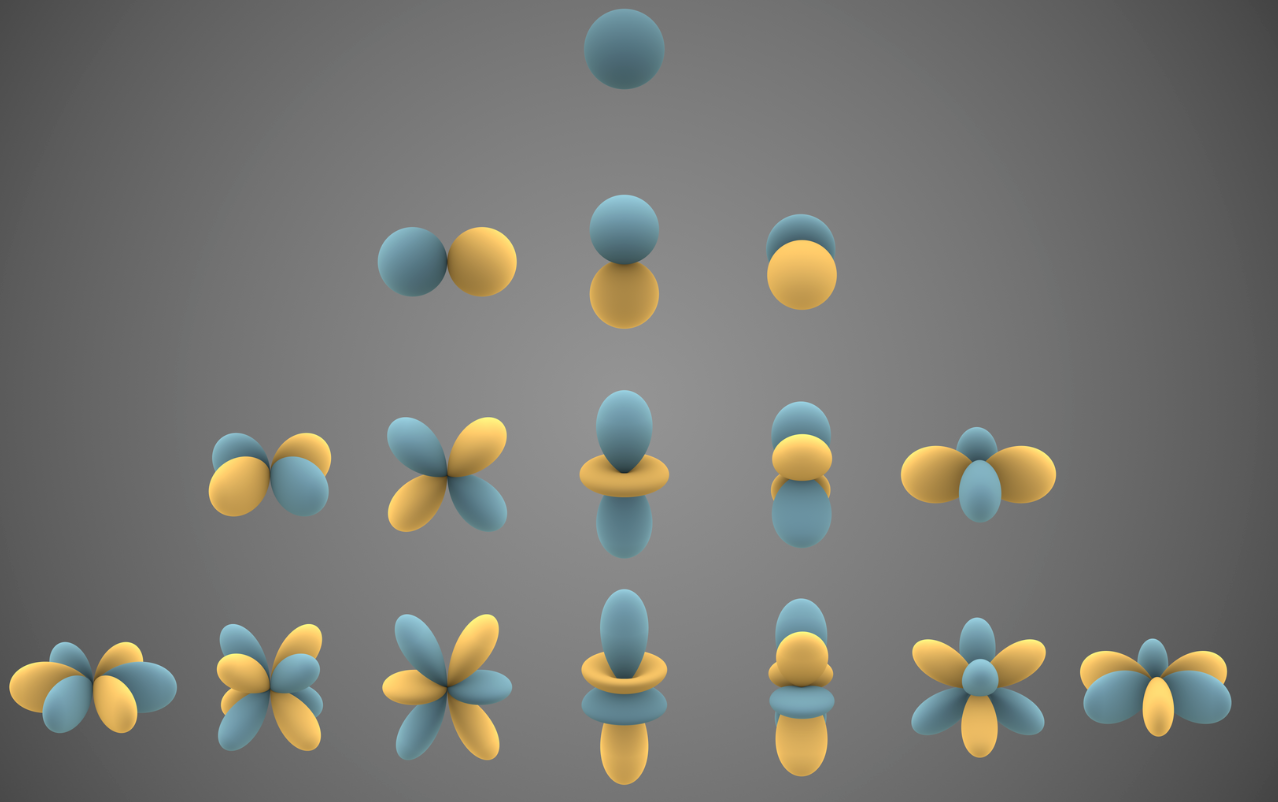
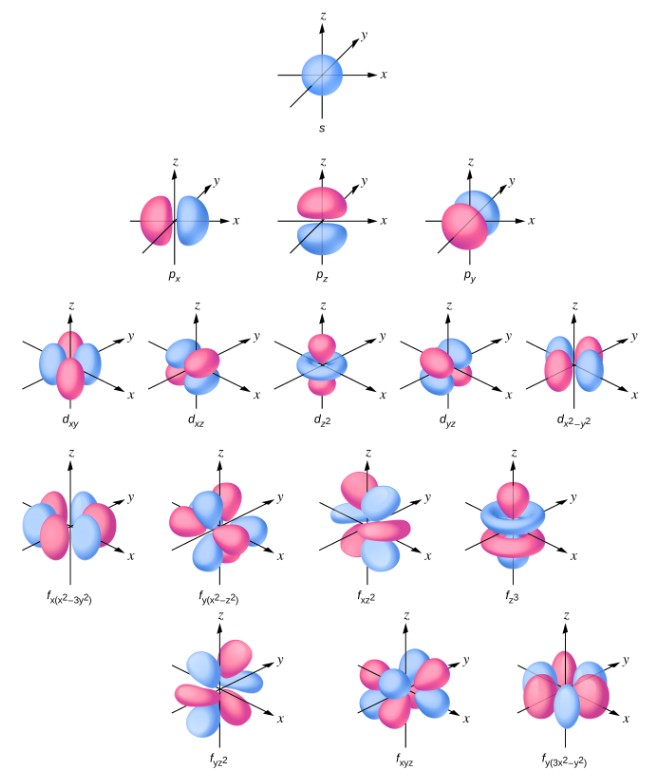
It turns out that we can describe the space electrons occupy if we apply the mathematics of a spherical harmonic series. The image below shows 4 levels of the series. The shapes define the space that electrons occupy around an atom. Each row represents a group of individual orbitals. Top to bottom, they are labeled s, p, d and f. The orbitals are filled with electrons theoretically in order from top to bottom rows as you move up the periodic table by atomic number, with each orbital holding as many as 2 electrons. Remember, orbitals are not physical objects. Each of them define a region of space in which one or two electrons spend their time. Also, there is some nuance in the energy levels of the orbitals. No matter though for this post.
Below is a chart showing atomic orbitals oriented in an xyz coordinate system. Interactions of orbitals between atoms or molecules very much depend on how they are oriented as they contact.
The common elements we are most familiar with have s, p and d valence orbitals around the nucleus. As we increase the atomic number of the elements we drop down the rows of orbitals on the periodic table, the valence electrons get further away from the nucleus where they are better shielded by the innermost electrons. The consequence is that the energy needed by the first valence electron to escape becomes smaller.
Neodymium magnetism comes from the 4 unpaired f-electrons with their individual spins aligned in the same direction giving the atom a large magnetic dipole moment. The unit crystal of Nd2Fe14B magnetizes along a preferred crystal axis that is difficult to change. So, the large magnetic dipole moment from the 4 unpaired electrons in each Nd atom in the unit crystal are locked in space.
We live in a time of permanent magnets with extraordinarily high magnetic field strengths. They’re called rare earth magnets and two REEs stand out in particular in this application- Neodymium (Nd) and Dysprosium (Dy). Nd is the primary REE in this type of magnet, but It turns out that up to 6 % of Nd can be replaced with Dy to increase coercivity and increase resistance to demagnetization. This is important for heavy duty magnet applications like windmills and electric cars. It is estimated that replacement of Nd with Dy in REE magnets amounts to ~100 grams of Dy per car. Based on Toyota’s planned output 3.5 million battery operated electric vehicles per year by 2030, the current reserves Dy would soon be exhausted.
Rare earth magnets are generally comprised of 3 elements; Neodymium, Nd; Iron, Fe; and Boron, B, proportioned according to the formula Nd2Fe14B. Dy is an optional component of these magnets.
So, obviously Dy is a highly desirable metal for efficient use of permanent RE magnets. Even among the REEs, Dy is a minor element. There are no known minerals having Dy as the major REE. The crustal abundance of Dy is 0.3 ppm and the recycle rate is <10%. The major reserve holders are China, Russia, and the USA. Incidentally, for some years now China has been disinclined to supply REE ore in favor of value added REE finished goods. This is in contrast to their buying copper ore from Chile or Peru in order to capture lower copper costs by doing their own refining. They know what they are doing.
Plainly, much is yet to be done in regard to putting a recycle loop in place for REEs in products. This is especially true for dysprosium. So, do we wait for the free market to respond when the situation is dire and the bulk of the REEs are already consigned to landfills around the world?
Note: For the sake of keeping the post light and airy, I’ve made some generalizations above. Of course there are exceptions and nuances. There always are.
Columbia University associate professor of linguistics in the Slavic Department John McWhorter was interviewed August 18, 2021, about the evolution of the word “woke.” It is found on a substack podcast called “Banished” by Amna Khalid with a written transcript. Below is a short reply by McWhorter on the history of “woke.”
JOHN McWHORTER: Well, woke actually goes back further than many people would think. It’s actually first documented in the early 60s and it was a Black slang. What it meant was politically aware of certain realities that operate largely below the surface, but have a determinative effect on, for example, the Black American condition. And so you might think, if you were you or me, that woke is about 10 years old. But actually people were saying it on the Black street long before that. It did not leave the Black street. Then, in roughly the 2000-teens, it jumped the rails and started being used by a certain kind of politically aware white person on the left. And what it meant at first in the general culture was somebody who understands certain basic leftist analysises [sic] of the world. What it really was, was a substitute for a term that had worn out. It replaced politically correct, which, if you’re just old enough now, you can remember was used without irony back in the late 70s and early 80s. And what it meant was that you have a basic understanding of liberal/leftist realities. Then it became PC. PCstarted being used as a slur to ridicule the kind of person who used that kind of ideology as a bludgeon in a smug kind of way. And so you couldn’t say politically correct without making somebody laugh by, say, 2010.
Before there was woke, there was “politically correct,” or PC, which was a pejorative used to disparage the liberal’s idea of social equality. PC was used as an occasion to flash sarcastic air quotes to telegraph the senders disdain for liberals. Right wingers love to suggest that liberals are candy-ass in their views. Turns out that liberals value kindness more than some which may actually be candy-assed now and then. But what of it?



 Lamentations on Chemistry