Author Archives: gaussling

About gaussling

Gaussling is a senior scientist in the chemical business. He occasionally breaks glassware, spreads confusion and has been known to generate new forms of hazardous waste. Gaussling also digs aerospace, geology, and community theatre.

“Make America Florida” WTF??

All around universal genius and gazillionaire Elon Musk will be engaging Florida Governor Ron DeSantis in a conversation that will include DeSantis’ announcement of his bid for the US presidency. The DeSantis krewe is obviously trying to distance themselves from #45, but not so much that they can’t poach his voters. They’re embracing capitalist folk hero and boy wonder Elon Musk’s endorsement in hopes of snagging MAGA voters who have grown weary of #45.

The DeSantis campaign has dreamed up the slogan “Make America Florida.” I’m incredulous at hearing this. Outside of Florida, “Florida Man” is a common reference to someone who is maniacal, irrational, delusional or insane. This is because, extrapolating from the news, Florida has an overabundance of them. More likely, there is more reporting of police notes than other places. Is it slander? Of course! It’s American humor unlikely to amuse outside of the US.

Credit: I don’t know, somewhere in the interwebs.

What remains to be seen is whether or not “Make America Florida” will catch on outside of the state. Especially in northern states outside of the old Confederacy. Some think that there is still a north/south divide in the US by some measures. I’ll leave that for others to expound on.

Applying DeSantis’ penchant for belligerent and punitive state politics, his presidency would surely be a setback for US democracy and a step forward for autocracy along the path the GOP is heading for. The GOP model of the US is not a place I’d care to live.

Baptist Hate-Preacher

A video dropped from the sky showing Christian preacher Jason Graber of the Sure Foundation Baptist Church in Spokane advocating for the execution of the parents of transgender kids by a gunshot to the back of the head. This video is echoing all over the interwebs. It is important to realize that managers who oversee news distribution are duty bound to allow only items that attract the greatest number of eyeballs through the filter. Their job performance is judged on this basis. They curate the news minute-by-minute as it happens.

Graber is a small frog in a very large pond. He and his flock are a small group in Spokane. However, I’m sure that his homophobia and anti-trans speech rhymes with what a great many people believe. You do not have to be explicitly pro-gay or pro-transgender to see that these views are a stage-4 malignancy in our democracy.

However, there is nothing new to this kind of vile speech. This is part of hellfire and brimstone preaching that has been in America since the very beginning. Only today it is amplified and distributed broadly in the Mulligan stew of today’s electronic media. Who would have guessed that the invention of the transistor would lead to this?

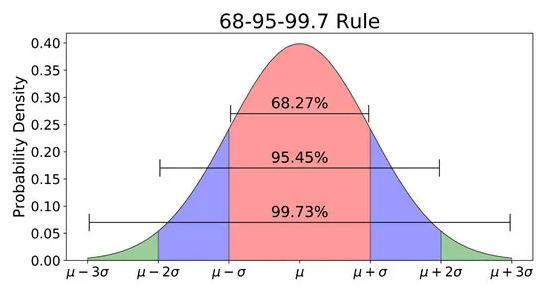
Plainly this preacher-man does not represent the views of all Christians. Population attributes are generally distributed as a normal distribution or sometimes called a bell curve with extremes on each side. Let’s say in this case that on the left extreme are those of Christ-like temperament of love and forgiveness and on the right extreme are those of hellfire and brimstone temperament. This character is obviously on the hellfire and brimstone end of the curve. In a normal distribution the population of extreme members is low and the bulk of the members are midrange. The mathematical ideal is sometimes called a Gaussian distribution after the great mathematician Karl Friedrich Gauss**.

A normal distribution curve showing population percentages vs deviations from the average (Greek letter mu). Source: Simply Psychology, https://www.simplypsychology.org/normal-distribution.html

Brother Graber is very much on the extreme end of the curve, even for a fundamentalist. But the freakshow he puts on causes much rubbernecking on the great interstate highway of life. It makes him look bigger than he really is. Media rewards extremism with large viewership. Look at #45, the Elephant Man of media. You just can’t take your eyes off him.

One weakness of members of the human distribution is that many are liable to believe that his outrageousness is a measure of the purity of his righteous devotion to God. He is devoted alright. To a bronze-age deity who plays favorites and metes out lethal justice to the infidels. Historically, this kind of deity has always held an appeal to people. It so happens that I am not one of them. Tradition can offer great comfort for many. But it can also be unneeded baggage that bogs you down in the muck of obsolete beliefs. It is the imaginary cosmology of Deities, a theory of the universe that sees angels and demons lurking behind every tree. What’s behind every tree? The backside of the tree of course.

==========

**My blog name, Gaussling, is in honor of Gauss and in no way is meant to suggest that my mathematical abilities are anywhere near his. Au contraire.

AI

The historian Niall Ferguson has made some important points recently on the topic of Artificial Intelligence (AI). Ferguson also published a piece online in Bloomberg. His point was built around the idea that AI should be considered an alien intelligence not to automatically be trusted.

[This isn’t Ferguson, this is my own view.] It is important to remember that the AI phenomenon we’re presently experiencing is that it’s the beginning of an economic bubble. It is a commercial product line constructed for the generation of wealth. It is meant to be a stand-in or augmentation for human beings. This contrivance has the potential for exceeding human abilities in a great many applications in both peace and war. AI will have lightning quick access to the world of information on and off the internet. It will produce both intended and unintended consequences, both of which may be considerable.

AI can be taught to be politically agnostic on one extreme, a political demagogue on the other, or something in between. It can be instructed to commit deception and espionage or angelic kindness. It can be instructed to apply Asimov’s 3 Laws of Robotics or not. Everything depends on the intentions of those in control.

Look around the internet world. It is plagued with troublemakers who are able to escape detection. There is tremendous good available from the internet, obviously, but there are also individuals, criminal enterprises and malevolent governments that are constantly rattling the doorknobs of legitimate websites looking for a way in. Social media has opened up a broad avenue for the efficient delivery of propaganda and swindling to the millions of unwary folk.

AI has a great many applications where it will be of tremendous help to people and organizations. One of the effects of technology advancement is that the time needed for completion of a given task is reduced. Another effect seen since the invention of the wheel is the reduction of labor. Eliminating people from a project reduces costs and increases the concentration of wealth to a few. Understand that cost reductions in business aren’t frequently passed along to consumers. The benefits of cost reductions belong to the stakeholders and will only be directly passed along if absolutely necessary. Cost reductions often manifest as stable pricing over time or a nulling out of inflation, which is a benefit to consumers.

AI will be an honest and moralistic force only if it is instructed to be. Look at the excessively clever application of psychology and show business in advertising. This is a result of fierce competition in the marketplace. Do we really believe that AI will be any different? Given the current state of world affairs, AI will be used as leverage for the transfer of wealth and power from the many to the few. This is the behavior of technological advance.

The promoters of AI will sing its high praises and accuse the doubters of being Luddites. They’ll remind us of the buggy whip and the steam locomotive. In some sense they’ll be right. But our recurring blind spot is with unbridled development. Capitalism as is currently practiced isn’t equipped with much in the way of forward looking moral or existential wariness. It is concerned with the efficient use of capital and distribution of goods. Thoughtful reflection about the future isn’t part of the equation. Greed and desire are the engines of capitalism.

AI will amplify both the best and the worst in us. We must be prepared for the worst because it will come.

Drilling Wastewater Capacity is Running Out in the Permian Basin

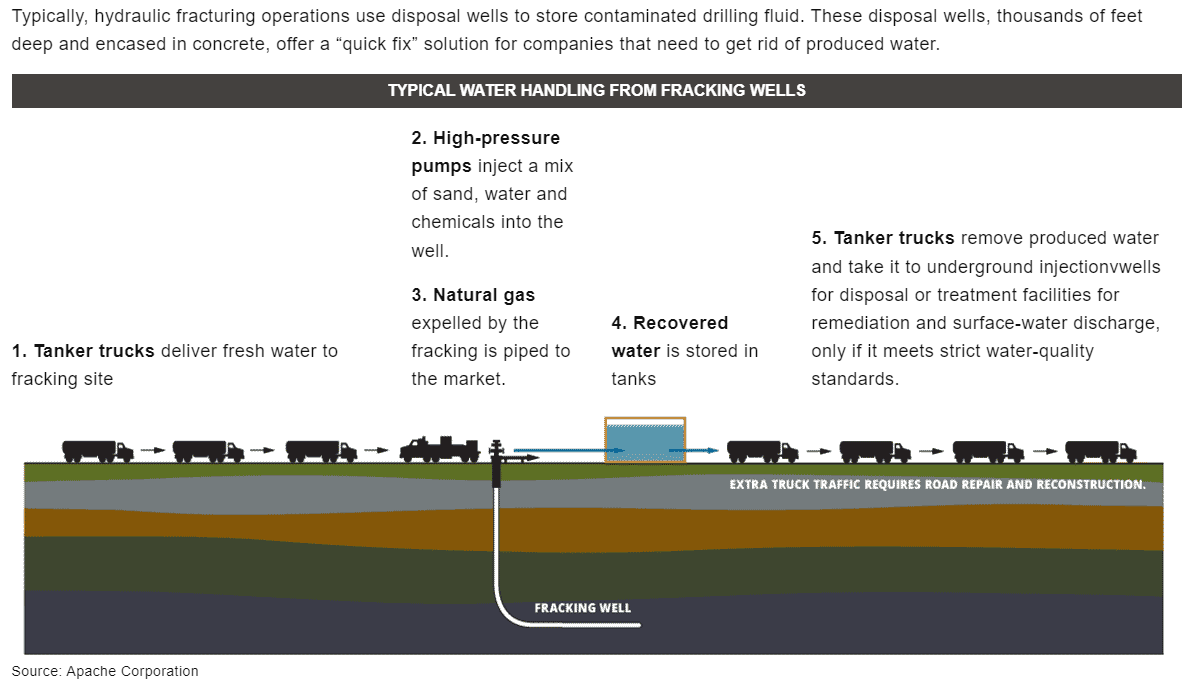
BNN Bloomberg published an article by David Wethe about a crisis building up in the Permian Basin shale-oilfield in west Texas. Drilling is facing the possibility of shutting down unless the new wastewater disposal wells are found. Wastewater is generated at a rate of 16 million barrels per day in the area and is pumped into disposal wells. The water can be up to 10 times saltier than seawater. These wells are seeing increasing backpressure indicating they are nearing capacity. Without disposal well space, oil drilling cannot continue to move forward. Associated with the disposal wells are earthquakes in the region.

From the article-

The Texas Railroad Commission, which regulates drilling in the largest US oil state, in December announced cuts to water disposal in certain areas after a 5.4-magnitude quake rocked the region. 

“We are one earthquake away from having a whole different dynamic” in the shale sector, Railroad Commissioner Jim Wright told the Oilfield Water Markets Conference in Fort Worth this week. Drilling will “come to a screeching halt” unless the industry develops “seismic-resilient” disposal techniques or alternative uses for the 16 million barrels (672 million gallons) of wastewater injected underground in the Permian region on a daily basis.

The water-recycling sector only has the capacity to process about 30% of the waste flows for reuse in fracking, Amanda Brock, CEO of Aris Water Solutions, told the conference. 

Credit: https://www.bnnbloomberg.ca/shale-oil-drillers-are-running-out-of-places-to-dump-toxic-wastewater-1.1922000

Houston-based Oil & Gas producer Apache Corporation was cited by the Texas Comptroller website as an example of applied water conservation.

Credit: https://comptroller.texas.gov/economy/fiscal-notes/2015/october/fracking.php

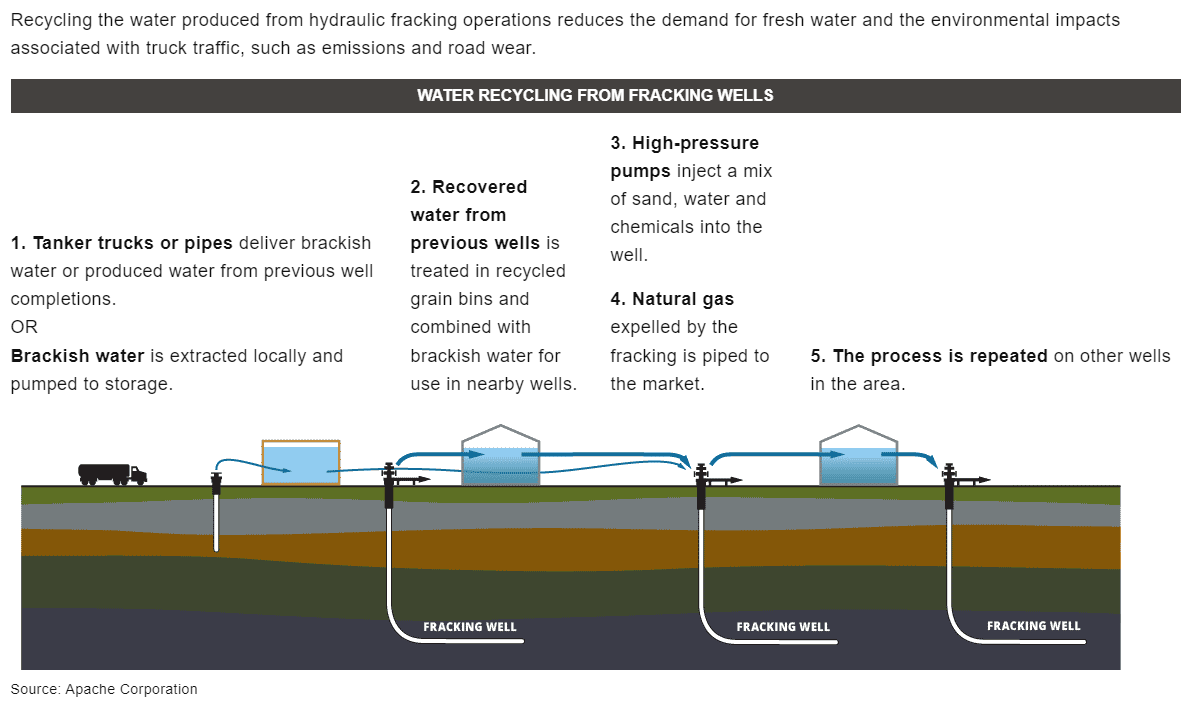
According to Apache, hydraulic fracturing, or fracking, can use 340,000 barrels of water per well. In order to conserve water, they treat and reuse water recovered from previous well completions. They also use brackish water from the local Santa Rosa aquifer which they collect in lined containment basins which can be transferred by pipes to other drill sites.

Say what you will about oil & gas companies, but this seems pretty progressive to me. The financial pressures on exploration and drilling people is immense. Compounding it is the highly volatile oil & gas market adding to the risk. It is no wonder that opening a new oil field is called a “play.”

Somehow Apache found the motivation and the funds to conserve water in an industry not known for progressive actions like this. The scheme does not seem technically difficult at first blush. It does, however, require up-from money to be allocated to the recycling infrastructure. Should the day come when recycling of water becomes mandatory, Apache will be in a good spot.

Credit: https://comptroller.texas.gov/economy/fiscal-notes/2015/october/fracking.php

Hydraulic fracturing is a very contentious subject. Proponents cite the urgent need for oil & gas energy in the economy. This is meant to justify what environmental damage may come from it with their chosen practices. Opponents cite the adverse effects of leakage of both fracking fluid and produced water to potable groundwater. A pathway for drilling fluid migration also opens a pathway for oil & gas seepage as well. One EPA draft-document from 2011 is available for scrutiny. It is in regard to fracking activity in the Marcellus Shale area of Pennsylvania.

It is interesting to note that Radium-226 was identified in the water samples. Ra-226 is the most stable decay of the radium isotopes (alpha decay, half-life 1600 years) and derives from the uranium-238 decay chain. Ra-226 alpha decays to radon-222 (alpha, half life 3.8 days) followed by numerous alpha and beta decays to Lead-206 which is stable.

Drilling muds are highly engineered fluids that have very specific properties. They must have closely controlled density and rheology in order to perform properly. Returning drilling mud is stripped of drilling chips and sent back down the hole for recycling. Managing your drilling mud is an important part of the art and science of drilling for oil. I am unaware of the significance of ground contamination by drilling mud.

Online you can find a long list of substances used in hydraulic fracturing. There is a large variety of formulated commercial products, possibly containing multiple chemicals, that are used in fracking fluids in the US. Determining the actual chemical hazards at any given fracking site will require knowledge of what they are using. Safety Data Sheets may or may not be helpful in uncovering the chemical composition of a fluid. The hazards associated with fracking fluids naturally depends on the identities of the chemicals present, the amount of chemical and the way it is presented in the environment. Dose makes the poison as Paracelsus said in 1538.

Note to the wise: If you plan on raising a stink about “chemicals” in the local fracking activities, try to find out what chemicals are being used. Chemicals can vary widely in their toxic potency and health effects. Be armed with specific information to the extent possible. If you stand there angrily gibbering on about “chemicals” it will be seen as loudmouthed histrionics. Hand waving arguments can be brushed off with handwaving dismissal. If you can talk about specific chemicals, then you can bring the issue into a sharper focus and demand facts.

Dow Goes Nuclear

It has been announced that Dow and X-Energy will be building a nuclear power plant to feed Dow’s 4700 acre Seadrift, TX, manufacturing facility. The plant will be comprised of a 4 pack of Xe-100 80 Megawatt (electric) High Temperature Gas Cooled Reactor (HTGR) pebble bed reactors. The reactors are spec’d to each produce 200 MW thermal and 80 MW electric. The design is referred to as a small modular reactor facility and is part of the U.S. Department of Energy’s (DOE’s) Advanced Reactor Demonstration Program (ARDP).

According to Wikipedia, the history of pebble bed reactor operation is checkered by design and operational problems, many of which relate to the tennis ball sized graphite pebbles themselves. During operation of the pebble bed, radioactive graphite dust is generated leading to eventual contamination problems. Pebbles getting stuck within the equipment are difficult to dislodge and can lead to fracturing in doing so. The reactor needs fire protection because the hot pebbles are combustible when exposed to air.

The HTGR pebble bed design has many features that are very positive. The spaces between the pebbles duct the cooling gas, avoiding the need for coolant piping in the reactor. The absence of water prevents the formation of hydrogen by neutron collisions with the water. Hydrogen generated in a reactor will migrate into metal components and cause embrittlement leading to possible component failure. Overall, the design of a HTGR pebble bed reactor is considered to be much less complex than a water moderated reactor due to the lack of an elaborate water cooling system.

Despite the happy talk about their technology the maker of the system, X-Energy, will have to show how past problems with the pebble bed design have been overcome. Their website gives no clues about overcoming problems encountered in the past. The Nuclear Regulatory Commission is a tough crowd and both Dow and X-Energy will have to provide a strong case for safe operation.

I wish them success.

Alien Fasteners. Wingnuts from Space, Redeux.

This was first posted 1/3/2010 and is herein posted once again. My big question is, what the hell is with the saucer design for interstellar travel? Saucers have a large surface to volume ratio which inherently restricts the size of everything they would have to bring along. Don’t they have food and luggage to pack? The same argument holds even if they are tiny buggers. This line of investigation will have to wait for another post.

+-+-+-+-+-+-+-+

Imagine that you and a companion are out for an evening stroll after a big dinner, say in a park somewhere. You hear a curious whining sound and look up to see an alien spaceship on a landing approach to the park. The craft lands and the crew scuttles off to perform some tedious abduction or organ harvest in the neighborhood.

Your companion exclaims “Golly! There is something you don’t see every day!”. But you’re unmoved by your companions incisive commentary. Because you see this as a long sought opportunity to examine an alien craft up close.

What would you look at? The propulsion system? Or perhaps the weapons array or guidance system? Pffft.

I would look at something much more mundane. I think it would be very enlightening to see what kind of fasteners they use. That’s right. Fasteners. Nuts, bolts, latches, bungees, straps, nails, hinges, hooks & loops, and rivets. How do these confounded exo-buggers hold things together? What’s the deal?

Fasteners are mechanical contrivances used to restrain objects into a desired configuration, often by the application and fixing of tension or compression through some structural element.  Think of all of the fasteners we encounter before we set foot out the door every morning.

Elastic articles of clothing perform a fastening function through the application of tension about numerous body parts through the miracle of Spandex/Lycra.  Shoe laces are fastening devices that apply and hold tension on opposing shoe upper elements wrapped over the arch of the foot.

Moving upwards, the zipper is a fastener that works in concert with a trouser/skirt button or snap fastener.  The belt and buckle are a fastener ensemble that together apply and hold tension about the circumference of the waist to keep ones trousers from succumbing to the pull of gravity.

Other fasteners include shirt buttons, brassiere connectors (damn those things!), earring wires, eyeglass frames (they connect to your face), cell phone belt attachments, the deadbolt on the front door, all manner of electrical connectors, and the list goes on and on. Electrical connectors are especially interesting because they combine the functions of electrical continuity and fastener. All are a compromise between the competing interests of biomechanics, convenience, safety, regulatory standards, and custom.

Fasteners with aliens, not alien fasteners.https://www.etsy.com/listing/926698830/alien-fabric-button-metal-hair?ga_order=most_relevant&ga_search_type=all&ga_view_type=gallery&ga_search_query=alien+barrette&ref=sr_gallery-1-5&sts=1&organic_search_click=1

So, back to the space ship. How would space faring beings approach the problem of fastening materials and components. Would they use individual components fastened together or would they use integrated component assemblies that support multiple functions? Perhaps the mechanical fastener question is moot because components would be cast, glued, or welded.

Integrated components have a certain appeal, but, by their integrated  nature could serve as a node from which to initiate failure propagation to multiple systems. For instance, if a battery was built to serve as a structural element for the craft, could a battery failure of some sort serve to initiate a structural failure mode? At what point is it foolish to integrate systems rather than leave them distributed? As always, it depends.

I think an alien spacecraft would have at least a few kinds of obvious fasteners. Surely alien technologies are subject to component failures and would require occasional repair.  Of interest would be the concessions to alien biomechanics.

Humans occasionally use wingnuts to fasten objects that need not be permanently affixed. The wingnut is simply a style of threaded nut that has two modest protuberances that allow for torsion and compression to be applied by the fingers and wrist. The wingnut is not functional for beings who lack the sort of articulated digits that we have. Perhaps an alien being would have a latch or other contrivance to accommodate its appendages.

Of course, all of this alien talk is just a device with which to cast the matter of fasteners into a more interesting light. Fasteners are part of our collective technological heritage and are rather under-appreciated. But, if you are unfortunate enough to be abducted by aliens, I suspect that the matter of alien fasteners might be of immediate interest.

There Are Benefits to Sending Light, Short Women to Mars

A paper is out comparing the resources needed to send women vs men on a trip to Mars. The paper, appearing in Nature publication Scientific Reports is: Scott, J.P.R., Green, D.A., Weerts, G. et al. Effects of body size and countermeasure exercise on estimates of life support resources during all-female crewed exploration missionsSci Rep 13, 5950 (2023). https://doi.org/10.1038/s41598-023-31713-6.

The paper is worth a look, but I’ve cut and pasted the conclusions below-

When compared at the 50th percentile for stature for US females and males, these differences increased to − 11% to − 41% and translated to larger reductions in TEE, O2 and water requirements, and less CO2 and Hprod during 1080-day missions using CM exercise. Differences between female and male theoretical astronauts result from lower resting and exercising O2 requirements (based on available astronaut data) of female astronauts, who are lighter than male astronauts at equivalent statures and have lower relative VO2max values. These data, combined with the current move towards smaller diameter space habitat modules, point to a number of potential advantages of all-female crews during future human space exploration missions.

A female crew would require less energy and less weight in provisions than men just from the benefits of smaller scale metabolism alone. Looks like hurtling women to Mars is an all-around winning idea.

Gladwell on Power Distance

Malcom Gladwell recently wrote a short essay titled “What I Found at a Mennonite Wedding”. While I don’t hold the iron age theory of the universe that the big religions have, I have always admired groups like the Quakers who practice simplicity and humility. Gladwell relates the idea of “power distance” that he observes at the Mennonite wedding he attended.

Power distance is an anthropological concept developed by psychologist Geert Hofstede. According to Wikipedia, this refers to “inequality and unequal distributions of power between parties“. Somewhat later the term was further refined by the Global Leadership and Organizational Behavior Effectiveness (GLOBE) project. GLOBE defined power distance as “the degree to which members of an organization or society expect and agree that power should be shared unequally”.

Once you see the definition, it’s meaning seems obvious. The phenomenon appears where individuals and groups seek control over others. It relies on the natural inclination of people to go along to get along or to seek affiliation. The recent MAGA love affair with president #45 carries the distinct smell of a public willing to turn more power over to a single person- the extension of power distance. It happened with Putin, Stalin, Hitler, Mussolini, and others.

The connection to the Mennonite wedding is that the wedding party themselves served up lunch to the guests. This is a power distance shortening action meant to recognize and serve the guests as part of the community.

Some people criticize Gladwell for being just a bit shallow in his writings. He seems to write the view from 5,000 ft rather than from an alligator’s viewpoint in the swamp. There is a place for generalization … if you want readers, that is.

Thoriated Tungsten. Why?

I saw the words “thoriated tungsten” somewhere in the literature and became curious as to what brought these two metals together. Before I get to thoriated tungsten, I’ll give a little background on tungsten and filaments made from it. There is a surprising amount of art and science in tungsten filaments. Tungsten filaments split into two broad applications- illumination and thermionic emission.

I’ve been curious about the effect of surging LED lighting demand on the tungsten filament business and tungsten demand overall. Naively, I guessed that there might be a noticeable effect on tungsten demand. A Google search only turns up people who want to sell a market research document. One of these web sites claims that demand for tungsten is expected to nearly double from 2021 to 2029 from $4.41 Billion to $7.56 Billion. The major demand for this metal is from the mining and drilling industries in the form of tungsten carbide cutting tools. The major producers of tungsten are China, Russia, Portugal, Austria and Bolivia, with China producing the vast majority.

The important tungsten ores are-

  • Wolframite, (Fe2+)WO4 to (Mn2+)WO4
  • Ferberite, FeWO4
  • Hübnerite, MnWO4
  • Scheelite, Ca(WO4)

All have a +2 cation and the tungstate -2 oxyanion. The WO4-2 tungstate anion has tetrahedral geometry similar to sulfate and can also form polyoxotungstates with octahedral WO6 geometry. Polyoxotungstates can form clusters by the sharing of octahedral oxygens similar to silicates. A large number of interesting polyoxotungstates have been identified.

Tungsten filament- a coil of coils.

Tungsten turned out to be a perfect choice for light bulb filaments due to it high melting point and its mechanical integrity at high temperature. The coiled coil filament design proved to be much superior to a single coil or a straight filament. Below is a picture found at this website showing the illumination differences in the 3 configurations of the tungsten element. The difference in filament geometry is striking.

The photo above shows a 240 VAC 60 Watt bulb where a coiled coil has been uncoiled to produce a single coil section and a straight section. The whole coil is there. Light bulbs are filled with a mixture of inert nitrogen and argon at below atmospheric pressure. A coil allows a greater length of tungsten wire to be easily placed in the bulb and a coil of coils even more so. During operation the filament suffers heat losses by conduction and convection of the bulb gases. The primary coil and the coil of coils serve to reduce exposure of the filament to the cooling gas flow. The coil provides some self-heating due to the proximity of the coil to itself. It intercepts some of the radiant energy and heats further. In the coil of coils, this effect is much more pronounced as seen in the picture above. The Lamptech website containing this photo is well worth a visit.

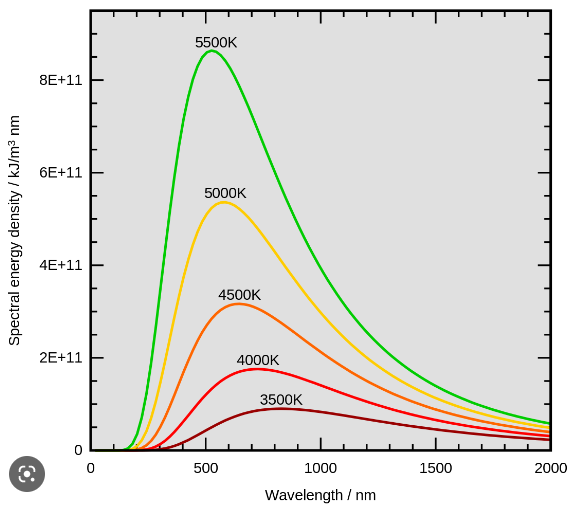
Wikipedia: Wien’s Law plot showing how peak black-body radiation varies with temperature. Visible light is between about 380 and 750 nanometers. https://en.wikipedia.org/wiki/Wien%27s_displacement_law

As mentioned above, one advantage of using tungsten as a filament is that it has an extremely high melting temperature of 3422 oC (3695 K). This allows the filament to be heated to very high temperature with the resulting blue shifted black body curve (above), This allows the spectrum to be brighter in the shorter wavelengths and consequently less reddish to the eye than a lower temperature filament. Wiens Law is the basis of color temperature.

When you shop for LED light bulbs, you might notice that LED bulbs are rated on the basis of color temperature. The lower the color temperature, the more yellow/red the light will be. The higher the color temperature, the more whitish the light will be.

However, with high operating temperatures a filament can evaporate, removing mass and robustness. Tungsten filaments, among others, are susceptible to this mode of failure. Another mode of failure occurs when a tungsten filament is hung vertically. Convection of the hot gasses in the bulb causes the top of the filament to get hotter and fail sooner. You’ll notice that lamp filaments tend to be strung horizontally.

Why tungsten halogen? Over time a tungsten filament will evaporate enough tungsten to blacken the bulb and become fragile. The presence of a halogen vapor in a light bulb causes a reaction between the tungsten and the halogen leading to redeposition of the tungsten back to the filament. However, this process requires higher bulb envelop temperatures, i.e., >250 oC. I have to assume that the small size of halogen lamps is to assure that the bulb temperature remains high for the tungsten-halogen recycle.

Thermionic Emission

Tungsten filaments in light bulbs is an application familiar to everyone. But there is another important use of tungsten filaments. The production of electron emission from filaments has been in use for a very long time. A hot filament or other hot surface under vacuum can be made to produce electron beams that can be accelerated or deflected and focused to do useful things. The electron beams can be made to carry modulated signals that can be put to use in detecting or radiating radio signals for radio, television or a myriad of other uses. The old vacuum picture tubes in early television used a filament to generate an electron beam that could be directed to scan across a phosphor coated surface to produce moving images.

What caught my attention when sorting through the tungsten literature was the mention of thoriated tungsten filaments. This topic goes back to the 1920’s with Irving Langmuir. In 1923 he published a paper in Physical Review Langmuir found that the rate of electron emission from 1 to 2 % thoriated tungsten to be “it was discovered that by suitable treatment the filaments, containing 1 to 2 per cent of thoria, could be activated so as to give an electron emission many thousand times that of a pure tungsten filament at the same temperature.” He found that the efficiency and life of a tungsten filament could be extended by spiking the tungsten with thorium oxide. He postulated that thorium is reduced and migrates to the surface of the tungsten filament forming at most an atomic monolayer. Thermionic emission occurs when a hot object like a filament evaporates electrons.

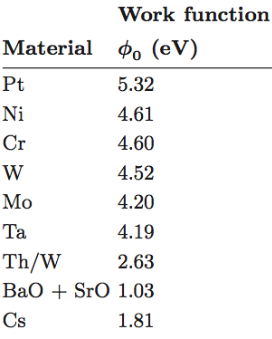
Every substance has work function energy in eV that is required to remove an electron from a surface. Additives to tungsten like lanthanum, cerium or thorium or their oxides have a lower energy work function than does tungsten and will produce a greater flux of electrons. This even applies to TIG welding where an electric discharge must jump across a workpiece and a sharpened tungsten rod.

A 1-2 % thoriated tungsten welding rod or filament will allow thorium to migrate to the surface via grain boundaries while in operation and deposit on the surface. The work function energy of thorium is lower than that of tungsten, so the thoriated surface can release more electrons at a given temperature.

Work function energies of various compositions

Notes on Depression

Oh no! Is this another gush of Too Much Information that no one really wants to hear? I guess it could be. As it happens, I’ve accumulated a lifetime of insights into depression that could be lost if I happen to suddenly fall over dead. It would be a shame to not pass it along, so here goes.

Background

It dawned on me some time ago that much of the emotional agony I experienced as a young child seems to have been early manifestations of what would be a lifetime of struggle with depression. Except for a parental divorce when I was ten, I had a normal rural pre-teen upbringing in the vast corn and soybean fields of Iowa. Summers were hot and sticky and winters were extremely cold. We had vast pastures and river banks to explore and badgers to watch out for. We detassled corn and pulled weeds by hand in the bean fields for a few weeks every summer. Field labor was not my favorite thing.

It was the 1960’s and black-and-white television was full of news about the space race and the crazy hippies and Viet Nam. Hippies were using drugs and rioting, astronauts in cool spacesuits were riding capsules into space and F-4 Phantoms were flying and sometimes crashing in Viet Nam. This was the frame of reference of the time.

I was pretty lucky as the eldest of 5 kids. Despite the divorce of my parents and all the upset that goes along with it, we had wonderful grandparents. They stepped in and provided considerable care and comfort in our lives. While this family upset was an aggravating factor in my depression, it wasn’t at the root of it. There was something more fundamental to it.

Everyone experiences dark periods in their lives that somehow expire and normal emotional being returns. I had episodes of this as well and they would subside. Growing up has its ups and downs, learnings and misunderstandings. What began to happen was that these dark periods would last for weeks and months with no obvious triggers that set it off. Those around me couldn’t understand why the darkness persisted in a kid who outwardly had nothing to be sad about.

Added to this was the fact that I had no natural athletic abilities other than dashing to get out of the way and no interest in sports. My family was in a quandary about what to do with a boy who didn’t like sports. This contributed to social isolation that, frankly, I enjoyed. Solitude was something that I craved but got only too infrequently. I still crave solitude.

Jumping ahead on the timeline

Depression is a state where you lose hope, ambition, social contact, interest, energy and sometimes even the will to live. It is a potentially deadly condition that deserves attention by medical professionals. There is talk therapy, drug therapy and probably a few other things I’m unaware of. Speaking for myself only, talk therapy helped me to get a greater understanding of the condition itself, but really not much else of lasting effect. I still got and remained depressed. I needed drugs.

I have been trying various antidepressants since the late 1970’s with unequal success. I started with imipramine at age 19 but it made me sleepy and inattentive with dry mouth so I eventually decided to quit using it. It is a tricyclic antidepressant introduced in 1957 and was prescribed by a general practice MD. Deciding to discontinue drug therapy is a common problem practiced by many depressed individuals and I did the same numerous times.

I managed to get into college and get a BA in chemistry without antidepressants. However, in grad school I went back to drug therapy with Prozac and Paxil. After some dosage adjustments I found it to be very helpful for a while. Eventually my depression overwhelmed the drug. What I eventually realized was that I was in a situation that was very stressful even without depression. My depression was aggravating my situation which was grad school which was amplifying the depression. There was a feedback loop. I needed to self-actualize. I needed a major achievement giving me more control over my life. I wanted to be a chemistry prof.

I finished grad school and went on to a 2-year postdoc. Unfortunately, my marriage failed a few months into the move to Texas and my postdoc. Suddenly I was alone in a large Texas city with no vehicle and a very low paying job. Texas being Texas, there was no decent public transportation so I spent a good deal of time walking and thinking in the miserable heat and humidity.

One day as I began my morning walk to the university lab where I worked my mood started out … normal. Halfway there my mood began to darken abruptly as though a curtain dropped blocking the light. I had nothing depressing on my mind that might have triggered it. The light of a normal mood state just extinguished.

This continued for many months. I again went to a general practitioner MD and he put me on lithium. I took this for 2 months. It did absolutely nothing other than to make me dizzy. At least I wasn’t manic depressive. I went off it and found a shrink across the city for help. He took a lot of notes over many sessions and never spoke. I talked and he listened. Eventually he said that he wanted to prescribe an MAO inhibitor. He handed me a prescription. Back at the university I did a deep dive on this class of medications to see what they were about. I concluded that, given the many risks and side effects, there was no way I’d take this. Never went back to that shrink again.

Years later, after enduring the depression over a 5 year career in teaching, I got an industry job. The company folded 10 months after I arrived so I went to work in construction to feed the family while searching for another chemistry job. I got the chemistry job and worked for about 10 years while on Prozac and other SSRI’s. But eventually the depression had become unmanageable with the meds I was taking. My family doc gave up and made some suggestions about what to do. It turned out that he had depression too and left medicine.

Eventually I found a shrink who ended up being quite good. This time there was titration involved. We spent a year or two fine tuning a mix of medications. What worked was the combination of bupropion and escitalopram. I eventually figured out that a large part of what I had thought of as “just” depression in fact had an element of uncontrolled anxiety to it. The medications I was taking did nothing for the anxiety. Bupropion has been shown to have beneficial effect on anxiety associated with depression.

But something unexpected happened. My anxiety was suppressed so deeply that I wasn’t worrying about much of anything. A person needs to have enough anxiousness to stay on top of life’s challenges. We made an adjustment in dosage and things are now fine.

Things I’ve noticed that are helpful

  • Get the right help early. Family practice docs can only go a short distance into treating depression. Mine eventually gave up and handed me a list of shrinks. It worked, but only after I was way down the timeline.
  • Well intended folks may suggest alternative medicines or greater religious devotion. I’ve never found these things persuasive or useful.
  • Sometimes talk therapy or attitude changes just do not work. Don’t feel bad if they do not work for you.
  • Exercise can be very helpful.
  • Reclusiveness is an effect of depression. I’m still not over this part.
  • Don’t pay attention to famous scientologists who talk down drugs. They’re idiots.
  • A shrink is a physician who has specialized in psychiatry. Psychiatry today is substantially about medication. These folks have a deep understanding of the pharmacology of the different meds and what constitutes reasonable expectations.
  • Depression meds may not fix basic personality issues. If you’re an asshole while you are depressed, you could still be one when you are better.
  • Finding better help may seem difficult. You have to reach out and contact people which may be undesirable. You might be unduly pessimistic about the benefits of finding a shrink. It’s like digging a tunnel into rock. You have to keep showing up and swinging the pickaxe against the wall. Eventually you’ll get through.
  • The source of your depression and anxiety may be more than just brain chemistry. Your life situation might be genuinely awful as well. Fighting depression may require that you change how you are living and who you are around. Some people are toxic and a greater distance from them may be needed.
  • A course of self-improvement can be helpful as well as a change in living arrangements.
  • Avoid suicide. It might seem like the fastest way out of the pain, but it really is a permanent solution to a temporary problem**. Also, your suicide is likely to be the main thing people will remember about you. You wouldn’t want that.
  • Depression can get worse as we age. Be aware of this.
  • The world is truly a beautiful place full of wonders to discover. Dive in. Be curious.

** The phrase “permanent solution to a temporary problem” is admittedly a bit pollyannish. This would be of no comfort to someone in a death camp or gulag. While not words of universal relevance, I must assume the Dear Reader and a great many others are not in a death camp. While not useful advice to everyone, it still applies to a large number of people.