Wow. This gives me chills. In the last week this blog has been visited twice by chatgpt-content-generator.online. If AI is getting content from me, what other crazy sh*t are they retrieving?
An AI visit
Leave a reply

Wow. This gives me chills. In the last week this blog has been visited twice by chatgpt-content-generator.online. If AI is getting content from me, what other crazy sh*t are they retrieving?
I really want to blather on about the Fox talking head Tucker Carlson and how he got himself dumped from his network. But that would be indecent self-indulgence. Instead, I’ll just bathe in the warm glow of schadenfreude.
Along with the fact that #45 is running for president again is the sickening prospect of two more years of news coverage of his orange face spewing streams of lies, exaggerations and deflections. Broadcasters and news providers in all media can’t resist the bloviating #45 because he attracts admiring eyeballs and those enchanted by the freakish spectacle of human idiocy at its worst.
As bad as the prospect of #45 returning to the White House is the reality check that a large block of the voting public will vote for him again. After 6 years of shameful behavior and nauseating political drama, it is quite clear that most in the MAGA crowd are not put off by his behavior.
A vote for #45 the isolationist is a vote for instability in Europe. Czar Putin will see to it that recovery of former Soviet states will happen. The US cannot be isolationist as Russia executes its land grab. At this period in history, western isolationism by passive acceptance of Russian expansionism is a one-way ticket to Russian authoritarian hegemony. This is an end state that we in the west should be able to agree on.
The world has learned that Russia’s conventional land forces are not so formidable. This is the unexpected downside of the invasion for Putin. However, Russia has always considered that the use of nuclear weapons is part of a continuum rather that preceded by a firebreak as with the west. The Russian talking heads have been keen to remind us of the power of their nuclear triad. Little mention is made of the US nuclear triad that more than matches it. The presence of nuclear sea launched ballistic missile submarines on both sides alone renders a nuclear conflict as suicide for both sides.
Americans should go to YouTube and find translated video of Russian talking heads spewing the most vile hate speech you can imagine at the Ukrainians and western powers. Polish public television TVP is a good place to start. Many Russian talking heads are speaking in favor of an all out war with the west, including nuclear weapons. Many claim that WWIII has already begun. We have been reduced to non-human beasts deserving of painful death for daring to push back Russian efforts to expand their great empire. Some figures claim that the west is after their oil & gas resources.
The reason I suggest viewing this content is to understand the constant high intensity of their internal propaganda. While there is some open criticism of the military, criticism of Putin himself is religiously avoided. Many say that Putin is surrounded by incompetent people. This is the information environment that the Russian people are subject to on a daily basis. It is difficult to believe that Russian citizens will rise up to overthrow the Putin regime through some kind of a democratic effort. More likely someone around Putin will take over with his blessing.
Russian propaganda is not some side specialty that issues from an office somewhere in Moscow. It is built into the whole governing apparatus and supervised by the GRU. Russia is very effective at not only generating fake news, but also mass confusion about what is happening. A Russian propaganda campaign is actually a layer cake of misdirection through a series of changing stories. People become confused about what is happening and are likely to lose focus.
Here is an interesting link to propaganda.
Dislaimer: I am not a food science guy and I have no formal training in dairy science. However, I worked in a dairy processing plant as a lab tech for three years and picked up a few things. This is my perspective from the manufacturing side.
Having worked in a dairy processing plant, I learned that there is no mystery to how cheese was invented/discovered. Just let milk sit unrefrigerated for a few days and it will clabber up. Stray bacteria, yeasts and mold spores are in the air and breath everywhere and many, if not most, are capable of feeding on the milk. In doing so, acids may be produced which will denature and unravel the proteins and bring them out of solution as a solid. Many microorganisms can ferment milk, but that is not to say that the cheese will be desirable or even edible. Before refrigeration, cheese was inevitable. Even with refrigeration cheese will happen, only a bit slower. Be one with the cheese.
As an undergraduate, lo these many years ago, I spent a few years working in the QC lab of a diary processing plant. My job was to perform certain analytical and microbial quality control procedures on the many products the plant manufactured. We produced fluid milk, cottage cheese, sour cream, whipping cream, half-and-half, single serving dairy creamers, a flavored shake product, orange juice, and flavored novelty beverages for kids. We packaged under our brand as well as for other brands.
People are very particular about their milk. Chunky milk sets off alarm bells for most of us. Many people dump their milk at the expiration date. Unless the milk has been allowed to warm up to room temperature or it has been contaminated, it should be good for another week. The expiration date is when the producer’s guarantee of freshness expires, not when it will go bad. Encountering pathogens in milk is comparatively rare these days.
The input of milk to the plant was in the form of raw milk straight from the farms by way of shiny stainless steel tanker trucks. We would receive 2-3 6000 gallon tankers per day. If we rejected a tanker, there always seemed to be another plant nearby that would take it. Rejections, which were few, were usually due to off-flavors picked up from the farm or it was high in coliforms.
Before the milk was unloaded it had to be tested. First, the receiving operator would insert an agitator into the tanker manway and stir the raw milk to mix the cream back into the milk. He would then use a stainless steel dipper and pull out a sample for the first tests. The temperature of the tank load would be taken, then the sample would be thermostatted to a specified temperature. At this point he would take a mouth full and approve it for taste and odor. This is called an organoleptic, or taste, test. He claimed to be able to detect the odor or taste of the cow (cowy), the barn (barny), grass (grassy), and certain weeds (weedy) in the cows diet. I have never been an enthusiastic milk drinker and having an aversion to tasting raw milk, I never took the opportunity to verify these flavors.
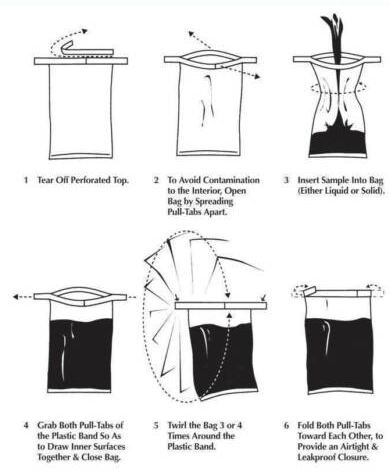
He would then place a sample in a twirl pack, label it and send it to the lab for approval. There were several tests it had to pass before approval could be made. The % solids had to be above a particular value. To do this test, we would pipette a specified volume of raw milk onto an absorbent fiberglass pad and cover it with another. Then into the microwave it goes. The microwave had a built-in electronic balance so it would readout the % solids directly after drying. This is done to detect shipments that had been diluted with water. Milk was bought and sold by the pound or hundred weight and it was not unknown for farmers in the past to “extend” the weight of their milk production with water.
The pH of the milk was taken as a cross check to be sure that fermentation wasn’t underway. When milk ferments, it gradually becomes more acidic and will keep going until the acid inhibits further growth. In days past it was not unknown for farmers to neutralize fermenting milk with NaOH or some other base. While this could put the pH back where it should be, it would affect the % solids and the flavor. It was a trick of last resort.
The raw milk sample was also tested for beta-lactam antibiotics by two methods before approving the tanker. Cows were prone to getting mastitis from an aggressive milking schedule. Excessive dosing of dairy cattle with antibiotics to get them back into production could lead to antibiotics showing up in the milk. The state regulators watched this closely.
We used a standard disk assay method looking for inhibition in the growth of bacillus stearothermophilus spores suspended in agar growth media (it has been renamed Geobacillus). A small disk of filter paper wetted with a milk sample was placed on a petri dish of B. stearothermophilus spores in agar was warmed for 3-4 hours at 50 to 60 C. A positive result would appear as an inhibition ring around the disk indicating suppressed microbial growth. This was always compared with a disk spiked with a standard. A positive result would be recorded if the inhibition ring around the sample was larger than the ring around the standard. This test took a bit of time so it was used mainly as a cross check for the “Charm” test.
A faster test for beta-lactam antibiotics was the Charm test. This test used a radiolabeled reagent that would indicate the presence of beta-lactam antibiotics in a test sample. The sample was placed on a planchet which was heated to dryness and then put in a radiation counter for a set period of time. The turnaround time was ~15-20 minutes. This allowed for faster approval. From a Google search, it doesn’t appear that this version of a Charm test is now in service. It appears that a test strip can be used instead.
In the dairy business the fat content of milk is very important. It is a milk component that can be isolated and used to produce high margin products like ice cream, novelties, whipping cream, coffee cream and half-and-half. Every day there is a milk fat budget that you must work within. Regular drinking milk, sometimes called fluid milk, is graded into fat content categories. There is 0.5 %, 1 %, 2 %, and what we referred to as “homo”, referring to homogenized, regular 4 %. All of the fluid milk is homogenized.
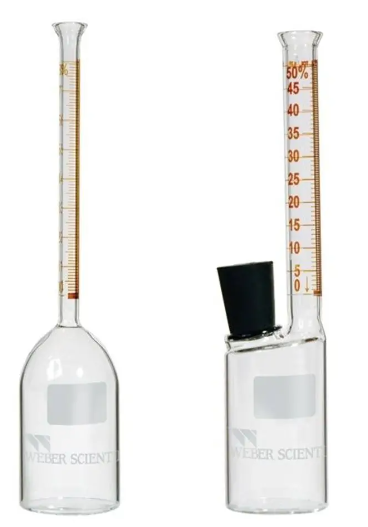
Babcock bottles for volumetric dairy fat analysis. Weber Scientific, https://www.weberscientific.com/babcock-test-bottles-weber
Once the raw milk is approved, it must be altered in a few ways to make it shelf stable and presentable. The more equipment milk passes through, the more chance there is to give it an off-flavor. It is homogenized to produce a uniform, stable dispersion. This prevents the milk from separating on storage to form a cream layer on top. Many people like having the cream separate from the milk, however.
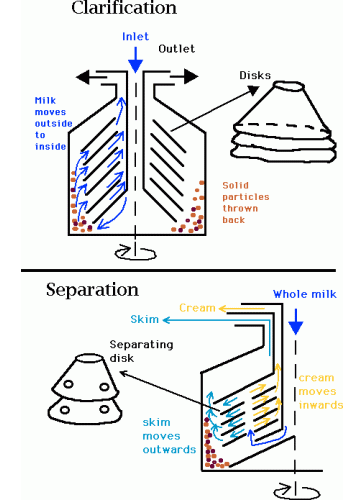
Early in the processing is the centrifugation step. Our plant had a centrifuge (“separator”) that would separate any solids present in the raw milk The centrifuge consisted of a stack of spinning conical plates that separated the cream as well as any solids present. The solids included cow hair, cellular matter, and dirt- stuff that you don’t want to dwell on. The fat content of milk skimmed in this way could be precisely controlled and operated on a continuous basis.
From the manufacturing point of view, processing and packaging an inhomogeneous mixture is a quality control problem. First, a continuous flow process works better if the composition of the material is uniform. Making sure that every customer gets their fair share of quality, creamy milk is important for making happy customers. Second, if the fluid milk composition is variable over time, it is hard to guarantee that you will recover enough of the valuable cream you want to divert for other products yet produce consistent fluid milk. In milk processing, consistency is everything.
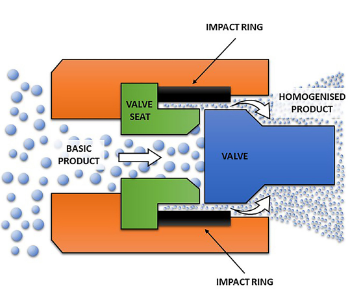
Homogenization of milk can be done in a couple of ways, but they all share the process of shearing a 2-phase liquid. A jet of milk can be aimed at a stationary plate. The shear in the fluid at impact can break up the fat globules into a smaller size to give a stable suspension. The more popular method is to apply shear by forcing the milk through very small openings at high pressure. Shearing a liquid is a stretching action on a parcel of the fat leading to dispersal of the fat globules into smaller droplets and better dispersion.
At some point milk producers discovered that there was a market for low fat milk. Producers were happy to expand into this market because it would bring diet-conscious customers back into consuming fluid milk. Milk was commoditized long ago so there are many competitors out there grasping for your dairy dollars. For producers, low fat milk is an opportunity to direct excess dairy fat into more profitable products while keeping the volume in fluid milk sales up. A steady flow of commodity product is always a good thing for a business.
In production, milk fat content is something that has to be carefully managed. X pounds of dairy fat come into the plant every day and X (minus losses) pounds go out as product. You want to produce as much high margin, high-fat product as possible but you must also stay competitive in the fluid milk business. Commodity fluid milk keeps stable cash flow and your valuable shelf space in the supermarkets.
When the tankers come in at 4:00 am you want to get a fat content for the accountants and the plant managers. We paid for raw milk on the basis of fat content and weight. The standard fat test method we used was a volumetric test called the Gerber method. We would combine a standard volume of milk with butanol and fairly concentrated sulfuric acid in a Babcock bottle and heat it. We would then spin it in a centrifuge to separate the fat layer from the acidic layer. The fat would rise into the calibrated neck of the flask where we would directly read off the value using a caliper. The butanol helped to clarify the fat layer.
On occasion the plant’s fat budget would get misaligned and milk fat (cream) would have to be tanked in from elsewhere.
The plant produced about 1 million small dairy creamer cups per month that are for a single portion of coffee. The creamer fat % was determined for the batch, not individually. Samples were, however, individually tested for bacteria and taste and taken every 15 minutes.
We produced sour cream using active cultures for fermentation. We packaged sour cream as well as several flavors of potato chip dip. Chip dip is just sour cream flavored with solid spices. It is interesting to note that active bacterial cultures can become infected and die from a virus called a bacteriophage or just “phage“. Having a phage rampaging through your fermentation and packaging operation is a serious problem. You must shut everything down, maybe dispose of your raw materials and the latest product lots, and then hit everything with bleach and scrubbing and then restart with close attention.
We produced whipping cream and half-and-half. The whipping cream was produced as a heavy whip with about 36 % fat. Half-and-half was around 12 % fat. These two products were sold as sterile products meaning that they were, unlike fluid milk, completely free of bacteria. More on that in a bit.
Pasteurization of milk was an important improvement that dramatically improved the shelf-life of dairy products as well as reducing the incidence of milk-borne infection. In times past, milk-born illness was a serious problem. Today it is only greatly attenuated, not eliminated. Milk is an excellent growth medium for microorganisms like bacteria, yeasts and molds. There is water, fats, proteins and sugars. The udders of a cow are low to the ground and back where the manure comes from. Contamination of the udders is a given. Good sanitation from the udders to the consumer must be in place at all times.
Back then, the word was that it took about 2000 bacteria per milliliter to cause an off-flavor. However I cannot verify this.
The trick to milk processing is to avoid contaminating it during manufacture and packaging. Bacteria, yeasts and mold spores are in the air and everywhere else. We assayed for general microbial contamination and specifically for E. coli. The general assay was for the general hygiene of the plant and raw milk. The E. coli testing was used to gauge the microbial contamination from the operators. Humans harbor coliforms naturally in the gut. We live with them in harmony. They crowd out pathogenic bacteria for us and in turn we feed them. However, if our personal hygiene habits are poor, coliforms will show up in the product. The hands are the usual source of contamination. It must be understood that not all coliforms are pathogenic. Occasionally a pathogenic strain shows up and spreads around, making people very sick or worse. Unfortunately, these bad strains are only discovered after people start getting sick. So, as a kind of canary in the coal mine, coliform tests are used to measure the processing hygiene of the process.
The state health department was always very interested in coliform contamination. They would collect dairy products from the supermarket and test them for coliforms. A bad result would immediately cause the heat to be turned up on the plant managers. It was infrequent but taken very seriously. It usually pertained to cottage cheese. Cutting and collecting the curds was a manual operation, though the operators always wore gloves. The health department could embargo a plant’s output from the market for repeat offenses.
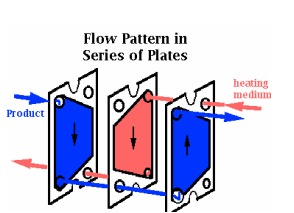
In common use is the HTST, High Temperature Short Time, method of pasteurization. HTST involves a short contact time of fluid milk with a moderately “high” temperature surface. This was done in a “press” which was a horizontal stack of alternating plates through which a heat transfer liquid and fluid milk would pass. The plates were compressed with a screw device holding them together under pressure- a press.
Be sure to understand that pasteurization does not equal sterilization. There is pasteurization and there is ultra-pasteurization. The first is an attenuation of the microbial load. The second refers to sterilization from ultra-high temperature, UHT, processing. In the case of American fluid milk, the kind that requires refrigeration, it is attenuated only. It is not sterile. This milk is usually good for 1 week past the expiration date if it has been constantly refrigerated. If it has been warmed to room temperature, then it is good for about 1 day, give or take. When a bacteria culture grows, the population rises slowly for a short time and then ramps into what is called the log phase (logarithmic growth). The population of bacteria grows via binary fission which is exponential growth. This situation leads to spoilage.
Milk and other dairy products that do not require refrigeration have been ultra-pasteurized by UHT. This is a bit delicate because too much contact time could lead to caramelization of the milk. These products should be sterile and an unopened container should have a long shelf-life at room temperature. Once the container is open and exposed to anything external it is subject to microbial growth.
The automated packaging equipment would spray in a small shot of concentrated hydrogen peroxide (~35 %) into the empty packages in an effort to cut down on microbial contamination just prior to the filling stage. Hydrogen peroxide is unstable in milk and decomposes quickly. Unfortunately, some bacteria have catalase which rapidly decomposes hydrogen peroxide into oxygen and water, thereby making them resistant to the sanitizing effect of the peroxide. Some bacteria, like Pseudomonas aeruginosa, are resistant to hydrogen peroxide.
On one occasion we encountered agar plates from a fluid milk sample that became green after the normal incubation. We had never seen this before. I opened a dish and took a whiff. It was fruity smelling. Since I had taken microbiology as an elective as an undergrad (chem major) I was aware that Pseudomonas aeruginosa was famous for its fruity smell, but cultures of it were blue. I performed a catalase test by pouring some hydrogen peroxide on the plate and the peroxide immediately began to fizz- positive result. This was consistent with P. aeruginosa. But why was the plate green? Well, when you have a bacterium that produces blue colonies in a yellow agar medium, you get green. Presto, we identified it. We dumped the lot and cleaned the equipment and never saw it again.
Our ultra-pasteurized products were sampled by taking packaged milk off the packaging line every 20 minutes and putting it into a 90 F hotbox for 48 hours. After the time was up we opened each container and put a sterilized loop into it and inoculated an agar plate. Then the containers were each tasted by the lab tech (me) for any off flavors. Most samples passed both the microbial and the taste testing. Usually there were several in the 4 or 5 milk crates that were bad. I’ve never been a big fan of milk when even it is cold, so this warm milk at the end of its shelf life was no picnic. We would open a carton, take a swig and hold it long enough to pick up the taste, then spit it into the sink, holding back the gag reflex all the while. We tended to do this rapidly to get it over with, but in doing so we would occasionally get a mouthful of sour milk with chunks or just whey. Both would be carbonated and tangy from fermentation and sometimes show stormy fermentation. It was gross and disgusting. Heavy whip that was clean would sometimes be surreptitiously churned into butter by a certain lab tech who was eventually caught and fired. He was handing it out to folks in his church. Management said it was a case of a dairy product of unknown quality leaving the plant. Yeah, Ok.
UHT fluid milk stored at room temperature is popular in Europe and a few other countries but not so much in the US. I guess we’re just squeamish about milk here. I know I am.
Our plant also produced cottage cheese. No big mystery here. We filled a rectangular vat with warmed skim milk and added a mixture of weak acids to it. I recall that the curdling acids was a mix of phosphoric and lactic acids. This method was known as “direct set.” After a short time the milk curdled with the white curd floating as a solid mass in the yellowish whey. The operators would use a multibladed knife the cut the curds into cube shaped chunks. Then the whey was discarded into the sanitary sewer and the curds were washed and loaded into a machine for packaging. Most cottage cheese was blended with a salted cream to give it a creamy texture. Some of the curds were packaged as “dry curds”.
For a long time the plant would send the whey from the cottage cheese process down the sanitary sewer. Then one day we were given a very large sewer bill. It had jumped from $2,000 to about $26,000 per month. You could hear a clattering noise from all of the bricks the accountants were shi**ing. The giant invoice was for all of the biological oxygen demand (BOD) that our whey was actually consuming at the sewage treatment plant. The folks at the treatment plant had been noticing that the BOD of the sewage going into the plant had been swinging around but couldn’t figure it out. Then one day they noticed that the problem popped up when they saw cheese curds floating in with the waste. They connected the curds and presented us with a hefty bill for the plant capacity we were consuming by dumping whey down the drain. Soon thereafter we sold the whey to hog farmers. Whey has a few percent of protein content. The farmers were happy but we never heard what the pigs thought.
Finally, we had a juice packaging operation. We produced orange juice and a small portioned flavored beverage that went by some childish name. We bought orange juice concentrate in 55 gallon drums and would just dump it into a mixing vat and dilute it to spec. Easy peasy. It would then go to packaging in the isolated juice room. Same with the other beverage. I think we had more contamination issues with the juice than anything else. The juice was especially prone to going off from yeasts and molds. There was usually gas generated that would bulge the containers. This became a serious shelf-life issue when it happened. Instead of bleach they cleaned the juice room with quaternary ammonium based cleaning agents (“quats”). I think we mistakenly thought that the contamination came from us. It could have been spores riding along with the concentrate. We never tested for that.
We had a large, chilled warehouse held at 38 F for storing product. We also had a cold box at -40 F for warehousing ice cream from another plant. The plant was also a distribution center. The chiller plant used ammonia. When it needed maintenance, it was critical to get a reefer guy who would work on ammonia systems. Not everyone will do this.
I learned a bunch and grew from doing this work. I don’t think I’ll go back though.
While cockeyed optimists are working toward a new age of electric vehicles in the glare of an admiring public, I find myself standing off to the side mired in skepticism. What are the long-term consequences of large-scale electrification of transportation?
The industrial revolution as we in the west see it began as early as 1760 and continues through today. Outwardly it bears some resemblance to an expanding foam. A foam consists of a large number of conjoined bubbles, each representing some economic activity in the form of a product or service. A business or product hits the market and commonly grows along a sigmoidal curve. Over time across the world the mass of growing bubbles expand collectively as the population grows and technology advances. Bubbles initiate, grow and sometimes collapse or merge as consolidation and new generations of technology come along and obsolescence takes its toll.
The generation of great wealth often builds from the initiation of a bubble. The invention of the steam engine, the Bessemer process for the production of steel, the introduction of kerosene replacing whale oil, the Haber process for the production of ammonia and explosives, and thousands of other fundamental innovations to the industrial economy played part in the growing the present mass of economic bubbles worldwide.
After years of simmering on the back burner, electric automobile demand has finally taken off with help from Tesla’s electric cars. Today, electric vehicles are part of a bubble that is still in the early days of growth. The early speculators in the field stand the best chance of winning big market share. A major contribution to this development is the recent availability of cheap, energy dense lithium-ion batteries.
Of all of the metals in the periodic table, lithium is the lightest and has the greatest standard Li+/Li reduction potential at -3.045 volts. The large electrode potential and the high specific energy capacity of Lithium (3.86 Ah/gram) makes lithium an ideal anode material. Recall from basic high school electricity that DC power = volts x amps. Higher voltage and/or higher amperage gives higher power (energy per second). Of all the metals, lithium has the highest reduction potential (volts).
Rechargeable lithium batteries have high mass and volume energy density which is a distinct advantage for powering portable devices including vehicles. Progress in the development of lithium-ion batteries was worth a Nobel Prize in 2019 for John B. Goodenough, M. Stanley Whittingham and Akira Yoshino.
All of this happy talk of a lithium-powered rechargeable future should be cause for celebration, right? New deposits of lithium are being discovered and exploited worldwide. But cobalt? Not so much. Alternatives to LiCoO2 batteries are being explored enthusiastically with some emphasis on alternatives to cobalt. But, the clock is ticking. The more infrastructure and sales being built around cobalt-containing batteries, the harder it will become for alternatives to come into use.
One of the consequences of increasing demand for lithium in the energy marketplace is the effect on the price and availability of industrial lithium chemicals. In particular, organolithium products. The chemical industry is already seeing sharp price increases for these materials. For those in the organic chemicals domain like pharmaceuticals and organic specialty chemicals, common alkyllithium products like methyllithium and butyllithium are driven by lithium prices and are already seeing steep price increases.
Is it just background inflation or is burgeoning lithium demand driving it? Both I’d say. Potentially worse is the effect on manufacturers of organolithium products. Will they stay in the organolithium business, at least in the US, or switch to energy-related products? It is my guess that there will always be suppliers for organolithium demand in chemical processing.
A concern with increasing lithium demand has to do with recycling of lithium and perhaps cobalt. Hopefully there are people working on this with an eye to scale up soon. A rechargeable battery contains a dog’s lunch of chemical substances, not all of which may be economically recoverable to specification for reuse. In general, chemical processes can be devised to recover and purify components. But, the costs of achieving the desired specification may price it out of the market. With lithium recovery, in general the lithium in a recovery process must be taken to the point where it is an actual raw material for battery use and meets the specifications. Mines often produce lithium carbonate or lithium hydroxide as their output. Li2CO3 is convenient because it precipitates from aqueous mixtures. It must also be price competitive with “virgin” lithium raw materials as well.
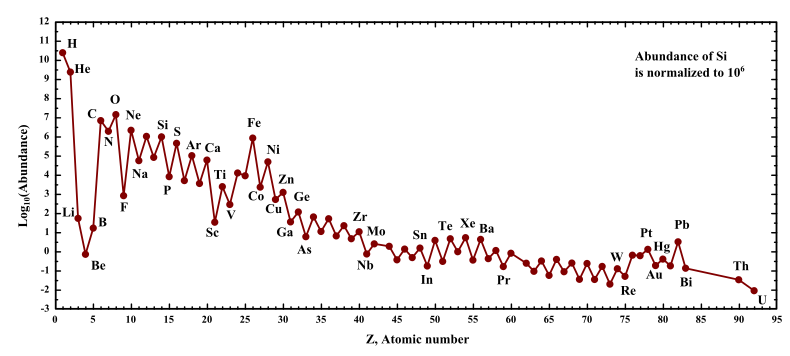
Lithium ranks 33rd in terrestrial abundance and less than that in cosmic abundance. Unlike some other elements like iron, lithium nuclei formed are rapidly destroyed in stars throughout their life cycle. Lithium nuclei are just too delicate to survive stellar interiors. The big bang is thought to have produced a small amount of primordial lithium-7. Most lithium seems to form during spallation reactions when galactic cosmic rays collide with interstellar carbon, nitrogen and oxygen (CNO) nuclei and are split apart from high energy collisions yielding lithium, beryllium and boron- LiBeB. All three elements of LiBeB are cosmically scarce as shown on the chart below.
Lithium is found chiefly in two forms geologically. One is in granite pegmatite formations such as the pyroxene mineral spodumene, or lithium aluminum inosilicate, LiAl(SiO3)2. This lithium mineral is obtained through hard rock mining in a few locations globally, chiefly Australia.

Chemical Definition: Salt; an ionic compound; A salt consists of the positive ion (cation) of a base and the negative ion (anion) of an acid. The word “salt” is a large category of substances, but for maximum confusion it also refers to a specific compound, NaCl or common table salt. In this post the word refers to the category of ionic compounds.
The other source category is lithium-enriched brines. The US Geological Survey has proposed a geological model for brine or salt deposition. According to Bradley, et al.,
“All producing lithium brine deposits share a number of first-order characteristics: (1) arid climate; (2) closed basin containing a laya or salar; (3) tectonically driven subsidence; (4) associated igneous or geothermal activity; (5) suitable lithium source-rocks; 6) one or more adequate aquifers; and (7) sufficient time to concentrate a brine.”
Lithium and other soluble metal species are extracted from underground source rock by hot, high pressure hydrothermal fluids and eventually end up in subsurface, in underwater brine pools or on the surface as a salt lake or a salt flat or salar. These deposits commonly accumulate in isolated locations that have prevented drainage. An excellent summary of salt deposits can be found here.
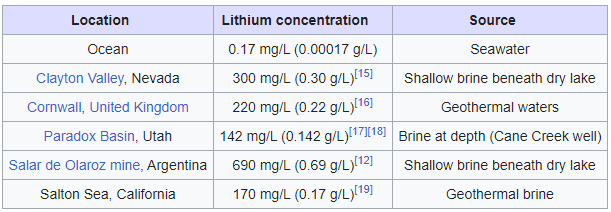
Critical to any kind of mineral mining is the definition of an economic deposit. The size of an economic deposit varies with the market value of the mineral, meaning that as the value per ton of ore increases, the extent of the economic deposit may increase to include less concentrated ore. If you want to invest in a mine, it is good to understand this. A good opportunity may vanish if the market price of the mineral or metal drops below the profit objectives. Hopefully this happens before investment dollars are spent digging dirt.
Lithium mining seems to be a reasonably safe investment given the anticipated demand growth unless страшный товарищ путины invasion of Ukraine lets the nuclear genie out of the bottle.
Just for fun, there is an old joke about the definition of a mine-
Mine; noun, a hole in the ground with a liar standing at the top.
According to an article in The Hill, the organization Physicians for Social Responsibility published a detailed report on the state of PFAS usage in oil and gas drilling operations including fracking. Note that many if not most states allow drillers to claim that the components of their drilling fluids are a trade secret and exempt from public disclosure. The quantities mentioned in the report are astoundingly large in magnitude. They report that “between 2013 and 2022, drilling operations have injected at least 261 New Mexico wells with 9,000 pounds of per- and polyfluoroalkyl substances (PFAS) for use in fracking,” Further, the article states that “During the same period, oil and gas companies injected more than 8,200 wells with a total of 243 million pounds of fracking chemicals — likely including PFAS — kept undisclosed due to “trade secret shields,” per the report.“
[Note: A reader rightly pointed out that 9000 lbs divided by 261 wells works out to only 34 lbs/well in New Mexico. My thinking was that adding PFAS release to an untenable situation where oil & gas operate under loose environmental constraints already was a step too far. The aforementioned 243 million lbs of fracking chemicals gives no indication of how much, if any, PFAS is included. I understand why additives are blended in with drilling fluids and there are many strong technical and economic reasons for it. There must be boundaries on how much pollution we produce- even with oil & gas production.]
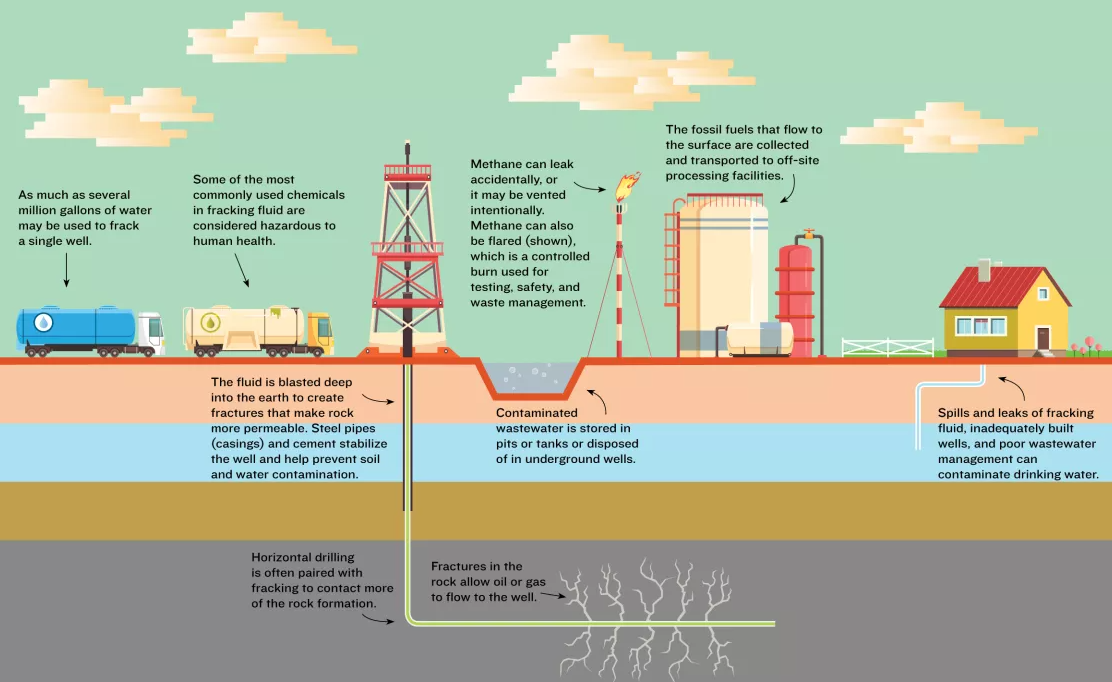
Fracking involves the injection of water, sand and certain chemicals at high pressure to fracture and prop open fissures produced in the formation for increased recovery of oil and gas. This is not a new technique. However, the oil and gas industry has seen to it that they can enjoy trade secrecy and immunity from much regulatory oversight while engaging in their operations. Their injection of chemicals into the ground has been subject to precious little oversight in terms of what and how much they can/should pump into the ground. Underground there is no air oxidation, weathering or photodegradation to break down the substances they pump into the ground. The immediate threat may be nil, but over the upcoming centuries, our descendants may drill into groundwater formations that have been contaminated by earlier petroleum operations. We should tread easily being mindful of our future civilization.
This blatant side-stepping of transparency by oil & gas is made possible through lobbying the local, state and federal government. If they get any push back, they drag out the old saw about jobs, jobs, jobs. No official, elected or appointed, wants to be seen acting against jobs. So, all manner of dubious ideas go forward with the blessing of our officials. We citizens fail to vote in sensible regulation because jobs, jobs, jobs. It doesn’t matter that jobs in oil & gas are famously in the feast or famine category, oil & gas companies always get their way.
Everyday I drive by unmanned oil tank batteries silently doing their automated jobs. The work force is reduced to truck drivers or supervisors visiting only periodically. The roughnecks and the crew who laid the pipes are long gone. At work I frequently train new employees who have left oil & gas because it was too unsteady.
Recently a few states have signed legislation to ban products containing forever chemicals within their state. No mention of well injection chemicals, but at least this is a start.
Good gravy. What a freakin’ mess. It seems like everywhere investigators look, they find perfluorinated alkyl residues- drinking water, fish, people, etc. These fluorinated substances are known as PFAS, PFOS, PFOA, PFHxS or perfluorohexane sulfonic acid, and PFNA or perfluorononanoic acid. The “per” in front of perfluorinated just means that the molecule has as many fluorine atoms connected as possible.
According to the National Association for Surface Finishing, PFAS “properties are useful to the performance of hundreds of industrial applications and consumer products such as carpeting, apparels, upholstery, food paper wrappings, wire and cable coatings and in the manufacturing of semiconductors.“
I will use the term “PFAS” to represent any and all of variations in this small molecule category of perfluorinated substances.
The EPA has kicked into overdrive and is ginning up new regulations, including drinking water standards. “EPA’s proposal, if finalized, would regulate PFOA and PFOS as individual contaminants, and will regulate four other PFAS – PFNA, PFHxS, PFBS, and GenX Chemicals – as a mixture … PFOA and PFOS: EPA is proposing to regulate PFOA and PFOS at a level they can be reliably measured at 4 parts per trillion.” This is around the detection limit for these compounds.
From an EPA website–
PFAS can be present in our water, soil, air, and food as well as in materials found in our homes or workplaces, including:
Details on specific molecular pharmacology mechanisms are a bit thin. The perfluorinated part of PFAS is chemically quite inert and very hydrophobic, but often the perfluorinated group is connected to something polar like a carboxylic acid as with PFOA which can give surfactant properties. Most of the utility of PFAS comes from the fluorinated part. About the only way to get a chemical reaction with perfluorinated organic hydrocarbons is to contact them with alkali metals like sodium or potassium, or even with magnesium or aluminum. The last two are probably less reactive than the alkali metals. The good news is, precious few have alkali metals lying around to blunder into contact with TeflonTM.
All of this toxicity talk seems to be at the “increased this” or “decreased that” correlation stage presently. Another table from the EPA website-
Current peer-reviewed scientific studies have shown that exposure to certain levels of PFAS may lead to:
Along the way to the consumer are the PFAS chemical manufacturers and their customers that formulate the PFAS into their products. Then there are the retailers who sell PFAS-loaded products to the consumer. The benefits of perfluorinated materials are often revealed as claims for non-stick, repellency or fire retardancy. At some point the whole chain will have to back off on their repellency marketing.
Just for fun, the only substance that a gecko’s foot cannot stick to is PTFE.
So, should all use of PFAS substances be abolished? I think that applications can be prioritized according to relative importance. Fire retardancy is a health and safety related use and is a very important attribute in certain circumstances like fire extinguishing agents. Liquid fuel fires are special because spraying water on burning fuel will result in the fuel floating on top of water and continuing to burn. Foam is used because it can float on top of the fuel and smother it. A thoughtful evaluation of retaining PFAS agents for a select few applications like fire suppression should be made.
Using PFAS to prevent grease stains from soaking through fast food wrappers, water repellency or stain resistance on carpets is likely a basket of applications that we can live without.
In doing background reading for this I found something very interesting. There is such a thing as “Teflon Flu”, also known as polymer fume fever. When a perfluorinated non-stick coating, say, on a pan is subjected to temperatures of around 450 C, the coating begins to decompose and will generate vapors that are hazardous.
We should all remember that TeflonTM is a Chemours trademark and refers to a polytetrafluoroethylene polymer (PTFE). PTFE is a macromolecule unlike PFAS substances. PTFE is in the same persistence class as a “forever substance,” but as an insoluble solid polymer it is not mobilized at the level of molecules so migration into the cellular architecture isn’t viable path as with PFAS. The PTFE polymer is extraordinarily useful in the world and has many, many uses as a polymeric, chemically inert material and should not be cast into the dumpster with its cousins, the PFAS compounds.
The Drug Enforcement Agency (DEA) reports that it has seized xylazine and fentanyl mixtures in 48 of 50 states in the US. They mention that while fentanyl is responsive to naloxone, xylazine is not an opioid. Consequently, an overdose of a fentanyl/xylazine mixture may not respond to naloxone as expected.
DEA says that the great majority of fentanyl in the US comes from the Sinaloa and Jalisco cartels in Mexico, with the raw materials coming from China.
Xylazine is used in veterinary medicine as a sedative with analgesic and muscle relaxant properties. It would be interesting to see what the sulfur brings to the table as far as biological activity goes. You have to go to a bit of trouble to put the sulfur there so it must do something.
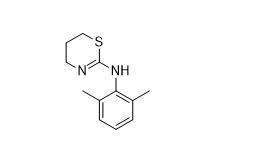
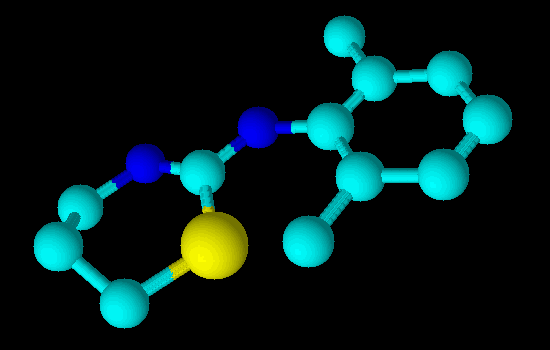
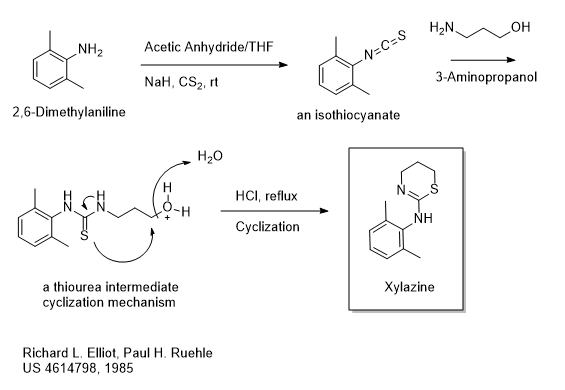
One reaction scheme for the preparation of xylazine is shown below. It is from expired US patent 4614798A (1985), Example 1, assigned to Vetamix. This prep uses acetic anhydride which is a List II chemical in the US. An acetamide intermediate is prepared from the aniline which is then reduced with sodium hydride and treated with carbon disulfide to give the reactive isothiocyanate intermediate. Finally, 3-aminopropanol adds to the isothiocyanate carbon to give the thiourea alcohol. Acid catalyzed cyclization by displacement of water by sulfur gives the xylazine product. This is some good meat-and-potatoes heterocyclic chemistry.
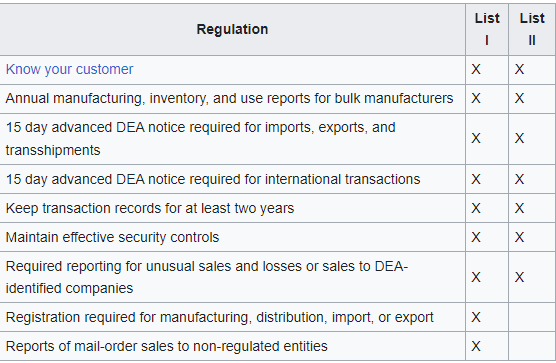
List II chemicals are subject to few serious reporting requirements in the US as seen in the table below. I suspect that the DEA benefits from good will disclosures. Following acetic anhydride shipment would be a good start in finding illicit labs in the US for several illegal drugs including xylazine, but it seems to be made in Mexico. Raw materials from China and drugs from Mexican labs add up to a very hard problem. Hard to tell how the cartel boys are making xylazine just from the internets.
A few years ago I found myself wandering through the Denver Museum of Nature and Science where I happened upon a robotics exhibition. In terms of the museum arts and sciences it was well conceived and executed, complete with a topical gift shop in the exit. All of the displays were accessible to the public in terms of language or hands-on widgetry. At each hands-on exhibit there stood a determined 5 to 8 year old yanking the controls around in a frantic effort to steer the robotic device away from the wall of the test area while onlookers yawned, waiting their turn. A visitor might have concluded that the purpose of the robot was to become stuck against an obstacle- a task it performed well.
These kinds of future technology exhibits are always popular at the museum. The lead-up to the exhibit is given all of the ballyhoo that the museum could afford. The theme of the exhibit is supercharged with the promise of a brighter tomorrow through the use of snazzy technology. If automobiles can be tied in, so much the better. It is a celebration of the triumph of technology for the everyman. The subtext was that only by the clever application of technology will we continue to improve our lives. These wonderful robots with their mechanical limbs and primate form would free humans from the dangers and tedium of the work-a-day world.
As I threaded my way through the exhibit I was struck by a sad realization. We’re celebrating the replacement of people with automation. The exhibit was a valentine to all of the entrepreneurs, engineers, investors and vendors who are trying their best to render obsolete much of the remaining workforce. This planned obsolescence has been going for many, many years.
Despite being against our own best interest, we patrons excitedly embrace these “futurama” style exhibitions, perhaps because secretly all of us believe that we will evade the job title of “obsolete”. Absent in the exhibit was a display on what the redundant workers would be doing with their involuntary free time. Fishing or golfing no doubt.
The top-level beneficiaries of robotics are the owners of the factories that make and use them. The driver is that robotics properly done may extend margin growth into the future. A way to overcome foreign competition is by reducing overhead, especially labor costs. Robotics and AI are economic bubbles in the same manner that computers and smart phones have been. The early adopters could enjoy a competitive advantage by the way they use their resources. Profits are unlikely to be channeled into hiring because, well, they’re profiting from the use of robotics. Once automation becomes normalized, there is no going back.
Insider business tip: Healthy companies match labor to the demand for product. More demand, more labor. Increased profits may go towards growth and acquisition, or it may go to the stockholders or to bonuses for management. But rarely if ever a price reduction to the public. If you are making a dandy profit and sales are strong, why hire or reduce prices?
The secondary level beneficiaries will be the consumer who will likely be oblivious to the fact that widget prices have not risen lately. Lower overhead does not automatically result in price savings for the end user. Extra margins will be absorbed by the manufacturer or seller. Just as likely, extra margins may be consumed by the manufacturer in wholesale price negotiations with retailers in the eternal battle for retail shelf space.
Many will offer that the history of man’s use of tools from the stone axe and wheel to AI driven automation is/was inevitable. The ascent of mankind is driven in part by our ability to use tools and develop a command of energy. It is difficult to think of a progressive industrial technology that did not result in the reduction of labor contribution to the overall cost of production. Nobody mourns the loss of the mule team and wagon, steam locomotives, or whale oil. We celebrate obsolescence and we take rapid progress for granted. Technological triumphalism is what we all celebrate.
But we should remind ourselves that there exists a substantial negative aspect of the story of technological progress. It is the very thing it enables: the reduction of labor hours per unit of production. The drive to raise profit margins is relentless, partly because the cost of doing business rises always rises and eats into margins. Labor costs in particular are always front and center in the mind of business owners.
The situation today is different than when Henry Ford developed his form of mass production. Then there was a smaller population with a significantly larger fraction of people living on farms capable of growing their own food. Many common goods and services were in the hands of local business operators who produced locally and distributed locally. Restrictions on manufacturing and business operations were less onerous than today allowing for greater flexibility in methodology. It may be fair to say that mass production is now widespread and optimized to some degree as a whole. Early automation with just limit switches and relays has given way to microprocessor-controlled process machinery. What is happening presently is the introduction of artificial intelligence (AI). This is the natural progression of technology.
However, we can look a step or two ahead further and ask the question, when will an AI system take over the total management of a factory? When will an AI system have human subordinates? How tight of a leash would we allow an AI system to have on the management of people? The presence of slack in the organization no doubt makes many job descriptions tolerable. What if AI tightened all of the slack in business operations where every half second is accounted for? Would people consent to working for an AI? Companies like Amazon are getting close to this, but there is still human oversight. Extrapolating, it is easy to predict that one day, very quietly, human management will disappear at some level and in its place will be an AI system.
AI has to be taught. Will there be standards of behavior built-in governing how AI interacts with its human subordinates? Will everyone want their companies managed by an AI programmed to have a Jack Welch profile? My god, I hope not.
Another awful thought is the possibility of government and the military run by AI. Let that roll around in your mind for a bit.
There is a need to get back to basic principles here. What is our purpose in life? For most I think it is to love and be loved as well as to participate in some kind of rewarding activity. We all want to be useful and to leave behind some kind of legacy. There is no doubt that the replacement of human labor by AI-driven systems will continue to move forward, encroaching on all of our lives. Ultimately this is driven by a few people at the top who will reap the rewards to the greater concentration of wealth by a few trillionaires. Is concentrated control of limited resources a good thing? Is there any choice?
There is also a large fraction of the population that is not very progressive or forward looking at all. While they enjoy the devices and comforts of advanced technology, they neither understand or care about what is needed to develop a drug or design a new semiconductor chip. Behind our modern civilization is an educated and skilled workforce. However, the US is comprised of many people who are anti-intellectual by nature. This trait has been there all along and will into the future.
In some ways these people are disruptive to the progress and stability of the American experiment and, as of this writing, it isn’t at all clear how this will play out. The USA may well not be a stable enough environment in the future to sustain the continued, very expensive growth of technology. Technological advance requires highly educated workforce who can afford the training to get there. Just to stay even with what we already have, the pipeline of educated people needs to be full.
Forward looking people, the ones who want to sustain our advanced civilization, must step up and be counted or the thing will expire. For all of its problems, the US has nonetheless been a productive incubator of innovation and a great many positive aspects of advanced civilization in the form of a noisy, somewhat chaotic liberal democracy. The goose that laid the golden egg is still alive. Shouldn’t we keep it going?
>>> Warning. This essay contains liberal political content. No chemistry here. This isn’t a “balanced discussion” of political values. I am flatly calling foul on WASPish conservatives who I maintain are destabilizing what has been an imperfect but productive US culture. <<<

No, the great knob of Florida isn’t DeSantis, although it is an amusing thought. Anybody remember when electronic devices had selector knobs that you would twist a certain number of clicks to the desired setting? The knob was constructed with detents that would hold the knob to a specific place in the rotation of a selector switch. It is a nice little simile for many things in life. For this writing, I refer to how the WASP (White Anglo Saxon Protestant) Republican party (GOP) of the US state of Florida is methodically clicking the legislative knob toward their ultraconservative model of the social order. This is to be expected, I suppose, except that lately Florida is taking very large steps in the direction of banning many resources and services that were previously not the subject of legislation. DeSantis is backed by a substantially older, low information base of Republicans.
DeSantis’ thin-skinned punishment of Disney, Inc., makes him a very waspish WASP. But Mickey was clever. He had the board write up an agreement containing the Royalty Lives Clause before the governing board was dissolved. What a hoot!
Knobs are clicking all over the country. States with similar Don’t Say Gay bills in progress are: Arkansas, Georgia, Hawaii, Indiana, Iowa, Kentucky, Louisiana, Michigan and of course, Missouri. This issue seemingly fell out of the sky in the last few years and has spread like wildfire. Sexuality has always summoned the Puritan in Americans, but homosexuality conjures images of the worst kind in them. Conservative leaders are leaping over one another to click the big knob while the MAGA people have their time in the sun.
[Side note] A old friend has been breathing fire on Facebook about the “liberal agenda” including imminent loss of the 2nd amendment and confiscation of guns. As usual, George Soros is blamed. Imagine the folly of attempting to confiscate guns in the US. It would be a complete disaster with widespread chaos and casualties. It ain’t gonna happen. Wackos with firearms and mass shootings will remain a baked-in feature of the US cultural landscape as far as anyone can see going forward.
Used to be, the radical right wing could be counted on to be squarely against “big government”. But now we find them burying their heads into public education like a tick. Recent legislation in Florida and other like-minded states is aimed at censoring library books and curriculum having “controversial” content, namely any mention of LGBTQ+ lifestyles, alternative gender designations and any history or social studies that might suggest white complicity in past inequities (critical racial theory, CRT). This controversy is a longstanding conflict with conservatives that, like IBS, has flared up again. This time, however, they have new vocabulary such as “woke” and “CRT”, and rancid mouthpieces like Tucker Carlson to continuously beat the propaganda drum. Joseph Goebbels would have loved Tucker.
One overreach by the GOP is the matter of their public attack on gender affirming care for minors suffering from gender identity issues. Republicans have put their cloven hooves down on this (ok, this was sarcastic). In the Republican view, minors should only receive treatment by way of “curing” gender identity issues by conversion to the heterosexual, birth gender side. The alternative is to just tough it out until they reach adulthood. The associated personal strife and suicidal risk connected to gender identity issues are unpersuasive to conservative WASPs.
Public schools have a mandate to provide a quality education for all students, including those with special needs. Public school teachers and their districts want teach students how to overcome life’s challenges and take advantage of opportunities. Gender identity issues can spiral into learning difficulties or even suicide. Parents are frequently at their wits end dealing with it and look upon the public schools to provide the right environment, specialists and curriculum. Very often, the parent(s) of troubled kids do not have the financial resources to provide treatment for their students nor can they take time from work. The schools have limited resources as well but they try because they are expected to.
The GOP image of gender affirming care is a manufactured bugaboo, much like so-called CRT or wokeness have been. It is another rallying cry for the angry and disenfranchised. Republicans know that they can readily frighten some fraction of low information conservatives into voting Republican by claiming widespread pedophilia, gay-anything, evolution or just general liberal leanings. Legislative knobs are clicking all across the country over this matter. Grand Poohbahs of the soon-to-be Christocratic States of America (Ok, that’s satire) are loudly proclaiming that there is a liberal agenda to turn kids gay. Just as absurd, some believe that seeing or hearing a drag queen could harm their immortal souls.
The LGBTQ+ issue, if you can call it that, is a straw man devised to sideline people into a state of outrage. That said, however, I can’t think of a pedagogical reason for extensive exposure to sexuality in general as a subject matter in classrooms with any more than a passing mention in grades K-9. In my view, however, for grades 10-12, discussion or readings on sexuality as a sociological phenomenon should not be out of bounds. Parents who object to even this could send a note to the teacher excusing their child from this topic. Deeper study can be left to college level. The acknowledgement that alternative pairings between people or gender identity even exists is not an invitation to join in. Kids have always sought out ‘forbidden” information. If they don’t learn from knowledgeable sources, they’ll pick up odd versions of it elsewhere.
We had a similar problem years ago with sex ed in the schools. More than a few imagined that the Kama Sutra was the textbook and spoke out aghast that kids will have exposure to this. In reality, the topic was based on biology and how reproductive systems work. Sexually transmitted disease was gently introduced as something to watch out for. The histrionics at local school board meetings could be intense. No, we’re not teaching little Johnny and little Susie how to do it. They’ll figure that out on their own.
Behind this is longstanding momentum from the large, assertive and well-funded conservative evangelical wing of the GOP. Their strategists and grandees know that if they repeatedly state that public schools are teaching LGBTQ+ lifestyles or CRT, low information voters will reliably panic and vote GOP. They’re right. There are large numbers of low information voters who are easily swayed by GOP hyperbole and outright lies. Schools are just a step stool for GOP power grabbing. Religious indoctrination and basic morality are firmly the responsibility of the family.
The public schools are for learning the massive amount of information that is of a secular nature. You know, like accounting, drivers ed, wood shop, spelling, math, PE, foreign languages, chemistry, physics and biology to name a few. You know, the things that the Bible is silent on. For crying out loud, God gave us brains and expects us to fill in the blank spaces.
<END>
 Lamentations on Chemistry