Gaussling is a senior scientist in the chemical business. He occasionally breaks glassware, spreads confusion and has been known to generate new forms of hazardous waste. Gaussling also digs aerospace, geology, and community theatre.
According to Argus there are problems with the processing of Permian West Texas Intermediate (WTI) crude oil. Natural gas liquids, NGL, and additives are being blended upstream into WTI in an effort to boost profits in the face of low prices for crude oil. This is causing processing problems downstream. The problematic NGL component is butane.
The purpose behind adding NGLs is to lighten the WTI into a higher grade. Refineries not accustomed to receiving WTI that has been lightened with NGL are having problems with excessive light fractions that the refinery was not designed for. Crude enhanced with NGLs produce a higher output of light end yields, leading to production bottle necks. Further, the NGL enhanced crude is less dense and occupy more space in pipeline than does typical crude. As of the time of the report by Argus, is was unclear where the NGLs are coming from. NGLs are naturally found in crude oil.
Mercaptans are increasingly problematic, especially for export to countries with more stringent requirements for sulfur. Sulfur compounds are destructive to refinery operations and are subject to regulatory restrictions in some fuels like diesel and jet fuel.
Offshore US Gulf medium sour Mars refers to oil produced by a platform in the Gulf of Mexico and it serves as a benchmark for quality. Recently zinc contamination has been found in Mars crude stream. This has led to supply chain interruptions and refinery problems.
On CNBC today there was a report describing a looming shortage of trinitrotoluene, TNT, in the USA. According to this report, the USA quit manufacturing TNT in favor of importing it around 1986. Weapons-related consumption of TNT occurs both in military explosives for US stockpiles and for exported munitions. With Putin’s ridiculous war against Ukraine, America’s export of TNT-related munitions has increased, depleting the national inventory.
According to CNBC, the USA has been importing TNT from countries like Poland, Turkey, South Korea, Australia, and India. Recently, the price of TNT has increased to $20 per pound, increasing the cost of blowing rock, tanks and people to smithereens.
Some business considerations
If the competitive price for TNT is $20 per pound, then you want to ship it at a cost of at least $10 per pound. Even better would be $5-$8 per pound. This would be wonderful, but the fact is that the commodity chemical business is a high volume, low margin business. A margin squeeze is to be expected. Margins of a few dollars per pound wouldn’t be unusual for commodity chemicals.
Product below specifications can either be reworked or sold as a lower grade of product if there is demand. Commonly, below spec product can be blended with above spec product to pass QA. A TNT production plant coming online will increase the amount of product in the market, leading to depressed prices. What I’ve just said applies to the chemical industry at large, not just for explosives like TNT.
Unlike products such as bulldozers and trucks that leave the plant and go to work to create wealth, military armaments are not tools for wealth creation when used. They are consumables made for offensive or defensive destruction. Mining explosives are used to create wealth, but artillery shells are spent in conflict.
In the meantime, in Kentucky
In response to the precarious dependence on foreign vendors, the US government has awarded a contract to Repkon USA to construct a TNT manufacturing facility in Graham, KY. None other than the elderly Kentucky Senator Mitch “Grandpa” McConnell was present for the ceremony in Kentucky.
A bit of nitroaromatic history
TNT was first synthesized in 1863 by German chemist Julius Wilbrand during research in the area of synthetic yellow dyes. It wasn’t until 1891 that the explosive properties of TNT were discovered by German chemist Carl Häussermann. The earliest reported use of TNT as a military explosive was in 1902 and was used to fill artillery shells. As luck would have it, TNT is relatively insensitive and can be safely melted and poured into artillery shells or other munitions. According to Wikipedia, unlike the British explosive Lyddite, aka picric acid, TNT-filled artillery shells would not explode in contact with ships. Rather, TNT could withstand penetration of armor and then detonate internally. Artillery shells filled with the more sensitive picric acid would explode on contact with armor and explode externally, wasting its energy.
The older cousin of TNT, Picric acid, was used in the Battle of Omdurman, the Second Boer War, the Russo-Japanese War, and World War I. Picric acid was first synthesized from indigo by Peter Woulfe in 1771. It was synthesized purposely in 1841 by French chemist Jean-Baptiste Dumas. Of interest is the fact that the synthesis of indigo and other dyes was a target of much experimentation in Germany in the 1800’s.
Nitroglycerin
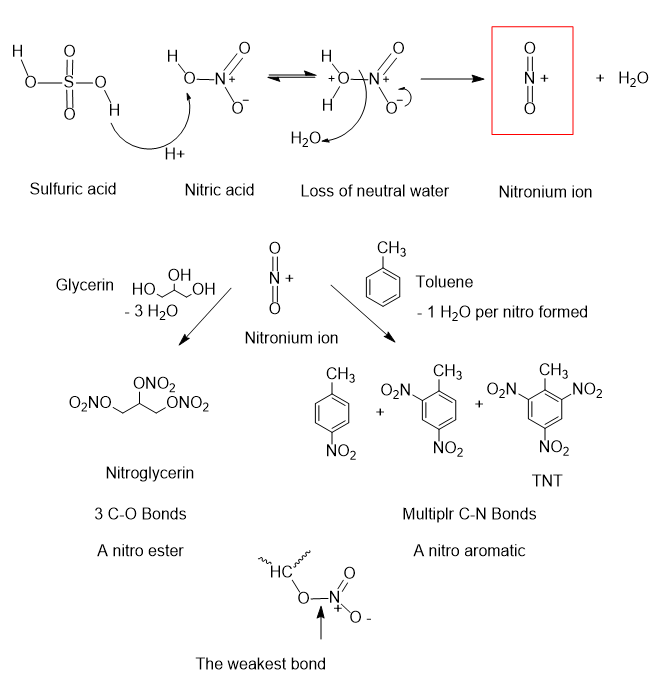
A quote from Wikipedia “The nitration of glycerin in 1846 by Ascanio Sobrero. He initially called it ‘pyroglycerine‘, and warned vigorously against its use. In fact, he was so frightened by what he created that he kept it a secret for over a year” (Wikipedia). Nitroglycerin is a nitrate ester wherein the three carbon atoms of glycerin are connected to the nitrogen through an oxygen atom. while TNT is a nitro compound with the nitrogen is connected to carbon atoms of toluene. The great sensitivity of nitroglycerin lies in the C-O-N connections while TNT and picric acid have C-N connections. Nitroglycerin is classified as a “nitro ester” while TNT and picric acid are “nitro aromatics.” The nitro ester functionality is much more susceptible to rapid disassembly by a stimulus like mechanical shock or heat.
The nitration of aromatic substances like benzene, phenol and toluene led to the introduction of powerful and relatively easy to manufacture explosives. Naturally, substances that are explosive attract great attention and have undergone a high degree of practical use to perfect.
People routinely disregard the ills of society, but when it comes to developing weapons of war, we become freaking Leonardo Di Vinci.
WWI saw the wide use of picric-acid-filled artillery shells that produced a new degree of violent destruction where used. At the same time the gas automatic machine gun, invented by Hiram Maxim, was introduced into warfare. WWI set the standard for violent death with the introduction of the Maxim machine gun and high explosives.
Interestingly, there is a medical use for nitroglycerin. It is used to treat angina. I have some at home myself, though I’ve never had to use it, thankfully.
Some words about nitration
Nitration of alcohols and aromatic compounds requires a source of -NO2, usually it’s nitric acid. However, the nitrating ability of nitric acid alone is weak, rather it must be activated to produce a more reactive form of nitrate. Sulfuric acid is a stronger acid than nitric acid and consequently is able to remove an oxygen atom by dehydration of the O-H group of nitrate anion producing water and affording a highly reactive (NO2)+ cation. The 6 electrons sandwiching the carbon skeleton of aromatic rings as with TNT, etc., are susceptible to attack by positively charged species and the (NO2)+ cation does the job. The advantage of nitric acid in all practicality is that a hydrogen atom, H+, is already attached producing a water molecule that will easily detach from the nitrogen to form the reactive species, (NO2)+. [As an aside, in chemical processing, liquids are easier and safer to transfer by pumps and piping as opposed to solid addition.]
Formation of nitro esters and nitro aromatics. Graphics by Buford Pusser.
The production of TNT might seem fairly simple- all that is needed are the cheap commodity chemicals toluene, sulfuric acid and nitric acid plus reactors and other process equipment that can resist strongly corrosive acids. The scale of the process will need to be large enough to capture the economies of scale in accordance with capital costs. Utilities like heating and chilling will be needed as well as possible on-site water treatment if allowed. And don’t forget an idiot-proof written procedure and EHS staff as well as talented management. A properly equipped analytical lab will be required for QA/QC.
More fundamentally you’ll need a remote site on which to build a plant that is supplied with sufficient electrical power as well as water and sewer. The state, county and nearby towns will insist on iron-clad assurances of worker safety and proper hazardous waste management. The state will be watching air emissions closely. Then there is finding an insurer to cover the plant and operations.
If you start a nitration operation, why not plan for products in addition to TNT? It can be unwise to operate a 1 act pony. What if the pony dies?
Note: This is one of my most instructive memories from 10th grade and has been dredged up from the murky past. By 10th grade I had already absorbed a book on the electronics of vacuum tube radios. At this time you could go to a drug store and find a vacuum tube tester which also had an inventory of common vacuum tubes shelved below the tester. If the tube you plucked out of the TV set failed the test, you could buy a replacement. A burned-out filament was common and easy to spot because the tube was not illuminated by the filament from inside and was dark.
Oh yes. The involuntary grunting noise is the sound one makes while being electrocuted.
=================
Make magazine is one of my very favorite publications. It’s made for hillbilly engineers and aspirants like myself. Their Maker Shed Store offers kits as well as plans for making all sorts of cool gadgets.
Kit building and garage engineering are important activites for aspiring young scientists. We senior scientist types should be on the ready to mentor local high school students in their bid to learn about technology from the ground upwards.
Electronic experience is invaluable to all experimentalists- physicists, chemists, geologists, biologists, etc., and is a subject of lifelong utility. Many students do not have peer groups or family members who can help them get into this subject. [for many years I’ve trained new hires twice monthly in electrostatic discharge safety and am constantly amazed at how few people know even the most basic aspects of electricity. This includes drawing a schematic of a flashlight which led to the shrugging of shoulders.]
As a junior high school kid, I worked on TV sets (tube electronics) and acquired some electrical and mechanical ability in doing so. I actually fixed a few problems, surprisingly. A family friend had a TV repair shop (remember those?) and as a result I had a steady supply of TV chassis to take apart for my collection of parts like potentiometers, switches, vacuum tubes and variable capacitors.
Like most kids tearin’ stuff apart and eyeing the construction methods and components, I gained valuable electrical insights and personal experience with electrical current. Like the time I discharged a picture tube through my hand while trying to remove a flyback transformer from my grandparent’s color TV. It was great lesson in capacitance and isolated static charge. As my grandparents sat on the Davenport and watched, they heard a sudden and involuntary grunting noise burst from my mouth as I hurled myself from a squatting position by the opened console TV set and backwards across the room. I probably absorbed more joules of energy from landing on my backside than the joules absorbed by my hand. Luckily, I was not burned. The next day I learned how to properly discharge the aquadag in the picture tube.
A strong electric shock is nothing at all like tangling with an vicious animal who might stand there after the altercation spent and panting, wondering in its little badger brain how to tear an even bigger chunk out of your leg. A discharged electrical device bears the same silent affect before as afterwards. It’s wicked electrons are inanimate and unparticular in their singular drive to find ground. An unexpected jolt from a device is much like a magical experience. It comes from nowhere and everywhere and is over in the blink of an eye. Afterwards you stand there in shock and awe of the effect of even modest amounts of energy.
The impulse to do science is also the impulse to find boundary conditions of phenomena. Where are the edges? How does it switch on or off? You have to be willing to leave some skin in the game to find out about things.
RIP to the crew of the UPS MD-11 that crashed on takeoff in Louisville, KY.One senior airline pilot believes that the incident possibly began on takeoff in the gap between V1 and V-rotate speeds where an airplane is most vulnerable to engine failure. V1 is the speed where a decision must be made to continue the takeoff or abort. Aborting at V1 is still slow enough to stop before the end of the runway. Exceeding V1 speed obligates the crew to take off lest they depart the end of the runway. V-rotate is the speed where the nose is lifted to begin the climb off the ground.
The MD-11 that crashed. Notice the tri-jet configuration with the engine at the bottom of the vertical stabilizer. An MD-11 is a modified DC-10.
On takeoff the MD-11 is full of fuel (35,000 gallons in this case at 6 lbs. per gallon) and at full power. Near max gross weight and with no further power to add, an airliner might lift a few feet off the ground in ground effect but settling down off the runway at high speed and full of fuel is a gamble most are likely to lose. For commercial jet aircraft, the maximum landing weight and the maximum takeoff weight are different, with the landing weight being a bit lower. A jet taking off at max gross weight and then wanting to return to the airport right away must either dump fuel or loiter nearby to burn off excess fuel. Landing too heavy may result in blown tires and/or landing gear damage. Loss of a main landing gear will result in the wing and possibly the engine contacting the ground which can result in the plane pivoting abruptly and possibly tipping over.
The above explanation rests on the cited airline pilot’s early assessment as well as basic aeronautical knowledge. I watch this pilot’s videos regularly and have come to trust his content. The NTSB is investigating and will issue a final report in due time. Explanations prior to the release of the final report will contain some amount speculation. However, some speculators are better than others.
The senior airline pilot on YouTube referred to the fire as an “uncontained” engine fire. A contained engine fire within the engine cowling is almost always survivable, but when the entire engine with pylon breaks off at the wing mount as with this MD-11, the airplane will naturally want to yaw and roll over the missing engine as in what happened. It’s reminiscent in some ways of the engine fire and crash of the Air France Concorde crash in Paris in 2000. In the Concorde crash, a left engine sucked in some tire fragments from a blown tire after running over debris on the runway.
The loss of the entire left engine with pylon resulted in the American Airlines flight 191 crash at Chicago O’Hare in 1979. The cause was due to stress fracturing and failure in the attachment assembly between the left engine pylon and the wing during engine maintenance. Instead of disconnecting just the engine, the airline found it saved 200 hours of maintenance time to disconnect the pylon from the wing instead of detaching only the engine.
Aircraft structures are designed to withstand forces along certain directions. For example, a bird impacting and entering the cockpit may not be a major design criterion. Side loading of a landing gear from landing partially sideways results in forces that otherwise may be tolerated, but lateral forces may overstress the gear assembly, destroying the tires adding to the fa8lure sequence. A pressurized aircraft is designed to withstand internal air pressure and pressure cycling, but not necessarily from other directions beyond some conservative specification. Wings are designed to withstand a certain amount of positive and negative g-forces as well as some flexure, but beyond these specs, the crew are airline test pilots expanding the performance envelope.
You’ve probably heard that #47 has asked the Pentagon to be ready for action. According to an article in The Hill, President #47 has labeled Nigeria as a “Country of Particular Concern”, or CPC. This designation stems from news that Islamic terrorists are allegedly attacking Nigerian Christians. A group of approximately 30 American Christian religious leaders and a few politicians like Ted Cruz and Rep. Riley Moore (R-W.Va.) as well as the entertainers Nicki Minaj and Bill Maher have made a convincing enough case for the President to make the CPC declaration.
The [CPC] designation compels the president to consult with the designated government, draft up a foreign policy action plan, and consult with Congress about implementation. [H.R.2431 — 105th Congress (1997-1998) within 90 days.] –Laura Kelly – 11/03/25, The Hill
If you read H.R. 2431 (2018), you’ll find:
Title IV: Presidential Actions – Subtitle I: Targeted Responses to Violations of Religious Freedom Abroad – Directs the President, for each foreign country in which the government engages in or tolerates violations of religious freedom (including particularly severe violations), to oppose such violations by taking certain actions and promoting the right to freedom of religion in that country. [emphasis mine]
(Sec. 405) Specifies among the actions the President maytake: (1) public condemnation; (2) delay or cancellation of scientific and cultural exchanges; (3) withdrawal, limitation, or suspension of U.S. development assistance and U.S. security assistance; (4) instruction of U.S. executive directors of international financial institutions to vote against loans primarily benefiting the foreign government responsible for such violations; (5) restrictions on the issuance of licenses to export any goods or technology to such foreign government; (6) prohibition against the making, guaranteeing, or insuring of loans, or extension of credit by certain U.S. financial institutions to the violating government; and (7) prohibition of U.S. Government procurement of goods or services from such government. Provides for: (1) commensurate actions in substitution for any of the above presidential actions; and (2) binding agreements with foreign governments obliging them to cease, or take substantial steps to address and phase out, the acts, policies, or practices constituting violations of religious freedom.
(Sec. 407) Authorizes the President to waive the requirements of this Act if certain conditions are met.
(Sec. 410) Prohibits judicial review of presidential actions or agency actions taken under this Act.
My reading of Title IV of H.R. 2431 is that the President is compelled to take certain actions against Nigeria. While taking no action does not seem to be specifically barred, I didn’t see it listed as an option.
The potential threat by the President is in sending an expeditionary military force to Nigeria to stop the violence on Christians. According to Wikipedia, the population (2023) of Nigeria is estimated at 236,747,130 people. Unless the terrorists are wearing military uniforms, how will our troops find them and what’s to prevent a guerrilla war with the terrorists gradually taking bites out of our soldiers as they did in Viet Nam, Iraq and Afghanistan? Guerilla warfare has time and again proven successful against superior military forces.
America does not need another distant land war … this time in west-central Africa with guerilla fighters in the jungle. Peace through superior firepower only works if you can find the targets. Perhaps we should call in favors from Israeli special forces?
Finally, conflict between religions is a conflict between ideas. When both sides believe that they have authority based on the supernatural, short of religious conversion or death how do you decisively win such a war? A war of attrition, perhaps?
As a military conflict progresses, what is to prevent escalation on the part of US forces. Or is this just to be the work of a few military advisors? Remember, that is how the US stumbled into the Viet Nam war.
I received an email from Academia.org stating that they could turn a research paper which they suggested into a cartoon. Well, what could I do but give it a try?
Cartoon based on a my paper of mine in JOC (long ago) on the facile synthesis of molecules with chiral, enantiomerically pure quaternary carbons. It was a synthetic methodology paper.
Considering that the cartoon has only 4 panels to it, this isn’t so terrible. The title of the paper did have some ordinary vocabulary in it like: the, of, and pure. Isn’t that enough for everyone? Crimony!
In truth this “service” is meant to tickle my funny bone enough to lower my cheapskate defenses, hopefully causing me to subscribe to their service. It didn’t work, this time.
The “facile synthesis machine” is up there with the “Wayback Machine” in terms of wishful thinking.
Secretary of Defense Hegseth and the public affairs office with the Department of War in Washington, DC, announced late Friday that 2 policy changes will go into effect on January 1, 2026, both relating to the military dress code. First, unless otherwise specified, Fridays will become casual Friday. Second, ties worn by service members will be red and extra-long. This change has been in the works since 2016.
White House Deputy Chief of Staff Stephen Miller was rushed from the White House outhouse to the hospital late Friday evening for a severe RCI, Rectal-Cranial Inversion. Members of his immediate family said only that this came as no surprise.
A spokesman for President Trump said that the East Wing conversion has already gone over budget owing to the late addition of state-of-the-art-secret doors and passageways. The secret doors are designed for the quiet removal of foreign guests who refuse to speak English.
The White House Office of Global Disruption has announced the decision to rename an offensive digit. It has been named “Trump” and it replaces the name “five”. MAGA rejoiced in the elimination of the Antifa-approved name five, e.g. trump, trumpteen or trump thousand trump hundred and trumptytrump. When asked whether or not this is a wise move, Trump replied that someone said that this will be the greatest change ever in mathematics.
The design below is found on a t-shirt offered by Humorous History Company. It’s a hoot! Have to order one. I hope they don’t mind my reproducing it here.
This is an encore release of a much earlier post. –gaussling
After an insane week in the lab a road trip to the cool meadows of the nearby mountain range was just what the doctor called for. It was the last weekend before the family- one teacher and one kid- return to school. Summer break 2009 is history.
We piled in the car and pointed it uphill towards Leadville, Colorado. The planetary atmosphere thinly blankets this insanely high mountain city. It was just what I needed to clear my scrambled mind. Nothing like blinding sunshine and mild oxygen starvation to reset a brain in chronic spasm from sensory overload.
Leadville sits at 10,152 feet above sea level. If you doubt the effect on your stamina, just take a short sprint in any direction. Or just plod up the stairs of your hotel. Lordy. All of those business dinners- all that lovely Cabernet and Crème Brûlée- and years of driving a desk have caught up with me.
Leadville is located in the Colorado mineral belt and began to populate with fortune seekers about the time of the Colorado gold rush in 1859. Some placer gold was found in the streams, particularly in what was then called California Gulch, but for the most part Leadville became a silver camp.
In 1874, two investors with metallurgical training, Alvinius B. Woods and William H. Stevens arrived in Leadville and analyzed the muds found in the local sluicing operations. According to A Companion to the American West, edited by William Francis Deverell, (2004, Blackwell Publishing, ISBN 0-631-21357-0, p. 319) Woods and Stevens found the heavy black mud so problematic for gold sluicing was in fact composed of lead carbonate with high levels of silver. Woods and Stevens invested $50,000, quietly buying as many claims as they could and began hydraulic mining operations immediately.
By 1890 there were nearly 90 mines in operation employing 6000 miners. At its peak there were 14 smelter operations supporting the mines. Leadville was a genuine boom town with the expected mix of characters.
A mine is a hole in the ground with a liar standing at the top.
All mining towns have characters who go on to dominate local legends and stories. Among the well-known-for-being-famous rags to riches to rags players in Leadville are Horace and Agusta Tabor, along with Horace’s mistress and 2nd wife, Elizabeth “Baby Doe”.
To make a long story short, Horace was a struggling shop keeper who invested in a mine east of Leadville. Though it was salted by the previous owner to entice buyers, Tabor dug 25 ft further down the shaft and struck a rich and extensive vein of silver ore. The operation was called the Matchless Mine, after Tabor’s favorite brand of chewing tobacco.
According to the tour operators, Tabor operated the Matchless Mine 24/7 for 13 years, pulling an average of $2000/day of silver out of it. At its peak, the mine is said to have employed 100 people. Miners were paid the common rate of $3.00 per day to climb 365 ft to the bottom of the shaft for 12 hour shifts.
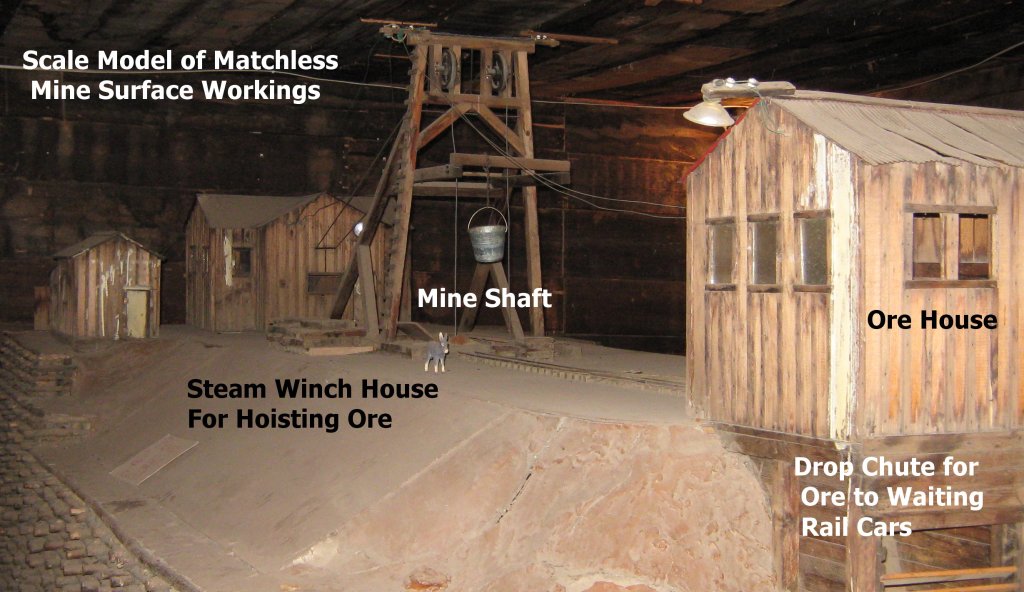
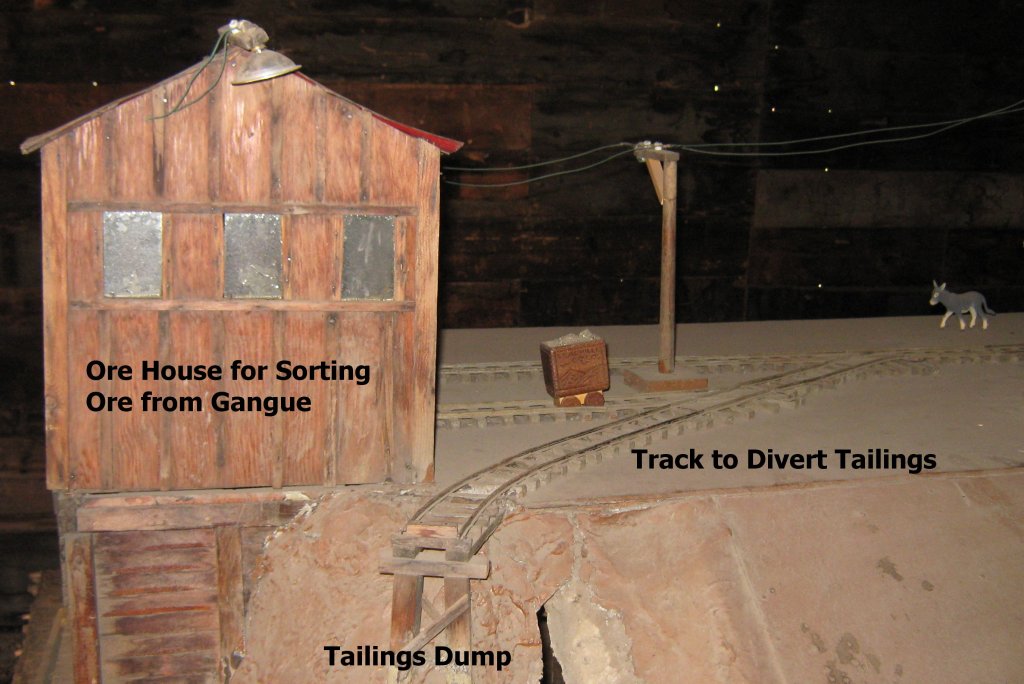
The underground workings of the mine followed the vein structure and focused on sending concentrated ore to the surface. Buckets carrying approximately one ton of ore per load (my estimate) were tipped into ore carts and rolled into the ore house for hand sorting. The most highly concentrated and valuable ore was dumped down a chute for loading into a rail car and the gangue (or tailings) was dumped into the gulch.
An assay building (not shown) was on site to provide a continuous assay and accounting of silver sent to the smelter in Pueblo, Colorado. Unlike many other mine operators, Tabor owned a rail operation and had a spur at the mine for pickup and delivery of ore. Many mine operators had to employ mule-skinners to cart wagon loads of ore to a rail siding for transport to the nearest smelter.
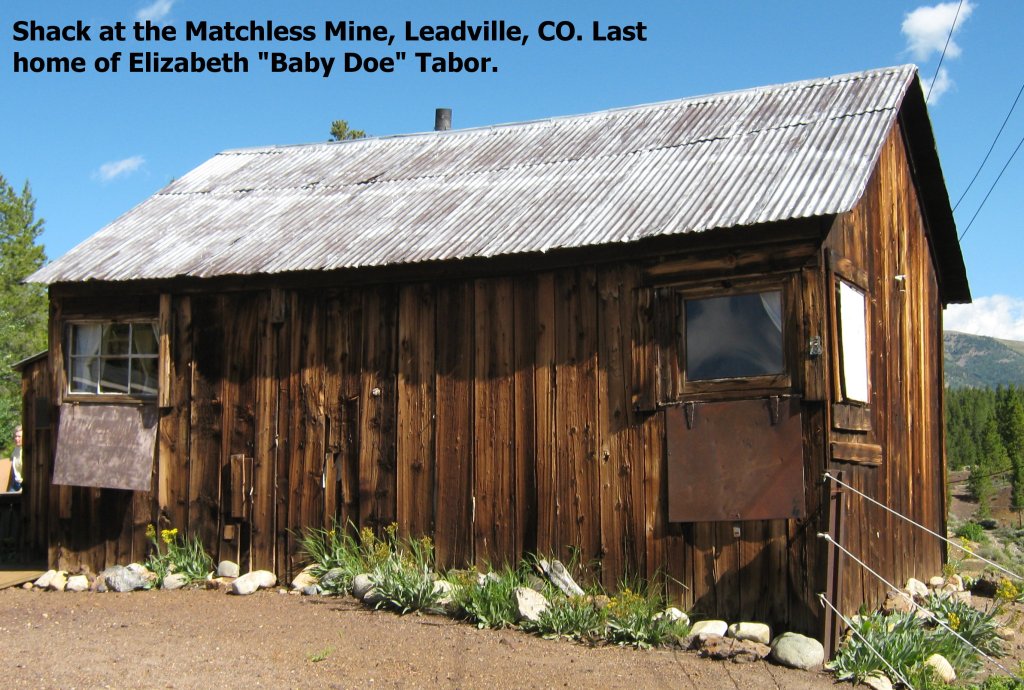
In 1893 the repeal of the Sherman Silver Purchase Act and the collapse of the railroad industry bubble were part of a panic that lead to a crash in silver prices. Tabor lost everything and, as a respected public figure, was appointed postmaster of Denver for a short time. Eventually Tabor died at age 69 in 1899. Ex-wife Agusta had invested her divorce settlement wisely in Denver and lived comfortably. Widow Baby Doe Tabor was found frozen stiff in her shack at the Matchless Mine in 1935.
Matchless Mine Shack
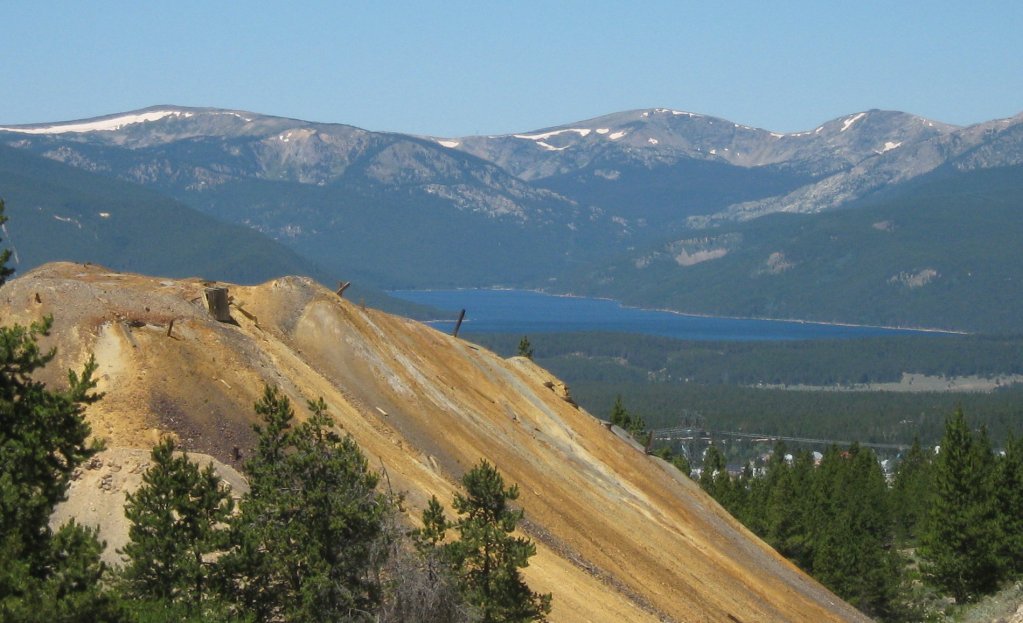
All of the digging from the boom time of Leadville has left an enduring legacy for those who live in the watershed. Much of the mining activity occurred uphill, east of the city and as a result, that area is pock marked with many large colorful tailings heaps. While the colors are interesting to ponder and sample, the ground and surface waters are greatly affected by aqueous extraction of metals from these piles.
If you stand next to one of these heaps, you can’t help but notice the smell of sulfur. The ore and tailings are enriched in sulfides and once exposed to air and water, oxidation occurs to make corrosive runoff. This is a kind of heap leaching phenomenon that will eventually exhaust itself, but only at the cost of water quality.
Boomtown Legacy (Copyright 2009 All rights reserved)
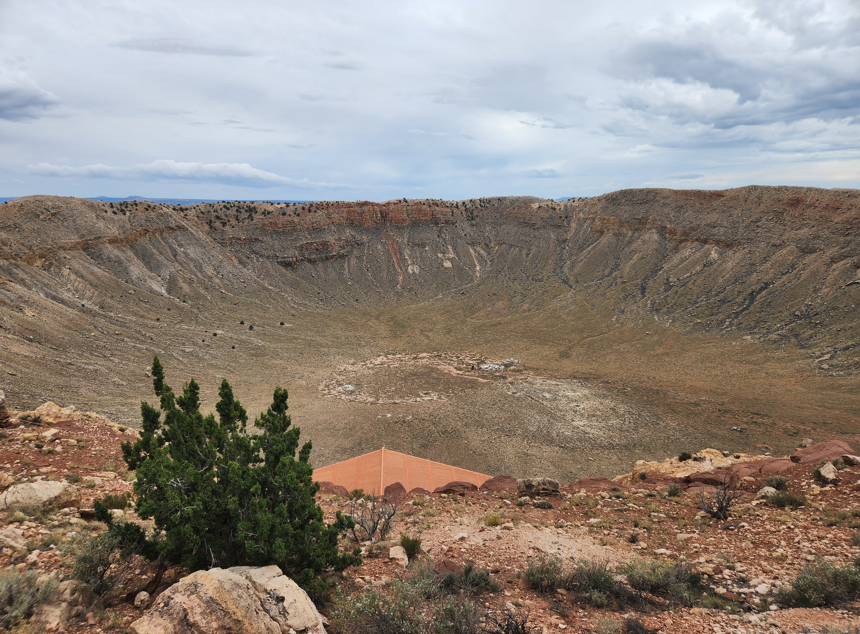
Recently we flew into Albuquerque, NM, and then took I-40 to the Barringer Meteor Crater southwest of Winslow, AZ, and 5 1/2 miles south of I-40. This was a bucket list trip for me but maybe not so much for my long-suffering spouse. I’ll spare the reader of all of the obligatory selfies.
View of the Barringer Meteor Crater from the northern observation area. The brown roof in the foreground is a shelter with seating and with plaques commemorating those who own or have cared for the crater. Photo by Arnold Ziffel.
The meteor hit the AZ location 50,000 years ago and blasted a crater out of the local sandstone. The fellow who first bought the site, Barringer, believed that iron remnants of the meteor were buried within the crater, so he obtained the site by filing mining claims in 1903 that included the crater. He dug a 200 ft mineshaft into the center and drilled exploratory holes hoping to strike a rich lode of iron. Sadly for him, he found only sandstone. In fact, the fragmented remains of the meteor are scattered over the surrounding landscape. Daniel M. Barringer, a mining engineer and businessman, who bought the mining claims believed the crater was due to a meteor impact. It was many years later that professional opinions agreed that the crater was meteoric in origin. The Crater has been in in the hands of the Barringer family from the beginning.
Photo by Arnold Ziffel.
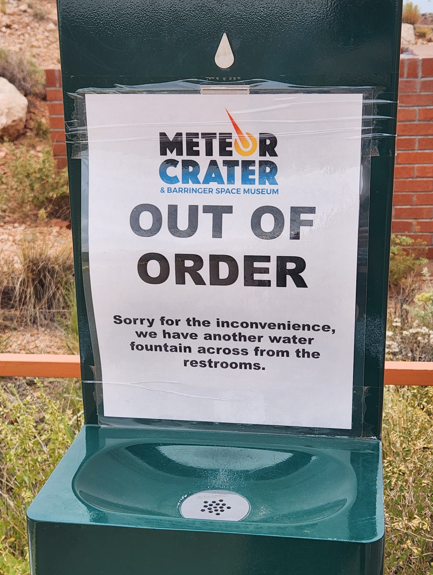
I thought this was amusing at first glance, seemingly warning that the Meteor Crater was out of order, but it was just for the water fountain. The visitor’s center has a large gift shop and an auditorium for a short video of the site and its history. The only path to the crater is through the visitor’s center. It is all private property.
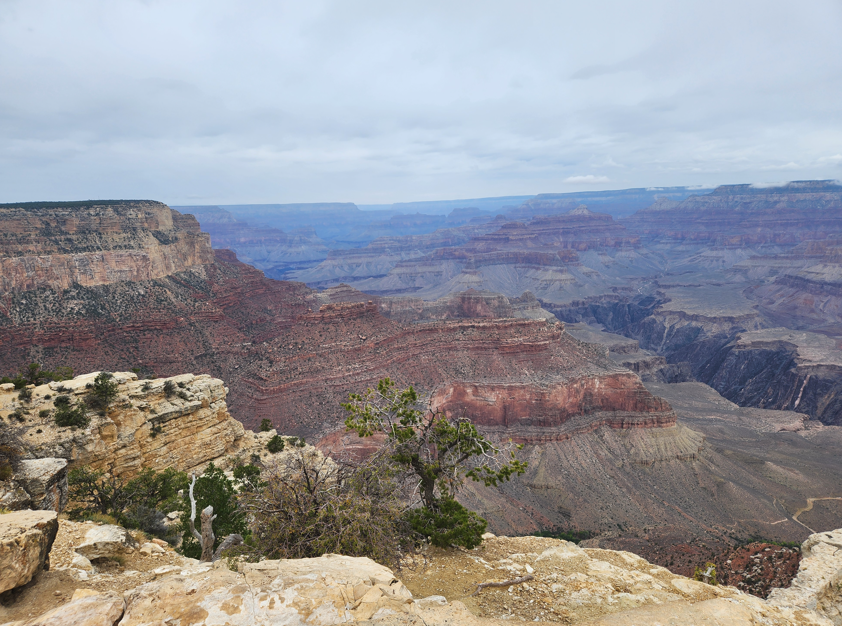
The second big hole in Arizona is a whopper located north of Flagstaff. It is the Grand Canyon, of course. I had scheduled a helicopter tour of the canyon with Maverick Helicopter. at the Grand Canyon National Park Airport. They have 5 gleaming Airbus H130 helicopters that can carry 6 passengers each. Everyone gets headphones to speak in the noisy choppers.
View of the Grand Canyon looking northwest from the south rim. Photo by Arnold Ziffel.
Everybody has seen countless photos with all of the breathless descriptions of the canyon, and yes, it is definitely Grand. We took a ground tour with Pink Jeep Tours in one of their custom pink Jeeps. This was in the fall shoulder season for tourism so the crowds were manageable. Gawping at it from the rim was nice but to have a real canyon experience I think you have to go into the canyon.
Note: Some of the VLA pictures are duplicated from a recent post.
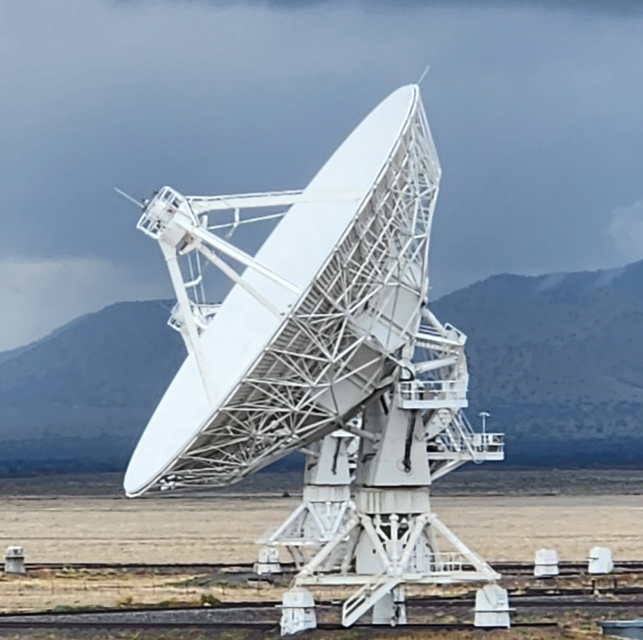
Once we completed our tour of Arizona’s two gaping holes, we pointed the car east and drove to the Very Large Array (VLA) near Magdalena, NM. They put on an open house for the public on Oct. 11, so I was obligated to grab another bucket list trip. Again, the spouse unit was luke-warm but I was impressed.
One of the 26 operating dishes at the VLA in New Mexico. Photo by Arnold Ziffel.
One of the 27 dishes is in the shop and 26 are in the field.
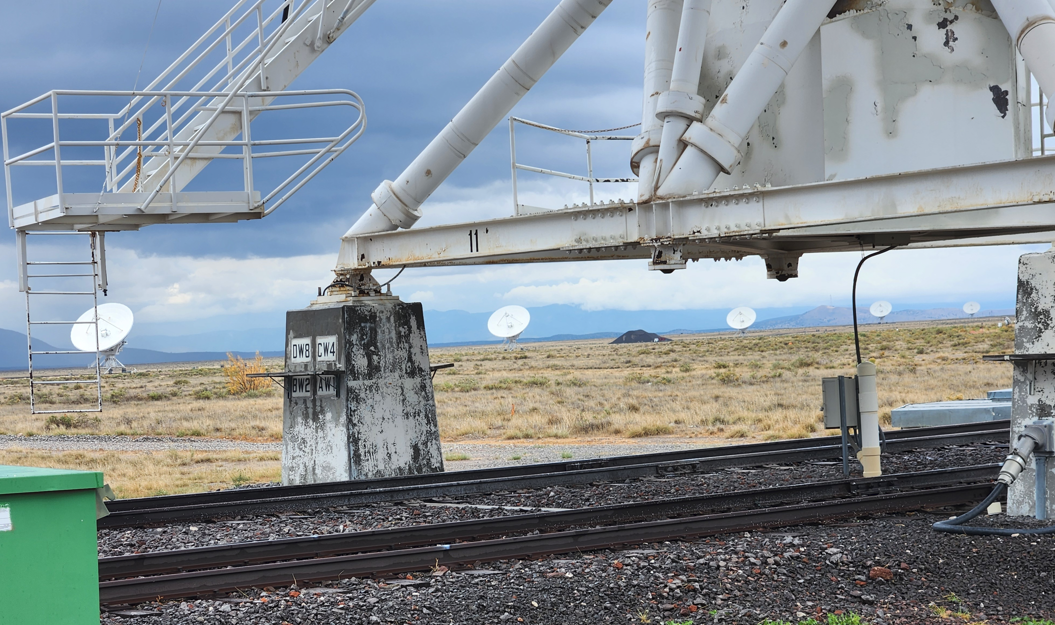
A view from under one of the dishes towards 5 more. Photo by Arnold Ziffel.
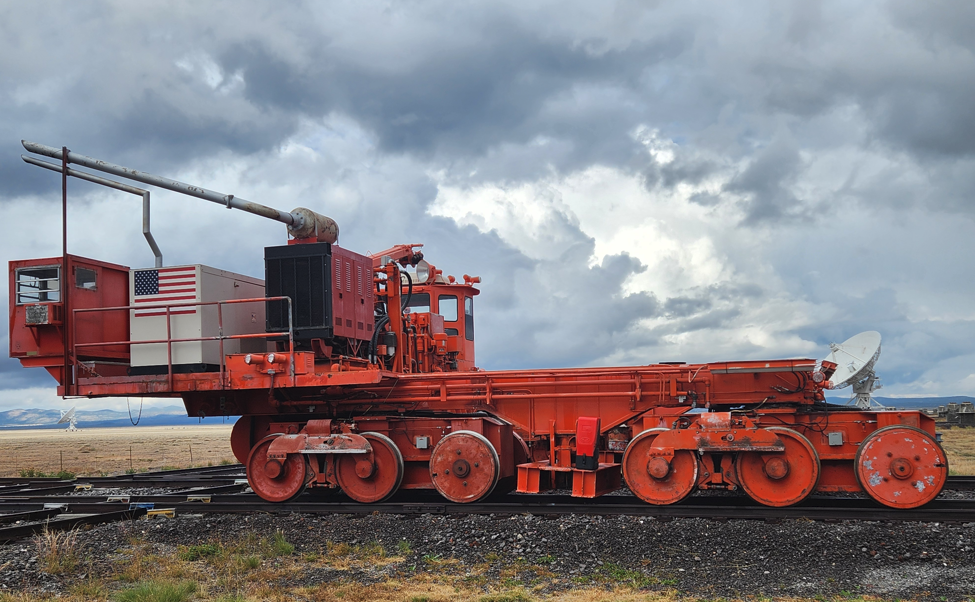
This is the machine they use at VLA to haul around the dishes when they need to be moved. When loaded it moves at 2 mph. Photo by Arnold Ziffel.
It takes the dish transport machine two weeks to reposition all 26 VLA dishes. The rails were installed to be rated for highspeed rail operations. This rating evidently ensures that dish transport is as smooth as possible.
One of the side effects of my 5 years of community theater experience on top of my beta-blocker high blood pressure meds has been that I tend not to get stage fright. I am likely to say things thar ordinarily I might not say. Beta-blockers have been successfully used to suppress the anxiety of stage fright. It works. The young radio astronomer tour guide kept referring to black holes in his spiel. Tired of this patronizing whizbang black hoIe talk, I asked him if it was possible for an astronomer to not mention black holes while speaking. He said he didn’t know. The younger VLA astronomers in the group were greatly amused by this blunt question.
When asked about the sensitivity of the VLA radio telescope system, the guide said that if you were out at the orbit of Pluto and used your cell phone, you would be the brightest radio object in the sky. Yikes.
A year ago atop Mauna Kea on the Island of Hawai’i we saw these radio telescopes. The photo does not show the howling, frigid wind. It was dang cold.
Radio telescopes just below the very summit of Mauna Kea on Hawai’i Island. Photo by Ginger Rogers.
After VLA we left for Albuquerque 2 hours to the north. The next day while waiting for our flight, we visited the National Museum of Nuclear Science & History. There was a similar museum in Las Vegas, but a bit smaller. This museum was packed with artifacts from the early nuclear age.
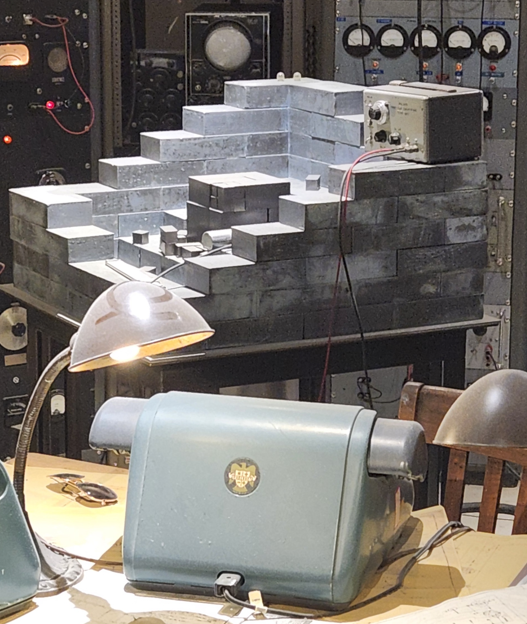
A mockup of an atomic pile used for Dragon’s Tail experiments aimed at finding the critical mass of the explosive pit. Lead bricks were piled up around a stack of what I believe are uranium cubes surrounding the fissile material. Some kind of radiation detector lies next to the pile.
At the time of the Manhattan Project, not much was known about the range of hazards of radiation exposure and dosing. And this may have been especially true for neutron exposure. Neutron activation was known, but the physiological consequences were poorly understood. Large doses of radiation correlates well with physiological effects, but in the low dose range, it begins to be sketchy. Radiation dosing tends to be stochastic in its effects.
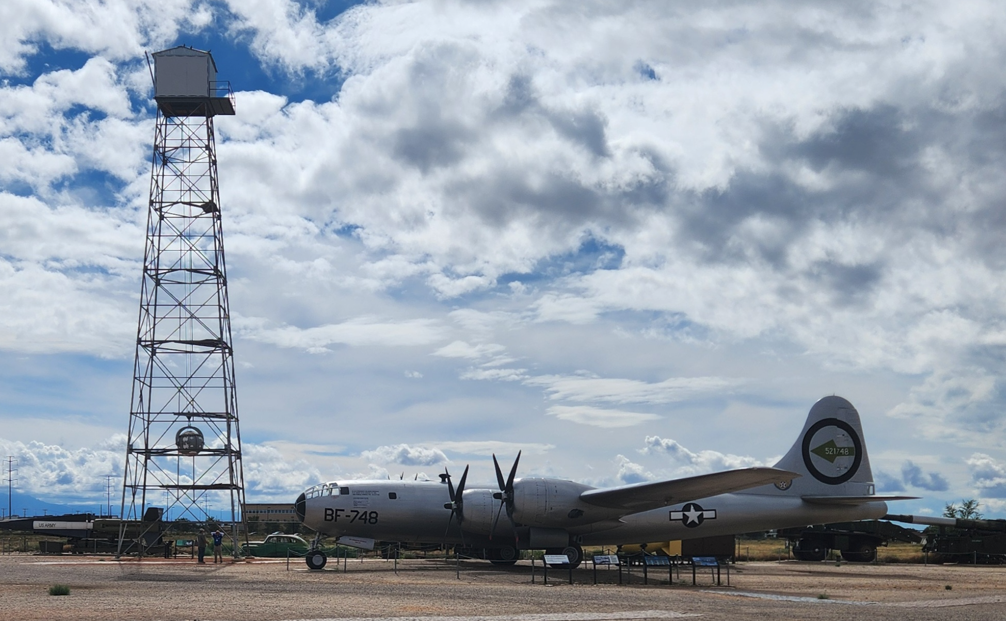
Outside of the Nuclear Museum were numerous rockets and aircraft on display. Notably a model of the tower that held the Trinity gadget. On the lower end of the tower the gadget can be seen being hoisted up into the tower.
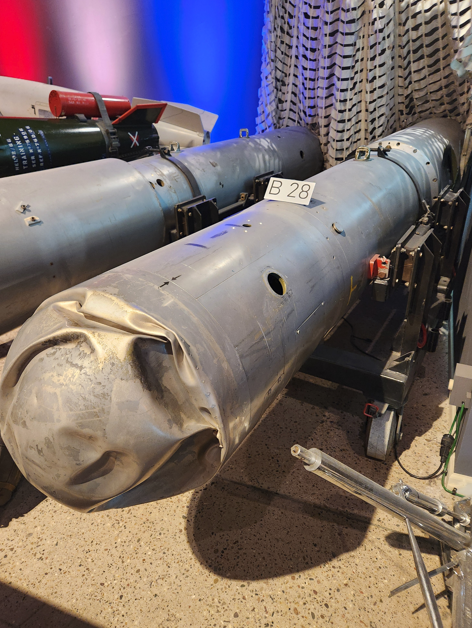
What a thermonuclear weapon looks like after it is dropped from a bomber by accident.
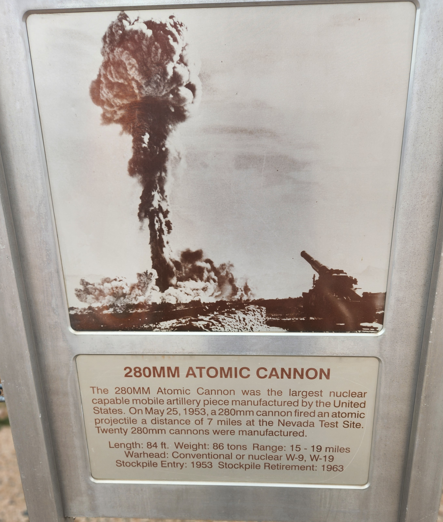
The actual cannon that fired a nuclear cannon shell and seen in film.
A photo after the nuclear cannon shell detonated.
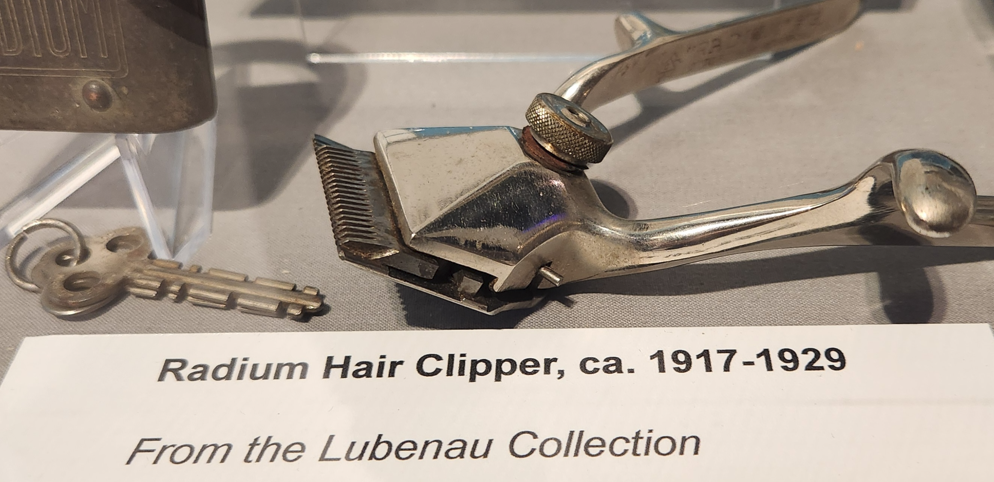
Why a radium hair clipper? Because there is a sucker born every minute.
Early atomic age children’s literature.
On my 50th birthday I actually went uranium prospecting near Idaho Springs, CO. I had a tip that pitchblende had been spotted nearby. All I managed to do was contaminate the Geiger counter with natural radioactive material that spoiled the calibration of the counter. Pisser.
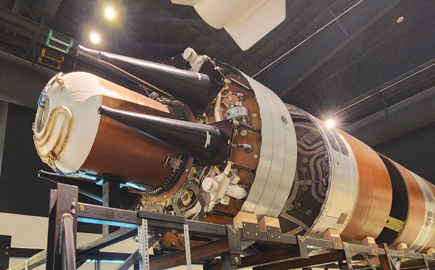
The top end of an ICBM with numerous MIRVs (the black conical objects).
A mockup of the top end of an ICBM with numerous MIRVs, Multiple Independently-targetable Reentry Vehicles.
Alert!! I spotted a Radio Shack store driving through Socorro. Driving by I could see shelves inside- it looked open for business. It was like spotting a wooly mammoth or a Dodo bird. I spent a lot of money at Radio Shack while in high school in the ’70s.







 Lamentations on Chemistry